The merger first: two vendors, one company
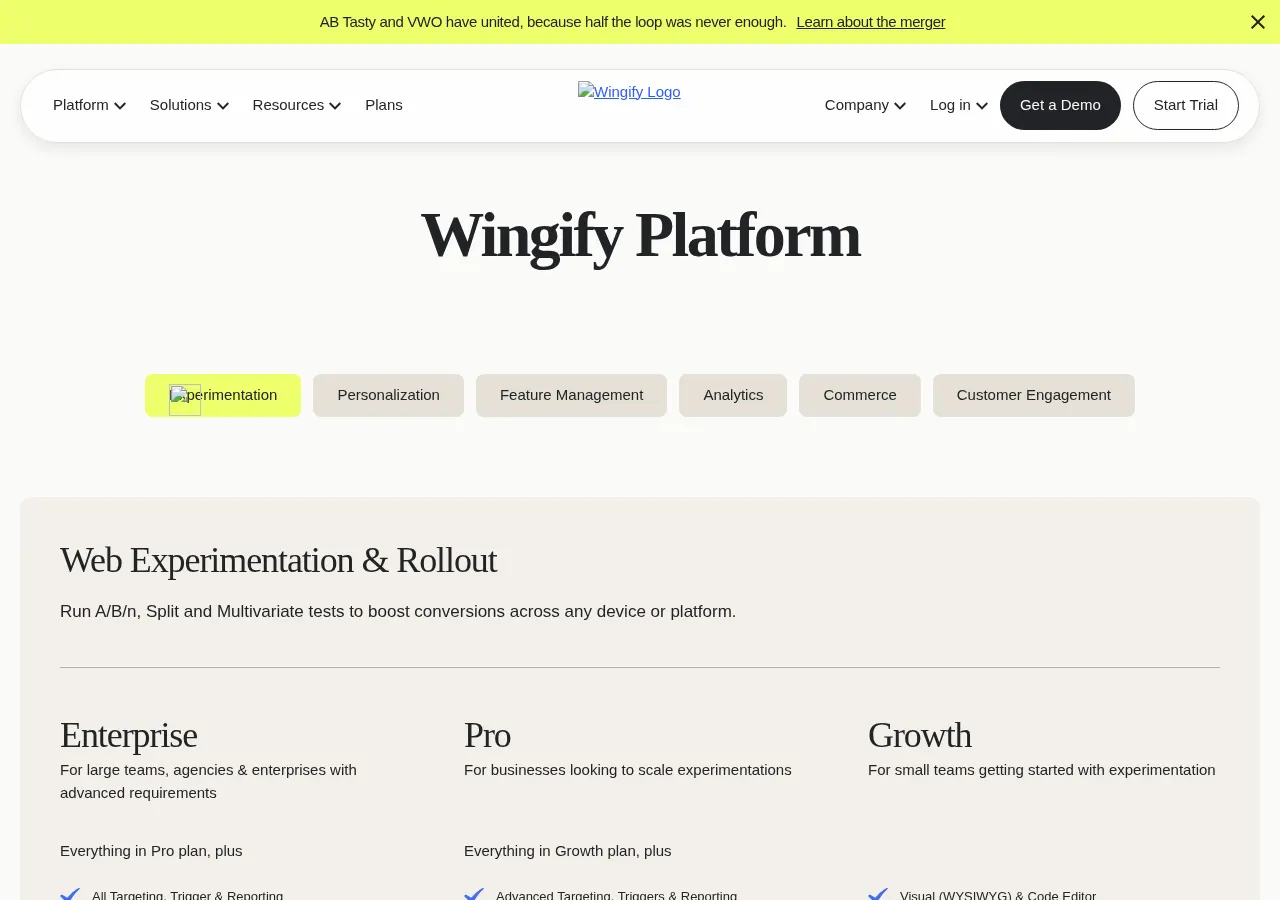
The first fact in any comparison written in late 2026 is the one most comparison pages still miss: the field consolidated. In January 2026, AB Tasty and VWO merged under Everstone Capital, and in September 2026 the combined company launched as Wingify. Visiting abtasty.com/pricing now returns Wingify's pricing page, which carries a banner reading "AB Tasty and VWO have united, because half the loop was never enough."
That changes the buying decision in three ways. First, the leverage of playing VWO against AB Tasty is gone. Second, the roadmaps are converging: VWO's experimentation platform and AB Tasty's personalization and feature-management modules are sold as one Wingify platform. Third, the pricing risk moves from the list price to the contract: both halves of Wingify price by monthly active users and feature tier, with custom quotes and annual contracts, so the number on the renewal is where the cost lands.
The buyer is choosing between Optimizely's enterprise stack and Wingify's combined experimentation-plus-personalization stack. The sections below price each vendor on what it actually publishes — and say plainly where no price is published at all.
The three platforms, honestly priced
Start with what each vendor puts on its own pricing page.
Optimizely publishes no prices. Its pricing page states that every plan is individually packaged and invites the buyer to describe its digital needs so a plan can be created together. The product is Agentic Experimentation: A/B, multi-page, feature, and server-side testing, a proprietary Stats Engine, real-time personalization, warehouse-native analytics, and feature management as a sibling product. Third-party reporting puts Web Experimentation from $36,000 a year — a reported floor, not a vendor list price.
VWO, now Wingify, publishes plan names and feature ceilings but no dollar figures. The Web Experimentation and Rollout product has three tiers. Growth, for small teams, includes the visual and code editor, unlimited experiments, variations and metrics, basic targeting, triggers and reporting, multi-arm bandit and rollout campaigns, a QA assistant, and single-page application support. Pro adds advanced targeting, triggers and reporting, guardrails metrics, sample ratio mismatch detection, multivariate testing, cross-domain testing, and user collaboration. Enterprise adds all targeting, triggers and reporting, the rich widgets library, self-hosting, an ROI dashboard, approval workflows, mutually exclusive groups, single sign-on, API access, and 24×7 support. Pricing is based on monthly active users, tailored to traffic volume, products, and implementation scope. Third-party reporting from March 2026 puts Growth from approximately $198 a month for 10,000 monthly tested users, Pro from around $531 a month, and Enterprise custom, often exceeding $1,265 a month at scale — market reports, not Wingify list prices.
AB Tasty publishes no pricing either, and its pricing page no longer exists as a separate page. The platform is sold in three functional tiers — Experimentation, Personalization, and the full platform with feature management and server-side testing — all on custom quotes with annual contracts. Reported market data from March to May 2026 clusters mid-market deployments at roughly $1,000 to $3,000 a month for core experimentation, with enterprise contracts starting around $60,000 a year and ranging to $150,000 or more for high traffic and the full bundle. There is no free tier and no self-serve trial; the 30-day trial runs through sales. AB Tasty's differentiator is EmotionsAI, its emotional audience targeting, and a single platform for client-side and server-side experimentation — now the same platform Wingify sells.
The honest summary is a table of what is published, not of prices:
| Vendor | Public list price | Meter | Free tier | Contract |
|---|---|---|---|---|
| Optimizely | None — quote only | Tested users (reported) | None | Annual, individually packaged |
| VWO (Wingify) | None — quote only; Growth reported from ~$198/mo at 10,000 MTU | Monthly active users | Free trial | Annual, custom |
| AB Tasty (Wingify) | None — quote only; mid-market reported $1,000–$3,000/mo | Monthly sessions | 30-day trial via sales | Annual, custom |
The sample-size math that decides the tier
Because none of the three publishes a price, the buyer's first calculation should not be the quote — it should be the sample size. The meter on every plan is tested users, and the number a test needs is fixed by statistics, not by the vendor. For a two-sided test at 5 percent significance and 80 percent power, visitors per variation are approximately:
where p is the baseline conversion rate and δ is the absolute lift to detect. A store converting at 5 percent that wants to detect a 20 percent relative lift — δ = 0.01 — needs:
That is 15,200 tested users for a two-variant test. At 10,000 monthly tested users — the reported Growth band — that single test takes a month and a half to read. A store converting at 2 percent that wants to detect a 10 percent relative lift — δ = 0.002 — needs 78,400 visitors per variation, or 156,800 tested users. At 50,000 monthly tested users, that test takes more than three months. The meter decides the velocity: a plan that covers 10,000 tested users a month buys one slow test at a time, not a testing program.
The cost-per-tested-user math makes the same point. On the reported VWO Growth figure of $198 a month for 10,000 monthly tested users, the unit cost is:
That unit cost holds only inside the band it was quoted for. A site at 50,000 monthly tested users is five times the Growth band, and the quote for that band is not five times $198 — it is whatever sales prices the next tier at. The tier boundary matters more than the entry price.
The worked example: the 50,000-visitor store
Take a fictional SaaS storefront, Northwind Commerce, with 50,000 monthly tested users, a 4 percent baseline conversion rate, and a checkout team that wants to detect a 15 percent relative lift — δ = 0.006. The sample size per variation is:
Two variations need 34,133 tested users, or about three weeks at Northwind's traffic — roughly one test a month with time to spare, or two tests in mutually exclusive groups on the Enterprise tier.
Now price it. Northwind's 50,000 tested users are five times the reported VWO Growth band of 10,000, so Growth does not cover the program — the quote moves to Pro or Enterprise, and the reported Pro figure of around $531 a month is itself a banded quote, not a list price. AB Tasty's reported mid-market band of $1,000 to $3,000 a month covers Northwind's volume, putting the annual cost at $12,000 to $36,000. Optimizely's reported floor of $36,000 a year is the top of AB Tasty's mid-market band, and its Stats Engine — sequential testing that lets a team peek at results without inflating the false-positive rate — justifies the premium for continuous testers.
The decision for Northwind is therefore not a price comparison. It is a contract comparison: three quotes for the same 50,000 tested users, requested in the same week, with the same traffic figure, the same feature list, and the same contract term.
The feature ceilings that force the upgrade
The tier that fits on price is not always the tier that fits on features. Multivariate testing sits in VWO Pro, not Growth. Sample ratio mismatch detection, the guardrail that catches a broken randomizer before it corrupts a test, is also Pro. Server-side testing and feature flags sit in AB Tasty's full-platform tier and in Optimizely's Feature Experimentation — a team that wants to test behind the API, in the checkout service, or in a mobile app needs the higher tier on either vendor. Single sign-on, approval workflows, and API access sit in VWO Enterprise. Data retention is 13 months for VWO's core products, but behavior analytics data is stored for 30 days on Growth, 60 days on Pro, and 90 days on Enterprise — a team that analyses tests a quarter later needs the higher tier or an export pipeline, which is what Optimizely's warehouse-native analytics is built for.
The GDPR angle is practical. All three vendors process visitor data under the buyer's instruction, and the consent question is whether the testing snippet fires before or after consent. VWO's Growth tier includes basic targeting and triggers, which is where the consent gate lives; AB Tasty's personalization tier adds audience segmentation on the same consent signal. A team operating in the EU should confirm the consent-mode wiring in the trial, not after the contract is signed.
The decision table
| Situation | Best fit | Why | Authority |
|---|---|---|---|
| Under 10,000 tested users a month, one test at a time | VWO Growth (reported from ~$198/mo) | Cheapest reported entry; unlimited experiments | VWO pricing page |
| 10,000–50,000 tested users, multivariate tests | VWO Pro (reported from ~$531/mo) | MVT and SRM detection sit in Pro | VWO pricing page |
| Personalization plus testing, one platform | AB Tasty / Wingify full platform (reported $1,000–$3,000/mo) | EmotionsAI and audience segmentation in one contract | AB Tasty pricing reports, May 2026 |
| Continuous testing, server-side, warehouse analytics | Optimizely (reported from $36,000/yr) | Stats Engine, server-side, warehouse analytics | Optimizely pricing page |
| Traffic under 5,000 tested users a month | None of the three | A 10 percent lift needs 78,400 visitors per variation at 2 percent — the test never finishes | Sample-size formula above |
| Two quotes from VWO and AB Tasty | One negotiation, not two | The vendors merged in January 2026 under Everstone Capital | Wingify merger banner; Mida, May 2026 |
Who should not buy any of the three
The operator boundary is the traffic floor. A site with fewer than 5,000 monthly tested users cannot run a meaningful A/B program on any of these platforms: a 10 percent relative lift at a 2 percent baseline needs 156,800 tested users, more than two and a half years of traffic. That buyer should fix the traffic or the conversion rate first, with session replay and analytics, and come back when a test can finish inside a quarter. The second boundary is the Google Optimize refugee: Google Optimize shut down in September 2023, and teams that migrated to a free tool since then should not assume the enterprise tier is the next step. The third boundary is the team without a developer: server-side testing, feature flags, and personalization all need engineering time.
Founder & CEO Insight — Enow A. Jovial
The buying sequence, in order
- [x] Step 1: Compute the sample size. Baseline conversion rate and the smallest lift worth detecting give the visitors per variation; divide by monthly tested users for the months per test.
- [x] Step 2: Map the traffic to the tier. Under 10,000 tested users a month is the Growth band; 50,000 is Pro or Enterprise territory on any vendor.
- [x] Step 3: List the features that force the upgrade. Multivariate testing, server-side tests, feature flags, single sign-on, and retention beyond 90 days each sit above the entry tier.
- [x] Step 4: Request all three quotes in the same week, on the same traffic figure, feature list, and contract term — and get the renewal price in writing.
- [x] Step 5: Confirm the merger in the contract. A VWO quote and an AB Tasty quote now come from Wingify; confirm the product name, support team, and data retention the contract names.
- [x] Step 6: Trial the consent wiring. Fire the snippet behind the consent gate in the trial, and confirm the analytics retention on the quoted tier before signing.
- [x] Step 7: Price the test, not the tool. Run the expected lift through the ROI calculator once the sample size is known — a test that cannot finish inside a quarter is a cost, not an investment.
The comparison ends where it started: with the merger. Optimizely is the independent enterprise stack, with the Stats Engine and the warehouse-native analytics to justify its reported $36,000 floor. Wingify is the combined VWO and AB Tasty platform, with the cheaper reported entry point and the personalization layer the other two do not bundle. The buyer who runs the sample-size math first, gets three quotes on the same traffic in the same week, and reads the renewal clause before the first-year discount buys the right tier at the right price. The session replay pricing comparison prices the analytics layer that feeds the test hypotheses, the tagging and CDP comparison prices the data pipeline the tests depend on, and the feature flag comparison prices the flags that server-side tests run on.