Google Tag Manager vs Segment vs RudderStack: Tagging and CDP Pricing Playbook
Google Tag Manager costs $0. Segment starts at $120 a month. RudderStack starts at $265 a month. Those three numbers answer nothing on their own, because the three tools do not sell the same thing: Tag Manager fires tags, Segment sells a customer data platform metered by people, and RudderStack sells a customer data platform metered by events.
This playbook prices all three from the vendors' own pages, opened and read on 7 November 2026, and rebuilds the monthly bill at three stated volumes: 1 million, 10 million, and 100 million events a month. The conversion between the two paid meters uses one stated assumption — 100 tracked events per monthly tracked user — so every number below can be re-derived from the vendors' printed rates. Where a vendor publishes no figure, the playbook says so.
Three tools, three meters
Google Tag Manager is a tag management system, not a data platform. It holds tags, triggers, and variables in a container, fires them in the browser or on a server, and sends the data on to destinations such as Google Analytics 4 or Google Ads. It stores no event history, resolves no identities, and syncs nothing to a warehouse. Google's Marketing Platform page states the offer plainly: Tag Manager delivers "simple, reliable, easily integrated tag management solutions — for free", and Google's support comparison against gtag.js lists the cost of both as "Free". The paid tier is Tag Manager 360, an enterprise product with custom pricing bundled with GA360. Server-side tagging is the one place a bill appears: the server container runs on the operator's own Google Cloud project, billed by Google Cloud, not by Tag Manager.
Segment — sold by Twilio as Connections — collects each event once and routes it to more than 700 destinations, with a warehouse sync on top. Its meter is the monthly tracked user, or MTU: any unique user Segment collects data on in a billing month, including anonymous visitors who never log in. Free costs $0 and covers 1,000 visitors a month, with 2 sources, 1 warehouse destination synced once a day, and 500,000 Reverse ETL records a month. Team starts at $120 a month for 10,000 visitors, adds unlimited sources, Public API access, 1,000,000 Reverse ETL records, twice-daily warehouse syncs, and a 14-day free trial. Business is custom volume on a sales quote, and it is the only tier with identity resolution (Unify), data-quality Protocols, Engage activation, and Predictions.
RudderStack is a warehouse-first customer data platform: events flow through its pipeline and the operator's own warehouse — Snowflake, BigQuery, Redshift, or Databricks — is the primary store rather than a vendor-hosted profile database. Its meter is the event. Free costs $0 and covers 250,000 events a month, with 16 SDK sources, 200+ cloud destinations, warehouse destinations, reverse ETL, and a 3-hour warehouse sync. Growth starts at $265 a month for 1 million events, with a 30-day free trial, unlimited team members, unlimited tracking plans, a 30-minute warehouse sync, 2 workspaces, and 25 reverse ETL connections. Annual billing saves 15% on Growth. Enterprise is custom, with a 5-minute sync and Profiles identity resolution.
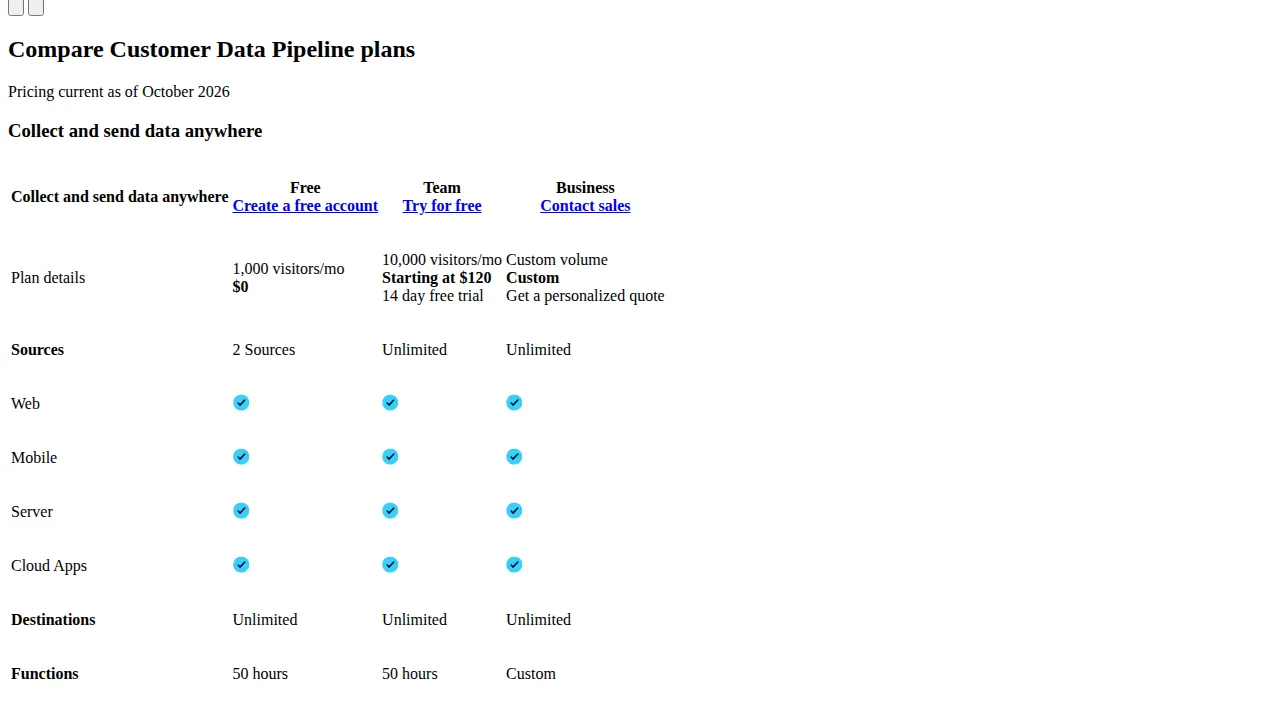
The per-unit price table
Side by side: Tag Manager charges nothing because it keeps nothing; Segment charges per person tracked; RudderStack charges per event collected.
| Meter | Google Tag Manager | Segment (Twilio) | RudderStack | Authority |
| --- | --- | --- | --- | --- |
| Meter | None — $0 | Monthly tracked user (MTU) | Event | Vendor pages |
| Free tier ceiling | Unlimited tags, $0 | 1,000 visitors/mo | 250,000 events/mo | Vendor pages |
| First paid tier | Tag Manager 360, custom | Team, from $120/mo for 10,000 MTUs | Growth, $265/mo for 1M events | Vendor pages |
| Overage rate | None published | +$12 / 1,000 MTUs (10K–25K); +$11 (25K–100K); +$10 (100K+) | Cost per million events at current tier price | Vendor pages |
| Warehouse sync | None | Free: daily; Team: twice daily | Free: 3 h; Growth: 30 min; Enterprise: 5 min | Vendor pages |
| Identity resolution | None | Business tier only (Unify) | Enterprise tier only (Profiles) | Vendor pages |
| Annual discount | None | Up to 20% | 15% on Growth | Vendor pages |
> [!KEY TAKEAWAY]
> Pick the meter that matches the shape of the traffic, not the headline price. Anonymous-heavy traffic punishes Segment's MTU meter; event-heavy instrumentation punishes RudderStack's event meter; Tag Manager punishes neither, because it stores nothing.
Free tiers and the ceilings that bite
The three free offers fail in different ways, and the failure mode is the decision. Segment Free stops at 1,000 visitors a month with 2 sources and one warehouse destination. A content site doing 5,000 visitors a month is already past it, even if only 200 ever sign up — anonymous visitors count as MTUs, and the pricing page says so. Team is the first tier with unlimited sources and Public API access, so the real floor for a growing product is $120 a month, not $0.
RudderStack Free stops at 250,000 events a month, and the pricing page is explicit about what happens next: data processing stops after the second consecutive overage. There is no soft landing and no invoice — the pipeline halts. A product sending 300,000 events a month needs Growth at $265, and the trial carries a cumulative cap of 25 million events. The Free plan's 3-hour warehouse sync is also a working constraint: dashboards built on the warehouse run up to three hours stale.
Tag Manager's free tier has no ceiling on tags, triggers, or containers, and no overage mechanism, because there is no meter. Its ceiling is functional instead: no warehouse, no identity graph, no event replay, no reverse ETL.
> [!WARNING]
> RudderStack Free stops processing data after the second consecutive overage. A product that drifts past 250,000 events a month does not get a bill — it gets silence. Put an event-volume alert in place before the first overage, not after the second.
Turning the meters into a monthly bill
Segment's Team bill for a volume between 25,000 and 100,000 MTUs is the base plus two overage bands:
$
\text{Monthly bill} = \$120 + 15 \times \$12 + \frac{\text{MTU} - 25{,}000}{1{,}000} \times \$11
$
At 100,000 MTUs that is $120 + $180 + 75 × $11 = $120 + $180 + $825 = $1,125 a month. Below 10,000 MTUs the bill is the flat $120; above 100,000 the marginal thousand costs $10.
RudderStack's overage is priced at the per-million-event cost of the tier already held, as the vendor's own billing documentation shows with a worked example:
$
\text{Monthly bill} = \text{Tier price} + \frac{\text{Events over tier}}{1{,}000{,}000} \times \text{Tier price}
$
On the 1 million tier, a month with 1.5 million events costs $265 + 0.5 × $265 = $265 + $132.50 = $397.50.
Three profiles, priced to the dollar
Profile A — 1 million events a month, about 10,000 MTUs at the stated 100-events-per-user assumption.
| Profile A: 1M events / ~10K MTUs | Google Tag Manager | Segment | RudderStack |
| --- | --- | --- | --- |
| Monthly bill | $0 | $120 | $265 |
| Annual bill (monthly billing) | $0 | $1,440 | $3,180 |
| Annual bill (annual billing) | $0 | ~$1,152 (up to 20% off) | $2,700 ($225/mo) |
Segment wins Profile A by more than half, because 10,000 MTUs is exactly the Team base. RudderStack costs more than twice as much here — the event meter is at its most expensive per unit on the smallest tier.
Profile B — 10 million events a month, about 100,000 MTUs.
| Profile B: 10M events / ~100K MTUs | Google Tag Manager | Segment | RudderStack |
| --- | --- | --- | --- |
| Monthly bill | $0 | $1,125 | $1,675 |
| Annual bill (monthly billing) | $0 | $13,500 | $20,100 |
| Annual bill (annual billing) | $0 | ~$10,800 (up to 20% off) | $17,040 ($1,420/mo) |
Segment still wins, by $550 a month. The gap narrows as the event-per-user ratio rises: at 200 events per user, 10 million events means only 50,000 MTUs, and Segment's bill falls to $575, while RudderStack stays at $1,675.
Profile C — 100 million events a month, about 1,000,000 MTUs.
| Profile C: 100M events / ~1M MTUs | Google Tag Manager | Segment | RudderStack |
| --- | --- | --- | --- |
| Monthly bill | $0 | $10,125 | Custom (Enterprise) |
| Annual bill | $0 | $121,500 | Custom |
Segment's arithmetic at 1,000,000 MTUs is $120 + $180 + $825 + 900 × $10 = $10,125 a month. RudderStack's self-serve Growth ladder ends at 25 million events for $2,750 a month; above that the vendor directs buyers to a negotiated Enterprise contract, so no self-serve figure exists for 100 million events and none is printed here. At this volume RudderStack's price is a negotiation, while Segment's is a formula.
Warehouse destinations and who owns the data
The pricing argument is also an ownership argument. RudderStack's warehouse-first design means the warehouse is the system of record: events land in Snowflake, BigQuery, Redshift, or Databricks. If the RudderStack contract ends, the history stays in the operator's warehouse. Segment stores profiles in its own system and syncs copies to the warehouse — once a day on Free, twice a day on Team — so the warehouse is a copy, not the original. Tag Manager stores nothing anywhere.
That difference shows up in the exit cost. Leaving Segment means rebuilding the identity graph and the destination mappings, and the features that make Segment sticky — Unify identity resolution, Protocols data quality, Engage activation — exist only on the custom-priced Business tier, so the price of the features that create lock-in is itself unquoted. Leaving RudderStack means pointing the same warehouse at a new pipeline; the open-source core can even be self-hosted.
The decision, by shape
| Your shape | Pick | Why |
| --- | --- | --- |
| Single site, GA4 + Ads only | Google Tag Manager | $0, no meter, nothing to migrate |
| Under 10,000 users, many destinations | Segment Team | $120 flat, unlimited sources, 700+ destinations |
| Event-heavy product, warehouse-first | RudderStack Growth | $265 at 1M events, warehouse is the record |
| Anonymous-heavy traffic | RudderStack | Anonymous visitors inflate Segment's MTU count |
| High events per user | Segment | MTU meter ignores how chatty each user is |
| Regulated data, EU residency, self-host | RudderStack | Warehouse-first, open-source core, self-host option |
| Identity resolution + activation | Segment Business | Unify and Engage live here — but priced on quote |
Who should not adopt a CDP
A customer data platform is the wrong purchase for many of the teams that buy one. Do not adopt Segment or RudderStack if the stack has two destinations and no warehouse: Tag Manager plus direct integrations cost $0 and one afternoon of setup. Do not adopt either if the product has fewer than 1,000 monthly users and no data hire. Do not adopt Segment Business for Unify and Engage without a written quote first: the two features that justify the tier are priced by sales conversation. Do not adopt RudderStack Free for a production pipeline without an event-volume alert. And do not adopt any CDP to fix a tracking plan that does not exist — a CDP routes events, it does not decide what to track.
A numbered workflow to pick and prove it
1. Export 30 days of event volume and monthly tracked users from the current analytics tool before opening any pricing page.
2. Compute events per user. Below 50, the MTU meter is usually cheaper; above 200, the event meter usually wins; between the two, price both.
3. Price the profile on Segment and RudderStack with the formulas above, at current volume and at double volume, and keep the arithmetic in a spreadsheet.
4. Run Tag Manager alone for two weeks and list every destination that needed its own tag — that list is the real case for a CDP.
5. Trial the cheaper CDP on its free trial (Segment 14 days, RudderStack 30 days) with production volume, then compare the trial invoice against the forecast line by line.
6. Check the warehouse sync lag against the reporting need: daily on Segment Free, twice daily on Team, 30 minutes on RudderStack Growth.
7. Set billing alerts at 80% of the free-tier ceiling and at 50% and 80% of the forecast paid bill, on day one.
8. Re-price every quarter: the formulas stay the same, only the rates and the volume move.
Running a CDP bill through a business also means running it through the books. The monthly invoice is a deductible SaaS expense for an LLC, S-Corp, or C-Corp, and the vendor's invoice — Segment's billing page holds the MTU breakdown, RudderStack's holds the event-tier detail — is the record the CPA asks for at year end under GAAP. Keep the EIN on the billing profile, collect a W-9 from a US vendor or a W-8BEN from a non-US one, and export the usage CSV each month through the vendor's API so a disputed charge can be traced to a specific month and meter. Where a client reimburses the CDP, invoice it as a pass-through line with the vendor's invoice attached.
For the neighbouring options, compare the Google Analytics 4 vs Mixpanel vs Amplitude product analytics pricing guide to see what the destinations themselves cost, and the cold email deliverability SPF DKIM DMARC guide if the activation side is email. Run the totals through the Website Cost Estimator.
> [!TIP]
> Price at double volume before signing. Segment's overage ladder and RudderStack's tier steps both reward the volume you will have in six months, not the volume you have today — and the cheaper vendor at today's volume is not always the cheaper vendor at double.
> [!FOUNDER]
> "A free tag manager is not a free data platform. Pay for the meter that matches your traffic — people or events — and the bill stops surprising you."
> — Enow A. Jovial, Founder & Chief Executive Officer
Tag Manager is free because it keeps nothing. Segment charges per person and wins when each person is quiet. RudderStack charges per event and wins when the crowd is anonymous or the warehouse is the system of record. Measure the volume, run the two formulas, read one real invoice — and the meter that fits is the one to pay.