Three vendors, three units
n8n, Zapier, and Make all sell the same outcome — work that happens without a human touching it — and they bill for it in three different units: Zapier sells tasks, Make sells credits, n8n sells executions. A buyer who compares the three headline prices without converting the units will pick the wrong tool with confidence.
Every price below comes from the three vendors own pricing pages, opened on 7 November 2026, on annual billing throughout; monthly-billing prices appear where published, marked derived where computed from the vendor own stated saving. n8n prices in euros, Zapier and Make in dollars, with no exchange rate assumed.
> [!KEY TAKEAWAY]
> Never compare a Zapier task to a Make credit to an n8n execution. One run with four action steps costs four Zapier tasks and four Make credits, but exactly one n8n execution. The unit is the whole pricing decision.
The units, in the vendors own words
Zapier defines its unit in the pricing FAQ: each successful action in a Zap counts as a separate task. The trigger is free, and checking for new data is free — Zapier states it never charges a task to check for new data, only when a Zap successfully completes an action. A failed action does not count.
Zapier prices AI steps separately. Most app-action steps cost one task, while Formatter, Paths, Filters, Delay, Looping, Sub-Zaps, Digests, Zapier Manager, Storage, Tables, and Forms cost zero. A Code step costs one task per step. An AI step costs one task on standard models, three on advanced, and five on premium — per AI step and per tool call. Two premium AI steps plus one tool call use fifteen tasks per run before any app action is counted.
Make changed its unit on 27 August 2026. Credits are now the billing unit: each action a scenario performs consumes credits, and most actions consume one. A run that reads a Pipedrive record, writes a Google Sheet row, and posts a tweet uses three credits. Error-handler modules and the Router consume none, while some features using the Make AI Provider consume more than one. Older Make comparisons price operations; that unit is out of date — the billing unit on the live pricing page is the credit.
n8n defines its unit in its FAQ as a single run of an entire workflow: it does not matter how many steps are in the workflow or how much data it processes — it is still a single execution. That is the structural difference here. A forty-step workflow costs one execution on n8n, forty tasks on Zapier, and roughly forty credits on Make. n8n states that one execution can do things that would take 10,000 operations in other tools — the vendor claim, quoted as a claim.
The price ladders
Zapier sells tasks in tiers. Free covers 100 tasks a month at zero dollars, for one user, with two-step Zaps. Professional starts at $19.99 a month — the yearly-billing price of the 750-task tier; pay monthly and it is $29.99. Team starts at $69 a month, the yearly-billing price of the 2,000-task tier, and includes up to 25 users. Enterprise is contact sales. Pay yearly saves 33 percent; the page carries 9,000 plus app connections.
| Zapier tier | Tasks per month | Yearly billing, dollars per month | Monthly billing, dollars per month |
| :--- | :--- | :--- | :--- |
| Free | 100 | 0.00 | 0.00 |
| Professional 750 | 750 | 19.99 | 29.99 |
| Professional 1,500 | 1,500 | 39.00 | 58.50 |
| Professional 10,000 | 10,000 | 129.00 | 193.50 |
| Professional 100,000 | 100,000 | 489.00 | 733.50 |
The per-task price falls hard with volume. At yearly billing, the 1,500-task tier costs $39.00 divided by 1,500, or $0.026 per included task; the 100,000-task tier costs $489.00 divided by 100,000, or $0.00489 — a fall of 81.2 percent. The tier boundary is a cliff: 1,001 tasks a month cannot sit on the 750-task tier, so it pays the 1,500-task tier price for 499 tasks it does not use.
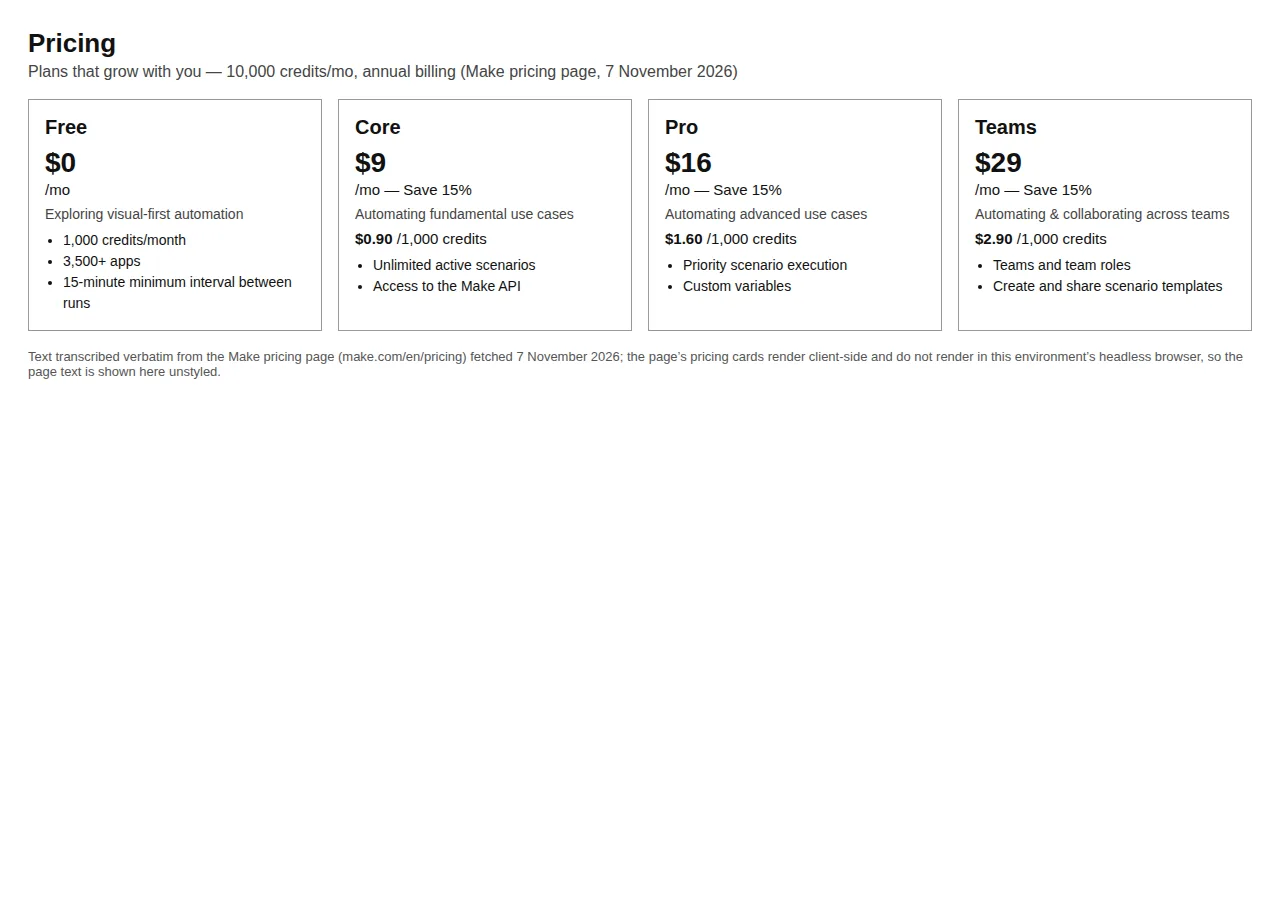
Make sells credits by the thousand at a flat rate inside each plan. At the 10,000-credits-a-month slider position on annual billing, Core is $9 a month, Pro $16, and Teams $29 — rates of $0.90, $1.60, and $2.90 per 1,000 credits. Annual billing saves 15 percent; monthly-billing equivalents computed from that saving are 1.06, 1.88, and 3.41 dollars per 1,000 credits, marked derived because the page does not print them. Free covers 1,000 credits a month at $0, with a 15-minute minimum interval between runs. Enterprise is custom pricing. Make credits expire at the end of the term, and unused credits do not roll over. Extra credits come in bundles of 1,000 or 10,000, and Core, Pro, and Teams can auto-purchase 10,000 credits before the balance runs out.
n8n sells executions in four tiers, and all plans include unlimited users, unlimited workflows, and every integration. Starter is 20 euros a month on annual billing for 2,500 executions. Pro is 50 euros for 10,000. Business is 667 euros for 40,000 executions and is self-hosted only. Enterprise is custom, hosted or self-hosted, with 200 plus concurrent executions. Annual billing saves 17 percent; monthly-billing equivalents from that saving are 24.10, 60.24, and 803.61 euros, marked derived because the page does not print them.
| n8n plan | Executions per month | Annual billing, euros per month | Cost per execution at full use |
| :--- | :--- | :--- | :--- |
| Starter | 2,500 | 20.00 | 0.008 |
| Pro | 10,000 | 50.00 | 0.005 |
| Business, self-hosted only | 40,000 | 667.00 | 0.0167 |
The per-execution price rises from Pro to Business because Business is priced for governance — SSO and LDAP, queue mode, Git version control — not for volume. A buyer who picks Business for the execution count alone pays 3.3 times the Pro per-execution rate for features they may not need. The Community Edition is the free self-hosted route, published on GitHub with no licence fee stated; the server it runs on is a separate bill that n8n does not price.
Worked example: the same workflow on all three
Assume one workflow run has four billable steps — a trigger plus three actions is the common shape, and the trigger itself is free on Zapier. That gives four tasks on Zapier, four credits on Make, and one execution on n8n per run. The table prices that workload at three volumes, on annual billing throughout.
| Runs per month | Zapier tasks | Make credits | n8n executions | Zapier bill | Make Core bill | n8n bill |
| :--- | :--- | :--- | :--- | :--- | :--- | :--- |
| 1,000 | 4,000 | 4,000 | 1,000 | 89.00 dollars, Pro 5K | 3.60 dollars | 20.00 euros, Starter |
| 10,000 | 40,000 | 40,000 | 10,000 | 289.00 dollars, Pro 50K | 36.00 dollars | 50.00 euros, Pro |
| 100,000 | 400,000 | 400,000 | 100,000 | 1,499.00 dollars, Pro 500K | 360.00 dollars | No listed tier |
The Zapier per-task math at 10,000 tasks a month:
$
\text{Cost per Task} = \frac{\text{Monthly Price}}{\text{Included Tasks}} = \frac{129.00}{10{,}000} = 0.0129
$
The Make bill at 40,000 credits a month on Core:
$
\text{Make Bill} = \frac{\text{Credits per Month}}{1{,}000} \times \text{Rate per 1{,}000 Credits} = \frac{40{,}000}{1{,}000} \times 0.90 = 36.00
$
Two facts jump out. First, Make Core is the cheapest bill at all three volumes — 3.60, 36.00, and 360.00 dollars — because its per-credit rate of 0.0009 dollars is the lowest per-step rate on any ladder here; the Zapier cheapest rate, 0.00489 dollars per task at the 100,000-task tier, is 5.43 times that rate. Second, the n8n bill barely moves until it hits a wall: 20 euros covers 1,000 runs, 50 euros covers 10,000 runs, and at 100,000 runs there is no listed price, because Business caps at 40,000 executions. On monthly billing the order does not change.
> [!WARNING]
> The 100,000-run row is where n8n stops publishing a price. Business caps at 40,000 executions a month, and the pricing page gives no number above that. Do not budget an n8n cloud deployment at 100,000 runs a month from this page — the number is a sales conversation, not a list price.
Where the cheapest tool changes
The crossover that matters is between step counts, not vendors: Make charges per module action, n8n charges per run, so the longer the workflow, the better n8n looks. The break-even step count is one division:
$
\text{Break-Even Steps} = \frac{\text{n8n Cost per Execution}}{\text{Make Cost per Credit}} = \frac{0.005}{0.0009} = 5.56
$
n8n Pro costs 0.005 euros per execution at full use; Make Core costs 0.0009 dollars per credit. At euro-dollar parity, a workflow averaging 6 or more module actions per run costs less on n8n Pro than on Make Core. On Starter, at 0.008 euros per execution, the break-even is 8.89 — so 9 or more steps. The exact number moves with the exchange rate: at 1 euro to 1.15 dollars the Pro break-even is 6.39 steps, so 7 steps.
Zapier has no crossover against Make Core inside the published ladders: at equal step counts, the Make Core rate of 0.0009 dollars per credit sits below the Zapier cheapest rate of 0.00489 dollars per task at every volume. Zapier wins on other axes instead — 9,000 plus connections and AI steps on the same task meter — but none of those change the bill.
| Situation | Pick | Why | Authority |
| :--- | :--- | :--- | :--- |
| Under 5 steps per run, any volume | Make Core | Lowest per-step rate on any ladder, 0.0009 dollars per credit | Make pricing page, 7 Nov 2026 |
| 6 plus steps per run, under 10,000 runs a month | n8n Pro | One execution per run beats per-step billing past 5.56 steps | n8n pricing page; Make pricing page, 7 Nov 2026 |
Self-hosting n8n: the line nobody else has
Self-hosting is the one cost line in this comparison that only n8n offers. The Community Edition is free software on GitHub: no licence fee is stated on the pricing page, and the operator pays for the server, the maintenance, and the uptime. The Business licence is 667 euros a month on annual billing, covers 40,000 executions, and is self-hosted only — it buys governance, not volume. Enterprise adds the compliance surface: external secret store integration, log streaming, extended retention, dedicated support with an SLA.
The honest self-host line is two numbers and one open item: Community software at zero, or a Business licence at 667 euros a month, plus a server bill that n8n does not price and this article does not invent. A small virtual server running the Community Edition is the cheapest automation in this whole comparison at low volume — and the only option here where an outage at 2 a.m. is the operator problem, not the vendor.
> [!TIP]
> Price the server before praising the free licence. A Community Edition instance on a small virtual server is cheap; the same instance with backups, monitoring, and someone on call is a different number.
Ceilings, expiry, and overage
Three quiet rules decide more real bills than the headline prices do. First, Make credits expire at the end of the term, and unused credits do not roll over. Second, Zapier switches an account to pay-as-you-go at its task limit, unless that switch is turned off; the per-task overage rate is not published on the pages checked here, so it cannot be budgeted from the list price. Third, n8n states that workflows keep running when the quota is exceeded, and that overage charges may apply — again with no rate published. Treat an unpublished overage rate as a question for the vendor, not as zero. The failure mode is a bill that arrives after the work is done, priced at a rate you never saw.
The selection sequence
1. Count steps per run across the five highest-volume workflows, and take the average. The step count decides more than the run count does.
2. Convert runs to billable units: runs times steps for Zapier tasks and Make credits, runs alone for n8n executions.
3. Find the tier each number lands in on each ladder, and read the price at that tier — not the starting-from price, which is always the smallest tier.
4. Run the per-unit division for each vendor at the tier you landed in, and compare the three per-unit rates, not the three headline prices.
5. Check the ceilings: runs past 40,000 a month need an n8n Enterprise quote; tasks past 2,000,000 a month need a Zapier custom limit. Price AI steps separately on Zapier: count premium-model AI steps and tool calls, multiply by five tasks each, and add them to the task total before choosing a tier.
6. Decide self-host or cloud for n8n, and get the server quote before comparing the Community Edition against any paid tier.
7. Re-run the comparison on annual and on monthly billing, and record which term the budget assumes — the Zapier gap is 33 percent. Then put the final numbers through the pricing calculator with the real run and step counts, and keep the arithmetic next to the decision so the next person can re-run it.
The same ladder method prices email volume in the transactional email pricing playbook, per-seat discipline in the engineering issue tracking comparison, and the same tier-cliff problem in the project management pricing comparison.
> [!FOUNDER]
> "Every vendor in this comparison is telling the truth about its own price and staying quiet about the unit. Zapier sells you the step, Make sells you the action, n8n sells you the run — and the cheapest of the three is whichever unit your workflows use least. Count your steps before you count your dollars, because the vendor already did."
> — Enow A. Jovial, Founder & Chief Executive Officer