The three meters: one pay-as-you-go, one bundled, one metered by the thousand
Mailgun, SendGrid, and Amazon SES all sell the same promise — your application's email reaches the inbox — and all three price it so the headline monthly figure is the least informative number on the page. Mailgun charges by tier with included volume and per-thousand overage. SendGrid charges by tier with a hard included ceiling and no per-thousand meter at all. SES charges $0.10 per thousand emails with no tier, no included volume, and no monthly fee. The same application sending 100,000 transactional emails a month pays $90 on Mailgun Scale, $89.95 on SendGrid Pro, and $10 on SES. The bill is decided by which meter you hit first: included volume, overage rate, or the dedicated IP your deliverability depends on.
> [!KEY TAKEAWAY]
> Compare these senders on the monthly cost at your actual volume, including the dedicated IP. At 100,000 emails a month, SES costs $10 without an IP and $34.95 with one; SendGrid Essentials costs $34.95 without one and Pro costs $89.95 with one; Mailgun Scale costs $90 with one included. SES with a dedicated IP and SendGrid Essentials without one cost exactly the same $419.40 a year.
Why it matters: the meter you hit first sets the price
Transactional email is a metered utility dressed as a flat fee. Every sender bundles three meters — included volume, overage rate, and the dedicated IP — and the upgrade trigger is whichever meter your operation crosses first. A side project sending 3,000 password resets a month never touches a ceiling anywhere, so the cheapest meter wins outright. A SaaS sending 250,000 receipts, invoices, and notifications a month crosses the included-volume ceiling on Mailgun Basic, the tier ceiling on SendGrid Essentials, and no ceiling at all on SES — because SES has no ceiling. That is why the same three vendors produce three different "cheapest" answers depending on the shape of the sender, and why a pricing page read without your own numbers is a trap. Email spend is sticky: sender reputation accumulates on the IP and domain, and migrating costs weeks of warm-up.
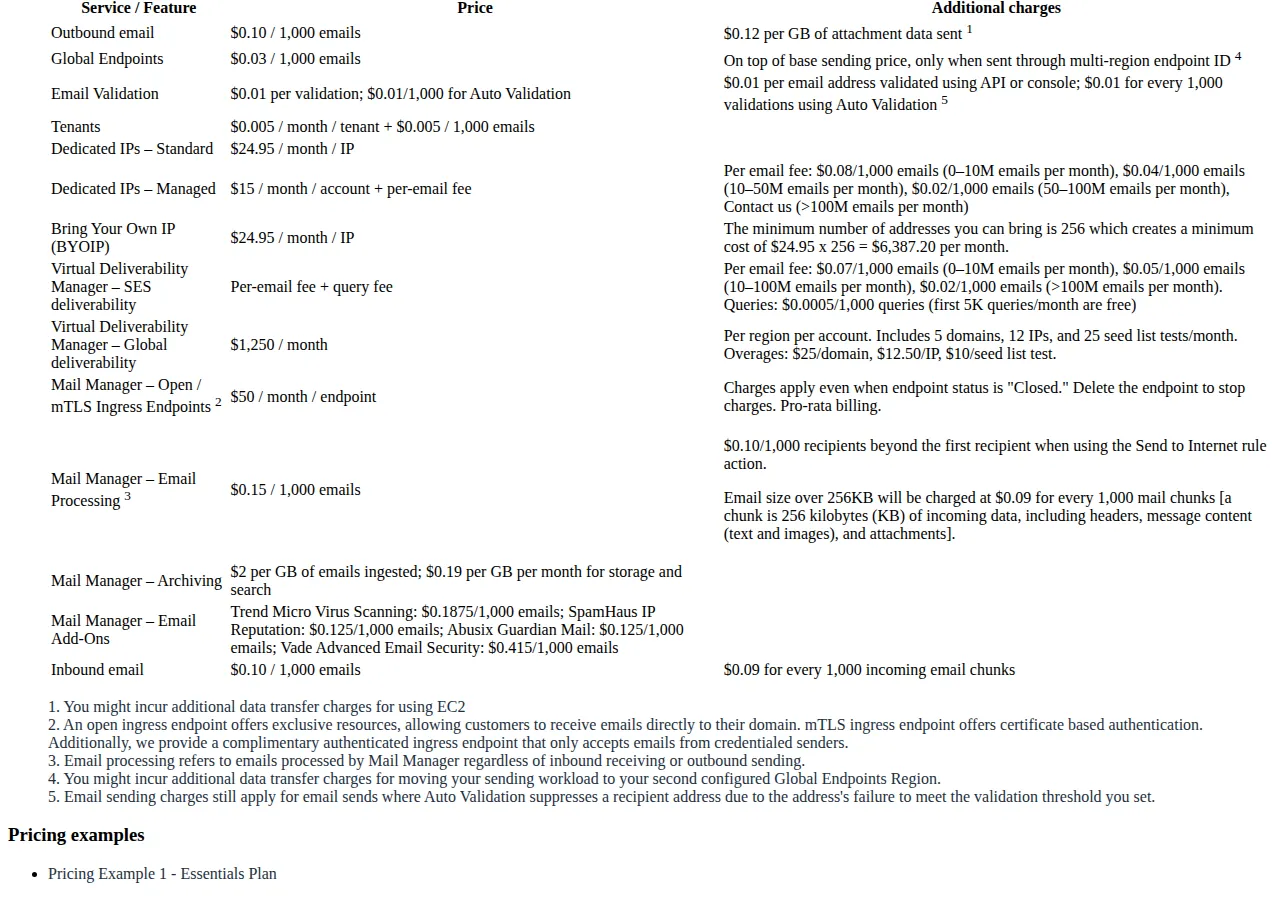
Amazon SES lists outbound email at $0.10 per 1,000, with a worked example on the page: 2,000,000 emails cost $200.00.
The price ladders, read off the vendors' pages
All figures below are the prices each vendor lists on its pricing page, read on 2026-11-05, in US dollars. Mailgun's figures are from its pricing page and SES's from the AWS pricing page. SendGrid's pricing page is a JavaScript application that publishes no prices in its HTML, so the SendGrid figures below are corroborated across three independent 2026 price trackers that agree on the ladder.
| Vendor | Entry tier | Mid tier | Top self-serve tier | Dedicated IP |
| :--- | :--- | :--- | :--- | :--- |
| Mailgun | Basic $15/mo, 10,000 included | Foundation $35/mo, 50,000 included | Scale $90/mo, 100,000 included | 1 included on Scale; extra $59/mo |
| SendGrid | Essentials $19.95/mo, 50,000 included | Essentials 100k $34.95/mo | Pro $89.95/mo, 100,000 included; Pro 300k $249/mo | 1 included on Pro; extra $30/mo |
| Amazon SES | No tiers — $0.10 per 1,000 emails | No monthly fee | No ceiling | Standard $24.95/mo; managed $15/mo + $0.08 per 1,000 |
The meters sit underneath the prices. Mailgun Basic includes 10,000 emails and charges $1.80 per 1,000 over that; Foundation includes 50,000 and charges $1.30 per 1,000 over; Scale includes 100,000 and charges $1.10 per 1,000 over. SendGrid Essentials includes 50,000 emails for $19.95 and 100,000 for $34.95, with no overage meter — cross the ceiling and you buy the next tier. Pro includes 100,000 for $89.95 and 300,000 for $249, with one dedicated IP included. SES charges $0.10 per 1,000 outbound emails, $0.12 per gigabyte of attachments, and $0.10 per 1,000 inbound emails, with no monthly fee and no included volume. New SES accounts start on Essentials at $0.16 per 1,000 unless they opt out to the à la carte $0.10 rate.
Mailgun's free tier is 100 emails a day, and Foundation carries a one-month free trial. SendGrid has no permanent free plan — it was retired in 2025 — and offers a 60-day trial at 100 emails a day. SES's old 62,000 free emails a month from EC2 is retired: new accounts from July 2025 get up to $200 in AWS Free Tier credits on a six-month plan, spendable within 12 months, and no perpetual free allowance. Log retention is one day on Mailgun Basic, five days on Foundation, and 30 days on Scale.
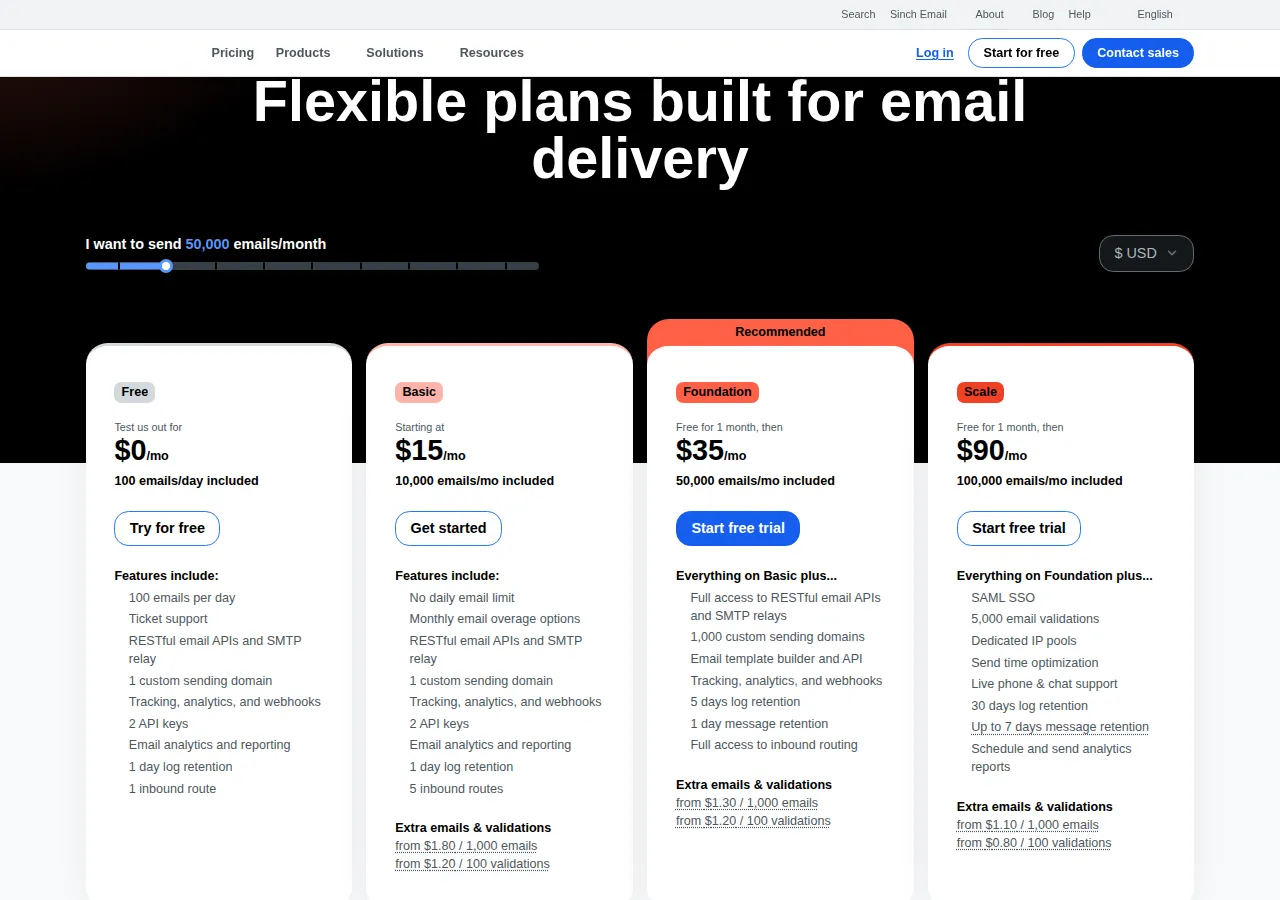
Mailgun lists Foundation at $35 a month for 50,000 emails, with Scale at $90 a month for 100,000 and one dedicated IP included.
The volume ledger
The honest comparison is the monthly cost at your volume, with the dedicated IP priced in — a shared IP is not the same product as a dedicated one.
$
\text{Monthly cost} = \text{Tier price} + \max(0, \text{Volume} - \text{Included}) \times \text{Overage rate}
$
| Emails per month | Mailgun | SendGrid | Amazon SES |
| :--- | :--- | :--- | :--- |
| 10,000 | $15 (Basic) | $19.95 (Essentials 50k) | $1.00 |
| 50,000 | $35 (Foundation) | $19.95 (Essentials) | $5.00 à la carte / $8.00 Essentials |
| 100,000 | $90 (Scale, IP included) | $34.95 (Essentials) / $89.95 (Pro, IP included) | $10.00 / $34.95 with IP |
| 250,000 | $255 (Scale + 150k overage) | $249 (Pro 300k, IP included) | $25.00 / $49.95 with IP |
| 1,000,000 | $1,080 (Scale + 900k overage) | Premier, quote only | $100.00 / $124.95 with IP |
At 100,000 emails a month the annual bill is $1,080 on Mailgun, $419.40 on SendGrid Essentials, $1,079.40 on SendGrid Pro, and $120 on SES without an IP or $419.40 with one. The tie is exact because $10 plus $24.95 equals $34.95 a month. The gap between SES with an IP and SendGrid Pro with an IP is $660 a year. At 1,000,000 emails a month the gap widens: Mailgun $1,080, SES $124.95 with an IP, and SendGrid has no self-serve tier — Premier is quote only.
Per-thousand effective rates at 50,000 emails a month: Mailgun $0.70, SendGrid $0.399, SES $0.10. The overage trap is Mailgun's: at 25,000 emails a month, Basic plus overage costs $15 plus 15 × $1.80, which is $42, while Foundation costs $35 for the same volume. The tier is cheaper than the overage once you cross 21,111 emails.
The break-even lines: where the bundled tier stops being cheapest
SES has no break-even point against the others, because its meter never rises: $0.10 per thousand at any volume. The break-even lines are between the bundled tiers themselves. Mailgun Foundation at $35 beats Basic plus overage once volume passes 21,111 emails a month. SendGrid Essentials at $19.95 beats Mailgun Basic above 12,750 emails a month — at 50,000, Mailgun Basic plus overage would cost $87.
$
\text{Mailgun Basic cost at volume } V = \$15 + \max(0, V - 10{,}000) \times \$0.0018
$
The dedicated IP is where the annual bill is decided. A dedicated IP costs $708 a year on Mailgun at $59 a month, $360 a year on SendGrid at $30 a month, and $299.40 a year on SES at $24.95 a month. SES's managed dedicated IP is $15 a month plus $0.08 per 1,000 emails — at 100,000 emails a month that is $23 a month, or $276 a year, cheaper than the standard $24.95 IP. The IP you already own is the cheapest of all: keep it, and SES's $10 a month at 100,000 emails is the floor no bundled tier can reach.
The free-tier ledger
The free tiers are where the three vendors diverge hardest, because one of them no longer has one. Mailgun's free tier is 100 emails a day, every day, with no expiry — enough for a side project sending 3,000 emails a month. SendGrid's 60-day trial at 100 emails a day is a trial, not a tier: on day 61 the bill starts at $19.95 a month whether you send one email or 50,000. SES has no free tier at all for new accounts — the $200 in AWS Free Tier credits covers 2,000,000 emails at the à la carte rate, and then the meter runs.
| Free offer | Mailgun | SendGrid | Amazon SES |
| :--- | :--- | :--- | :--- |
| Permanent free tier | 100 emails a day | None — retired 2025 | None — EC2 allowance retired |
| Trial | 1 month free on Foundation | 60 days, 100 emails a day | $200 AWS credits, 6-month plan |
| Cost at 3,000 a month after trial | $0 (inside free tier) | $19.95 | $0.30 |
> [!WARNING]
> SendGrid's retired free plan is the trap most often quoted in old comparisons: articles written before 2025 still list a free tier that no longer exists, and the 60-day trial is not a replacement for it. SES's retired 62,000-free-emails-from-EC2 allowance is the same trap — new accounts from July 2025 get $200 in credits, not a perpetual allowance. Verify the free tier on the vendor's current pricing page before you build on it.
Decision table
| Sender shape | Cheapest sender | Why | Watch out for |
| :--- | :--- | :--- | :--- |
| Side project, under 3,000 a month | Mailgun free tier — $0 | 100 emails a day, no expiry | 1-day log retention on Basic |
| SaaS, 50,000 a month, shared IP fine | SES — $5.00 a month | $0.10 per thousand, no tier | No included support; AWS console only |
| SaaS, 100,000 a month, dedicated IP | SES with IP — $34.95 a month | Ties Essentials; $660 a year under Pro | IP warm-up is your job |
| Agency, 250,000 a month, needs support | SendGrid Pro 300k — $249 a month | Dedicated IP included, human support | Mailgun is $6 a month more |
| High volume, 1,000,000 a month | SES with IP — $124.95 a month | $0.10 per thousand scales flat | SendGrid Premier is quote only |
> [!FOUNDER]
> "Founders compare the monthly headline and then pay the overage for a decade. A $5 difference between tiers is noise. A $0.10-per-thousand meter against a $1.10-per-thousand overage is $1,000 a month at a million emails. Price the meter, not the headline — and price the dedicated IP separately, because it is a second product hiding inside the first."
> — Enow A. Jovial, Founder & Chief Executive Officer
Who should NOT pick each sender
Who should NOT pick Mailgun: a sender whose volume sits just above a tier boundary, a team that needs more than a day of logs on the entry tier, or anyone who will pay the overage instead of upgrading.
Who should NOT pick SendGrid: a sender who needs a permanent free tier, a team sending over 300,000 emails a month on self-serve pricing, or anyone who assumes the trial converts to a free plan. On day 61 the bill starts at $19.95 a month.
Who should NOT pick SES: a team that needs a support contract and a dashboard a non-engineer can use, a sender who will not warm up a dedicated IP, or anyone who wants the vendor to manage deliverability.
> [!TIP]
> Start on SES à la carte at $0.10 per 1,000 and opt out of Essentials at $0.16 per 1,000 — new accounts start on Essentials unless they opt out, and the opt-out is worth $72 a year at 100,000 emails a month. Buy the standard dedicated IP at $24.95 a month only after the shared IP shows a deliverability problem you can measure; the managed IP at $15 a month plus $0.08 per 1,000 is cheaper below 124,000 emails a month.
Switch in five steps
1. Week 1: measure your volume. Count transactional emails sent in the last 30 days, split by type — password resets, receipts, notifications. The tier follows the total, not the biggest category.
2. Week 2: price all three at that volume. Run the volume ledger above with your number. If the answer is SES, confirm the à la carte opt-out; if it is a tier, confirm the included volume covers your busiest month.
3. Week 3: warm up the dedicated IP. Send a small share of traffic through the new IP and raise it over two weeks. A cold IP sent at full volume lands in spam.
4. Week 4: move one email type at a time. Password resets first, receipts second, marketing notifications last. One type at a time means one failure has one cause.
5. Week 5: verify deliverability. Check the bounce and complaint rates on the new sender against the old one, and keep the old sender as a fallback for one more month.
Execution checklist
The cheapest sender is the one whose meter fits your volume and whose IP policy fits your deliverability needs. For a side project under 3,000 emails a month, that is Mailgun's free tier at $0. For a SaaS sending 50,000 to 1,000,000 emails a month, that is SES at $0.10 per thousand — $5.00 at 50,000, $34.95 with a dedicated IP at 100,000, $124.95 with an IP at 1,000,000. For a team that needs a dedicated IP and human support at 250,000 emails a month, that is SendGrid Pro at $249. Run the volume ledger through the pricing calculator first. The cold email deliverability guide covers the SPF, DKIM, and DMARC records that decide whether any of these senders reaches the inbox, the automation tools comparison prices the workflow tools that trigger the emails, and the email marketing pricing comparison covers the marketing side.