What consolidation actually is
Consolidation is not adding two balance sheets together. It is presenting a parent and its subsidiaries as if they were a single company: combine the line items, eliminate everything the group did with itself, and split the result between the parent's shareholders and the noncontrolling interest. A parent that owns 80% of a subsidiary reports 100% of its assets and liabilities, then shows the 20% it does not own as a separate line inside equity. Consolidation inherits the bookkeeping chart of accounts for SaaS agencies.
The control test: two models, one answer
US GAAP runs two consolidation models, and the group must test both. The voting interest model is the familiar one: a parent holding more than 50% of the voting power has a controlling financial interest and consolidates under ASC 810-10-15-8. The variable interest entity model catches the structures built to avoid the first: an entity is a VIE when its equity at risk is insufficient to finance its activities without additional subordinated support, or when the equity holders lack the power to direct its activities. The primary beneficiary — the party with the power to direct the activities that most significantly impact the entity's economic performance, plus the obligation to absorb losses or the right to receive benefits that could be significant — consolidates the VIE regardless of how little voting stock it holds. KPMG's consolidation handbook traces the model to the 2003 changes that introduced the VIE framework.
Ownership percentage alone never answers the question. A 40% owner that controls the board through a management agreement, guarantees the entity's debt, and absorbs its first losses can be the primary beneficiary and must consolidate. A 60% owner whose voting rights are restricted by a shareholder agreement may not have control at all. The test is power plus economics, and the CPA who signs the audit will ask for the analysis in writing.
| Test | Voting interest model | Variable interest entity model | Authority |
|---|---|---|---|
| Trigger | More than 50% of voting power | Insufficient equity at risk, or equity holders lack decision power | ASC 810-10-15-8; ASC 810-10-15-14 |
| Who consolidates | The majority owner | The primary beneficiary | ASC 810-10-25-38A |
| Power test | Voting control | Power to direct the activities that most significantly impact economic performance | ASC 810-10-25-38A |
| Economics test | None beyond ownership | Obligation to absorb losses or right to receive benefits that could be significant | ASC 810-10-25-38A |
| Below 50% | No consolidation; equity method at 20–50% significant influence under ASC 323 | Consolidation possible at any ownership percentage | ASC 323; ASC 810 |
The elimination machine: four entries that must run every close
Eliminations are journal entries that run every reporting period, not once at acquisition. Four types cover nearly every group.
1. Intercompany sales and unrealized profit. Eliminate the sale in full, then defer the profit on goods still held. The parent sold goods to the subsidiary for $300,000 that cost $240,000. The elimination is: debit Sales $300,000, credit Cost of Goods Sold $300,000 — the sale disappears — then debit Cost of Goods Sold $60,000, credit Inventory $60,000, deferring the markup until the subsidiary sells the goods outside the group.
2. Intercompany loans and interest. The parent lent the subsidiary $500,000 at 6%, producing $30,000 of interest a year. Eliminate the receivable against the payable — debit Intercompany Payable $500,000, credit Intercompany Receivable $500,000 — and eliminate the interest — debit Interest Income $30,000, credit Interest Expense $30,000. The loan never existed from the group's perspective.
3. Intercompany services and fees. The parent charged a $120,000 management fee. Debit Management Fee Revenue $120,000, credit Management Fee Expense $120,000. The fee is real cash and real work, but it is not group revenue.
4. Intercompany dividends. A dividend from subsidiary to parent is a distribution of the group's own earnings to itself. Debit Dividend Income, credit Dividends Declared, for the full amount. Dividends paid to the noncontrolling interest stay — that cash genuinely left the group.
The amounts eliminated total $920,000: the $300,000 sale, the $500,000 loan, and the $120,000 fee. None of it was fraud. All of it would have been double-counted without the entries.
Worked example: consolidating Parent P and 80%-owned Subsidiary S
Parent P owns 80% of Subsidiary S. S reports assets of $2,000,000, liabilities of $800,000, and equity of $1,200,000 — common stock $500,000 plus retained earnings $700,000. S earned net income of $180,000 on EBITDA of $260,000. The intercompany items are the $300,000 downstream sale with $60,000 of unrealized profit still in S's inventory, the $500,000 loan, and the $120,000 fee.
The noncontrolling interest is 20% of S's equity, measured on S's reported equity:
NCI sits inside consolidated equity, on its own line — ASC 810-10-45 requires it there, not in liabilities and not buried in retained earnings. The NCI share of S's income is 20% of $180,000, or $36,000. The $60,000 downstream unrealized profit is allocated entirely to the parent, because the sale was the parent's sale: the parent booked the profit, so the parent bears the deferral. Splitting a downstream elimination with the NCI is the most commonly misapplied rule in first-time consolidations — it overstates the NCI and understates the parent's earnings by $12,000 on these numbers. An upstream sale, where S sells to P, reverses the allocation: the profit sits in S's books, so the elimination is shared 80/20.
Consolidated net income is P's standalone income plus S's $180,000, less the $60,000 deferred profit; the loan interest and the fee drop out entirely. The consolidated balance sheet shows 100% of S's assets and liabilities, inventory reduced by the $60,000, the intercompany receivable and payable both gone, and equity split $240,000 to the NCI. Run the multi-currency business exchange rate converter on the translation rates before you book them.
Foreign subsidiaries: the ASC 830 translation
A foreign subsidiary whose functional currency is its local currency is translated under the current rate method in ASC 830-30-45-3: all assets and liabilities at the rate on the balance sheet date, revenues and expenses at the weighted-average rate for the period, and equity at historical rates. Because three different rates translate one balance sheet, the translated statements do not balance on their own. The plug is the cumulative translation adjustment, reported in other comprehensive income under ASC 830-30-45-12 and accumulated in equity — it never touches net income, because the parent has not realised any gain or loss on its net investment.
The worked example: foreign subsidiary F holds net assets of €1,000,000 at year end. Opening net assets were €800,000 at the opening rate of 1.08, or $864,000. Net income was €200,000 at the weighted-average rate of 1.12, or $224,000. Closing net assets of €1,000,000 at the closing rate of 1.15 translate to $1,150,000. The CTA is the difference:
A $62,000 credit to other comprehensive income. If the euro had fallen, the same arithmetic produces a debit — a translation loss in equity, with no cash moving anywhere. ASC 830-30-45-17 adds one more split: the portion of the CTA attributable to the NCI is reported inside the NCI. The temporal method — remeasurement, used when the subsidiary's functional currency is the parent's reporting currency — is the opposite treatment: remeasurement gains and losses run through net income, not OCI. Choosing the wrong method is a restatement, not a presentation preference.
The consolidated tax return: sections 1502 and 1504
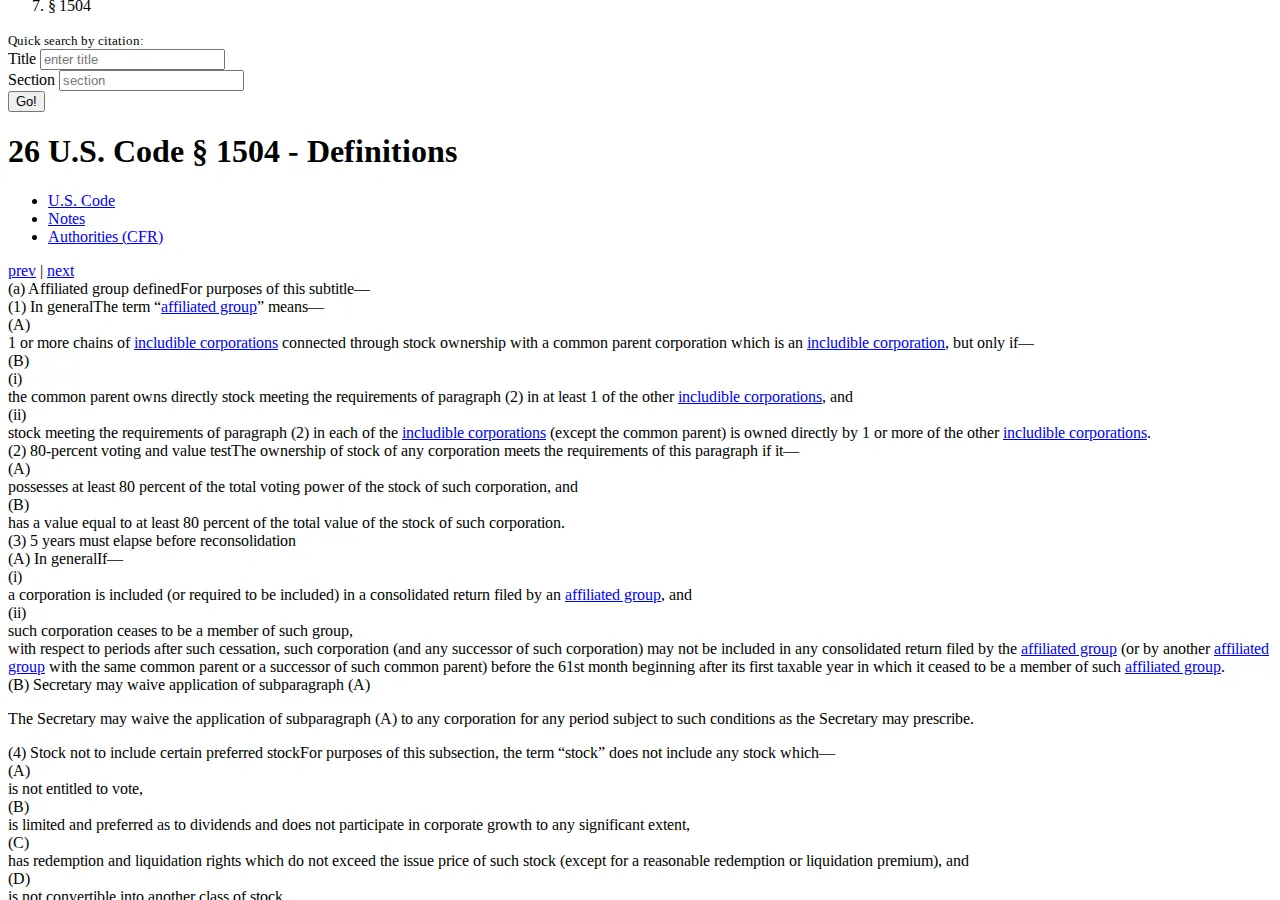
Book consolidation and tax consolidation are separate elections with separate tests. A group files a consolidated federal return only if it is an affiliated group under 26 U.S.C. § 1504: the common parent must own stock meeting the 80-percent voting and value test — at least 80% of the total voting power and at least 80% of the total value of the subsidiary's stock. S-Corps, foreign corporations, tax-exempt organisations, regulated investment companies, and real estate investment trusts are excluded from the definition of includible corporation, so a group that includes one cannot consolidate it for tax even if it consolidates it for book purposes. Once a corporation leaves a consolidated group, § 1504(a)(3) bars it from rejoining any group with the same common parent before the 61st month after the year it left — a five-year lockout the Secretary may waive only on application.
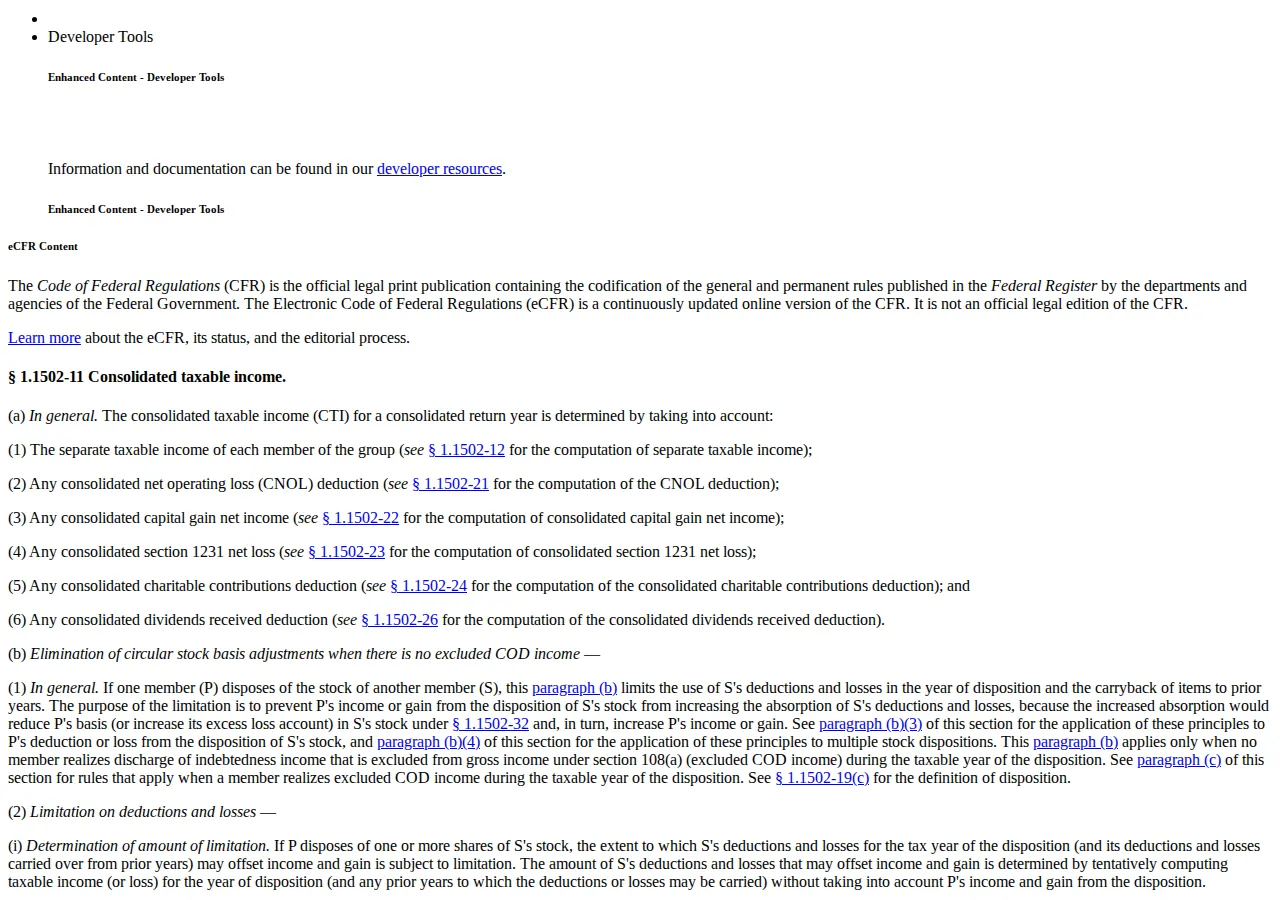
The computation runs under Treas. Reg. § 1.1502-11: consolidated taxable income starts with the separate taxable income of each member (§ 1.1502-12), adds the consolidated net operating loss (NOL) deduction (§ 1.1502-21), adds consolidated capital gain net income (§ 1.1502-22), and layers in the other consolidated items.
 Intercompany profit deferred for book purposes is deferred for tax too, through the § 1.1502-13 intercompany transaction rules, which is why the book and tax eliminations must be tracked in the same schedule — eliminate for book and forget tax, and the group overpays; eliminate for tax and forget book, and earnings are misstated.
The worked tax example: P's separate taxable income is $1,200,000 and S's is $400,000. The $60,000 of deferred profit reduces consolidated taxable income to $1,540,000. At the 21% federal corporate rate:
File Form 1120 for the group with Form 851, the affiliations schedule, listing every member, its ownership percentage, and its EIN. A group that holds an LLC taxed as a C-Corp consolidates it on the same terms as a corporation; an LLC that elected S-Corp status is excluded from the affiliated group entirely. The election is made by filing the first consolidated return, and it binds the group until the IRS grants permission to discontinue — it is not a year-by-year choice.
The consolidation close sequence
Step 1 — Confirm the consolidation scope. List every entity, test voting control and VIE status, and document the conclusion for each one. Anything between 20% and 50% without control goes to the equity method under ASC 323.
Step 2 — Align the charts and the periods. Map every subsidiary's accounts to the parent's chart, align fiscal year-ends, and lock the FX rates — closing, average, historical — in one schedule the whole group uses.
Step 3 — Combine, then eliminate. Add the trial balances line by line, then post the four elimination types. Reconcile the intercompany accounts to zero before you post anything else.
Step 4 — Translate foreign subsidiaries. Apply the current rate method, compute the CTA, and split the NCI share into the NCI.
Step 5 — Attribute income and equity. Compute the NCI share of each subsidiary's income, allocate downstream eliminations to the parent and upstream eliminations 80/20, and present the NCI as its own equity line.
Step 6 — Run the tax consolidation. Test the § 1504 80% threshold for each member, compute consolidated taxable income under § 1.1502-11, and file Form 1120 with Form 851. Reconcile the book-tax difference on the deferred profit and keep the schedule — the IRS will ask for it.
Founder & CEO Insight — Enow A. Jovial
The consolidation launch checklist
- [x] Scope documented: every entity tested for voting control and VIE status, conclusion in writing for the auditor.
- [x] Charts aligned: subsidiary accounts mapped to the parent chart, FX rates locked in one schedule.
- [x] Eliminations posted: sales and unrealised profit, loans and interest, fees, dividends — intercompany accounts at zero.
- [x] NCI computed: equity at the ownership percentage, downstream eliminations allocated to the parent only.
- [x] Translation done: current rate method applied, CTA booked to OCI, NCI share split out.
- [x] Tax consolidation tested: § 1504 80% test passed per member, Form 1120 with Form 851 filed.
- [x] Deferred profit tracked: the $60,000 scheduled for recognition when the goods sell outside the group, book and tax in one schedule.
For the pricing of the services between the entities before they are eliminated, the transfer pricing intercompany services playbook covers the arm's-length standard that governs what the group may charge itself. For keeping the underlying ledgers clean enough to consolidate, the automated bank reconciliation multi-currency ledger playbook covers the match-rate and exception-queue discipline that makes a group close possible. Consolidation does not fix a messy ledger — it multiplies the mess by the number of entities.