A different kind of VPN comparison
The mainstream VPN trio sells you a price that expires. Buy two years of NordVPN, ExpressVPN, or Surfshark and the renewal rate runs 2.6 to 3.3 times the introductory monthly price, starting the day the first term ends — our NordVPN vs ExpressVPN vs Surfshark VPN pricing playbook works that trap line by line. The trio in this guide sells the opposite promise.
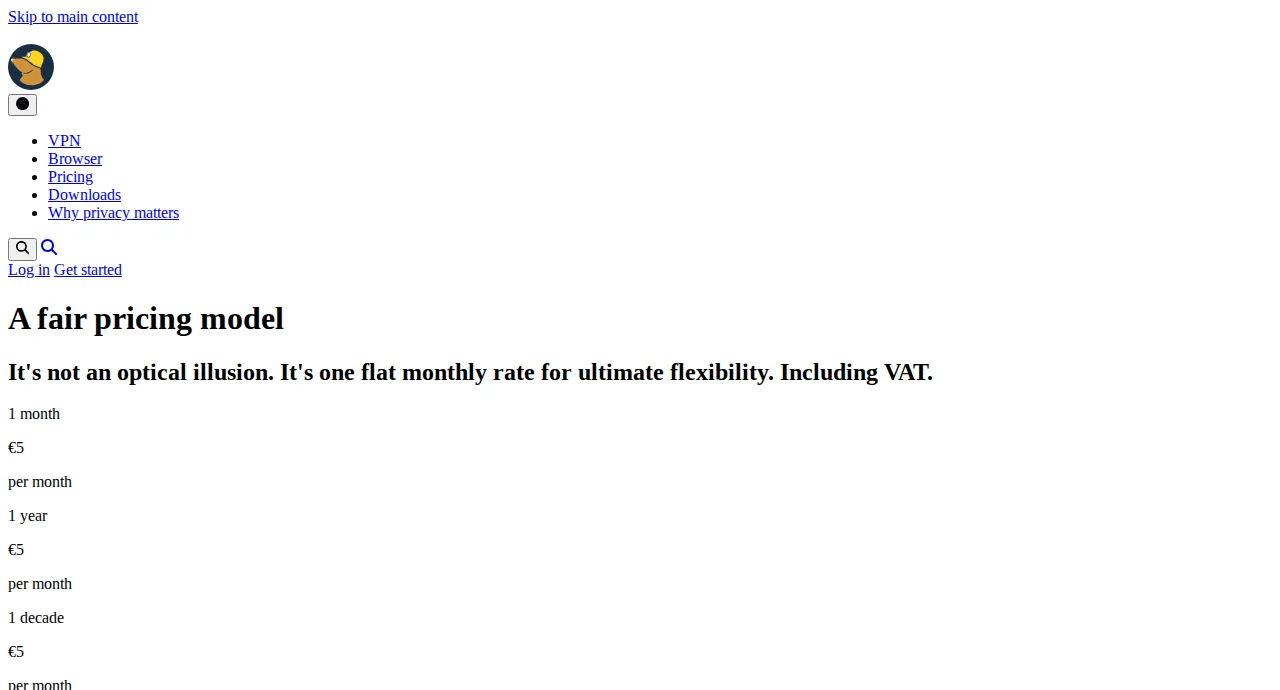
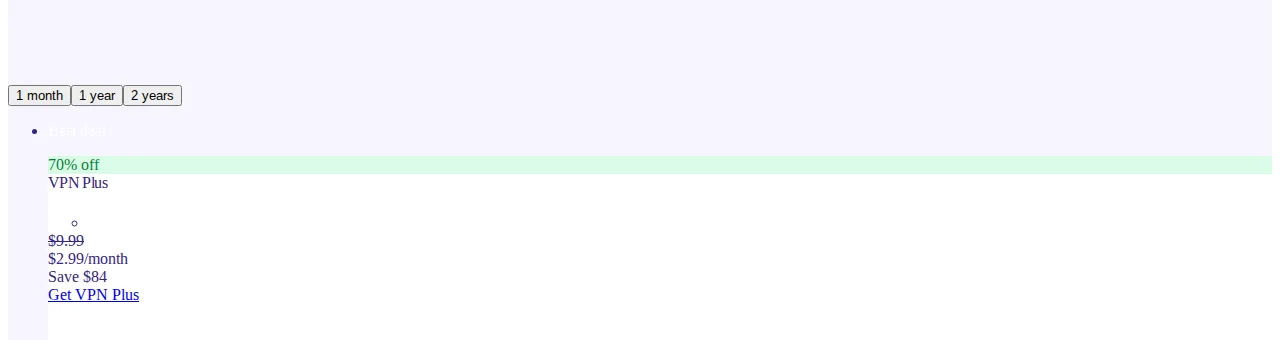
Mullvad charges €5 a month. One month, one year, one decade — all €5 a month, VAT included, the same rate since the 2009 launch. IVPN charges $6 a month or $60 a year for Standard and renews at exactly the same price. Proton VPN is the only one of the three that plays the promo game at all: VPN Plus drops to $2.99 a month on a two-year term, then renews at $83.88 a year. The question this guide answers is not which VPN is fastest — no speed testing was done here — but which price structure fits how long you will actually stay, and what privacy you get for the money.
Mullvad and IVPN sell the tunnel and almost nothing else. Proton VPN sells the tunnel as the front door to a wider encrypted suite — Mail, Pass, Drive, Calendar — and prices the VPN accordingly.
The three price structures on one page
Mullvad has one price and no tiers. Proton VPN has a free tier, a paid tier, and a bundle. IVPN has three tiers priced by what is bundled around the same VPN core.
Mullvad — €5 a month, flat, forever. One flat monthly rate, including VAT: a month costs €5, a year €60, a decade €600. The page prints the conversion itself — €5 is equivalent to $5.48, £4.19, SEK 56.10, A$8.28, and CA$7.87 — so the dollar math here uses Mullvad's own $5.48 figure. Accepted cryptocurrencies are discounted 10%, taking the effective rate to €4.50 a month, or €54 a year. Cash is accepted by post in nine currencies. There are no sales and no lifetime membership, and the price has not changed since the 2009 launch.
Proton VPN — $9.99 monthly, $2.99 on two years, $83.88 renewal. VPN Plus is $9.99 a month on monthly billing. The two-year term is $2.99 a month with 70% off and $84 saved, billed $35.88 for the first 12 months, then renewing at $83.88 every 12 months — $6.99 a month, 2.3 times the introductory rate. The plan covers 10 devices, the highest speed, 20,000+ servers in 140+ countries, streaming, and blocking for ads, trackers, and malware, with a 30-day money-back guarantee. Proton Unlimited, at $12.99 a month or $6.49 on two years, adds Mail, Pass, Calendar, and Drive. Proton Free costs $0: one device, medium speed, servers in 10 countries selected at random, no credit card required.
IVPN — $6, $8, or $10 a month; $60, $80, or $100 a year. IVPN restructured into three tiers in May 2026 with no price changes on the existing plans. Standard is $6 a month or $60 a year, covers 5 devices, and includes the VPN, multi-hop, obfuscation protocols, a SOCKS5 proxy, and AntiTracker. Plus is $8 a month or $80 a year, covers 5 devices, and adds modDNS and Mailx. Pro Suite is $10 a month or $100 a year, covers 10 devices, and adds Portmaster Pro for Linux and Windows. Weekly plans run $2, $3, and $4. IVPN is operated by IVPN Limited, registered in Gibraltar, and its plans renew at the price paid.
| Plan | Monthly | Annual | Devices | Money-back |
|---|---|---|---|---|
| Mullvad | €5 ($5.48) | €60 ($65.76) | 5 | 14 days, except cash payments |
| Proton VPN Plus, monthly | $9.99 | $119.88 | 10 | 30 days |
| Proton VPN Plus, 2-year | $2.99 first term | $35.88 first year; renews $83.88 | 10 | 30 days |
| Proton Free | $0 | $0 | 1 | — |
| IVPN Standard | $6 | $60 | 5 | 30-day refund |
| IVPN Plus | $8 | $80 | 5 | 30-day refund |
| IVPN Pro Suite | $10 | $100 | 10 | 30-day refund |
The annual math, with the renewal included
A VPN price is a subscription, so the honest unit is the three-year cost — long enough for every renewal in this trio to fire.
Proton VPN Plus is the cheapest across the first three years — $155.64 against $180 and about $197 — and the most expensive from year four onward, at $83.88 a year against IVPN Standard at $60 and Mullvad at about $65.76. At four years Proton totals $239.52 against IVPN Standard at $240 and Mullvad at about $263.
The per-device math differs. Mullvad's €60 a year covers 5 devices — €12 per device per year. IVPN Standard's $60 covers 5 — $12 per device per year. IVPN Pro Suite's $100 covers 10 — $10 per device per year. Proton VPN Plus at the $35.88 first-year price covers 10 — $3.59 per device in year one — and at the $83.88 renewal covers 10 at $8.39 per device per year.
Monthly billing is the penalty box in all three. Proton monthly billing costs $359.64 over three years against $155.64 on the two-year term — a $204.04 premium for the same service. IVPN monthly billing costs $216 over three years against $180 annual — a $36 premium. Mullvad has no penalty: monthly and annual cost exactly the same.
What privacy-first actually buys
The three vendors converge on the tunnel and diverge on everything around it. The differences below are the ones that decide a purchase once the price is understood — and they are all stated on the vendors' own pages.
No-email accounts. Mullvad generates an account number and asks for nothing else. IVPN issues an account ID and lets you add an email later only if you want contact. Proton VPN accounts are tied to a Proton account, which requires an email address. If the threat model includes the vendor itself holding your identity, Mullvad and IVPN are the only two in this trio that remove it by design.
Anonymous payment. Mullvad accepts cash by post in nine currencies, plus Bitcoin, Bitcoin Cash, and Monero at a 10% discount, bank wire, card, PayPal, Swish, Eps, Bancontact, iDEAL, and Przelewy24. IVPN accepts cash and Monero. Proton VPN accepts card and PayPal, and cash only in limited form. The cash option matters for exactly one buyer — the person whose payment trail is the threat — and for that buyer Mullvad is the only vendor that documents the process.
Devices and the network. Mullvad covers 5 devices and removed port forwarding — the pricing page links its own explanation, and the answer is final. IVPN Standard and Plus cover 5 devices, Pro Suite 10, and every tier includes multi-hop. Proton VPN Plus covers 10 devices with the largest network in the trio: 20,000+ servers in 140+ countries, against the two specialists, whose server counts are not published on the pages read for this guide.
The free tier. Only Proton VPN has one, and it is genuinely usable: unlimited data, one device, medium speed, servers in 10 countries, no credit card. Mullvad states plainly that it has no free plan; IVPN's cheapest test is the $2 weekly Standard plan.
Audits and transparency. Proton's pricing page states its service is open-source and independently audited, with no logs and no ads. Neither Mullvad's nor IVPN's pricing page carries an equivalent audit claim, so no audit firm or year is printed for either of them here.
| Attribute | Mullvad | Proton VPN Plus | IVPN Standard / Pro Suite | Authority |
|---|---|---|---|---|
| Annual price | €60 (~$65.76) | $35.88 first year; $83.88 renewal | $60 / $100 | Vendor pricing pages, Nov 2026 |
| Renewal | Same €5 forever | $83.88/yr ($6.99/mo) | Same price as purchase | Vendor pricing pages; IVPN plan-changes blog |
| Devices | 5 | 10 | 5 / 10 | Vendor pricing pages |
| No-email signup | Yes, account number | No, Proton account | Yes, account ID | Vendor pricing pages |
| Cash payment | Yes, 9 currencies | Limited | Yes | Mullvad pricing page |
| Free tier | No | Yes, 1 device | No | Proton pricing page; Mullvad pricing page |
| Port forwarding | No | Included | Included | Mullvad pricing page |
The protocol and privacy stack underneath the price
All three offer WireGuard, with OpenVPN over TCP or UDP as the fallback where networks block UDP traffic. A kill switch drops the connection if the tunnel fails, DNS leak protection keeps lookups inside the tunnel so your IP address never surfaces in a query, and the no-logs claim means the vendor keeps no record tying an IP address to an account. Mullvad and IVPN run no-KYC signup — no name, no email, no account trail — while cash at Mullvad sidesteps the AML identity checks card payments trigger. Proton is Swiss-based; Mullvad is Swedish, inside the EU, where GDPR governs the personal data it holds.
Who should not buy which
Do not buy Mullvad if you need port forwarding. It is removed and no plan brings it back. Do not buy Mullvad if you need ten devices on one account — five is the ceiling, and a second account costs a second €5.
Do not buy Proton VPN Plus on the two-year term if you will forget the renewal. The $2.99 rate saves $84 against monthly billing in year one, but it converts to $6.99 a month at renewal, and the vendor does not remind you with a discount. Buy it if you will calendar the renewal; buy IVPN Standard if you will not.
Do not buy IVPN Pro Suite for the VPN alone. The $40 a year over Plus buys Portmaster Pro and five more devices, not a better tunnel. If you run five devices or fewer, Plus is the same tunnel for $80.
Do not buy any of the three for streaming as the deciding factor. Only Proton publishes streaming as a headline feature on its pricing page, with 20,000+ servers behind it. The other two sell privacy, not catalogues, and their streaming was not tested for this guide.
The decision, in order
- Count your devices: five or fewer, all three fit; six to ten, only Proton Plus and IVPN Pro Suite fit.
- Decide whether the vendor may know you: if not, strike Proton and choose between Mullvad and IVPN on price.
- Decide whether you will calendar a renewal: if not, strike Proton's two-year term and choose between Mullvad at €60 a year and IVPN Standard at $60 a year.
- Decide whether you need a free tier or a bundle: if yes, Proton is the only answer — Free at $0, or Unlimited at $6.49 a month on two years.
- Run the three-year math on your own numbers in our pricing calculator before checkout.
- [x] Devices counted: the plan covers every device that will use it.
- [x] Renewal priced: the year-three cost is known, not just the checkout price.
- [x] Signup identity decided: email or account number, chosen deliberately.
- [x] Payment method chosen: card, crypto, or cash — and the discount, if any, claimed.
- [x] Trial run: the free tier or the $2 week used before the annual payment.
The mainstream trio still wins on one axis: promotional depth. NordVPN, ExpressVPN, and Surfshark will all beat $2.99 a month at checkout, sometimes by half. They lose on the axis this trio owns — the price in year three, the account that holds no email, and the payment that leaves no trail. If the job is to look like everyone else for the least money this month, buy the mainstream trio. If the job is to stay private for the least money every year, buy from this one — and if the tunnel travels with the rest of your stack, our IPv6 migration and dual-stack playbook prices the other half of the bill, the $0.005-per-hour public IPv4 rent the clouds started charging in 2024.
Founder & CEO Insight — Enow A. Jovial