The cheapest headline in this trio is Surfshark Starter at $2.49 a month on a two-year term, and the headline survives the math: over three years Surfshark Starter costs $126.48, ExpressVPN Basic $144.75, NordVPN Basic $198.54. NordVPN is the most expensive Basic on every horizon — its case has to be made on the bundle above Basic, not on the VPN price. The trap in all three is the renewal rate, 2.6 to 3.3 times the introductory monthly price, starting the day the first term ends.
The ladder, read November 2026
All three vendors sell three tiers on three terms, and all three add free months to the long terms, so the "two-year" plan is really 27 or 28 months and the "one-year" plan is really 15. The monthly price is the first-term total divided across those months, charged up front. Figures are US dollars before tax, read from each vendor's own pricing page or an independent reproduction of it in November 2026. NordVPN rotates promotions weekly — its own blog, updated November 3, 2026, prints a different table ($2.99 Basic on two years) from the live page read November 10 and re-checked November 12 ($3.49 Basic). Confirm every figure at checkout.
| Plan | 2-year term (per month) | First-term total | 1-year term (per month) | Monthly billing | Renews at (per year) | Authority |
|---|---|---|---|---|---|---|
| NordVPN Basic | $3.49 | $94.23 for 27 months | $4.99 | $14.99 | $139.08 | NordVPN pricing page, read Nov 10–12, 2026 |
| NordVPN Complete | $3.99 | $107.73 for 27 months | $5.99 | $19.99 | $219.48 | NordVPN pricing page, read Nov 10–12, 2026 |
| NordVPN Prime | $6.99 | $188.73 for 27 months | $8.99 | $29.99 | $296.28 | NordVPN pricing page, read Nov 10–12, 2026 |
| ExpressVPN Basic | $2.79 | $78.12 for 28 months | $4.99 | $14.99 | $99.95 | ExpressVPN order page, fetched Nov 18, 2026 |
| ExpressVPN Advanced | $3.99 | $111.72 for 28 months | $5.99 | $16.99 | $119.95 | ExpressVPN order page, fetched Nov 18, 2026 |
| ExpressVPN Pro | $6.99 | $195.72 for 28 months | $8.99 | $22.99 | $199.95 | ExpressVPN order page, fetched Nov 18, 2026 |
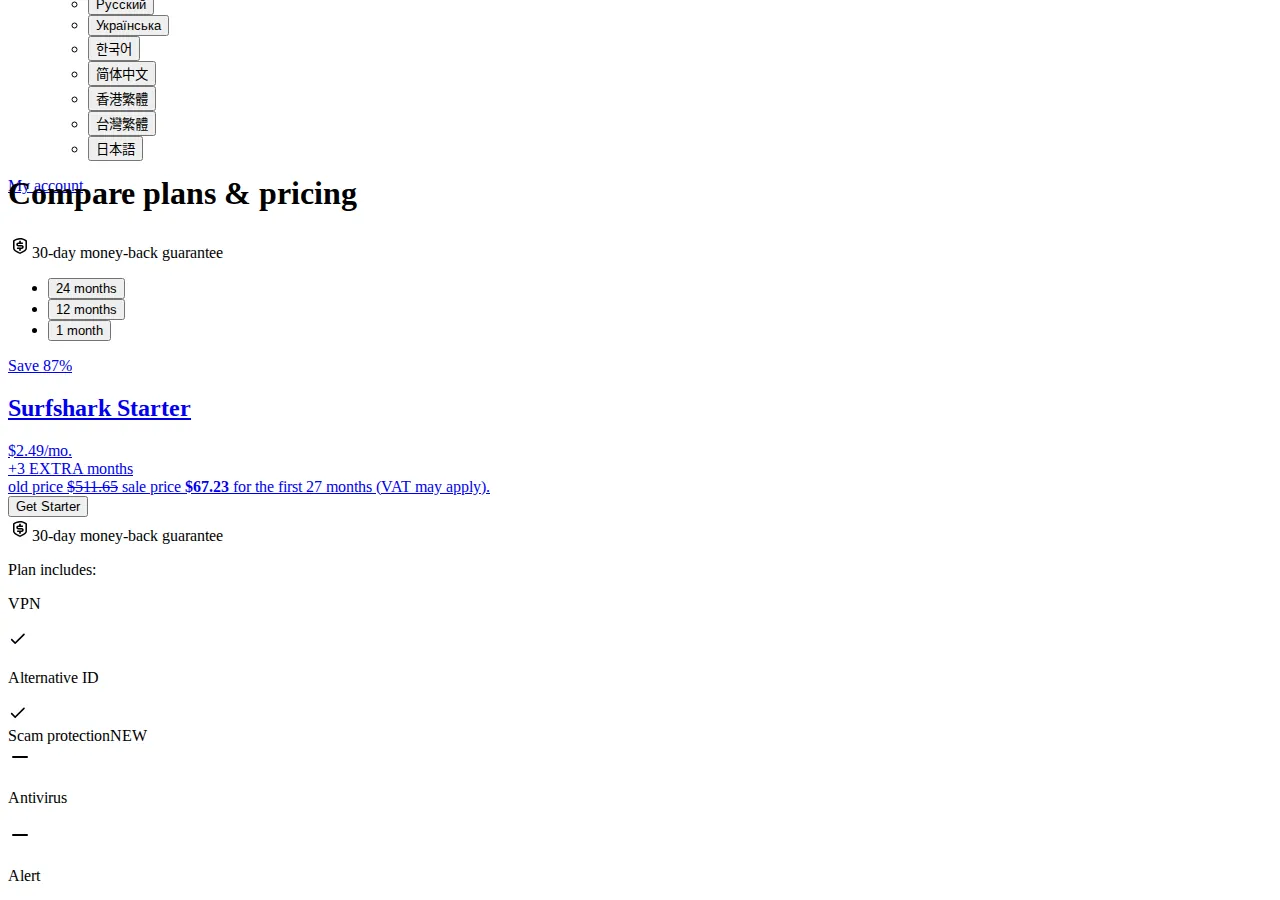
| Surfshark Starter | $2.49 | $67.23 for 27 months | $2.99 | $18.95 | $79 | Surfshark pricing page, fetched Nov 18, 2026 |
| Surfshark One | $2.49 | $67.23 for 27 months | $2.99 | $19.95 | $99 | Surfshark pricing page, fetched Nov 18, 2026 |
| Surfshark One+ | $3.99 | $107.73 for 27 months | $6.99 | $22.85 | $119 | Surfshark pricing page, fetched Nov 18, 2026 |
Two numbers deserve a second look. NordVPN Complete and Surfshark One+ cost exactly the same on the two-year term — $107.73 for 27 months — while buying different things: Complete adds 1 TB of storage and a password manager; One+ adds antivirus and breach monitoring. And NordVPN Basic and ExpressVPN Basic cost exactly the same on the one-year term — $74.85 for 15 months — while renewing $39.13 a year apart. The first term is where vendors compete; the renewal is where they get paid.
The three-year cost, worked in full
The honest comparison is what three years cost: the first term is 27 or 28 months and the renewal year is priced at the standard rate. The formula is the same for every plan:
On the entry tier, the ranking is unambiguous:
Surfshark Starter averages $3.51 a month across three years. ExpressVPN Basic averages $4.02. NordVPN Basic averages $5.52 — 57% more than Surfshark for the same job of encrypting traffic on up to 10 devices. The gap widens with time: every renewal year costs NordVPN Basic $139.08 against Surfshark's $79, a $60.08 annual difference that repeats for as long as you stay.
The monthly-plan penalty
Monthly billing exists to anchor the discount, and on Surfshark it is the worst value in consumer VPN by the numbers. Paying month to month over the same first-term months costs:
A single month of Surfshark Starter at $18.95 buys more than a quarter of the entire two-year term at $67.23. Monthly billing is defensible for one situation only: a single trip or a single month, cancelled before the second charge. Run your own horizon on the break-even calculator before you commit — the long plan pays for itself in month one on every plan here.
Devices: where the caps actually bite
NordVPN allows 10 simultaneous devices on every tier, ExpressVPN allows 10 on Basic, 12 on Advanced, and 14 on Express Pro, and Surfshark allows unlimited devices on every tier including Starter. On the two-year first term at a full house of 10: NordVPN Basic $0.35 per device per month, ExpressVPN Basic $0.28, Surfshark Starter $0.25 — and falling as you add more. But the per-device figure misleads too — at two devices Surfshark still costs less in total ($2.49 against $3.49), so there is no household size at which the cap makes NordVPN or ExpressVPN cheaper. The cap matters only at the boundary: an 11th device on NordVPN Basic or ExpressVPN Basic means a second account or a higher tier, while on Surfshark it means nothing. Count your devices before you buy, and count the router as one if you run the VPN at the router level — it covers the whole house.
For a business buyer, the same prices are a deductible operating expense, and the structure matters. An LLC, an S-Corp, and a C-Corp all deduct the subscription the same way — the difference is who signs: a single-member LLC owner buys on a personal card and reimburses, an S-Corp runs it through software spend, a C-Corp provisions seats centrally. Ask your CPA whether the invoice carries VAT outside the US, and whether the team plan's API provisioning and DNS leak protection are worth the B2B uplift over the consumer tier. A restaurant running a POS terminal over the house Wi-Fi is the concrete case: the VPN belongs on the router, not on one laptop.
Privacy: audits, jurisdictions, and what they do not prove
All three vendors publish no-logs policies, run RAM-only server fleets, and use AES-256 encryption. The differences are in the evidence trail, and the evidence is recent enough to check. NordVPN's no-logs policy has been assured six times — PwC in 2018 and 2020, Deloitte in 2022, 2023, 2024, and 2025, the latest engagement running November 10 to December 12, 2025 under ISAE 3000, with the report issued December 12, 2025. ExpressVPN's no-logs policy was assessed by KPMG as of February 28, 2025, its third KPMG engagement after September 2022 and December 2023, with PwC auditing in 2019 and Cure53 examining the Lightway protocol in 2025. Surfshark's no-logs policy was assured by Deloitte twice, first in January 2023 and again in June 2025. Jurisdictions differ: NordVPN is based in Panama, ExpressVPN in the British Virgin Islands, Surfshark in the Netherlands. Panama and the British Virgin Islands have no mandatory data-retention law for VPNs; the Netherlands sits inside the 14 Eyes intelligence-sharing arrangement, a real difference for a buyer whose threat model includes state-level adversaries.
Two honest caveats belong here. An audit is commissioned by the vendor and covers a specific window — it proves the setup matched the policy during testing, not what happens next year. And NordVPN and Surfshark share a parent company, Nord Security, so their two Deloitte reports are not two independent opinions about two independent companies. If independence of ownership matters to you, the honest pair to compare is NordVPN against ExpressVPN, not NordVPN against Surfshark. NordVPN runs NordLynx built on WireGuard, ExpressVPN runs Lightway, Surfshark runs WireGuard with MultiHop and Bypasser. For most buyers the protocol is a rounding error next to the price and the renewal.
Founder & CEO Insight — Enow A. Jovial
Who each one is actually for
NordVPN Basic is for the buyer who wants the longest audit trail and the largest feature surface — Double VPN, Onion over VPN, obfuscated servers, Threat Protection — and will pay $60 a year extra for it after year two. It is not for the buyer who only needs an encrypted tunnel. NordVPN Complete is the only tier here that bundles 1 TB of encrypted cloud storage, and it is the rational NordVPN pick if you were going to buy storage anyway. Prime adds identity-theft protection with $1M in coverage, but its identity monitoring is US-only — outside the United States, Prime buys nothing over Complete.
ExpressVPN is for the buyer who values the longest continuous audit record on a single architecture — KPMG since 2022, PwC before it — and Lightway's reputation on flaky mobile networks. Its Basic tier is the cheapest way to get that record after Surfshark. Advanced adds a password manager and breach monitoring for $1.20 a month more on the two-year term; Pro at $6.99 a month is the most expensive top tier and its eSIM extras are the thinnest reason to pay it.
Surfshark is for the household: unlimited devices, the lowest first term, the lowest renewal, and the lowest three-year total on every tier. Starter is the whole VPN with CleanWeb ad blocking, MultiHop, and Alternative ID; One adds antivirus and breach alerts for the same $2.49 a month on the two-year term — during the November promotion One costs exactly what Starter costs. One+ adds data-breach monitoring and private search at $3.99. Surfshark is not for the buyer whose threat model includes the Netherlands' intelligence-sharing arrangements, or who wants the deepest audit history — two Deloitte engagements against NordVPN's six.
| Decision | NordVPN | ExpressVPN | Surfshark | Authority |
|---|---|---|---|---|
| Lowest 2-year first term | $94.23 (Basic) | $78.12 (Basic) | $67.23 (Starter) | Vendor pricing pages, Nov 2026 |
| Lowest 3-year total | $198.54 (Basic) | $144.75 (Basic) | $126.48 (Starter) | Formula above; renewal rates as published |
| Lowest renewal (per year) | $139.08 | $99.95 | $79 | Vendor pricing pages, Nov 2026 |
| Device ceiling | 10 | 10 / 12 / 14 | Unlimited | Vendor pricing pages, Nov 2026 |
| Latest no-logs audit | Deloitte, Dec 2025 | KPMG, Feb 2025 | Deloitte, Jun 2025 | Vendor audit announcements |
| Server footprint | Thousands of servers, 164 locations | Servers in 113 countries | 4,500+ servers, 100 countries | Vendor pages, Nov 2026 |
The switching cost nobody prices
Switching VPNs costs about twenty minutes — install the new app, sign in, re-enter credentials, reconfigure split tunneling — which is why the renewal jump is a choice, not a trap. Treat the retention offer that appears when you cancel as a negotiation and compare it against a fresh first term elsewhere. Keep your VPN credentials and renewal dates in a password manager, not an email thread: the 1Password vs Bitwarden vs Dashlane pricing playbook prices the three. If you run the VPN on a router for a home lab, the Cloudflare Tunnel vs Tailscale vs ngrok comparison covers the self-hosted side of the same problem.
Buy it in this order
- [x] Count your devices first. 10 or fewer, any vendor works. 11 or more, only Surfshark's entry tier avoids a second account.
- [x] Pick the term, not the tier. Two years on any of the three beats monthly billing by $310 to $444 over the first term. If you cannot commit two years, take the one-year term — never monthly beyond a single month.
- [x] Price the renewal on day one. Write the renewal rate and date next to the purchase: NordVPN Basic $139.08 a year, ExpressVPN Basic $99.95, Surfshark Starter $79. If the renewal scares you, the vendor is telling you the real price.
- [x] Check the bundle math before upgrading. Complete only pays if you need the 1 TB of storage; One only pays if you need the antivirus; Advanced only pays if you need the password manager. The VPN itself is identical on every tier of the same vendor.
- [x] Verify the audit date, not just the audit. Deloitte 2025, KPMG February 2025, Deloitte June 2025. An audit from 2019 says nothing about 2026.
- [x] Set the renewal reminder before you close the tab. 30 days before the term ends, re-price all three. Cancel and switch if the renewal beats the new-customer price.