Microsoft Ads vs Google Ads: Search Pricing Playbook
Neither Microsoft Advertising nor Google Ads publishes a price list — no per-click rate card, no monthly fee — because both sell the same product the same way: a live auction, run every time someone searches, where you pay only when a click lands. The comparison that matters is the auction rule that sets your price, the budget rule that caps your month, and the benchmark data that tells you what a click actually costs.
Every price here was read from the vendors' own pages or WordStream by LOCALiQ's 2026 benchmarks on November 8, 2026. Where sources disagree on whether Microsoft clicks are cheaper, this guide shows the disagreement instead of picking the friendlier number.
The price list that does not exist
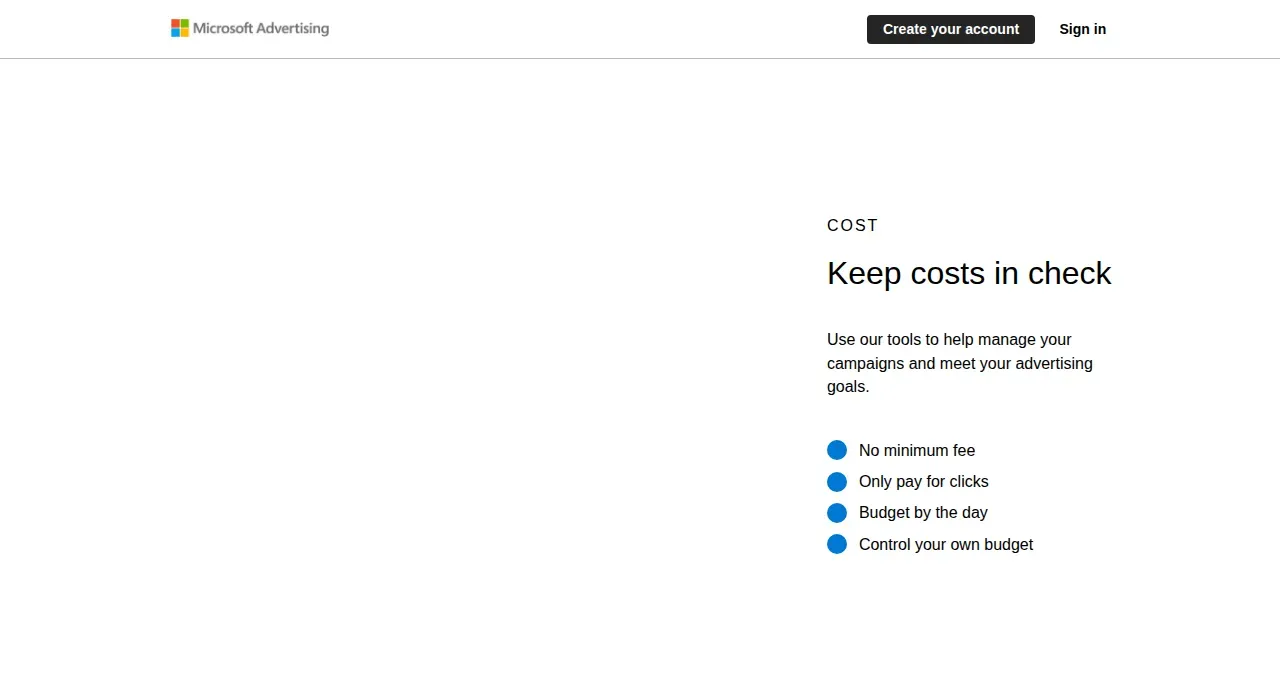
Both vendors state the same fee structure. Microsoft Advertising's homepage lists four cost facts: "No minimum fee", "Only pay for clicks", "Budget by the day", and "Control your own budget". Google Ads Help answers its own minimum-bid question the same way: "Bidding amounts are ultimately up to you." Neither charges a fee or sets a minimum daily budget. The only bill is the clicks.
| Cost item | Microsoft Advertising | Google Ads | Authority |
|---|---|---|---|
| Account setup | $0 | $0 | Vendor pages |
| Monthly platform fee | $0 | $0 | Vendor pages |
| Minimum spend | None — no minimum fee | None — bids are up to you | Vendor pages |
| Billing basis | Pay per click | Pay per click | Vendor pages |
| Budget control | Daily budget; monthly limit = daily budget × days in month | Average daily budget; monthly cap = daily budget × 30.4 | Microsoft Learn; Google Ads Help |
| Search network | Bing, Yahoo, DuckDuckGo, partner sites | Google Search | Vendor pages |
That table is the whole price list. Everything after it is auction mechanics and volume.
How the auction sets your price
Every search runs an auction. Google ranks ads by Ad Rank: maximum CPC bid multiplied by Quality Score. Quality Score is Google's 1-to-10 rating of the keyword, ad, and landing page, built from expected click-through rate, ad relevance, and landing page experience. Google's Help page notes Quality Score "isn't used at auction time to determine Ad Rank" — it is a diagnostic, not a live input.
You rarely pay your maximum bid. The winner pays only enough to beat the Ad Rank of the advertiser below, divided by its own Quality Score, plus one cent:
Advertiser A bids a maximum of $6.00 with a Quality Score of 8, for an Ad Rank of 48. Advertiser B bids $7.00 with a Quality Score of 5, for an Ad Rank of 35. A wins the top position despite bidding a dollar less, and pays $4.39 — 27 percent below the maximum bid. Drop A's Quality Score to 6 and the price rises to $5.84, up 33 percent. Microsoft runs the same second-price logic; its documentation states the match order: Exact, then Phrase, then Broad. One difference: Microsoft's Learn page shows broad match on "red flower" also matching the single-word queries "red" and "flower".
Budget controls: the $40 and $60 difference
Google sets an average daily budget and caps the month at 30.4 times that budget — the average number of days in a month. Google may spend up to twice the daily budget on a busy day (over-delivery), but the monthly charge cannot pass the 30.4 cap, and Google credits any excess. Its Help page works the example: a $10 daily budget means a maximum monthly charge of $304.
Microsoft calculates the monthly limit from the actual calendar. At $100 a day: Google $3,040 every month; Microsoft $3,000 in a 30-day month and $3,100 in a 31-day month. In a 31-day month Microsoft lets $60 more through; in a 30-day month Google lets $40 more through. It is the only structural pricing difference either vendor documents. Both platforms stop showing ads when the daily budget is reached.
What clicks actually cost: the 2026 benchmarks
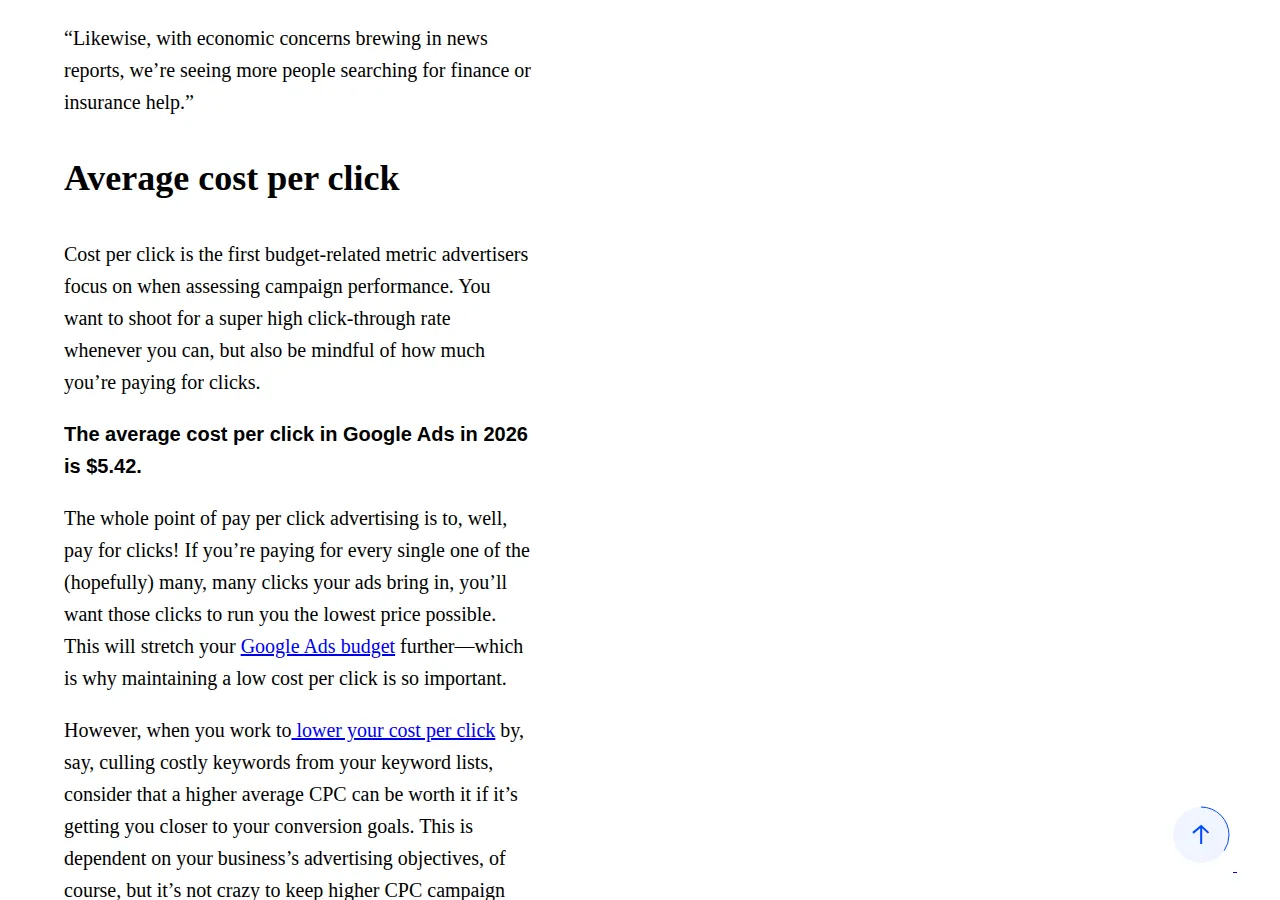
WordStream by LOCALiQ's 2026 edition covers more than 13,000 US search campaigns across 23 industries, April 2025 to March 2026, and reports medians — not averages. All-industry: 6.64 percent click-through rate, $5.42 cost per click, 8.18 percent conversion rate, $66.69 cost per lead. Against 2025, the click price rose from $5.26 to $5.42, conversion rose from 7.52 to 8.18 percent, and cost per lead fell from $70.11 to $66.69 — the first decrease in five years, with conversion up in 87 percent of industries.
| Industry | Average CPC | Conversion rate | Cost per lead | Authority |
|---|---|---|---|---|
| Attorneys & Legal Services | $9.87 | 5.55% | $131.63 | WordStream 2026 |
| Home & Home Improvement | $8.33 | 8.05% | $90.92 | WordStream 2026 |
| Business Services | $5.87 | 4.85% | $93.69 | WordStream 2026 |
| Arts & Entertainment | $1.63 | 5.91% | $26.84 | WordStream 2026 |
Each column is a separate median, so the three numbers in a row do not divide cleanly: attorneys at $9.87 a click and 5.55 percent conversion imply $177.84 per lead, but the published median is $131.63. Use the published cost-per-lead column, never the quotient.
At the blended medians, 500 clicks cost $2,710 for 40.9 leads, 5,000 cost $27,100 for 409, and 50,000 cost $271,000 for 4,090. The industry spread should set your budget: an attorney's click costs six times an arts click ($9.87 against $1.63), and a home-improvement lead costs nearly three and a half times an arts lead ($90.92 against $26.84). For the social side of the same budget, see our Google Ads vs Meta Ads small-business ROAS playbook.
The "Microsoft is cheaper" claim, audited
Ask whether Microsoft clicks cost less and you get three answers, all published in 2026. PPC Chief's consolidated dataset puts Google Search at a $4.22 average CPC against Microsoft at $1.54 — a 63.5 percent discount. Agency guides put the gap at 20 to 35 percent; a second guide at 30 to 33 percent. The range is 20 to 63 percent because the datasets measure different things: PPC Chief reports averages, the agency figures come from managed accounts, and WordStream blends both platforms into one $5.42 median.
Any article printing a single "Microsoft is 30 percent cheaper" figure as fact is quoting one dataset and hiding the other two. The math below runs on the blended median both platforms share and treats the Microsoft discount as an assumption to test.
Break-even math: what discount Microsoft must deliver
A cheaper click is only cheaper if it converts. Given a Google click price of $5.42 and a Google conversion rate of 8.18 percent, the break-even Microsoft click price is:
| If Microsoft converts at | Microsoft clicks must cost at most | Discount vs Google needed |
|---|---|---|
| 5.00% | $3.31 | 38.9% |
| 6.50% | $4.31 | 20.5% |
| 8.18% | $5.42 | 0.0% |
| 10.00% | $6.63 | Microsoft can cost 22.2% more |
If Microsoft converts at the same 8.18 percent as the blended median, any click below $5.42 wins. At 6.50 percent, Microsoft clicks must come in at $4.31 or cheaper — a 20.5 percent discount — just to tie Google on cost per lead. The conversion rate decides whether the discount is real — run both platforms for two weeks and plug each rate into this formula before moving a dollar of budget.
Three months, three budgets
Assume Microsoft clicks run 25 percent cheaper than the blended median — $4.07 a click — and convert at the same 8.18 percent. That discount is an assumption, chosen at the low end of the published 20-to-63 percent range.
| Monthly budget | Google clicks / leads | Microsoft clicks / leads | Extra clicks | Extra leads |
|---|---|---|---|---|
| $1,500 | 277 / 23 | 369 / 30 | +92 (+33%) | +7 |
| $10,000 | 1,845 / 151 | 2,457 / 201 | +612 (+33%) | +50 |
| $50,000 | 9,225 / 755 | 12,285 / 1,005 | +3,060 (+33%) | +250 |
Over three months the $10,000-a-month account buys 5,535 Google clicks and 453 leads, or 7,371 Microsoft clicks and 603 leads — 150 more leads for the same $30,000, if the 25 percent discount and equal conversion rate both hold. If the discount is really 20 percent, the extra clicks fall to 25 percent; if 63 percent, they rise past 170 percent. That spread is the argument for testing with your own keywords. Run your numbers through our break-even calculator before committing a quarterly budget.
What only one platform can do
Price is a tie; the differences are features one platform cannot copy.
Microsoft owns LinkedIn, and it is the only platform other than LinkedIn itself that lets you target by LinkedIn profile: company, industry, and job function — capped at 1,000 companies per ad group or campaign. For a B2B advertiser selling to named accounts, that is the difference between bidding on a keyword and bidding on a keyword searched by a target account's employee. Google has no equivalent. Our LinkedIn Ads vs Google Ads B2B lead-cost playbook prices the same targeting bought directly on LinkedIn, where the click costs far more.
Microsoft's Google Ads Import copies campaigns, ads, targets, ad extensions, and bid settings from Google Ads, and scheduled imports can re-run daily, weekly, or monthly. The one manual step Microsoft's blog names is associating the Universal Event Tracking tag the first time a remarketing list or conversion goal is imported.
Google's Smart Bidding sets bids at auction time using signals — query, device, browser, language, time of day — that manual bidding cannot match. Google reports more than 80 percent of its advertisers now use automated bidding, and switchers from Target CPA to Target ROAS see 14 percent more conversion value at a similar return on ad spend. Microsoft offers its own automated strategies, including a cost-per-sale option Google has no equivalent for: you pay only when a sale lands within 24 hours of a click. Volume is the last gap: Microsoft states more than 23 billion monthly searches and nearly 785 million monthly PC searchers (Comscore qSearch, March 2025) — roughly 770 million a day. Google says only "billions of searches per day", but billions plural against 770 million means a gap of at least several-fold.
Founder & CEO Insight — Enow A. Jovial
Who should not use which
Do not run Microsoft alone if your market is mobile-first and under 35: Bing's audience skews desktop and older. Do not run Google alone if you sell to named B2B accounts and have never tested LinkedIn profile targeting. Do not run either without conversion tracking installed and verified. And do not split a $500 monthly budget across both platforms — neither auction will gather enough data to learn.
The decision table
| If you need | Buy | Authority |
|---|---|---|
| Maximum search volume | Google Ads — billions of searches a day | Google Ads pages |
| B2B targeting by employer and role | Microsoft Ads — LinkedIn profile targeting | Microsoft Learn |
| Fastest second-platform launch | Microsoft Ads — Google Ads Import | Microsoft Learn |
| Auction-time automated bidding at scale | Google Ads — Smart Bidding, 80%+ adoption | Google Ads pages |
Execution checklist: price both platforms in two weeks
- Step 1 — Pull your industry row. Find your industry in the WordStream 2026 table and note its CPC, conversion rate, and cost per lead.
- Step 2 — Set the same daily budget on both platforms. Start at a daily budget you can sustain for 14 days — $50 a day is $700 for the test.
- Step 3 — Import, do not rebuild. Use Microsoft's Google Ads Import to copy the Google campaigns, then check budgets, bids, and locations before launching.
- Step 4 — Install conversion tracking first. Install Google conversion tracking and the Microsoft UET tag — do not launch until a test conversion registers on both.
- Step 5 — Run 14 days without touching bids. Let Smart Bidding on Google and the automated strategy on Microsoft learn; judge on cost per lead, not cost per click.
- Step 6 — Run the break-even formula. Take each platform's real conversion rate, compute the break-even click price, and move budget to the platform that beats break-even by the wider margin.
- Step 7 — Re-check the benchmarks every year. WordStream refreshes annually; the 2026 medians will be stale by mid-2027, so re-run the three-month table before renewing a quarterly budget.
Neither platform sells a price. Google sells the largest auction in search; Microsoft sells the same mechanics on a smaller audience, with LinkedIn targeting and a one-click import. Price the two with your own conversion rate and the break-even formula, and the cheaper platform will name itself.