What Advantage+ is now
Advantage+ shopping campaigns used to be a separate campaign type with their own setup flow and one ad set. Meta folded them into the regular Sales objective: since the rollout that began on May 29, 2025, any sales campaign keeping budget, audience, and placements on Advantage+ counts as an Advantage+ sales campaign, with every manual ad feature still available. Meta renamed Advantage+ shopping campaigns to Advantage+ sales campaigns on February 6, 2025, and the old type is being retired through the Marketing API — from version 25.0, in the first quarter of 2026, Advantage+ shopping campaigns can no longer be created or updated on any API version, and legacy campaigns using the existing customer budget cap are paused.
The definition is mechanical. A campaign is Advantage+ on when it uses Advantage+ campaign budget, Advantage+ audience in at least one ad set, and Advantage+ placements in all ad sets. Switch any of the three to a narrower manual setting and that section shows Advantage+ off — not an error, just a manual campaign without every automated optimisation. The Google Performance Max vs Search campaigns ROAS playbook runs the same within-platform comparison on Google, where the automated option is Performance Max and the manual option is keyword Search.
The three levers, and what each one takes
| Lever | What Meta decides | What you still supply | What turns it off |
|---|---|---|---|
| Advantage+ campaign budget | How the budget splits across ad sets | One campaign budget, daily or lifetime, with optional ad-set spending limits | Several ad sets on ad-set budgets, not one campaign budget |
| Advantage+ audience | Who sees the ads, beyond your inputs | Suggestions: age, gender, detailed targeting, custom audiences | Using "Further limit the reach of your ads" with "Use as a suggestion" unchecked |
| Advantage+ placements | Where the ads run across Meta's apps and surfaces | Nothing — every placement eligible by default | Excluding a placement in any ad set, or opting out of mobile or desktop |
Audience is the lever most buyers misunderstand. Meta splits your inputs in two. Audience controls are hard limits: locations, minimum age, languages, and custom audiences to exclude — your ads stay inside them. Audience suggestions are hints: age, gender, detailed targeting, and custom audience inclusions, which Meta uses first and then expands beyond. Raising the minimum age up to 25 or excluding a custom audience keeps it on. Account-level controls, like a minimum age for the whole ad account, do not change a campaign's Advantage+ state.
Two limits matter most. Advantage+ audience is not recommended for retargeting — Meta says so on its own help page, because retargeting is a defined list and the automation's job is to go beyond defined lists. And housing, employment, and credit campaigns have no access to Advantage+ audience at all, while social issues, elections or politics, and pharmaceutical campaigns may not get every Advantage+ feature.
What Meta claims, and what the claims are worth
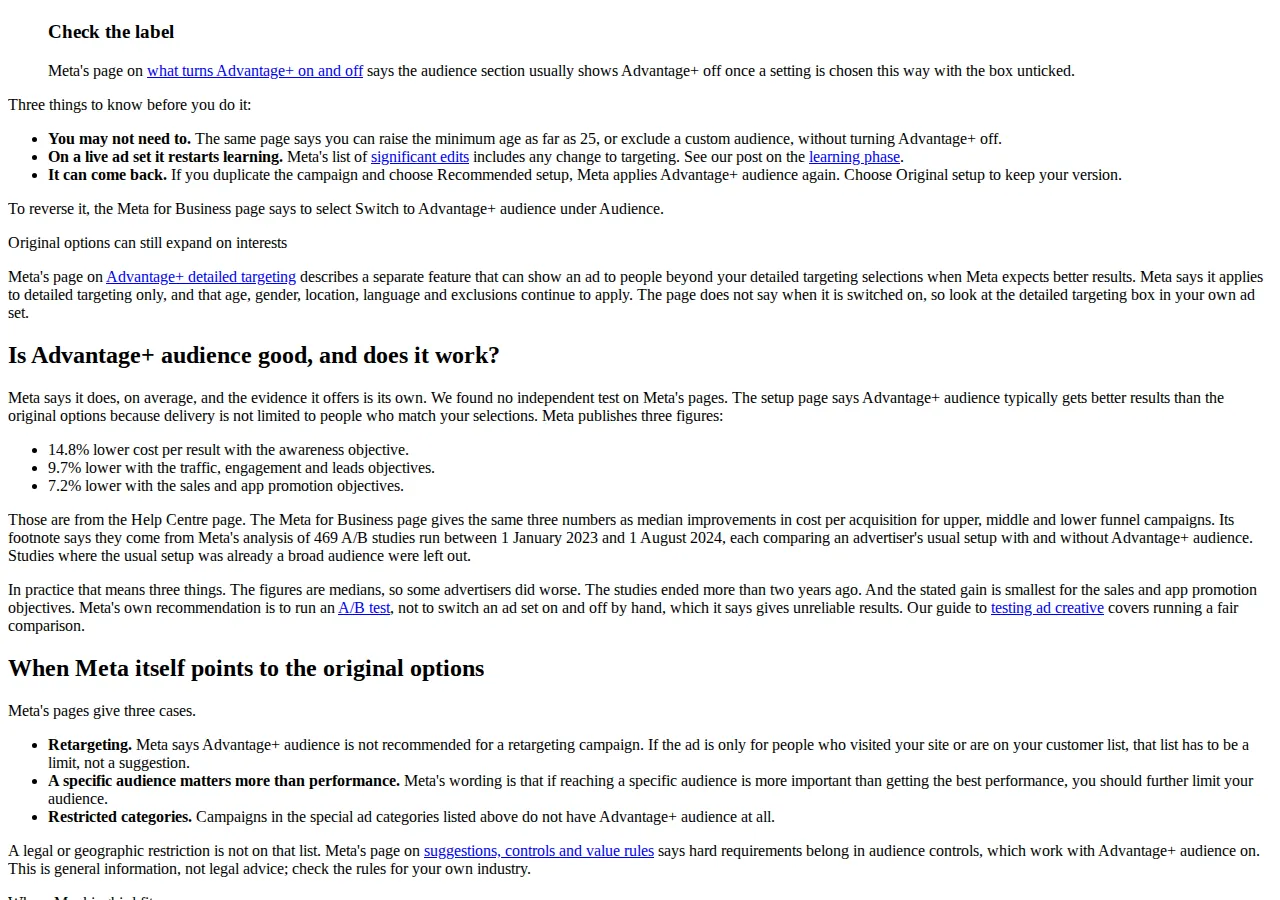
Meta publishes three headline figures, and they are not the same figure. The Help Center page on Advantage+ sales campaigns reports advertisers using them saw a 9% improvement in cost per conversion, on average. The Help Center page on Advantage+ audience reports three figures by objective: 14.8% lower cost per result for Awareness, 9.7% for Traffic, Engagement, and Leads, and 7.2% for Sales and App promotion. The footnote traces them to Meta's meta-analysis of 469 A/B studies run between January 1, 2023 and August 1, 2024, each comparing an advertiser's usual setup with the same setup plus Advantage+ audience. Meta's marketing page gives a fourth number, 20% lower cost per result on average — two Meta pages, two different averages, neither showing the sample or the period behind it.
The figures are medians: some advertisers did worse. The last test ended on August 1, 2024, more than two years before this article, and the stated gain is smallest for Sales and App promotion — the objectives a store actually buys on. Meta's own recommendation is an A/B test, not switching an ad set on and off by hand, which it says gives unreliable results.
Independent evidence cuts the other way. Haus, a measurement company that sells incrementality testing, published lessons from 640 Meta incrementality experiments in July 2025: in head-to-head tests, 58% of brands saw higher incremental ROAS on manual campaigns, and Advantage+ won for 42%. That is not a contradiction — it is a different measurement. Meta measures cost per conversion inside Ads Manager; Haus measures incremental sales against a holdout. A campaign can win the first and lose the second when its conversions would have happened anyway, which is what happens when Advantage+ spends on existing customers.
Worked example: one $10,000 month, two builds
Take a store spending $10,000 a month, manual cost per acquisition $40, average order value $120:
Apply Meta's 9%: the cost per acquisition falls to $40 × 0.91 = $36.40, and the same $10,000 buys:
That is 24.7 more purchases, a 9.9% increase, revenue of 274.7 × $120 = $32,967, ROAS 3.30x. Apply only the 7.2% audience figure for Sales: cost per acquisition $40 × 0.928 = $37.12, purchases 269.4, revenue $32,328, ROAS 3.23x. The difference between the two Meta figures is 5.3 purchases a month — real money, small enough that one bad week of creative fatigue erases it.
Now the number Meta does not publish. Advantage+ reports blended ROAS: new and existing customers together. Suppose 25% of Advantage+ purchases are existing customers who would have bought anyway, and 10% of manual purchases are. Incremental purchases are then 274.7 × 0.75 = 206.0 for Advantage+ against 250 × 0.90 = 225.0 for manual. On incremental purchases, the manual build wins — the Haus result, reproduced with arithmetic. The check is the audience-segments report: it splits new, engaged, and existing customers, and the split decides whether the 9% is real revenue or retargeting dressed as prospecting. Run the break-even through the ROI calculator with your own margin and order value before you set any Target ROAS — the calculator turns your margin into the break-even line in one step.
The learning floor: the budget Advantage+ needs before it works
Meta's help pages describe a learning phase of roughly 50 optimisation events in 7 days per ad set. At a $40 cost per purchase, that is:
About $286 a day per campaign, $4,000 a week for a two-campaign A/B test. Below that floor the campaign never leaves learning, and the comparison is between two unstable campaigns. Migrating or copying an old campaign into the new format restarts learning, with no workaround, so a migration is a decision to pay the learning cost again, and the budget for it belongs in the plan before the migration, not after.
The floor is also why small accounts should start manual: a store spending $30 a day cannot give either build 50 events a week, so the automation has nothing to learn from and the manual build's control is free. The store that can afford the floor can afford the test.
When manual wins
Manual is not the fallback for advertisers who fear automation — it is the right build in five cases:
Retargeting. Meta does not recommend Advantage+ audience for retargeting, and the reason is structural: retargeting is a defined list, and Advantage+ audience's job is to go beyond defined lists. Keep retargeting manual, with the audience as a fence, not a suggestion.
Special ad categories. Housing, employment, and credit campaigns have no access to Advantage+ audience. Social issues, elections or politics, and pharmaceutical campaigns may not get every Advantage+ feature. In one of these categories, the decision is made for you.
Small budgets. Below the 50-events-a-week floor, neither build learns, and the manual build's control costs nothing. Spend the money on creative and the conversion signal instead.
Margin-sensitive prospecting. Advantage+ optimises for the event and the value you send it. If the value signal is wrong — if the pixel fires on a $10 accessory the same way it fires on a $200 order — the automation optimises for the wrong thing, confidently. Manual targeting with value rules and the Conversions API is the fix, applied before you hand the budget to the automation.
Creative control. Advantage+ creative can generate video from static images, generally available since October 6, 2026, and it starts from the media you upload. If the brand cannot afford an off-brand variation on its best prospecting, the creative enhancements come off — and with them, part of the automation's edge.
The fair test
Run the test in Meta's Experiments tool, not by switching one ad set on and off. The two campaigns run the same ads, budget, and conversion event, with only the Advantage+ settings changed. Meta recommends at least 7 days; the guides that ran the test in 2026 use 7 to 30 days.
Read three numbers at the end, not one: cost per result tells you what Ads Manager thinks happened. The audience-segments split tells you how much was new customers. And the incrementality read — a holdout, or new-customer revenue against the test's cost — tells you whether the extra purchases were extra sales. A test reporting a 9% cost improvement and a 25% existing-customer share has not found a 9% improvement; it has found retargeting at prospecting prices.
Founder & CEO Insight — Enow A. Jovial
The decision sequence
- Check the floor first: fifty events a week per ad set at your cost per purchase. If the budget cannot clear it in both arms, run manual and spend the difference on creative.
- Wire the signal before the test: Conversions API connected, value rules set, the pixel firing on the purchase event with the real order value — the automation optimises for the signal it gets.
- Build the two campaigns identically: same ads, budget, and conversion event. Only the Advantage+ settings differ.
- Run it in Experiments for 7 to 30 days. No manual switching mid-test: a switch restarts learning and voids the comparison.
- Read the split, not the headline: cost per result, then the audience-segments report — new, engaged, existing — then the incremental read.
- Keep what won, and keep the loser as the control. The manual build stays as the retargeting and special-category build even when Advantage+ wins prospecting — it is the only build that holds a fence.
The Advantage+ checklist
- [x] Floor cleared: 50 events a week per ad set, about $286 a day at $40 per purchase, $4,000 a week for the pair.
- [x] Three levers confirmed: campaign budget, Advantage+ audience in at least one ad set, placements in every ad set — or the campaign is manual.
- [x] Signal wired: Conversions API connected, value rules set, purchase event carrying real order value.
- [x] Retargeting kept manual: Advantage+ audience is not recommended for it; the audience is a fence there, not a suggestion.
- [x] Test run in Experiments: 7 to 30 days, same ads and budget, only the Advantage+ settings changed.
- [x] Split read: new, engaged, and existing separated before any claim about the 9% is believed.
Advantage+ is the default for a reason: on Meta's own numbers it is cheaper per conversion, and for a store that can clear the learning floor and feed it creative, it usually is. Manual is the default for a different reason: it is the only build that holds a fence, runs a retargeting list, or survives a category the automation cannot enter. The choice is not between new and old. It is between a campaign you can measure and one you can only believe — and the test turns the second into the first.
For the cross-platform view, the Google Ads vs Meta Ads ROAS playbook prices search and social on the same budget, and the TikTok vs Meta ecommerce playbook prices the two social platforms on the same month. For the B2B case, where the conversion is a lead, the LinkedIn Ads vs Google Ads lead-cost guide covers the comparison that decides it.