Melio vs Bill.com vs QuickBooks Bill Pay: AP Pricing Head-to-Head
What does it cost to pay a bill? Melio sells an ACH allowance, BILL sells seats at $49–$89 per user per month, and QuickBooks Bill Pay is a flat add-on with free standard ACH. The workflow is covered in the accounts-payable automation playbook. Priced from the vendors' own pages, read November 13, 2026.
The three vendors at a glance
| Vendor | Pricing logic | Entry price | Per-payment ACH |
|---|---|---|---|
| Melio | Subscription + ACH allowance | $0 (Go) | $0.50 beyond allowance |
| BILL | Per user per month + per payment | $49/user/mo | $0.59 every payment |
| QuickBooks Bill Pay | Flat add-on to QuickBooks Online | $0 (Basic) | $0 standard ACH |
Prices are U.S. dollars, monthly billing unless stated, excluding tax.
Melio: an ACH allowance with a fee for everything else
Melio publishes five plans. Go costs $0 forever: one user, five free ACH a month. Core costs $25 a month ($20 annual) with 20 free ACH, plus $10 per extra user ($8 annual). Boost costs $55 ($44 annual) with 50 free ACH and the same $10 per extra user. Unlimited costs $80 ($64 annual) with unlimited ACH and users. Platinum is invite-only with custom pricing.
The subscription is only half the cost. From a bank account: $0.50 per ACH beyond the allowance, $1.50 per check, $20 fast check, $50 overnight check, 1% (capped at $75) for instant and same-day ACH, $10 per wire, 1% ($10–$75) for same-day wire. By card, add 2.9% on top of the receiving fee. International USD payments cost $20 flat; fast international 1% ($30–$95). Melio syncs with QuickBooks Online, Xero, QuickBooks Desktop, and NetSuite; approvals cover per-amount, per-vendor, and multiple approvals.
BILL: seats first, then a fee on every payment
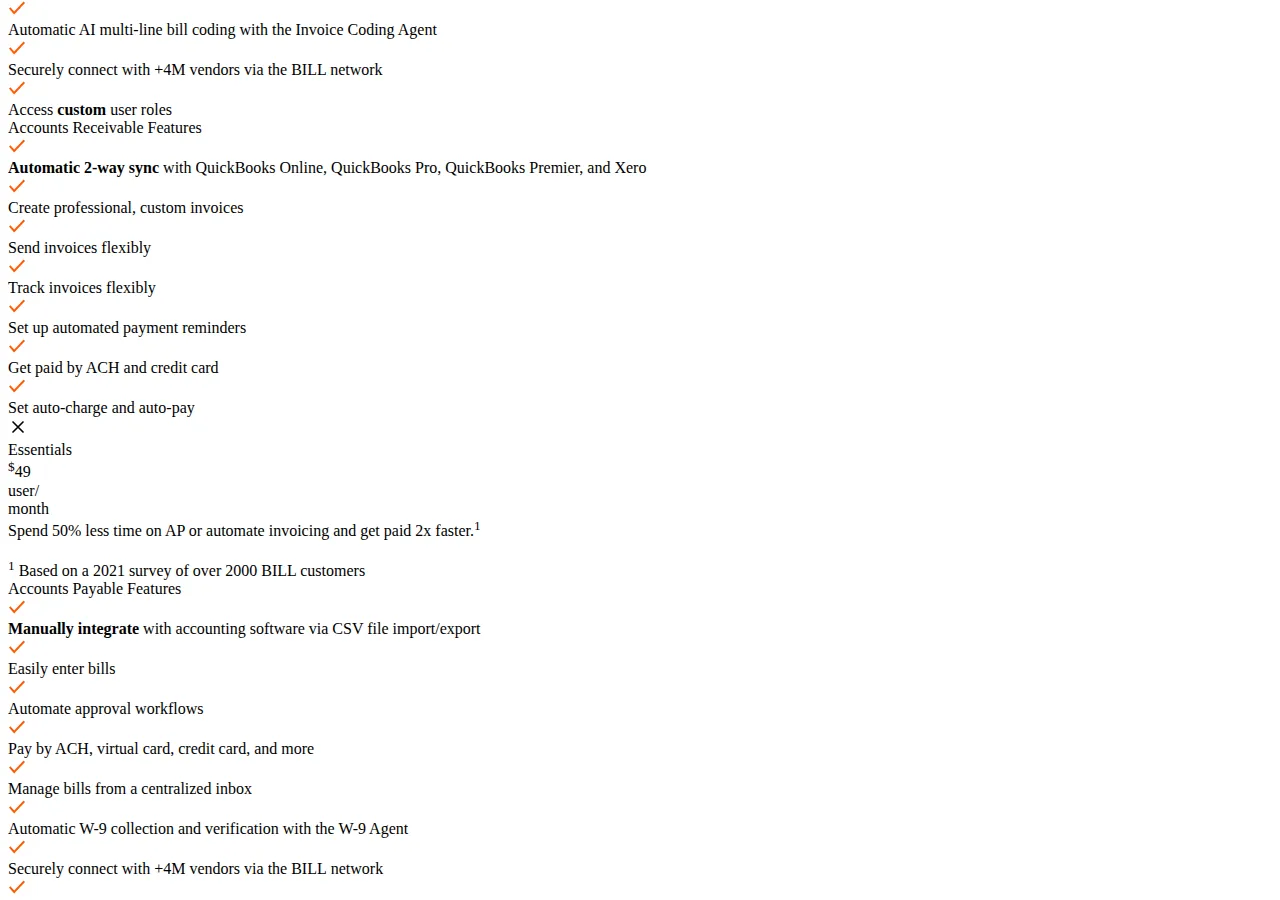
BILL publishes four AP and AR plans per user per month, plus free Spend and Expense. Essentials costs $49 per user per month. Team costs $65. Corporate costs $89 and is labelled the most popular tier. Enterprise is custom priced. Spend and Expense costs $0 per user per month.
The plan ladder is a feature ladder, and the rung that matters most is sync. Essentials syncs only by manual CSV, with six standard roles. Team adds automatic two-way sync with QuickBooks and Xero, plus custom roles and AI bill coding. Corporate adds custom approval policies, procurement, single sign-on, and approver-only discounts. Enterprise adds ERP sync (NetSuite, Sage Intacct, Dynamics), dual control, and API access.
BILL states some payment types carry per-transaction fees regardless of plan: $0.59 per ACH, $1.99 per check, 2.9% by card, $19.99 per international USD wire, nothing for an FX wire beyond the exchange rate. Instant transfers cost 1.25% ($1 minimum); faster checks $14.99–$24.99. Penalties: voiding a check $25, a failed ACH $50, a re-debit $25, a 1099 filing $2.99 per form.
QuickBooks Bill Pay: free ACH inside a subscription you already pay
QuickBooks Bill Pay is Intuit's bill-pay feature inside QuickBooks Online, not a standalone vendor. Basic costs $0 inside a QuickBooks Online subscription from $38 a month. Premium costs $15 a month ($7.50 for the first three months). Elite costs $45 a month ($22.50 for the first three months) and is included free with QuickBooks Online Advanced. Bill Pay users follow the QuickBooks plan's user limit, not a separate seat purchase.
Standard ACH is free on all tiers. Checks cost $1.50; Faster ACH $10; Instant Payment 1% ($100 maximum, $10 minimum transaction). Premium adds unlimited 1099 e-filing. Elite adds roles, approval workflows, and a payment release hold. Vendor Direct pays eligible bills the same day at no extra cost; free ACH takes three to five business days, checks up to two weeks.
Batches cap at 20 bills on Basic and 50 on Premium and Elite. Bill Pay pays by ACH or mailed check only — no card funding, wire, or international payment.
Worked math 1: Melio Core at 100 bills, three users
Melio's monthly cost:
Core at 100 bills a month with three users, on monthly billing:
Go would cost $47.50 in overage alone but allows only one user; Unlimited costs $80 flat, beating Core by $5 at 100 bills and $105 at 300. Run your own bill count through the profit calculator — the crossover moves with volume.
Worked math 2: BILL Essentials at 100 bills, three users
BILL's formula:
Essentials at 100 bills a month with three users:
The $206 splits into $147 of seats and $59 of fees — the seats are the cost. One user pays $108 at 100 bills; a second approver doubles the subscription line.
The volume table: 25, 100, and 300 bills a month
Monthly billing, three AP users, all standard ACH; QuickBooks Bill Pay uses the $38 floor.
| Monthly cost | 25 bills | 100 bills | 300 bills |
|---|---|---|---|
| Melio Go (1 user only) | $10.00 | $47.50 | $147.50 |
| Melio Core (3 users) | $47.50 | $85.00 | $185.00 |
| Melio Unlimited | $80.00 | $80.00 | $80.00 |
| BILL Essentials (3 users) | $161.75 | $206.00 | $324.00 |
| BILL Team (3 users) | $209.75 | $254.00 | $372.00 |
| BILL Corporate (3 users) | $281.75 | $326.00 | $444.00 |
| QB Bill Pay Basic | $38.00 | $38.00 | $38.00 |
| QB Bill Pay Premium | $53.00 | $53.00 | $53.00 |
| QB Bill Pay Elite | $83.00 | $83.00 | $83.00 |
First, QuickBooks Bill Pay Basic is cheapest at every volume for a QuickBooks Online user: $456 a year at 25 bills, against $570 for Melio Core and $1,941 for BILL Essentials. Second, Melio Unlimited is the only flat-priced plan without QuickBooks — the cheapest Xero choice past about 90 bills a month. Third, BILL never wins on price; it wins on multi-entity accounting, procurement, and ERP sync. Compare the QuickBooks vs Xero decision first, because the ledger choice decides which bill-pay prices are even available to you.
The decision matrix
| Situation | Choose | Authority |
|---|---|---|
| Books in QuickBooks Online, any volume | QB Bill Pay Basic | Intuit bill-pay page: $0 Basic, $0 standard ACH |
| Books in Xero, over ~90 bills a month | Melio Unlimited | Melio pricing page: $80 flat, unlimited ACH and users |
| Books in Xero, under 100 bills, 3 users | Melio Core | Melio pricing page: $25 + $10 per extra user, 20 free ACH |
| Multi-entity or NetSuite / Sage Intacct sync | BILL Enterprise (quote-only) | BILL pricing page: Enterprise adds ERP sync, custom priced |
| Procurement and custom approval policies | BILL Corporate | BILL pricing page: Corporate adds procurement, $89 per user |
| One approver, under 5 bills a month | Melio Go | Melio pricing page: $0, 1 user, 5 free ACH |
The card trap: 2.9% on a $2,000 bill
Both Melio and BILL charge 2.9% for card funding. On a $2,000 bill, that is $58; on Melio a card-funded fast check costs $78. Ten such bills a month cost $580 in card fees alone, more than a month of BILL Essentials seats. QuickBooks Bill Pay offers no card-funded route at all. Fund from the bank account unless the float is worth more than 2.9%; never fund a check by card.
Cross-border: wires, FX, and the missing rail
Melio charges $20 flat for an international USD payment, or 1% ($30–$95) for fast international. BILL charges $19.99 per international USD wire, and nothing for an international FX wire beyond the exchange rate. QuickBooks Bill Pay publishes no international payment option; its pages list ACH and mailed checks only. Ten USD wires a month cost $200 on Melio and $199.90 on BILL — unavailable on QuickBooks Bill Pay.
Speed: what "fast" costs on each rail
Free ACH takes three to five business days, checks up to two weeks; Vendor Direct pays eligible bills the same day at no extra cost. Melio same-day ACH costs 1% capped at $75. BILL instant transfers cost 1.25% ($1 minimum). On a $2,000 bill, same-day delivery costs $20 on Melio, $10 on Faster ACH, and $25 on BILL.
Approvals: policy-based ceilings, not dollar caps
None of the three vendors publishes a dollar ceiling on approvals. Melio offers per-amount, per-vendor, and multiple approvals. BILL offers standard approval policies on Essentials, custom approval policies on Corporate, and approver-only user discounts on Corporate, with dual control on Enterprise. QuickBooks Bill Pay offers no approval workflow on Basic, adds roles and permissions on Elite, and reserves the payment release workflow — money held until a designated approver releases it — for Elite. The practical ceiling is the batch limit: Basic caps a payment run at 20 bills, Premium and Elite at 50. On BILL the custom-approval tier is Corporate at $89 per user; on QuickBooks Bill Pay it is Elite at $45 flat; on Melio it is included from Core up.
Accounting sync: where the payment lands
QuickBooks Bill Pay posts inside QuickBooks Online — no sync at all. Melio syncs with QuickBooks Online, Xero, QuickBooks Desktop, and NetSuite. BILL syncs by manual CSV on Essentials, automatic two-way sync with QuickBooks and Xero on Team, and NetSuite, Sage Intacct, and Dynamics on Enterprise. A Xero business cannot use QuickBooks Bill Pay at any price. For the reconciliation work that follows any sync, see the automated bank reconciliation playbook.
Founder & CEO Insight — Enow A. Jovial
Balance-sheet stakes: what a wrong choice costs
A late vendor payment loses the early-payment discount, commonly 2% within 10 days — $40 on a $2,000 bill, $4,000 across 100 bills. A payment duplicated by a bad sync overstates expenses and understates cash until the reconciliation catches it. The 1099 line is the quiet one: BILL charges $2.99 per form filed with the IRS, while QuickBooks Bill Pay Premium and Elite include unlimited 1099 e-filing. Sixty contractors cost $179.40 a year in BILL 1099 fees, against $0 on Premium — the 1099 line alone can pay for the tier.
Who should avoid each vendor
Melio is wrong for a business with more than one approver on the free tier — Go allows one user. It is wrong for a business that pays mostly by check, because the $1.50 check fee applies on every plan. It is wrong for a business that needs procurement or multi-entity accounting. BILL is wrong for a one- or two-person business: one user on Essentials pays $49 a month; Melio Go charges $0. It is wrong for a business that pays 300 bills a month from a thin margin, where the $324 Essentials total is nearly nine times QuickBooks Bill Pay Basic. QuickBooks Bill Pay is wrong for any business that does not keep its books in QuickBooks Online — it is not a standalone product, and there is no Xero or NetSuite edition. It is wrong for a business with international suppliers or card-funded bills.
Run the switch: execution checklist
- Count the bills. Count bills, checks, and international wires per month over the last 90 days.
- Count the seats. List everyone who touches a payment — BILL charges per seat.
- Run the three formulas. Price all three vendors at your volume.
- Price the exceptions. Add checks at $1.50/$1.99, card bills at 2.9%, wires at $20/$19.99.
- Test the approval chain. Test your approval rule on a trial account and confirm the tier that holds it.
- Check the sync. Pay one real bill and confirm it posts without a manual import.
- Docket the trial end. Calendar the trial conversion date on day one — both trials convert automatically.
The decision in advance
Choose QuickBooks Bill Pay Basic if the books already live in QuickBooks Online: $38 a month all-in, free standard ACH. Choose Melio Unlimited for Xero past about 90 bills a month: $80 flat. Choose Melio Core for three people paying under 100 bills: $85 a month. Choose BILL only when you need what the others do not sell — and price the seats first, because the seats are the bill. The cheapest vendor is the one whose pricing logic matches how you actually pay.
Every bill these vendors pay goes out by ACH, and a return comes back with a code — the ACH return codes and NOC playbook decodes R01–R29 and the reinitiation rules.