Three meters for the same logs
Every log platform sells the same outcome — ingest the logs, keep them searchable, alert on them — and bills for it in a different unit. Logz.io bills per gigabyte ingested, with retention sold separately by the day and by temperature. Sumo Logic bills in credits, a prepaid pool that burns at a fixed rate per gigabyte ingested, per gigabyte stored, and per unit of everything else. Elastic Cloud Serverless bills per gigabyte ingested and per gigabyte retained each month, on a volume scale that starts high and steps down. The unit matters more than the headline price: a team that ingests little and queries constantly gets the opposite answer from a team that ingests heavily and queries rarely.
The comparison below runs all three on one workload, so the numbers are comparable: 100 GB of logs ingested a month, retained 30 days, queried daily by a small engineering team. Every figure comes from the vendor's own pricing page or pricing schedule, read in November 2026. Where a vendor hides its rates behind a calculator, the article says so and uses the vendor's published schedule instead.
| Vendor | Ingest meter | 100 GB ingest | 30-day retention | Monthly total | Query cost |
|---|---|---|---|---|---|
| Logz.io | $0.92 per GB | $92.00 | Hot +$69.00 / Warm +$34.50 / Cold +$2.30 | $161.00 / $126.50 / $94.30 | Included in the GB rate |
| Sumo Logic Essentials | 25 credits per GB (Continuous) | $375.00 | $22.50 | $397.50 | Included |
| Sumo Logic Essentials | 12 credits per GB (Frequent) | $180.00 | $22.50 | $202.50 | Included |
| Elastic Serverless Logs Essentials | $0.35 per GB (first 1,500 GB) | $35.00 | $3.60 | $38.60 | Search VCUs extra |
| Elastic Serverless Complete | $0.50 per GB (first 1,500 GB) | $50.00 | $4.00 | $54.00 | Search VCUs extra |
Logz.io: the gigabyte, plus the temperature
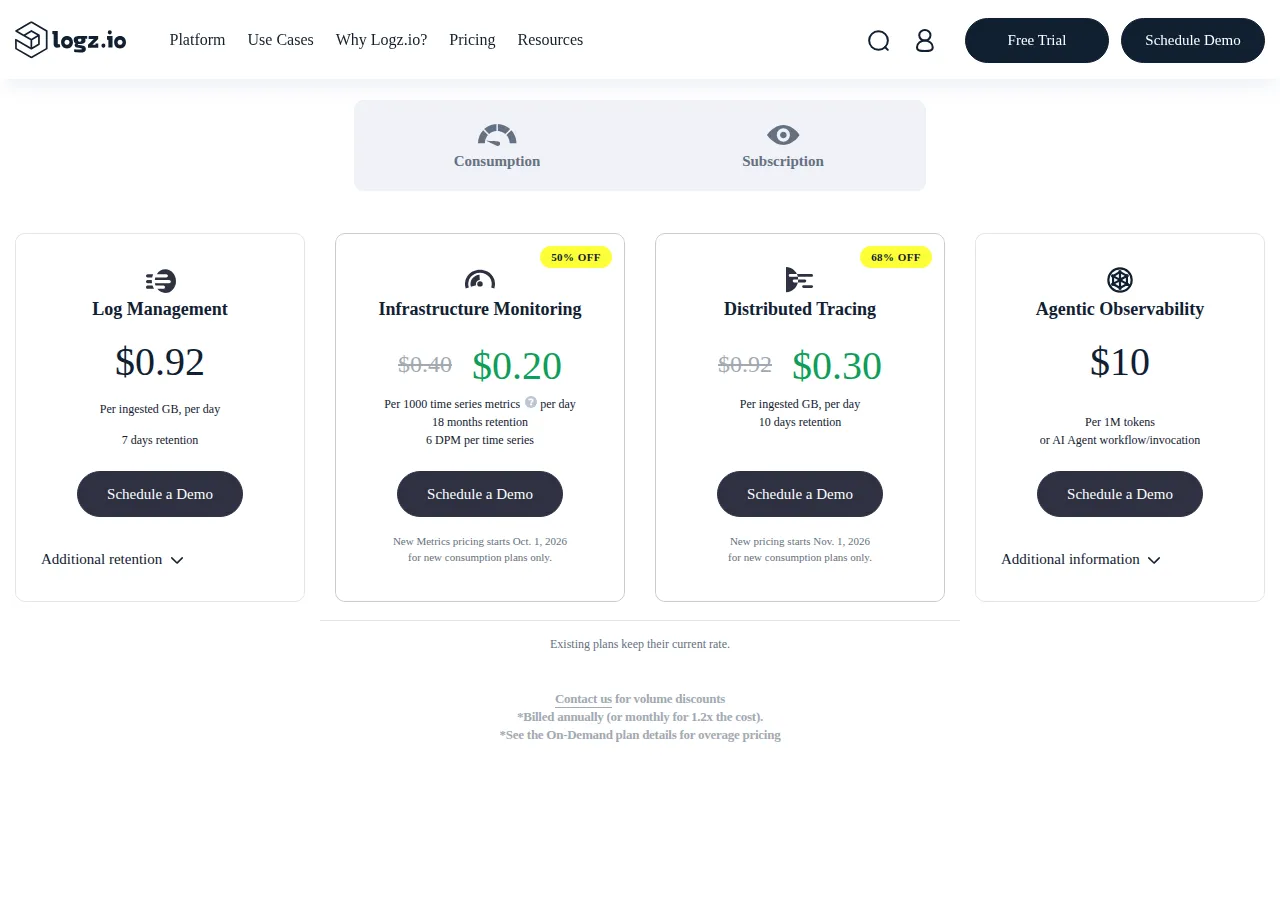
Logz.io's Open 360 platform prices log management at $0.92 per ingested GB, per day, with 7 days of retention included. The "per day" is the billing granularity: the meter runs daily on that day's ingested gigabytes, so a month of 100 GB costs 100 times $0.92, or $92.00. Infrastructure monitoring is priced separately at $0.40 per 1,000 time series metrics per day, and distributed tracing at $0.16 per 1 million spans per day — neither is in the log bill, and a team that buys all three pays three meters.
The retention is where the bill moves. Seven days are included; every day beyond that is an extension priced per gigabyte per day: hot $0.03, warm $0.015, cold $0.001. At 100 GB a month and 30 days of retention, the 23 extra days cost $69.00 hot, $34.50 warm, or $2.30 cold — monthly totals of $161.00, $126.50, and $94.30. The temperature is a query-speed decision, not a storage decision: hot answers in seconds, warm slower, cold is for compliance and rare investigations. A team that buys cold retention and then queries it daily has bought the wrong tier.
Logz.io also runs a promotion worth reading carefully: new consumption plans from November 2026 price distributed tracing at $0.30 per ingested GB per day, down from $0.92 — a 68 percent cut that applies to new plans only. The log rate itself is not discounted. The platform is consumption-based with no seat charge, so the bill scales with data, not headcount.
Sumo Logic: the credit pool
Sumo Logic sells credits, not gigabytes. A credit is a prepaid unit consumed at fixed conversion ratios across logs, metrics, traces, and security features, locked for the contract year. The list price per credit depends on the plan, in US dollars, annual payment, US deployment: Essentials $0.15, Enterprise Operations $0.2125, Enterprise Security $0.225, Enterprise Suite $0.25. Quarterly payment adds a 20 percent uplift, and a Frankfurt or global deployment adds another 20 percent, so an Enterprise Suite customer in Frankfurt paying quarterly pays $0.36 per credit — a 44 percent premium over the US annual baseline.
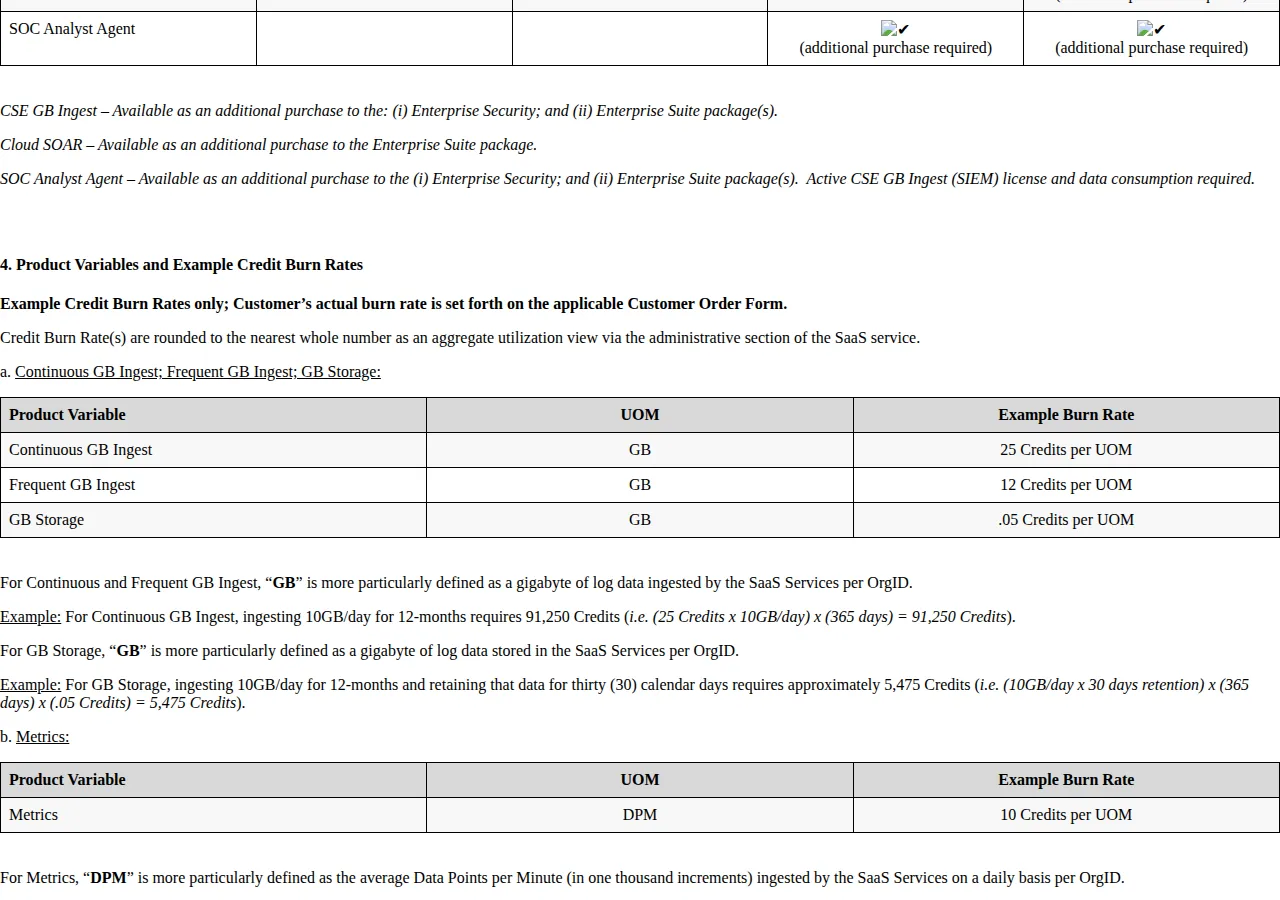
The burn rates are published in Sumo Logic's Cloud Flex Credit schedule, updated June 2026. Continuous GB ingest burns 25 credits per GB, Frequent 12, Infrequent 5, and GB storage 0.05 credits per GB. The schedule's own worked example confirms the arithmetic: ingesting 10 GB a day of Continuous logs for 12 months requires 91,250 credits, and retaining that data for 30 days requires about 5,475 credits.
On the standard workload at Essentials pricing, Continuous ingest costs 100 GB times 25 credits times $0.15, or $375.00 a month. Storage costs 100 GB times 30 days times 0.05 credits times $0.15, or $22.50. The Continuous total is $397.50 a month. Frequent ingest — the tier for logs that are searched occasionally rather than constantly — costs 100 times 12 times $0.15, or $180.00, plus the same $22.50 of storage, for $202.50. Infrequent ingest costs 100 times 5 times $0.15, or $75.00, plus $22.50, for $97.50 — cheaper than Logz.io on cold retention, but Infrequent logs are search-limited by design, and a team that queries them like Continuous logs will find the tier does not do what it needs.
The Flex rail is a different product wearing the same name. On Flex, log ingest is free and unlimited, and the bill is scans: every dashboard refresh, monitor evaluation, ad-hoc search, and Live Tail session consumes scan credits. Sumo Logic's pricing page quotes an estimated $2.05 to $3.14 per TB scanned, depending on the usage-intensity profile, and a mid-range profile runs 750 to 1,500 scans per GB ingested. On the standard workload, 100 GB times 750 scans is 75,000 GB scanned, or 75 TB, which at $3.14 a TB is $235.50 a month; at 1,500 scans a GB it is 150 TB, or $471.00. The Flex range for this workload is therefore roughly $154 to $471 a month before storage, and the scan multiplier is the whole game: a team with five dashboards refreshing every five minutes scans its data far more than a team that searches twice a day.
Elastic Cloud Serverless: the volume scale
Elastic Cloud Serverless Observability comes in two tiers, Logs Essentials and Complete, and bills per gigabyte ingested and per gigabyte retained each month. The rates are tiered by monthly volume, and the tiering is the trap: the pricing page advertises "from $0.07 per GB" for Logs Essentials ingest, but that is the last step of the scale, applying only to gigabytes above 150,000 a month. The first step — the first 1,500 GB each month — costs $0.35 per GB. Retention steps down the same way, from $0.036 per GB-month for the first 10,000 GB-months to $0.0169 above 2.5 million. Complete costs $0.50 per GB for the first 1,500 GB, stepping down to $0.0925, with retention from $0.04 to $0.0188.
On the standard workload, the first-step rates apply, because 100 GB is inside the first 1,500. Logs Essentials costs 100 times $0.35, or $35.00 for ingest, plus 100 times $0.036, or $3.60 for retention, for $38.60 a month. Complete costs 100 times $0.50, or $50.00, plus 100 times $0.04, or $4.00, for $54.00. Complete adds curated analysis of logs, metrics, traces, and synthetic tests, plus service level objectives, AI-assisted parsing, machine learning, and workflow automation — and every Serverless add-on, from synthetic tests to the Elastic Managed LLM, needs a Complete project. Logs Essentials is the right tier only if storing and analysing logs is the whole job.
Two costs sit outside the per-gigabyte rates. Search is billed in virtual compute units: search VCUs from $0.09 an hour, ingest VCUs from $0.14 an hour, ML VCUs from $0.07 an hour, with rates varying by region. A team that queries heavily pays for search on top of the $38.60, and the pricing page does not state how many VCU-hours a typical query load consumes — budget it as a variable, not as zero. Egress costs $0.05 per GB after the first 50 GB free. Elastic Cloud Hosted, the provisioned alternative, bills RAM-hours instead of gigabytes — $0.0282 per GB-hour on Standard in AWS us-east-1, tiers from $99 a month — which the Elasticsearch vs OpenSearch vs Algolia pricing playbook prices in full.
What the meter hides
The three vendors hide different costs, and the hiding place is the decision. Logz.io hides the retention extension: the $0.92 headline buys 7 days, and a 30-day policy costs 75 percent more on hot retention. Sumo Logic hides the scan: the $0 ingest headline on Flex buys a bill that grows with every dashboard refresh, and the credit price itself grows 44 percent with the wrong region and payment cadence. Elastic hides the volume step: the "from $0.07" headline buys $0.35 at the volumes a small team actually ingests, and the search VCU is an unpriced variable on top.
Scale the workload tenfold and the ranking barely moves. At 1,000 GB a month with 30-day retention, Logz.io costs $920.00 for ingest plus $690.00 of hot extension, or $1,610.00. Sumo Logic Continuous costs $3,750.00 plus $225.00 of storage, for $3,975.00. Elastic Logs Essentials costs $350.00 plus $36.00 of retention, for $386.00 — still inside the first 1,500 GB step. The per-gigabyte meter wins at every volume in this range. The ranking flips only when the workload changes shape: a team that queries rarely and stores mostly cold data pays Logz.io $94.30 at 100 GB, and a team that needs the SIEM and AI bundle pays Sumo Logic Enterprise Suite whatever the meter says.
| Profile | Best fit | Monthly cost at 100 GB | Why |
|---|---|---|---|
| Small team, daily queries, 30-day retention | Elastic Logs Essentials | $38.60 | Lowest per-GB ingest and retention; no seat charge |
| Compliance-first, rare queries, cold storage | Logz.io, cold retention | $94.30 | Cheapest cold extension at $0.001 per GB per day |
| Occasional search, predictable bill | Sumo Logic Frequent | $202.50 | Fixed credit burn, no scan surprises |
| SIEM-led, AI investigation | Sumo Logic Enterprise Suite | $662.50 | AI investigation and SIEM bundle; Continuous + storage at $0.25 per credit |
| Full observability suite, not logs only | Datadog / Grafana / New Relic | See suite playbook | Per-host and per-series meters, different decision |
Founder & CEO Insight — Enow A. Jovial
The switch checklist
The switch itself is a data-migration project, and the migration cost is the cost the comparison leaves out. Logs are append-only, and moving 30 days of history means re-ingesting it, which the new vendor bills as fresh ingest — $0.92 a gigabyte on Logz.io, $0.35 on Elastic Serverless. Budget the migration as one month of ingest on the new meter, during a low-volume window, with the old platform still running as the fallback.
- [x] Step 1 — Measure the real workload for two weeks: gigabytes ingested per day, retention the compliance policy requires, and the number of scheduled searches and dashboard refreshes per day.
- [x] Step 2 — Price all three meters on the measured workload: ingest, retention by temperature, and the query cost — scans on Sumo Flex, search VCUs on Elastic, re-ingest on Logz.io.
- [x] Step 3 — Read the "from" rate as a volume step, not a price: confirm which step the measured volume falls in, in writing, before signing.
- [x] Step 4 — Test the tier the team will actually use: run Frequent, not Continuous, if the team searches occasionally; run cold retention only if the team queries it rarely.
- [x] Step 5 — Confirm the per-credit rate on the order form: region and payment cadence move Sumo Logic's rate up to 44 percent above the US annual baseline.
- [x] Step 6 — Migrate once, with the old platform as fallback: re-ingest 30 days of history during a low-volume window and keep the old platform until the new alerts fire correctly.
The suite decision is separate from the log decision. If the team needs metrics, traces, and logs on one bill, the Datadog vs Grafana Cloud vs New Relic playbook prices the three suites on the same workload, and the Sentry vs Rollbar vs Bugsnag playbook prices error tracking for the team that only needs to know when the application breaks. Price the log meter with the pricing calculator before the trial ends.