Kong vs Apigee vs AWS API Gateway: API Management Pricing Playbook
Kong vs Apigee vs AWS API Gateway: API Management Pricing Playbook
An API gateway is the front door to everything a company sells over HTTP: it checks the API key or token, enforces the rate limit, and routes the call. At 10 million calls a month, the cheapest of Kong Konnect, Google Cloud Apigee, and Amazon API Gateway costs $13.60 and the most expensive $1,850. The gap is the pricing model: AWS sells raw calls, Apigee sells calls plus a rented environment, Kong sells a small bundle with a steep per-million overage.
This playbook prices all three from the vendors' own pricing pages, opened 12 November 2026, and works the monthly bill at 10 million, 100 million, and 1 billion calls, arithmetic shown. The same method runs through the cloudflare-vs-fastly-vs-aws-cloudfront-cdn-pricing-latency-playbook and the aws-lambda-vs-google-cloud-functions-vs-azure-functions-serverless-pricing; the supabase-vs-firebase-vs-planetscale-backend-platform-pricing covers the backend layer behind the gateway.
Step 1: the three pricing models, side by side
| Vendor | Unit | Headline rate | Free allowance |
|---|---|---|---|
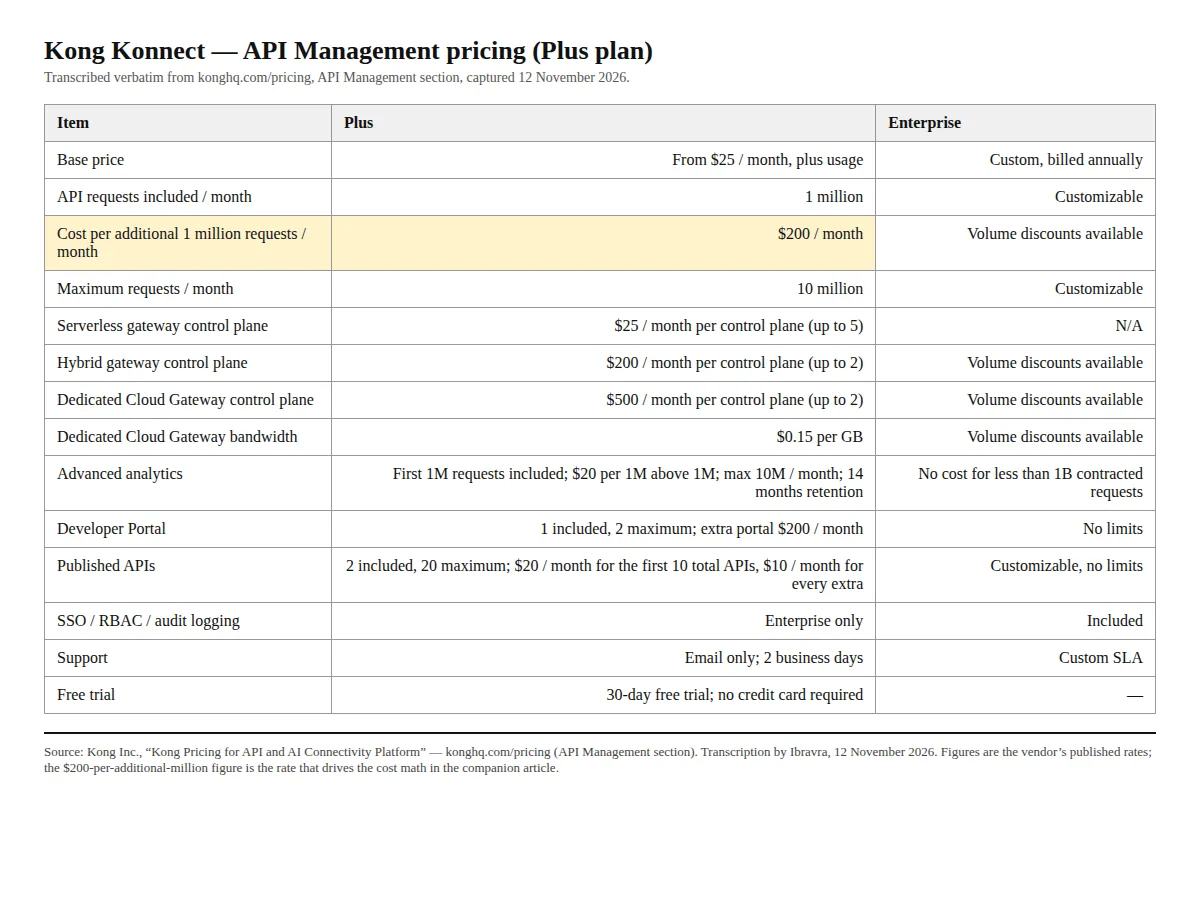
| Kong Konnect Plus | API requests | $200 per additional 1M / month | 1M requests / month |
| Apigee, Standard proxy | API calls | $20 / 1M to 50M, $16 to 500M, $13 above | 60-day evaluation sandbox |
| Apigee, Extensible proxy | API calls | $100 / 1M to 50M, $80 to 500M, $64 above | 60-day evaluation sandbox |
| AWS API Gateway, REST | API calls | $3.50 / 1M first 333M, $2.80 next 667M, $2.38 next 19B | 1M calls / month, 12 months, new accounts |
| AWS API Gateway, HTTP | API calls | $1.00 / 1M first 300M, $0.90 above | 1M calls / month, 12 months, new accounts |
Three facts jump out. The per-call spread is 57 to 1: Kong's $200 per million against AWS REST's $3.50. Kong and Apigee charge for the platform around the calls, while AWS charges nothing until a call arrives — and only AWS publishes a rate falling with volume all the way to a billion calls.
Step 2: Kong Konnect Plus — the $200-per-million problem
Kong's pricing page lists Konnect Plus from $25 a month, plus usage, 30-day free trial, no credit card. The base buys the control plane and 1 million API requests a month; every million after the first costs $200. The plan caps at 10 million requests a month; past that, the page says only "customizable" and points at custom-priced Enterprise, billed annually.
The gateway is priced separately: serverless $25 a month (up to 5, no SLA); hybrid $200 a month (up to 2, self-managed SLA); Dedicated Cloud Gateway $500 a month (up to 2) plus $0.15 per GB, 99.99% SLA. Konnect as a whole carries a 99.9% target availability per calendar month.
Then the metered extras: advanced analytics includes the first 1 million requests a month and charges $20 per million above that, capped at 10 million, 14 months of retention. The developer portal includes 1 portal (2 maximum); an extra $200 a month. Published APIs are 2 included, 20 maximum. Metering costs $20 per million ingested events; billing takes 0.4% of volume up to $250,000. Single sign-on (SSO), role-based access control (RBAC), and audit logging are Enterprise only; Plus support is email only.
The monthly bill for a Plus customer on one serverless control plane, analytics included:
where $V$ is millions of calls a month, the last term the analytics overage. At 10 million calls that is $25 + $25 + 9 \times \$200 + 9 \times \$20 = \$2,030$ a month — $185 per million calls before analytics, $203 with it. At 1 million calls the bill is $50, already fourteen times the AWS REST rate. The marginal million always costs $200, and the plan ends at 10 million.
Step 3: Apigee — the environment is the bill
Apigee's pay-as-you-go pricing has two moving parts: the per-call rate, which depends on the proxy type, and the environment rent, which depends on the tier. The Standard API proxy is a lightweight proxy with a subset of Apigee's policies, priced at $20 per million calls up to 50 million, $16 from 50 to 500 million, $13 above 500 million. The Extensible API proxy is the fully programmable proxy, priced at $100, $80, and $64 per million across the same tiers — exactly five times the Standard rate at every tier. Choosing the proxy type is the single largest cost decision on Apigee.
The environment rent is what makes Apigee expensive at low volume. A Base environment costs $365 a month per region, allows Standard proxies only, and caps at 50 queries per second (QPS), 99% SLA. An Intermediate environment costs $1,460 a month per region, allows Standard or Extensible proxies, caps at 100 QPS, 99% SLA. A Comprehensive environment costs $3,431 a month per region, autoscales QPS, and carries a 99.9% SLA in one region and 99.99% in two; extra deployments cost $0.04 an hour per region, Comprehensive only.
The QPS caps decide which environment a workload can run in: 10 million calls a month averages 3.9 requests a second — Base fits. One hundred million averages 38.6 a second — inside Base's 50 QPS on average, but any peak above it breaches the tier, so a real workload buys Intermediate. One billion averages 385.8 a second and needs Comprehensive. The tier follows the peak.
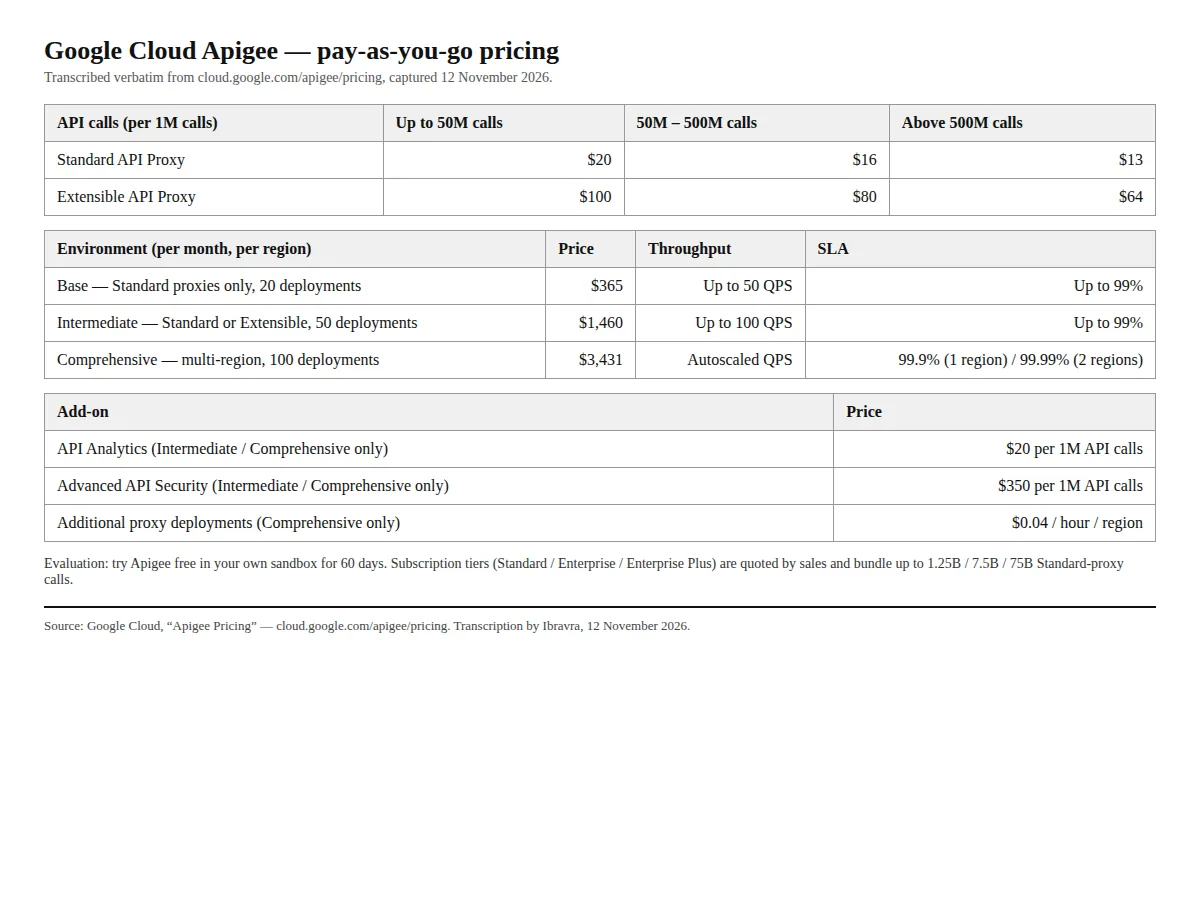
The add-ons are priced per million calls and can dwarf the base rate. API Analytics costs $20 per million calls, only in Intermediate or Comprehensive environments. Advanced API Security costs $350 per million calls — more than seventeen times the Standard proxy rate; at 10 million calls a month it adds $3,500 to a $565 bill.
Step 4: AWS API Gateway — the cheapest call, with two APIs inside
AWS sells three API types under one name; the type choice is a 3.5-to-1 cost decision. REST APIs cost $3.50 per million for the first 333 million requests a month, $2.80 for the next 667 million, and $2.38 for the next 19 billion. HTTP APIs cost $1.00 per million for the first 300 million and $0.90 above that. WebSocket APIs cost $1.00 per million messages for the first 1 billion, plus $0.25 per million connection minutes. There are no minimum fees and no upfront commitments. Data transfer out is $0.09 per GB on top; an optional REST cache runs $0.038 an hour for 1.6 GB.
The tier rates are the rates AWS itself uses in the worked examples on its own pricing page — its price-table cells render client-side, so this playbook verified them against the examples and against independent 2026 pricing guides, which agree. AWS's examples reproduce exactly: 5 million REST calls cost $17.50 plus $1.29 of transfer, $18.79 in total; 432 million HTTP calls cost $418.80.
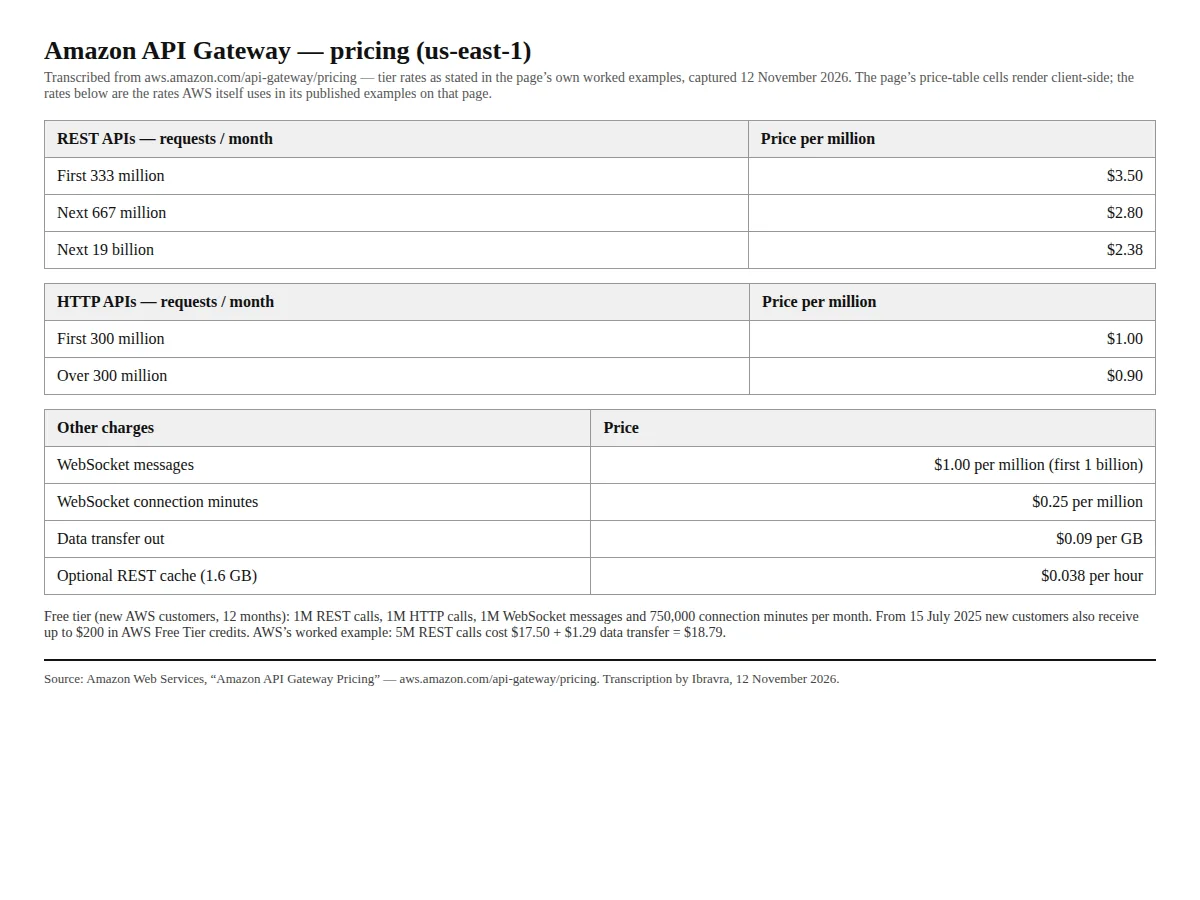
Two metering details decide real bills. HTTP APIs are metered in 512 KB increments, so a call with a 2 MB response counts as four requests — past about 1.5 MB per call, the cheap option becomes the expensive one. The free tier softens the first year for new accounts: 1 million REST calls, 1 million HTTP calls, 1 million WebSocket messages, 750,000 connection minutes a month for 12 months, plus up to $200 in Free Tier credits for accounts created from 15 July 2025. Request validation, usage plans, API keys, AWS WAF integration, and private VPC endpoints are REST-only — but a team defaulting to REST pays $2.50 per million requests it did not need, for as long as the API lives.
Step 5: the monthly bill at 10M, 100M, and 1B calls
The workload, stated as an assumption: a single-region JSON API, 4 KB average response, no caching, no add-ons, steady state after the free tier expires. Data transfer out is 40 GB at 10 million calls, 400 GB at 100 million, 4,000 GB at 1 billion, at $0.09 a GB — $3.60, $36, $360 a month on AWS. Apigee's networking is billed separately on Google Cloud rates and is excluded below.
| Monthly volume | AWS REST | AWS HTTP | Apigee Standard | Kong Konnect Plus |
|---|---|---|---|---|
| 10M calls | $38.60 ($3.86 / M) | $13.60 ($1.36 / M) | $565 ($56.50 / M) | $1,850 ($185 / M) |
| 100M calls | $386 ($3.86 / M) | $136 ($1.36 / M) | $3,260 ($32.60 / M) | No published price (Plus cap 10M) |
| 1B calls | $3,393.10 ($3.39 / M) | $1,290 ($1.29 / M) | $18,131 ($18.13 / M) | No published price (Plus cap 10M) |
The Apigee totals are call charges plus the smallest environment carrying the average load: $200 in calls plus $365 Base at 10 million; $1,800 plus $1,460 Intermediate at 100 million; $14,700 plus $3,431 Comprehensive at 1 billion. The Kong total at 10 million is the $25 base, one $25 serverless control plane, and 9 million overage calls at $200 — $2,030 with analytics. The Extensible proxy multiplies Apigee's call charges by five: $1,365, $10,460, and $76,431 a month.
Step 6: the crossover points, and who should buy what
The crossover between Kong and Apigee sits inside the range a small API actually lives in. Kong Plus costs $50 plus $200 per million above the first; Apigee Standard pay-as-you-go costs $365 plus $20 per million:
Below about 2.86 million calls a month, Kong Plus is cheaper than Apigee Standard — Apigee's $365 environment floor dominates. Above it, Apigee is cheaper and the gap widens fast: $565 against $1,850 at 10 million calls. Neither ever catches AWS: Kong's marginal million costs $200 against AWS REST's $3.50, Apigee's cheapest $13 against the same $3.50.
| Attribute | Kong Konnect Plus | Apigee pay-as-you-go | AWS API Gateway | Authority |
|---|---|---|---|---|
| Cheapest per call | $185 / M at 10M calls | $56.50 / M at 10M calls | $3.86 / M REST, $1.36 / M HTTP at 10M | Vendor pages |
| Published ceiling | 10M calls / month | None (to 75B on subscription) | None (to 20B+) | Vendor pages |
| Auth & rate limiting | JWT, API key, OAuth 2.0 plugins | API keys, OAuth 2.0, JWT policies | API keys, usage plans, IAM, Cognito | Vendor docs |
| Free tier | 30-day trial, no card | 60-day evaluation sandbox | 1M calls / month, 12 months | Vendor pages |
| SLA | 99.9% Konnect; 99.99% Dedicated | 99% Base / Intermediate; 99.9%–99.99% Comprehensive | 99.95% monthly uptime | Vendor pricing pages / AWS SLA |
Buy AWS API Gateway when the API is a front door and nothing more — as HTTP, not REST, unless it needs request validation, WAF, or private endpoints. Buy Apigee when the program needs the platform: API products, a developer portal, monetisation, analytics with 14 months of retention. Buy Kong Konnect when the gateways must run in your own cloud or on premises under one control plane — on Enterprise, not Plus, once the forecast passes 10 million calls.
The build operation: choosing, migrating, validating
- Measure the real workload for two weeks: calls a month, peak requests a second, average response size, the share needing validation, WAF, or private endpoints.
- Price all three vendors at the measured volume and at twice it, using the Step 5 formulas. Cheapest today, capped tomorrow, is a migration in six months.
- Check the ceilings, not the rates alone: Kong's 10-million Plus cap, Apigee's 50 and 100 QPS caps, the AWS REST features the workload needs.
- Trial on the free tier: Kong's 30-day trial, Apigee's 60-day sandbox, or a new AWS account's 12-month free tier. Put real traffic through it — that is where the add-ons show up.
- Migrate one API, not the program: stand the new gateway beside the old one, cut 5% of traffic over, check the first invoice against the Step 5 math.
- Validate the bill: confirm the per-million rate, the environment or control-plane charge, every add-on line. An unordered add-on on the invoice is the leak.
- Lock the decision in writing: the chosen vendor, the revisit volume, the exit plan. Re-price every quarter; vendor rate cards change.
Founder & CEO Insight — Enow A. Jovial