The IRS will not talk to your CPA about your audit until you file one form. Form 2848, Power of Attorney and Declaration of Representative, turns a hired professional into your voice before the Service: the person named on it may inspect and receive your confidential tax information and perform every act you could perform for the matters and years you list. Without it, the most expensive adviser in the room is a spectator.
The three authorizations: 2848, 8821, and 56
Founders pick the wrong authorization constantly. The IRS lists four: representation; appointing anyone to review or receive confidential tax information; designating a person on a tax form to discuss that return and year; or authorizing disclosure to a person brought into a call about a specific issue.
| Authorization | What the designee may do | Who may be named |
|---|---|---|
| Form 2848 — Power of Attorney | Represent, advocate, and sign on your behalf; inspect and receive confidential tax information | One eligible individual |
| Form 8821 — Tax Information Authorization | Inspect and/or receive confidential information for the tax types and years listed — nothing more | Any individual, firm, or organization |
| Form 56 — Fiduciary Relationship | Notify the IRS that a fiduciary stands in the taxpayer's position — the trustee signs the 2848 | Trustee, executor, administrator, receiver, or guardian |
Form 8821 is for those who need to see the numbers but must never speak for you: a lender verifying income or a buyer doing diligence. The designee may not speak on your behalf, disclose return information to another third party, advocate your position, or execute waivers, consents, or closing agreements — and may never endorse or negotiate your refund check or receive your refund by direct deposit. Section 6103(c) limits how that information may be disclosed or used, with a private right of action for unauthorized use.
Who may sign for you: the designation ladder
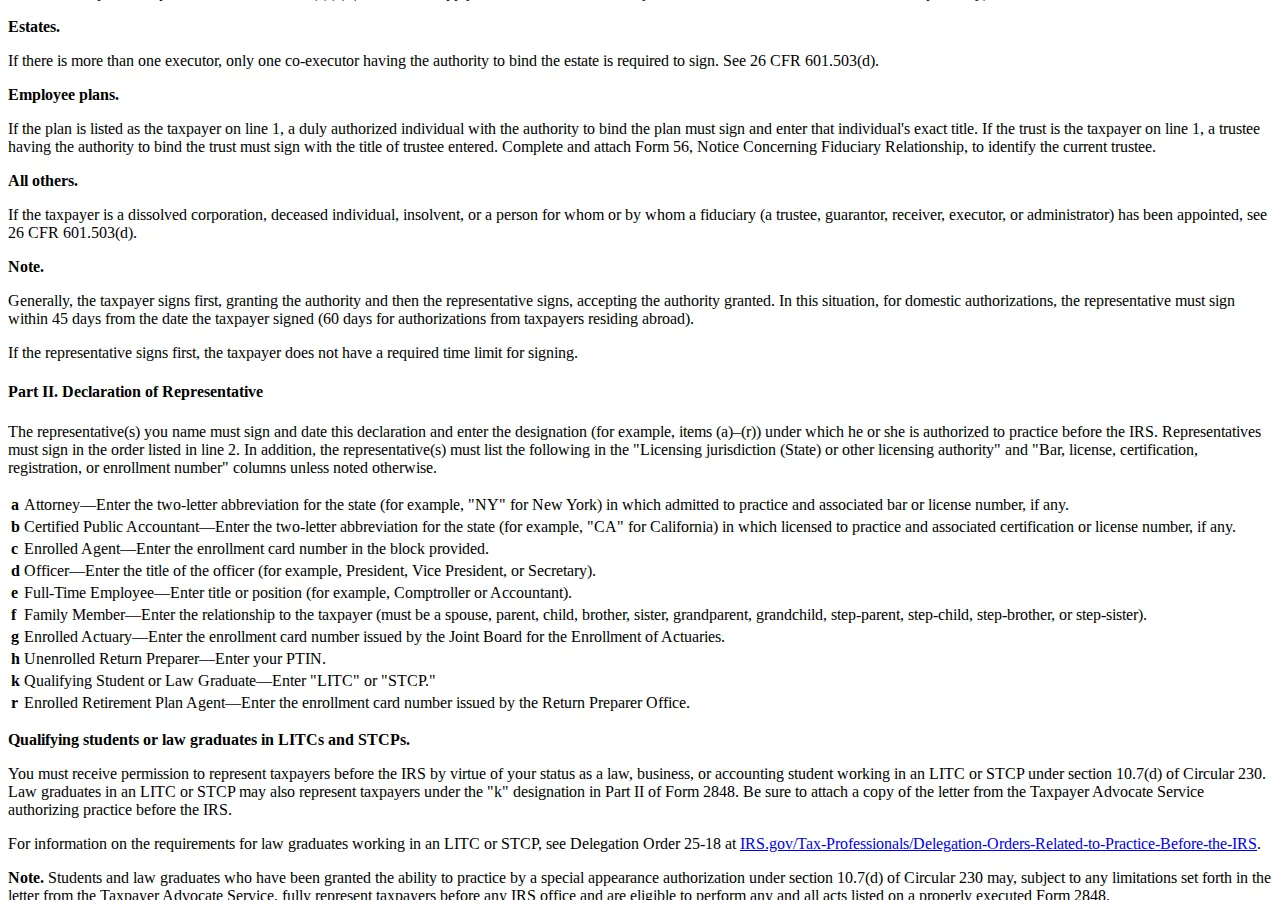
The individual you authorize must be eligible to practice before the IRS.
| Designation | Who qualifies — and what to enter |
|---|---|
| (a) Attorney | Admitted to practice before a state bar — state and bar number |
| (b) Certified Public Accountant | Licensed CPA — state and license number |
| (c) Enrolled Agent | Enrolled to practice before the IRS — enrollment number |
| (d) Officer | Officer of the taxpayer entity — title, for example President or Secretary |
| (e) Full-Time Employee | Full-time employee of the taxpayer — title, for example Comptroller |
| (f) Family Member | Spouse, parent, child, sibling, grandparent, grandchild, or step-relative |
| (g) Enrolled Actuary | Enrolled by the Joint Board for the Enrollment of Actuaries |
| (h) Unenrolled Return Preparer | Paid preparer without an (a)–(c) credential |
| (k) Qualifying Student or Law Graduate | Law, business, or accounting student in an LITC or STCP |
| (r) Enrolled Retirement Plan Agent | Enrolled by the Return Preparer Office |
Two designations carry limits that decide real cases. The unenrolled return preparer may represent a taxpayer only before revenue agents or customer service representatives during an examination of the tax period covered by the return that preparer prepared and signed — never before appeals officers, revenue officers, or Chief Counsel attorneys, and never to execute closing agreements, extend the assessment or collection period, or execute waivers or refund claims. The preparer must hold a valid active PTIN and, for returns prepared and signed after December 31, 2015, an Annual Filing Season Program Record of Completion. A preparer who fails any of those tests can still be given an 8821.
The student designation is narrower still: a law, business, or accounting student may practice only by special appearance under Circular 230 section 10.7(d), in a Low Income Taxpayer Clinic or Student Tax Clinic Program, and the CAF purges that practitioner 130 days after the taxpayer's signature:
A clinic case that runs past that date needs a fresh authorization. Any individual may also represent a taxpayer outside the United States.
Foreign-owned US entities meet this form constantly: a nonresident owner who cannot take the IRS call appoints a US representative. Our Form 5472 guide for foreign-owned LLCs runs the filing that creates the exposure; our W-9 vs W-8BEN contractor playbook decides which form collects the payee; and our 1099-NEC contractor reporting playbook runs the January 31 deadline the representative will be asked about.
The CAF: the nine-digit key
Every power of attorney that is not marked for a specific use is recorded on the Centralized Authorization File, the CAF — the IRS database that lets any assistor verify the person on the phone is authorized to hear your private tax information. Enter the nine-digit CAF number for each representative on line 2; if the IRS has not assigned one, enter "None." The CAF number is a unique nine-digit identification number — not the SSN, EIN, PTIN, or enrollment card number. If your representative cannot remember the number, the Practitioner Priority Service at 866-860-4259 will retrieve it.
Filing through a Tax Pro Account is the speed play the instructions now lead with: most requests record immediately to the CAF. The alternative is paper — mail or fax to the CAF unit.
Line by line: what each line does
Line 1 names the taxpayer and its identification number (SSN, ITIN, or EIN); line 2 names each representative with the CAF number, address, telephone, and fax. Line 3 is the heart of the form: the tax matters, with the type of tax, the federal tax form number, and the year or years or period or periods.
A 2848 that lists "Income, Form 1120, 2024" does not authorize anyone to answer a 2025 employment-tax notice or a civil penalty not related to a return. Where the penalty or payment is not related to a return, name it on line 3 — "Civil Penalty" with the description.
Line 4 is the specific-use switch: check the box if the power of attorney is for a specific use or issue that the IRS will not record on the CAF, and mail or fax the form to the IRS office handling the matter — not to a CAF unit.
Line 5a adds powers the default grant does not include: substitute or add another representative; execute consents allowing the IRS to disclose your return or return information to a third party; sign your income tax return, with the statement that the power of attorney is being filed under 26 CFR 1.6012-1(a)(5), which requires a power of attorney to be attached to a return signed by an agent; sign Form 907; and access your IRS records through an Intermediate Service Provider. Line 5b lists the acts the representative is not authorized to perform.
A new CAF-recorded power of attorney will generally revoke any earlier power of attorney recorded on the system for the same matter. If you do not want to revoke an existing power, check the box on line 6 and attach a copy of the prior power of attorney. Filing a Form 2848 will not revoke any Form 8821 that is in effect, but a new 8821 automatically revokes prior 8821s unless copies are attached.
Line 7 is the taxpayer declaration and signature, and it is where the form fails most often. The taxpayer — or the person authorized to sign for an entity: corporate officer, partner, guardian, executor, receiver, administrator, or trustee — must sign and date. Handwrite your signature if you file by mail or by fax; digital, electronic, or typed-font signatures are not valid.
Where to file: the three CAF units
The Where To File chart in the instructions routes every paper filing to one of three CAF units by the taxpayer's residence. The addresses and fax numbers are current in the September 2021 instructions — check IRS.gov/Form2848 before you fax.
| If you live in... | Mail or fax to... | Fax number |
|---|---|---|
| AL, AR, CT, DE, DC, FL, GA, IL, IN, KY, LA, ME, MD, MA, MI, MS, NH, NJ, NY, NC, OH, PA, RI, SC, TN, VT, VA, or WV | Internal Revenue Service, 5333 Getwell Road, Memphis, TN 38118 | 855-214-7519 |
| AK, AZ, CA, CO, HI, ID, IA, KS, MN, MO, MT, NE, NV, NM, ND, OK, OR, SD, TX, UT, WA, WI, or WY | Internal Revenue Service, 1973 Rulon White Blvd., Ogden, UT 84201 | 855-214-7522 |
| APO and FPO addresses, American Samoa, the Northern Mariana Islands, Guam, the U.S. Virgin Islands, Puerto Rico, a foreign country, or otherwise outside the United States | Internal Revenue Service, International CAF Team, 2970 Market Street, Philadelphia, PA 19104 | 855-772-3156 (outside the US: 304-707-9785) |
A form filed by mail or fax needs a handwritten signature — no typed name, no electronic signature, no digitized image. A form submitted online through a Tax Pro Account may carry an electronic signature: a typed name, a scanned image of a handwritten signature, a signature on an electronic pad, a stylus input, or third-party software. When the taxpayer signs electronically in a remote transaction and a third party submits the form, the third party must attest that it authenticated the taxpayer's identity: inspect a valid government-issued photo ID, compare the photo through a self-taken picture or video conference, record the name, SSN or ITIN, address, and date of birth, and verify them through secondary documentation. For a business entity, confirm the signing individual's authority and verify the entity's name, EIN, and address through secondary documentation. The one exception is personal knowledge — a previous business relationship, an immediate family member, or an employer-employee relationship.
Revocation and withdrawal: ending it in writing
A power of attorney stays in effect until you revoke the authorization or your representative withdraws it. To revoke, write "REVOKE" across the top of the first page with a current signature and date, then mail or fax a copy to the CAF unit. If you do not have a copy, send the IRS a statement of revocation that says the authority is revoked, lists the matters and years, and names each representative whose authority is revoked. To withdraw, the representative writes "WITHDRAW" across the top of the first page with a current signature and date and provides a copy to the CAF unit.
A new CAF-recorded 2848 generally revokes an earlier one for the same matter. A specific-use 2848 revokes nothing on the CAF. And a new 8821 automatically revokes prior 8821s unless copies are attached, while a new 2848 leaves 8821s untouched — each authorization family is its own stack.
Founder & CEO Insight — Enow A. Jovial
The filing sequence
- Pick the representative and the designation.
- Get the CAF number — ask the representative, or enter "None".
- Write line 3 exactly: the tax type, the form number, and every year or period the matter touches, checked against the notice.
- Decide lines 4, 5a, 5b, and 6 before you sign.
- Choose the channel: Tax Pro Account online, or paper to the correct CAF unit with a handwritten signature.
- Confirm it recorded: have the representative call the Practitioner Priority Service and verify the CAF record before the first substantive call with the IRS.
Operator checklist
- [x] Representative eligible to practice under a Part II designation.
- [x] CAF number entered or "None" — never an SSN, EIN, PTIN, or enrollment card number in its place.
- [x] Line 3 covers the notice — tax type, form number, and every year or period.
- [x] Line 4 decision made — specific use goes to the handling office.
- [x] Line 5a powers granted deliberately — substitute or add, third-party disclosure, return signing, Form 907 — and line 5b restrictions.
- [x] Line 6 checked with copies attached if a prior power must survive.
- [x] Correct CAF unit and fax number verified at IRS.gov/Form2848 before faxing.
- [x] Handwritten signature on paper filings; electronic signature only online.
- [x] Revocation diary set for the day a representation ends.
A power of attorney is a small form with an outsized blast radius: it decides who may hear your tax information, who may sign your name to an agreement with the United States, and who keeps that power until you take it back. File it deliberately, keep the CAF record current, and revoke it the day it stops being true. Before you price the representation, run the numbers through our Self-Employed Tax & Quarterly Estimator.