The 30% that leaves before you are paid
A foreign founder earns $10,000 in US-source royalties. The US payer sends $7,000. The missing $3,000 is not a fee and not a mistake: it is the 30% withholding tax on fixed or determinable annual or periodical income — FDAP — that section 1441 of the Internal Revenue Code imposes on foreign persons, collected by the payer before the money moves. The payer is the withholding agent, and it is liable for the tax if it fails to withhold.
Form W-8BEN is the document that changes the rate. It is one page, three parts, one signature, and it does three jobs at once: it establishes that you are not a US person, it claims that you are the beneficial owner of the income, and, where a treaty applies, it claims a reduced rate of withholding. With a valid form on file, the payer withholds the treaty rate instead of 30%. Without one, it withholds 30% of the gross amount — not of the profit, of the gross.
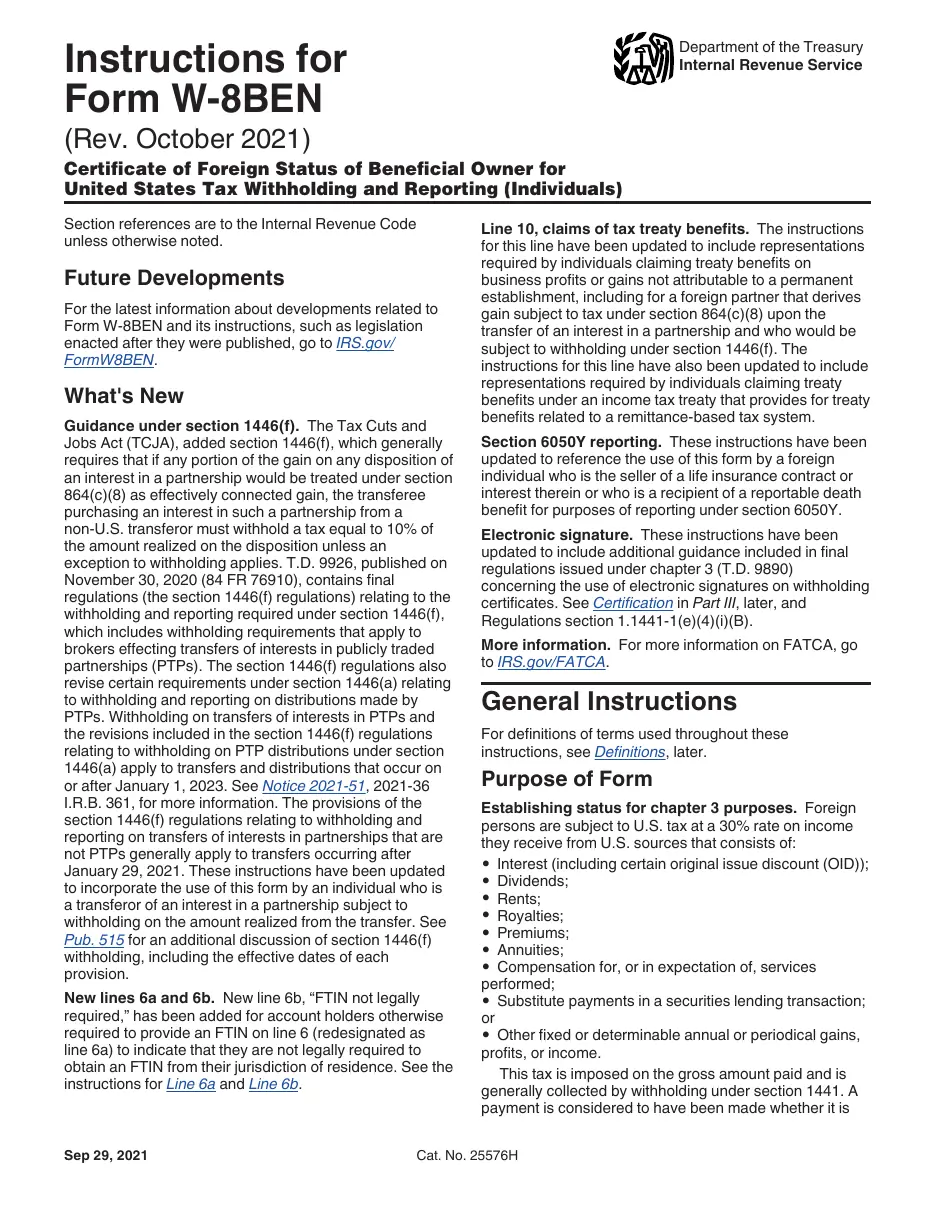
The instructions print the rule in the Purpose of Form section: foreign persons are subject to US tax at a 30% rate on income from US sources that consists of interest, dividends, rents, royalties, premiums, annuities, compensation for services, substitute payments, or other fixed or determinable annual or periodical gains, profits, or income.
What the form certifies, and who it is for
The form is for a nonresident alien individual who is the beneficial owner of an amount subject to withholding, or an account holder of a foreign financial institution documenting as a nonresident alien. Submit it when requested whether or not you claim a reduced rate.
Beneficial owner is a term of art: generally the person required under US tax principles to include the payment in gross income. A nominee, agent, or custodian is not a beneficial owner, and neither is a conduit whose participation in a transaction is disregarded. Foreign partnerships, foreign simple trusts, and foreign grantor trusts are not the beneficial owners of income paid to them — the partners or beneficiaries are. The case founders get wrong most often is the single-member LLC: if you are the single owner of a disregarded entity, you are the beneficial owner of income received by that entity, and you complete the W-8BEN in your own name. The LLC does not file it. Our Form W-7 ITIN playbook covers the number for Line 5; the EIN vs ITIN vs SSN playbook maps person-number vs company-number.
The form goes to the payer, not the IRS
Give Form W-8BEN to the withholding agent or payer before income is paid or credited to you, or before it is allocated if you are a partner. Do not send it to the IRS: the Service never sees the form, and the payer is the only party that can act on it.
A separate form generally goes to each withholding agent. If one payer sends you several types of income at different treaty rates, that payer may require a separate form for each type. If you own the income jointly with others, the agent treats it as foreign-owned only if every owner provides a Form W-8BEN or W-8BEN-E; a Form W-9 from any joint owner makes the payment US-person income.
Who files a different form
Filing the wrong W form is the fastest route to the default 30%.
| Your situation | File this | Why the W-8BEN is wrong |
|---|---|---|
| Foreign entity (corporation, partnership, trust) claiming treaty benefits or documenting status | Form W-8BEN-E | The W-8BEN is for individuals only |
| US citizen or other US person, including a resident alien | Form W-9 | A US person documents with a W-9, never a W-8 |
| Foreign intermediary, agent, nominee, or custodian acting for others | Form W-8IMY | You are not the beneficial owner |
| Nonresident alien claiming exemption on compensation for personal services performed in the US | Form 8233 or Form W-4 | Personal-services treaty claims run through Form 8233 |
| Income effectively connected with a US trade or business | Form W-8ECI | ECI is withheld under a different regime; if certified income becomes effectively connected, the W-8BEN stops being valid for it |
| Trustee of a foreign trust | Form W-8BEN-E or W-8IMY | A trustee files for the trust, not as an individual beneficial owner |
Line by line: the three parts
Part I identifies the beneficial owner. Line 1 is your legal name as it appears on your passport. Line 2 is your country of citizenship. Line 3 is your permanent residence address, a physical street address: a P.O. box gets the form flagged as invalid, and a registered agent or virtual office address is not a residence. Line 4 is a mailing address, only if it differs. Line 5 is your US taxpayer identification number, an ITIN or an EIN; blank usually blocks the treaty rate. Line 6a is your foreign tax identifying number; Line 6b, new in the October 2021 revision, is the box for when you are not legally required to obtain one.
Part II is the treaty-benefits claim, and it is where most forms fail. Line 9 names the country. Line 10 names the treaty article, the rate you claim, and the type of income — the instructions now also require representations for business profits not attributable to a permanent establishment and for partnership-interest transfer gains under section 864(c)(8). A claim without its article is not a claim: the payer cannot verify a rate from a country name alone. For 0% on UK royalties, Line 10 says United Kingdom, Article 12, 0%, royalties. For 15% on Canadian dividends, it says Canada, Article X, 15%, dividends. A wrong article number is a rejected form.
Part III is the certification, and the signature is what makes the form operative. You certify under penalties of perjury that you are the beneficial owner (or are authorized to sign for the beneficial owner), that you are not a US person, and that the treaty claim, if any, is correct. Electronic signatures are permitted under Regulations section 1.1441-1(e)(4)(i)(B) — but a signature is required: an unsigned W-8BEN is not a withholding certificate.
The treaty rates, worked
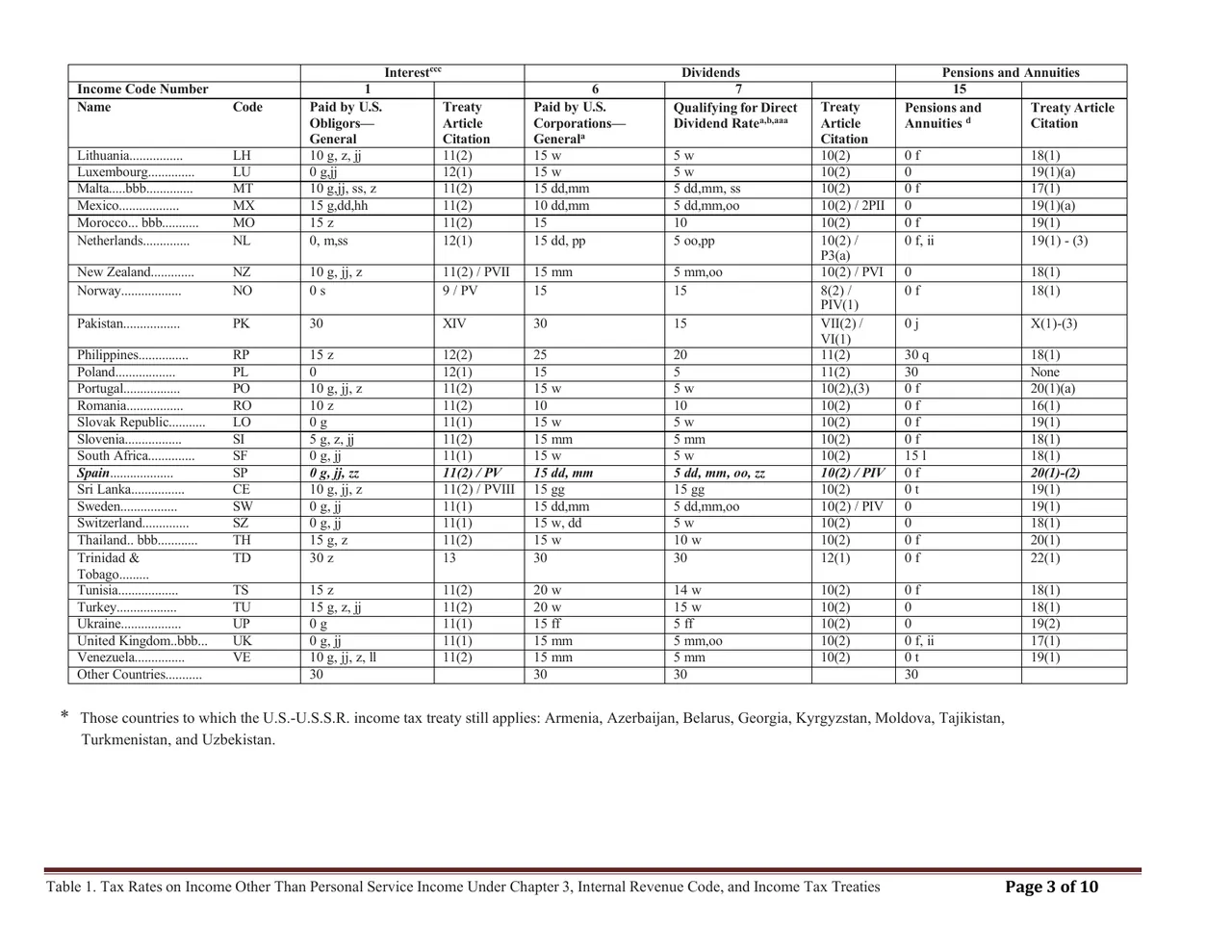
The treaty is where the money is. The IRS publishes the rates in Tax Treaty Table 1, revised May 2023: the rate on interest, on dividends in general, on dividends at the direct-dividend rate, and on royalties by type, with the treaty article beside each rate. The direct-dividend rate belongs to a company that owns a threshold share of the payer — usually 10% of the voting stock. An individual shareholder never gets it.
| Treaty country | Dividends, general | Dividends, direct (company, 10%+ voting stock) | Interest | Royalties | Authority |
|---|---|---|---|---|---|
| United Kingdom | 15% | 5% | 0% | 0% | Table 1; Arts. 10, 11, 12 |
| Canada | 15% | 5% | 0% | 0% copyright/patent; 10% general | Table 1; Arts. X, XI, XII |
| Germany | 15% | 5% | 0% | 0% | Table 1; Arts. 10, 11, 12 |
| India | 25% | 15% | 10–15% | 10–15% | Table 1; Arts. 10, 11, 12 |
| China | 10% | 10% | 10% | 10% | Table 1; Arts. 9, 10, 11 |
| No treaty (Singapore, Hong Kong, Brazil) | 30% | 30% | 30% | 30% | IRC § 1441 |
The saving on any payment is the gap between the statutory rate and the treaty rate, applied to the gross:
A UK resident receiving $10,000 in royalties keeps $3,000; the same founder on $10,000 in portfolio dividends keeps $1,500. At $50,000 of annual UK royalties, the form is worth $15,000 a year:
Run that number through our break-even calculator: the form usually pays for itself on the first payment. What the table does not do is decide eligibility: it warns it is not a comprehensive guide, and the treaty text, the Treasury Technical Explanation, and any competent-authority arrangement must be read to confirm a reduced rate. The limitation-on-benefits article is the usual trap: a resident who fails the LOB tests gets no treaty rate at all. The Form 5472 playbook covers the separate filing duty when the same foreign founder owns the US LLC that pays the income.
The validity clock
A Form W-8BEN will remain in effect for purposes of establishing foreign status for a period starting on the date the form is signed and ending on the last day of the third succeeding calendar year, unless a change in circumstances makes any information on the form incorrect. The instructions give the example: a form signed on September 30, 2015, remains valid through December 31, 2018. The rule is calendar-based: a form signed on any date in 2026 is valid through December 31, 2029, and the end date is always a December 31.
A change in circumstances ends the form immediately, whatever the calendar says. If a change makes any information on the form incorrect, notify the withholding agent, payer, or foreign financial institution within 30 days and file a new form. A change of address to a US address is a change; a move within the same foreign country, or to another foreign country, generally is not — but for a treaty claim, a move outside the treaty country is a change. If you become a US citizen or resident alien, notify the payer within 30 days and expect to provide a Form W-9: resident status turns on the substantial presence test in Publication 519.
What a mistake costs
The costs cluster in four places, each with a number attached. First, the plain default: no form, 30% withheld from the gross, recovered only by filing Form 1040-NR. Second, backup withholding under section 3406 at 24% on income not subject to foreign-person withholding — broker proceeds, short-term OID, bank deposit interest, and certain gambling winnings. Third, section 1446(f): a transferee buying a partnership interest from a non-US transferor withholds 10% of the amount realized where gain would be effectively connected under section 864(c)(8) — $20,000 on a $200,000 transfer:
A W-8BEN given for section 1441 or 1442 purposes generally satisfies the section 1446(a) and (f) documentation requirements as well, though the instructions warn the requirements do not always match. Fourth, chapter 4: a foreign financial institution that cannot document you as other than a US account may withhold 30%.
Who should not file a W-8BEN
Do not file a W-8BEN if you are a US citizen, even if you live abroad: use Form W-9. Do not file it if you are a resident alien: use Form W-9. Do not file it for a foreign entity: the entity files Form W-8BEN-E. Do not file it if your income is effectively connected with a US trade or business: file Form W-8ECI, because ECI is taxed on a net basis. Do not file it for compensation for personal services performed in the United States: that treaty claim runs through Form 8233.
The filing routine
- Confirm nonresident status first: run the substantial presence test in Publication 519. If you are a resident alien, the form is a W-9.
- Get the TIN before the first payment: apply for the ITIN on Form W-7; a blank Line 5 usually blocks the treaty rate.
- Find the treaty article: look up your country in IRS Tax Treaty Table 1, then read the article and the limitation-on-benefits clause.
- Complete all three parts: Part I with a physical address, Part II with country, article, rate, and income type, Part III signed.
- Deliver to every payer before the payment: one form per withholding agent, a separate form per income type if asked, a fresh form to any new payer.
- Calendar the expiry: a form signed in 2026 dies on December 31, 2029. Renew 90 days early; re-file within 30 days of any change in circumstances.
- [x] Nonresident status confirmed — substantial presence test run, W-9 ruled out.
- [x] ITIN or EIN on Line 5.
- [x] Treaty article verified — Table 1 rate checked against the treaty text and the LOB clause.
- [x] Form delivered before payment — to each payer, signed, with Line 6a or 6b completed.
- [x] Expiry calendared — December 31 of the third succeeding calendar year, renewal 90 days early.
Founder & CEO Insight — Enow A. Jovial