The number that unlocks the US tax system without an SSN
A foreign founder with a US LLC hits the same wall every time: the business needs a tax number, the founder needs one too, and the founder cannot get a Social Security number. The company's number is the EIN — our EIN application guide covers it. The founder's number is the ITIN, the Individual Taxpayer Identification Number, applied for on IRS Form W-7.
The IRS defines it in one sentence: an ITIN is a nine-digit number issued to individuals who are required for federal tax purposes to have a US taxpayer identification number but who do not have and are not eligible to get a Social Security number. You need one when you have a federal tax purpose — you are legally required to file a US federal return, you want to claim a refund or an allowable tax benefit. A return with all zero entries shows no federal tax purpose, and in that case you do not need to file or apply at all.
For a foreign founder the purpose is concrete: the LLC's income flows to the founder on a Schedule K-1, the founder files Form 1040-NR, and the return needs a number in the identification box. Without the ITIN, the return cannot be filed, the treaty benefit cannot be claimed, and the bank keeps waiting.
ITIN vs SSN vs EIN: three numbers, three jobs
All three numbers are nine digits, and founders confuse them because of it. They are not interchangeable, and using the wrong one in the wrong box is the most common avoidable error in a foreign-founder filing.
| Number | Who it belongs to | Who issues it | What it does | Authority |
|---|---|---|---|---|
| SSN | US citizen, permanent resident, or person admitted for US employment | Social Security Administration (Form SS-5) | Tax, work authorization, Social Security benefits | W-7 instructions |
| ITIN | Individual who needs a US tax number but cannot get an SSN | IRS (Form W-7) | Federal tax filing only | IRS ITIN page; 26 U.S.C. § 6109(i) |
| EIN | The business entity, not the person | IRS (Form SS-4) | Identifies the company on returns, payroll, and bank accounts | IRS EIN guidance; Form SS-4 |
Do not complete Form W-7 if you have an SSN or are eligible to get one. Eligibility means US citizenship, admission for permanent residence, or admission for US employment. If an SSN application is pending, do not file Form W-7 — complete it only if the Social Security Administration notifies you that you are ineligible, and attach the denial letter. You cannot have both: once you get an SSN, stop using the ITIN and notify the IRS so it can combine your records under the SSN.
The application package: W-7, return, documents
Form W-7 (Rev. December 2024) is a single-page application, and the package around it is what takes the time. The instructions list the contents in order, and the order is the procedure.
The form. Complete Form W-7 and tick the box that matches your reason for applying; a renewal needs a box ticked too. The reason boxes run from (a) nonresident alien required to file a return, through treaty claims, spouses and dependents, students and researchers, to the exception cases. Picking the wrong box is the most common reason a package comes back: the reason determines which documents the IRS expects and whether a return must be attached.
The return. A first-time application attaches Form W-7 to the front of the original tax return, with the SSN space left blank, plus the identity documents. Mail it to the ITIN address, not the regular return address. Without the return there is no federal tax purpose to process, and the instructions' Exceptions Tables are the only way around it — they list the cases where a return is not required, including the partnership-interest exception. Apply by the return's due date, including extensions; the IRS writes the assigned ITIN on your return and forwards it for processing.
The documents. Originals, or copies certified by the agency that issued them. Ordinary photocopies do not qualify, and notarized copies are not accepted — the instructions say so twice, because applicants keep sending them. The passport is the only document that stands alone as proof of both identity and foreign status; every other document proves one or the other, so two are needed. For certain dependents the passport is not stand-alone if it has no US date of entry, and proof of US residency is required on top. Section 6109(i)(2) is the statute behind the rule: the Secretary may accept only original documents or certified copies proving identity, foreign status, and residency.
The three routes: mail, agent, or in person
Three routes check the documents; the clock is the same on all three — the choice is cost, risk to your passport, and time.
| Route | Who checks the documents | Your originals | Cost | Best for |
|---|---|---|---|---|
| Mail to the IRS | IRS ITIN Operation, Austin | Mailed to Austin, returned within 60 days | Free | Applicants who can risk the post |
| Certifying Acceptance Agent (CAA) | IRS-approved agent, in the US or abroad | Verified in person, returned at once | Agent's fee, commonly $100–$500 | Non-residents who will not mail a passport |
| IRS Taxpayer Assistance Center (TAC) | IRS staff at a designated TAC | Verified at the appointment | Free | Visitors to the US who can book ahead |
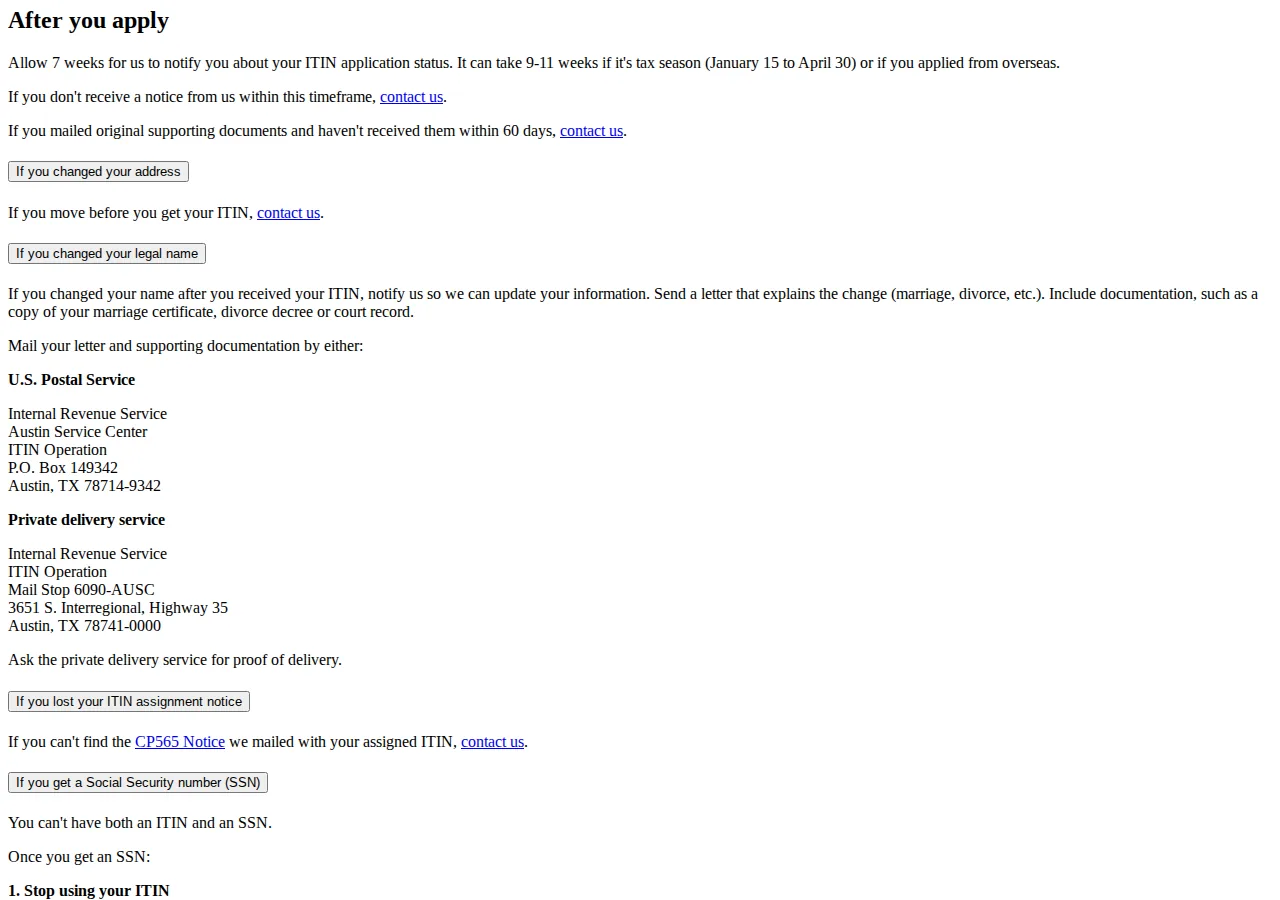
Mail. Send Form W-7, the return, and the documents to Internal Revenue Service, ITIN Operation, P.O. Box 149342, Austin, TX 78714-9342. By private delivery: ITIN Operation, Mail Stop 6090-AUSC, 3651 S. Interregional Highway 35, Austin, TX 78741 — ask the carrier for proof of delivery. The IRS returns original documents within 60 days.
Certifying Acceptance Agent. A CAA is authorized by the IRS to verify identity documents and submit the application, and the verification can happen abroad. For a primary applicant and spouse, a CAA can authenticate every listed document except foreign military ID cards. For dependents, only the passport and the civil birth certificate; anything else goes to the IRS. The CAA attaches Form W-7 (COA), the Certificate of Accuracy, showing which documents were verified. The interview can be by video, but the CAA must physically hold the original documents during it — documents cannot be authenticated over a camera.
Acceptance Agent. The second kind of agent helps complete Form W-7 and sends the IRS the originals or certified copies for every applicant. It reviews; it does not certify. Only a CAA keeps your passport in your hands.
The timeline math: work backwards from the due date
The IRS publishes one timeline, and it is a range, not a promise: allow seven weeks for the IRS to notify you about your ITIN application status; it can take nine to eleven weeks if it is tax season, January 15 to April 30, or if you applied from overseas. An incomplete package does not start the clock — it starts a correspondence round that adds weeks before the clock even begins.
Work backwards from the return the ITIN serves. A nonresident founder filing Form 1040-NR for April 15 needs the number assigned by the due date, including extensions, to claim the credits the assignment date governs — the child tax credit, the credit for other dependents, and the American opportunity tax credit all turn on it.
A partner whose LLC files Form 1065 on March 16 faces a tighter window: seven weeks back is January 26, eleven weeks back December 29 of the prior year. The partnership return cannot wait for the partner's ITIN, so the partner's application has to be in the post before the year even ends.
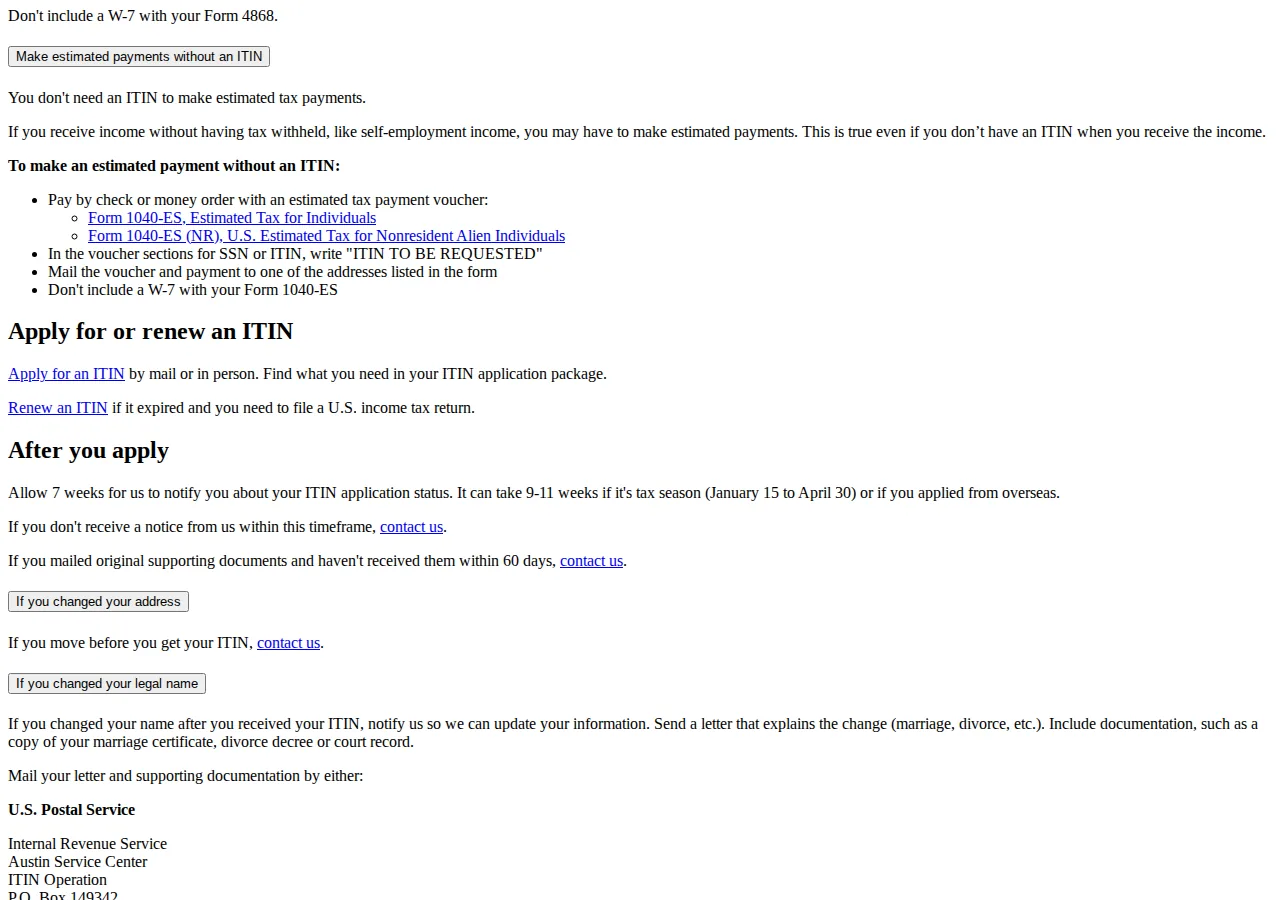
If the return will not be ready, do not rush the W-7. File Form 4868 for an extension instead: complete it, write "ITIN TO BE REQUESTED" wherever the SSN or ITIN is requested, and do not include a W-7 with it. The extension gives until October 15 to file without penalties — filing date only, so pay any tax owed by the April date. Estimated payments work the same way: pay with a Form 1040-ES or 1040-ES (NR) voucher, write "ITIN TO BE REQUESTED" in the number box, and do not include a W-7. You do not need an ITIN to pay the IRS; you need it to file the return that settles the account.
The expiry rule: three years of silence kills the number
An ITIN is not permanent. If your ITIN was not included on at least one US federal tax return for the last three consecutive tax years, it expires on December 31 of the third consecutive tax year and must be renewed before being used again on a return. Section 6109(i)(3) writes the trigger into the Code: an ITIN issued after December 31, 2012 remains in effect unless the individual files no return for three consecutive taxable years. Renewal uses the same Form W-7 and must include a US federal tax return unless you meet an exception; an ITIN assigned before 2013 that was never renewed needs the same. One reprieve: if the ITIN is used only on information returns filed by third parties, no renewal is needed — until you file a return yourself.
The assignment date matters beyond the expiry. The IRS considers the ITIN issued on or before the due date if you applied by that date and the IRS issues it as a result — applying late costs more than time: it can cost the credits.
What an ITIN cannot do
The limits are the point of the number, and the IRS lists them on the same page as the benefits. An ITIN does not qualify you for Social Security benefits or the earned income credit. It does not provide or change immigration status. It does not authorize you to work legally in the US. It does not serve as identification outside the federal tax system. A child with an ITIN cannot be counted as a qualifying child for the earned income credit, and for tax years 2018 through 2025 cannot be claimed as a qualifying child for the child tax credit or the additional child tax credit.
Since 2018, spouses and dependents are not eligible for an ITIN or a renewal unless claimed for an allowable tax benefit or filing their own return. The list is: a spouse filing a joint return, head of household, qualifying surviving spouse, American opportunity tax credit, premium tax credit, child and dependent care credit, or credit for other dependents. Our Form 1040-NR nonresident return playbook works the return the ITIN unlocks; the number itself unlocks nothing else.
The founder bottleneck: the ITIN, the EIN, and the bank
For a foreign founder the ITIN sits between the company and the bank. The LLC has its EIN; the founder has the ITIN; the bank wants both before the account works the way the business needs it to. Our foreign-founder banking guide shows which fintech underwriters ask for what — the ITIN turns a founder from an unnamed member into an identified taxpayer in the bank's file. It does not open the account by itself, but a founder without one is filing and banking with one hand tied.
The application, in order
- Confirm the federal tax purpose: a return to file, a treaty benefit to claim, or an allowable tax benefit for a spouse or dependent — otherwise do not apply.
- Confirm you cannot get an SSN: US citizen, permanent resident, or admitted for US employment means Form SS-5, not Form W-7.
- Complete Form W-7 (Rev. December 2024): tick the reason box that matches your case; a renewal needs a box too.
- Attach the original return behind the W-7: SSN space blank, unless an exception in the Exceptions Tables applies.
- Assemble the documents: passport as the stand-alone document, or two proving identity and foreign status; originals or certified copies only.
- Choose the route: CAA abroad to keep your passport, TAC in person if you are visiting the US, mail to Austin only if you can risk the originals.
- Calendar the clock: seven weeks, or nine to eleven in tax season or from overseas; originals back within 60 days; the ITIN letter is the CP565 notice.
Founder & CEO Insight — Enow A. Jovial