Three numbers run the American tax system, and founders keep putting the wrong one in the wrong box. The Social Security number identifies a person. The employer identification number identifies an employer. The individual taxpayer identification number identifies a person who needs to file or be reported on a U.S. tax return but cannot get a Social Security number. They look alike — nine digits, two dashes — and they are not interchangeable. An EIN is free and immediate online, an ITIN takes 7 weeks, and an expired ITIN on a return stops the return cold. Figures as read on November 15, 2026.
The statute that creates all three
The authority is short. Under IRC § 6109(a), any person required to make a return, statement or other document must include the identifying number prescribed for securing proper identification, must furnish that number to any other person who must file with respect to them, and must request the number of any other person they must file with respect to. For individuals, the identifying number is the Social Security account number. Treasury Regulation § 301.6109-1 then defines the three numbers by form and by job: Social Security numbers, ITINs and adoption taxpayer identification numbers take the form 000-00-0000; employer identification numbers take the form 00-0000000. SSNs, ITINs and ATINs identify individual persons. EINs identify employers. A person gets a person-number, an employer gets an employer-number, and the two never substitute for each other.
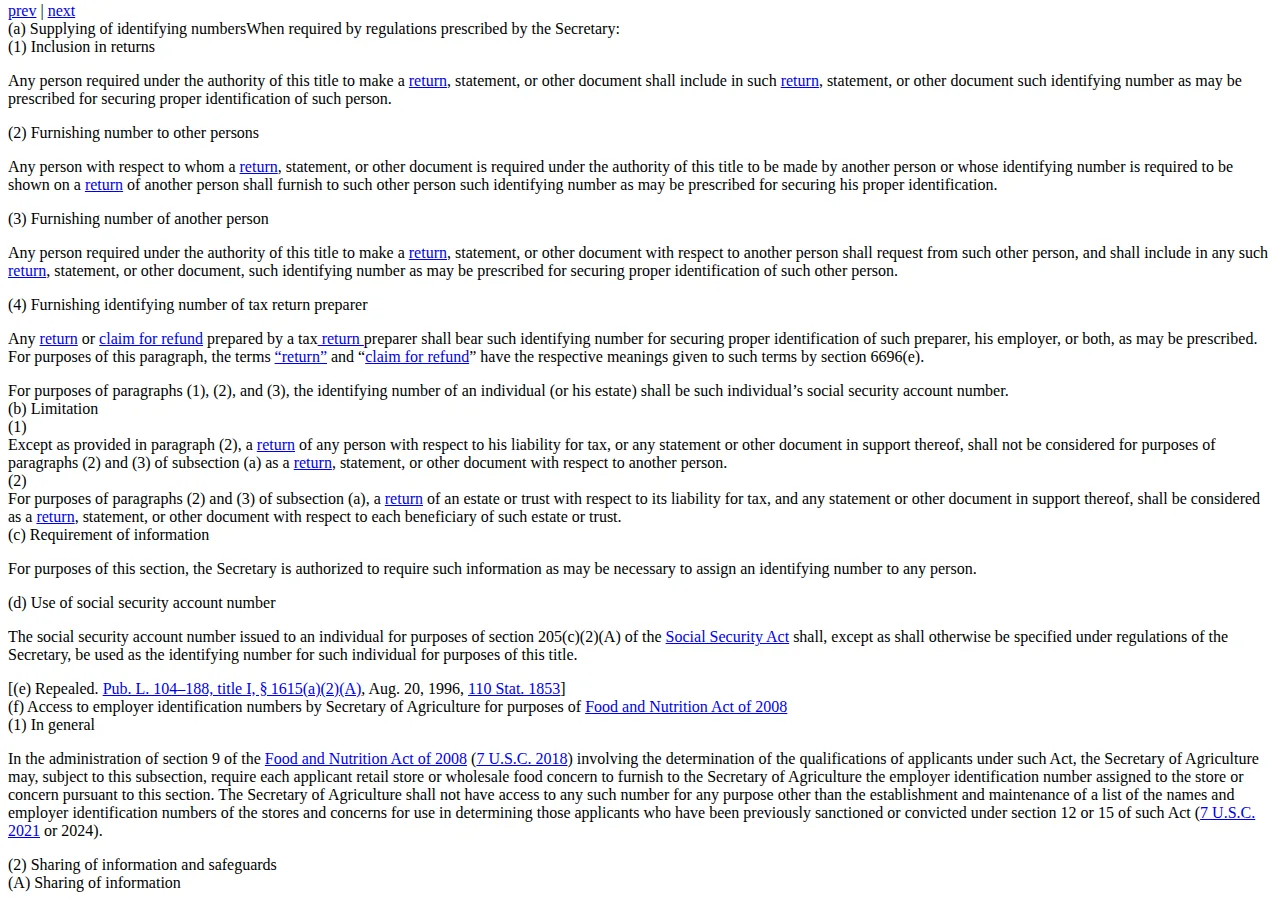
26 U.S.C. § 6109, above: the statute that creates the identifying-number duty on every return and statement.
The three numbers side by side
| Number | Identifies | Issued by | Application | Format | What it unlocks | Authority |
|---|---|---|---|---|---|---|
| SSN | An individual authorised to work in the U.S. | Social Security Administration | SSA Form SS-5 | 000-00-0000 | Employment, personal tax filing, Social Security benefits | IRC § 6109(a); Treas. Reg. § 301.6109-1(d) |
| EIN | An employer / entity | Internal Revenue Service | Form SS-4 | 00-0000000 | Business bank account, payroll, entity tax filing, W-9 | IRC § 6109; Instructions for Form SS-4 (12/2025) |
| ITIN | An individual who cannot get an SSN and must file or be reported | Internal Revenue Service | Form W-7 | 000-00-0000 | Personal federal tax filing only | Instructions for Form W-7; Treas. Reg. § 301.6109-1(d)(3) |
The SSN is the only one of the three that authorises work or qualifies anyone for benefits. The ITIN is issued for federal tax purposes only — it does not qualify you for Social Security benefits or authorise work. The EIN is the only one that belongs to the business, and the only one a bank asks for.
The EIN: Form SS-4, four routes, one free number
Form SS-4 is the application, and the IRS offers four routes with very different clocks. The online tool issues the EIN immediately when approved, and the EIN is free. The online route has three gates: the organisation must be domestic, formed in the United States or U.S. territories; its principal place of business must be in the United States or U.S. territories; and the responsible party must have an SSN or ITIN. The application must be completed in one session — it cannot be saved, and expires after 15 minutes of inactivity. The tool is available Monday through Friday 6:00 a.m. to 1:00 a.m. Eastern, Saturday 6:00 a.m. to 9:00 p.m., and Sunday 6:00 p.m. to 12:00 a.m.
The fax route runs under the IRS Fax-TIN program: fax the completed Form SS-4 and the EIN generally arrives within 4 business days. Mail takes approximately 4 weeks. The telephone route is for international applicants only: 267-941-1099 — not toll-free — 6:00 a.m. to 11:00 p.m. Eastern, Monday through Friday, and the caller must be authorised to receive the EIN and answer questions about Form SS-4. One limit binds every route: one EIN per responsible party, per day. For trusts the limit applies to the grantor, owner or trustor; for estates, to the decedent.
The responsible party is the person who controls, manages or directs the entity — for a corporation, the principal officer. Only one is named on the form, and the online tool will not run without their SSN or ITIN. A foreign founder with neither number is locked out of the online tool only, not out of an EIN: fax or phone is the way in. Our IRS Form 8832 entity classification election playbook covers what the EIN then gets used for — electing how the entity is taxed — and our IRS Form 2553 S-corp election deadline playbook covers the election that follows it.
The ITIN: Form W-7, 7 weeks, original documents
Form W-7 is the ITIN application, and its clock is the longest in this playbook. Allow 7 weeks for the IRS to notify you of your ITIN application status — 9 to 11 weeks if you submit during peak processing, January 15 through April 30, or if you are filing from overseas. The application must be submitted with original documents, or certified copies from the issuing agency, that support the information on the form. A passport is the stand-alone document most applicants use; dependents must show proof of U.S. residency unless they are dependents of U.S. military personnel stationed overseas.
File by mail or private delivery to the IRS ITIN Operation in Austin, Texas; in person at a Taxpayer Assistance Center; or through an acceptance agent. A Certifying Acceptance Agent can verify passports and birth certificates and return the documentation immediately — the mail route keeps your originals for the whole window, which is the practical reason to use a CAA when the passport cannot leave your hands. Spouses and dependents are not eligible for an ITIN, or to renew one, unless claimed for an allowable tax benefit or filing their own return.
The ITIN also has an expiry rule the other two numbers do not. If your ITIN was not included on at least one U.S. federal tax return for the last 3 consecutive tax years, it expires on December 31 of the third consecutive tax year and must be renewed before being used again on a federal tax return. An ITIN assigned before 2013 that was never renewed must be renewed with your return, and a renewal application must include a return unless you meet an exception. One exception matters for holding structures: if the ITIN is only used on information returns, you do not need to renew it now — but you will need to renew it the moment you file a federal tax return with it.
The foreign founder's critical path
The question that decides the timeline is not which form, but which order: a foreign founder with no SSN and no ITIN has two paths to a bankable entity, and the clocks differ by six weeks.
Path A wins when the only goal is the EIN: fax Form SS-4, receive the EIN in about 4 business days, and open the account. Path B is right when the founder personally must file a U.S. return — a nonresident alien with U.S.-source income, or a foreign partner whose share of partnership income must be reported under their own number. Then the ITIN is not a detour to the EIN but a separate obligation with its own 7-week clock: file Form W-7 first, in parallel with formation, rather than waiting until the return is due. The bank sequence follows the numbers: the business account needs the EIN, and the bank will also identify the responsible party — where an expired ITIN becomes a failed onboarding. Our foreign founder U.S. banking playbook walks the account opening itself, including which fintech underwriters accept which documents.
| Founder type | First number to get | Route | Clock | Authority |
|---|---|---|---|---|
| U.S. citizen or resident with SSN | EIN | Online Form SS-4 | Immediate | IRS EIN page, Nov 15, 2026 |
| Foreign founder, no SSN/ITIN, needs EIN only | EIN | Fax Form SS-4 (or phone) | ~4 business days | Instructions for Form SS-4 (12/2025) |
| Foreign founder who must file personally | ITIN, then EIN | Form W-7, then online SS-4 | 7 weeks, then immediate | Instructions for Form W-7 |
| Foreign founder, entity abroad, no U.S. place of business | EIN | Fax or mail only | ~4 business days / ~4 weeks | IRS EIN page, Nov 15, 2026 |
| Spouse or dependent claimed for a tax benefit | ITIN | Form W-7 with the return | 7 weeks | Instructions for Form W-7 |
Founder & CEO Insight — Enow A. Jovial
Who should not use which number
| Situation | Do not use | Use instead | Why |
|---|---|---|---|
| Hiring an employee | ITIN | SSN | Only an SSN authorises work; an ITIN is federal tax purposes only |
| Opening a business bank account | Personal SSN alone | EIN | The account belongs to the entity; the bank identifies the entity by EIN |
| Filing a personal U.S. return without an SSN | SSN (you have none) | ITIN | The ITIN exists for exactly this filing |
| Claiming Social Security benefits | ITIN | SSN | An ITIN does not qualify you for Social Security benefits |
| Reporting a partner's share of income | EIN | Partner's ITIN or SSN | The return needs the individual's number under IRC § 6109(a)(3) |
The SSN boundary is the one founders cross most dangerously. An ITIN in an employment verification, or an EIN where a personal number is required, is a mismatch the receiving system is built to reject — and the rejection arrives after the filing deadline has passed.
The execution checklist
- [x] Step 1: Name the responsible party before touching a form. That person's SSN or ITIN decides whether the online EIN tool is available.
- [x] Step 2: If the responsible party has an SSN or ITIN and the business is domestic, apply online. Finish in one sitting — the session expires after 15 minutes of inactivity — print the EIN confirmation letter and file it with the formation documents.
- [x] Step 3: If there is no SSN or ITIN, fax Form SS-4. Do not wait for an ITIN you do not need; the EIN generally arrives by fax within 4 business days. International applicants may also call 267-941-1099.
- [x] Step 4: If someone must file personally, file Form W-7 now, not at tax season. Allow 7 weeks, or 9 to 11 weeks from January 15 through April 30 or from overseas. Use a Certifying Acceptance Agent if the passport cannot be mailed.
- [x] Step 5: Check every ITIN for expiry before the return is prepared. An ITIN unused on any return for 3 consecutive tax years expires on December 31 of the third year; renew it with the return.
- [x] Step 6: Keep the numbers apart in your records. SSN for the person, EIN for the entity, ITIN for the person who cannot get an SSN. Never put one where the form asks for the other.
- [x] Step 7: Price the formation before you file. Run the entity costs through the pricing calculator so the free EIN is not the only number in the budget that is right.
The verdict: the SSN is the person's number, the EIN is the employer's number, and the ITIN is the tax number for the person who cannot get an SSN. The EIN is free and immediate online when the responsible party holds an SSN or ITIN; without one, fax Form SS-4 and wait about 4 business days. The ITIN takes 7 weeks on Form W-7, and it expires on December 31 of the third consecutive tax year it goes unused. Get the numbers in the right order, and formation is measured in days, not months.