A small employer with a $900 annual payroll tax bill files four quarterly returns a year under the default rules. Form 944 exists to cut that to one — but the employer does not choose it: the Internal Revenue Service decides who files annually, and the decision turns on a single number, $1,000 of annual employment tax liability.
The $1,000 line, worked from the instructions
The IRS states the design plainly: the form exists so the smallest employers — annual liability for social security, Medicare, and withheld federal income taxes of $1,000 or less — file and pay once a year instead of every quarter. The liability is the employer and employee shares of social security and Medicare tax, the federal income tax withheld from employees, and Additional Medicare Tax withheld from wages over $200,000. The test is a sum, not a wage figure, and the Instructions for Form 944 give the only sanctioned shortcut for estimating it: if you pay $5,000 or less in wages subject to social security and Medicare taxes and federal income tax withholding during the calendar year, you are generally likely to pay $1,000 or less in employment taxes.
The arithmetic behind that shortcut shows exactly where the headroom goes:
Social security runs 6.2% each (12.4% combined) and Medicare 1.45% each (2.9% combined), for 15.3% together. At $5,000 of wages that is $765, leaving $235 of federal income tax withholding before the $1,000 line is crossed. At $6,000 of wages the two payroll taxes alone are $918, leaving $82 of withholding headroom; at $6,536 they are $1,000 by themselves and no withholding fits. The practical boundary sits near $5,000 to $6,000 of annual wages for an employer whose withholding is light — and it moves with the withholding, which is why the IRS frames it as "generally likely" rather than a safe harbor.
The IRS decides, not you
Filing Form 944 is not an election you make on the form. It is a requirement the IRS assigns:
| Employer | May file Form 944? | Authority |
|---|---|---|
| Notified by the IRS to file Form 944 | Yes — and must, even above $1,000 | Instructions for Form 944 |
| Household employers only | No — use Schedule H (Form 1040) | Instructions for Form 944; Pub. 926 |
| Agricultural employers only | No — use Form 943 | Instructions for Form 944; Pub. 15 |
| Notified by the IRS to file quarterly Forms 941 | No — including after an approved opt-out | Instructions for Form 944; Rev. Proc. 2009-51 |
| Never notified, liability $1,000 or less | Only after requesting and receiving IRS confirmation | Instructions for Form 944 |
The household and agricultural exclusions are absolute — a household employer with a $400 annual liability still files Schedule H, a farm employer still files Form 943. The "never notified" row traps new employers: filing Form 944 without notification leaves you a quarterly filer with a missing set of Forms 941.
The two doors: requesting 944, or opting out to 941
The IRS runs both changes through the same first-quarter window, and the procedure is identical in both directions:
- Check for the notice: if the IRS already notified you to file Form 944, you are an annual filer; if it notified you to file Forms 941, you are a quarterly filer. No notice means quarterly.
- Call or write in the window: for calendar year 2026, call 800-829-4933 (267-941-1000 from outside the United States) between January 1 and April 1, 2026, or postmark a written request between January 1 and March 16, 2026, to the Department of the Treasury, Internal Revenue Service, Ogden, UT 84201-0038, or Cincinnati, OH 45999-0038, under Rev. Proc. 2009-51.
- Wait for the written notice: the IRS sends written confirmation when the requirement changes. No notice means the status quo stands — requesting Form 944 and hearing nothing means filing quarterly Forms 941; requesting quarterly forms and hearing nothing means filing Form 944. Check the current year's instructions for the exact window dates, since the IRS reissues them annually.
The return itself, line by line
Form 944 is two pages, both completed and signed on page 2. Enter your EIN — the nine-digit employer identification number — on every page, never a Social Security Number (SSN) or Individual Taxpayer Identification Number (ITIN); the EIN on the return must match the EIN on Form W-3. The money lines run in a fixed order. Line 1 takes wages, tips, and other compensation — the figure in box 1 of employees' Forms W-2. Line 2 takes the federal income tax withheld. Lines 4a through 4d multiply the taxable wage bases by the combined rates: 4a, social security wages at 0.124; 4b, social security tips at 0.124; 4c, Medicare wages and tips at 0.029; 4d, wages subject to Additional Medicare Tax withholding at 0.009, employee share only. The social security and Medicare taxes together are the FICA taxes — 12.4% and 2.9% combined. Line 9 is total taxes after adjustments and nonrefundable credits. Line 11 is the balance due; line 12 is the overpayment, refundable by direct deposit or applicable to the next return. Line 14 is the final-return box, checked with the final date wages were paid.
A worked example: one employee, $5,000 of annual wages, no tips, $200 withheld:
At $965 the employer is under the $1,000 line and, if notified, files Form 944. With $250 of withholding instead of $200 the same employer lands at $1,015 — over the line, eligible only if the IRS had already notified them. Fifty dollars of withholding is the difference between an annual filer and a quarterly filer at this scale. The IRS reconciles the return against the Forms W-2 totaled on Form W-3, so the W-2 and 944 figures must come from the same payroll run. The quarterly Form 941 filing playbook covers the return this employer files if the numbers grow past the line.
Deposits: the $2,500 rule is not the $1,000 rule
The most expensive confusion in this form is between two thresholds: $1,000 decides which return you file, $2,500 whether you deposit during the year. A Form 944 filer whose business grows may have to deposit FICA taxes and withholding during the year — and still files Form 944 for the year:
| Tax liability | Deposit requirement | Authority |
|---|---|---|
| Less than $2,500 for the year | No deposit required; pay with the return | Instructions for Form 944 |
| $2,500 or more for the year, less than $2,500 for the quarter | Deposit by the last day of the month after the quarter ends; Q4 under $2,500 may be paid with the return | Instructions for Form 944; Pub. 15 §11 |
| $2,500 or more for the quarter | Deposit monthly or semiweekly; $100,000 accumulated in a day means deposit by the next business day | Instructions for Form 944; Pub. 15 §11 |
Once deposits are required, the schedule comes from the lookback period — for 2026, calendar year 2024: $50,000 or less of total taxes on Form 944, line 9, makes you a monthly schedule depositor; more makes you a semiweekly schedule depositor. Monthly depositors pay by the 15th of the following month. Semiweekly depositors pay Wednesday-through-Friday wages by the following Wednesday and Saturday-through-Tuesday wages by the following Friday, and complete Form 945-A with the return. A new employer has zero lookback liability and starts monthly for the first two calendar years.
The quarterly deposit for the middle band follows directly from the annual total:
An annual liability of $9,600 produces four quarterly deposits of $2,400, each due by the last day of the month after the quarter. All deposits must be made by electronic funds transfer, through EFTPS — which is free — or the IRS business tax account. The accuracy-of-deposits rule forgives a shortfall up to the greater of $100 or 2% of the amount required, if made up by the makeup date — the return due date for monthly depositors, the first Wednesday or Friday on or after the 15th of the following month for semiweekly depositors.
What late costs
Publication 15, section 11, states the deposit rules "also apply to Form 943, Form 944, and Form 945", and the rates climb in steps set by section 6656:
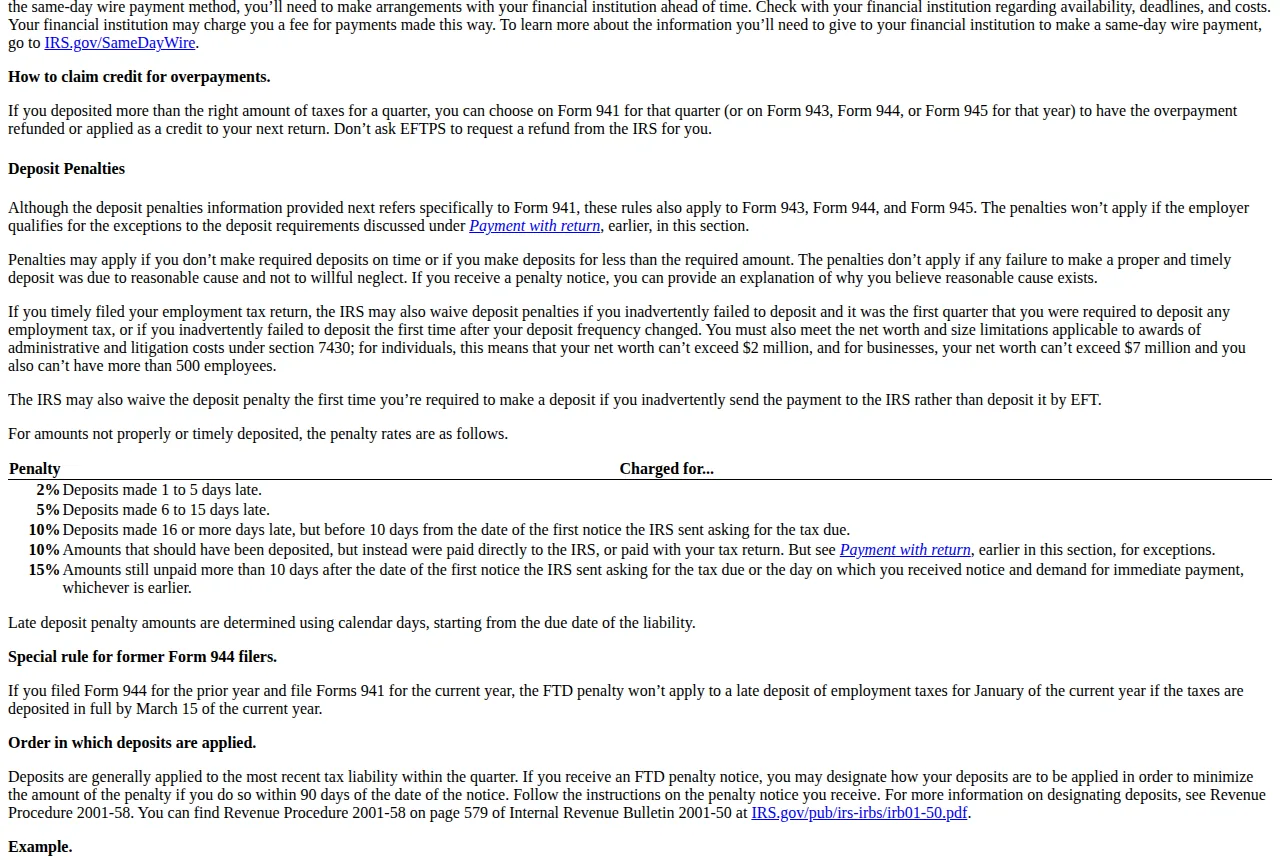
The penalty is the rate times the amount that should have been deposited:
A $2,400 quarterly deposit 7 days late falls in the 5% band and costs $120. Twenty days late it falls in the 10% band and costs $240 — and if still unpaid more than 10 days after the first IRS notice, the rate becomes 15% and the penalty is $360. Amounts paid directly to the IRS instead of deposited also draw 10%, unless a payment-with-return exception applies. The penalties do not apply if the failure was due to reasonable cause and not willful neglect, and the IRS may waive them the first time a deposit is required or after a frequency change, within the section 7430 limits — $2 million for individuals, $7 million and 500 employees for businesses. One relief is specific to this form: an employer who filed Form 944 last year and files Forms 941 this year owes no penalty on a late January deposit if the taxes are deposited in full by March 15.
Correcting a filed 944
Errors are corrected on Form 944-X, filed separately from the original return — never by filing a second Form 944. The limitation periods come from the Instructions for Form 944-X: overreported taxes within 3 years of filing or 2 years from payment, whichever is later; underreported taxes within 3 years of filing. A Form 944 filed before April 15 of the following year counts as filed on April 15. Two limits matter. First, you cannot correct federal income tax actually withheld from an employee in a prior year for a nonadministrative error — the wrong withholding table or a misclassified payment cannot be fixed. Second, Form 944-X cannot currently be filed electronically through Modernized e-File. File the correction on paper, after the original Form 944. The corrected quarterly return playbook covers the quarterly equivalent.
Who should not use Form 944
The annual return is the wrong tool in four situations. A growing employer whose liability will cross $1,000 mid-year should request quarterly Forms 941 in the first-quarter window. An employer who wants the cash-flow discipline of quarterly reconciliation should opt out: the annual return concentrates the whole year's liability into a single February payment. A household or agricultural employer cannot use it at all. And an employer with a semiweekly deposit schedule from a large lookback year should think twice: the annual return saves filing work, but the deposit work — Form 945-A, semiweekly deadlines, the $100,000 next-day rule — does not go away.
Execution checklist
- [x] Confirm the filing requirement in writing: check for the IRS notice to file Form 944; if none, call 800-829-4933 first, or ask a CPA to confirm it.
- [x] Run the eligibility math: 0.153 times annual wages plus federal income tax withheld; compare with $1,000.
- [x] Set the request window: call January 1 to April 1 or postmark a written request January 1 to March 16, to the Ogden or Cincinnati address.
- [x] Test the $2,500 deposit line separately: if line 9 will reach $2,500, set up EFTPS before the first deposit date.
- [x] Determine the deposit schedule from the lookback: calendar year 2024 line 9 total for 2026; $50,000 or less is monthly, more is semiweekly.
- [x] Calendar the return deadline: February 2 for the 2025 return, February 10 if deposits were made on time in full.
- [x] Reconcile with Form W-3 before filing: match withholding and the social security and Medicare wage figures with the W-2 totals.
- [x] Diary the 944-X clock and keep the evidence: 3 years from filing or 2 years from payment for overreported tax, 3 years from filing for underreported tax, paper filing only.
Founder & CEO Insight — Enow A. Jovial
Related reading: the quarterly Form 941 filing playbook covers the return you file when the business outgrows the $1,000 line; the corrected quarterly return playbook covers the quarterly correction path; and the quarterly estimated tax guide covers the estimated-tax side of the year. Check the formula against your own payroll with the self-employed tax estimator before the filing window opens.