IRS Form 8993 FDII Deduction Playbook
IRS Form 8993 FDII Deduction Playbook
Form 8993 is the only place the section 250 deduction is computed: one page, 29 lines. This playbook walks it line by line as printed in the December 2025 revision, works a full example, and deals with the problem: the statute has already been rewritten, and the form has not caught up yet. The companion Section 250 FDII and GILTI deduction playbook covers what the deduction is; this one covers how the form computes it.
Step 1: Read the form against the statute, not against last year's return
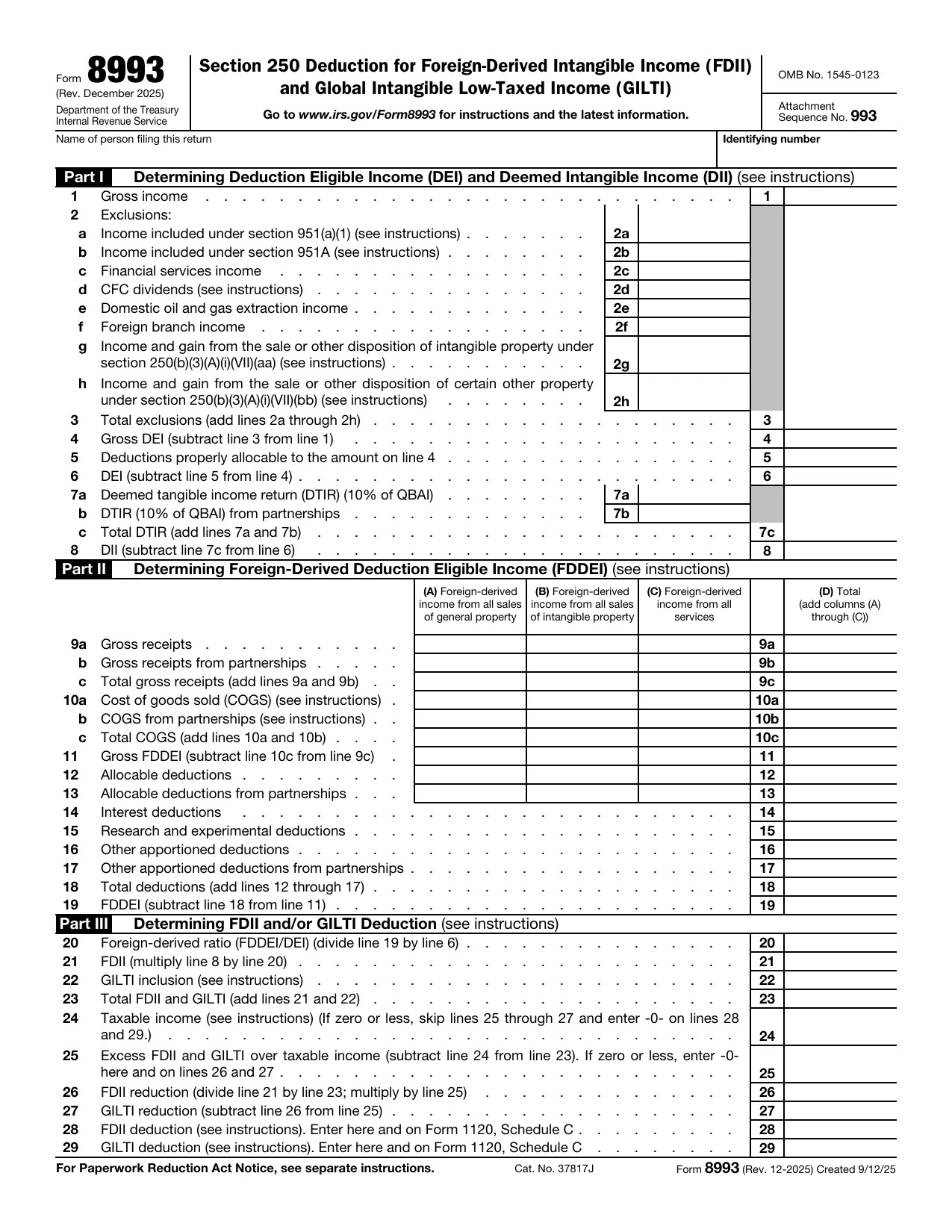
Form 8993 (Rev. December 2025, OMB No. 1545-0123, Attachment Sequence No. 993) is a single page: Part I determines DEI and DII, Part II determines FDDEI, Part III determines the deduction. The instructions say to use them for tax year 2025 and subsequent years until a superseding revision is issued. The One Big Beautiful Bill Act (Pub. L. 119-21, July 4, 2025) amended section 250, and the December 2025 form still prints the pre-amendment computation.
| Item | Tax year 2025 (form as printed) | 2026+ (statute as amended) | Authority |
|---|---|---|---|
| Foreign-derived amount | FDII — foreign-derived intangible income | FDDEI — foreign-derived deduction eligible income | P.L. 119-21 § 70323(b) |
| Deduction rate, foreign-derived | 37.5% on line 28 | 33.34% | P.L. 119-21 § 70321(a)(1) |
| Deduction rate, CFC inclusion | 50% of GILTI on line 29 | 40% of net CFC tested income | P.L. 119-21 § 70321(a)(2) |
| QBAI 10% routine return | Subtracted on lines 7a to 7c | Struck; no DTIR, no DII, no ratio | P.L. 119-21 § 70323(b)(2)(B) |
All domestic corporations — and U.S. individual shareholders of controlled foreign corporations (CFCs) making a section 962 election — must use Form 8993. The deduction is allowed only to domestic C-Corp taxpayers, excluding real estate investment trusts (REITs), regulated investment companies (RICs), and S-Corp taxpayers, plus section 962 electing individuals. A corporate partner takes its distributive share of the partnership's DEI, FDDEI, deductions, and QBAI from Schedule K-3 (Form 1065). Attach the form to the return, with the corporation's EIN in the identifying-number box; lines 28 and 29 go on Schedule C.
Step 2: Part I — lines 1 to 8, from gross income to deemed intangible income
Line 1 is gross income from Form 1120, line 11. Line 2 strips out eight categories, lines 2a through 2h, totaled on line 3: section 951(a)(1) and section 951A inclusions with the section 78 gross-up; financial services income; CFC dividends; domestic oil and gas extraction income; and foreign branch income. Lines 2g and 2h are the new OBBBA exclusions: gain from the sale of intangible property (section 367(d)(4)) and of property subject to depreciation, amortization, or depletion, for sales after June 16, 2025. For these two exclusions a sale does not include a lease or license.
Line 4 is gross DEI: line 1 minus line 3. Line 5 is the deductions properly allocable to line 4, under Treas. Reg. § 1.250(b)-1(d)(2). Line 6 is DEI: line 4 minus line 5. If the result is zero or negative, enter zero on line 6 — and the FDII deduction is zero, so enter zero on lines 21 and 28 and stop.
Line 7 is QBAI — qualified business asset investment — the average of the aggregate adjusted bases, as of the close of each quarter, in specified tangible property used in the trade or business and of a type for which a deduction is allowable under section 167. The deemed tangible income return (DTIR) is QBAI times 10 percent, on line 7a, plus the partner's share of partnership QBAI times 10 percent on line 7b, totaled on line 7c. Adjusted basis is determined under the alternative depreciation system of section 168(g). Property used for both DEI and non-DEI production is dual-use property under Treas. Reg. § 1.250(b)-2(d): only the DEI proportion of its basis counts. The regulation's example: a machine with a \$4,000x average basis and 80 percent of its depreciation to DEI puts \$3,200x in QBAI. Every dollar of QBAI removes ten cents of DII.
Line 8 is DII: line 6 minus line 7c; if zero or negative, enter zero on line 8 and on lines 21 and 28.
Step 3: Part II — lines 9 to 19, isolating the foreign-derived share
Part II asks how much of the corporation's DEI came from foreign sales and foreign services, in three columns — (A) general property, (B) intangible property, and (C) services. General property is any property other than IP (intangible property), a security, an interest in a partnership, trust, or estate, or a non-physical commodity. A transaction with both a sale and a service component is classified by its overall predominant character (Treas. Reg. § 1.250(b)-3(d)).
Line 9a is foreign-derived gross receipts in each column; line 9b adds the partner's share; line 9c totals them. Line 10a is cost of goods sold, line 10b the partnership share, line 10c the total. Line 11 is gross FDDEI: line 9c minus line 10c. Lines 12 through 17 subtract the deductions allocated and apportioned to gross FDDEI: line 12 allocable deductions, line 13 the partnership share, line 14 interest, line 15 R&E deductions, line 16 other apportioned deductions, and line 17 the partnership share of those. Line 18 totals them. Line 19 is FDDEI: line 11 minus line 18.
Three apportionment rules decide most of the Part II number: interest is apportioned on the tax book value of the taxpayer's assets; R&E deducted under section 174 is apportioned under Treas. Reg. § 1.861-17 by three-digit Standard Industrial Classification (SIC) product category; any other deduction without a definite relationship to a class of gross income is allocable to all of the taxpayer's gross income.
The foreign-use test is in section 250(b)(1) and (2). Property counts only if sold to a person who is not a United States person and the taxpayer establishes it is for a foreign use — any use, consumption, or disposition not within the United States. Services count only if provided to a person, or with respect to property, not located within the United States. For related parties the test tightens: a sale to a related foreign party counts only if the property is ultimately sold to an unrelated non-U.S. person, and a service counts only if it is not substantially similar to services the related party provides to persons in the United States. Related party means a member of an affiliated group under section 1504(a), with "more than 50 percent" substituted for "at least 80 percent". The substantiation rules sit in Treas. Reg. §§ 1.250(b)-3(f), 1.250(b)-4(d)(3), and 1.250(b)-5(e)(4).
Step 4: Part III — lines 20 to 29, the ratio, the limitation, and the deduction
Line 20 is the foreign-derived ratio: line 19 divided by line 6, capped at 1. Line 21 is FDII: line 8 multiplied by line 20. Line 22 is the GILTI inclusion from Form 8992, Part II, line 5; the IRS Form 8992 GILTI inclusion playbook walks that computation. Line 23 totals lines 21 and 22. Line 24 is taxable income determined without regard to section 250; if zero or less, skip lines 25 through 27 and enter zero on lines 28 and 29.
Lines 25 through 27 are the taxable-income limitation in section 250(a)(2). Line 25 is the excess of line 23 over line 24; if zero or less, enter zero on lines 25, 26, and 27. If positive, the excess is split between FDII and GILTI in proportion to their shares of line 23: the line 26 worksheet takes the FDII share (line A excess × line B FDII ÷ line C total), and the line 27 worksheet takes the rest (line F excess − line G FDII reduction).
Line 28 is the FDII deduction: line 21 minus line 26, multiplied by 37.5 percent on the form as printed. Line 29 is the GILTI deduction: line 22 minus line 27, plus any amount treated as a dividend under section 78 attributable to GILTI (Form 1118, Schedule A, column 3(b)), multiplied by 50 percent. If a filed Form 8993 later proves incorrect, file a corrected Form 8993 with an amended return and enter "Corrected" at the top.
Step 5: Work the example through all 29 lines
A domestic C-Corp files for tax year 2025 with gross income of \$100.0 million. Exclusions on line 2 total \$20.0 million, including a \$5.0 million section 951A inclusion and \$15.0 million of foreign branch income. Gross DEI on line 4 is \$80.0 million; allocable deductions on line 5 are \$30.0 million; DEI on line 6 is \$50.0 million. QBAI is \$100.0 million, so line 7c is:
DII on line 8 is \$40.0 million. Gross receipts on line 9c are \$60.0 million and cost of goods sold on line 10c is \$18.0 million, so gross FDDEI on line 11 is \$42.0 million; deductions on line 18 are \$12.0 million, so FDDEI on line 19 is \$30.0 million. The foreign-derived ratio on line 20 is:
FDII on line 21 is \$40.0 million times 0.60, or \$24.0 million. The GILTI inclusion on line 22 is \$10.0 million, so line 23 totals \$34.0 million. Taxable income on line 24 is \$40.0 million, so line 25 is zero and there is no limitation. The FDII deduction on line 28 is:
The GILTI deduction on line 29, with a \$1.0 million section 78 gross-up, is (\$10.0 million plus \$1.0 million) times 50 percent, or \$5.5 million. The total section 250 deduction is \$14.5 million, saving \$3.045 million at the 21 percent rate. The effective rate on FDII is 13.125 percent; on GILTI, 10.5 percent. Run the volume through the ROI calculator.
If taxable income on line 24 were \$20.0 million, the \$14.0 million excess would cut the FDII deduction to \$5.294 million (line 26 reduction \$9.882 million) and the GILTI reduction would be \$4.118 million — \$3.706 million off the FDII deduction alone.
Step 6: What changes for tax years beginning after December 31, 2025
For 2026 the computation above stops being the law. Section 70323(b)(2)(B) strikes section 250(b)(1) and (2) — the definitions of FDII, deemed intangible income, and deemed tangible income return. The current statute contains no QBAI, no DTIR, no DII, and no ratio: section 250(a)(1)(A) allows 33.34 percent of FDDEI directly. On the worked example's facts, the 2026 deduction would be:
against \$9.0 million for 2025 — \$1.002 million more, on identical facts, because the QBAI subtraction and the ratio no longer shrink the base. The effective rate on FDDEI becomes about 14.00 percent; on NCTI, 12.6 percent. Section 70322(b) also rewrites the DEI expense rule for 2026: DEI subtracts only expenses and deductions, including taxes, other than interest expense and research or experimental expenditures, properly allocable to the gross income.
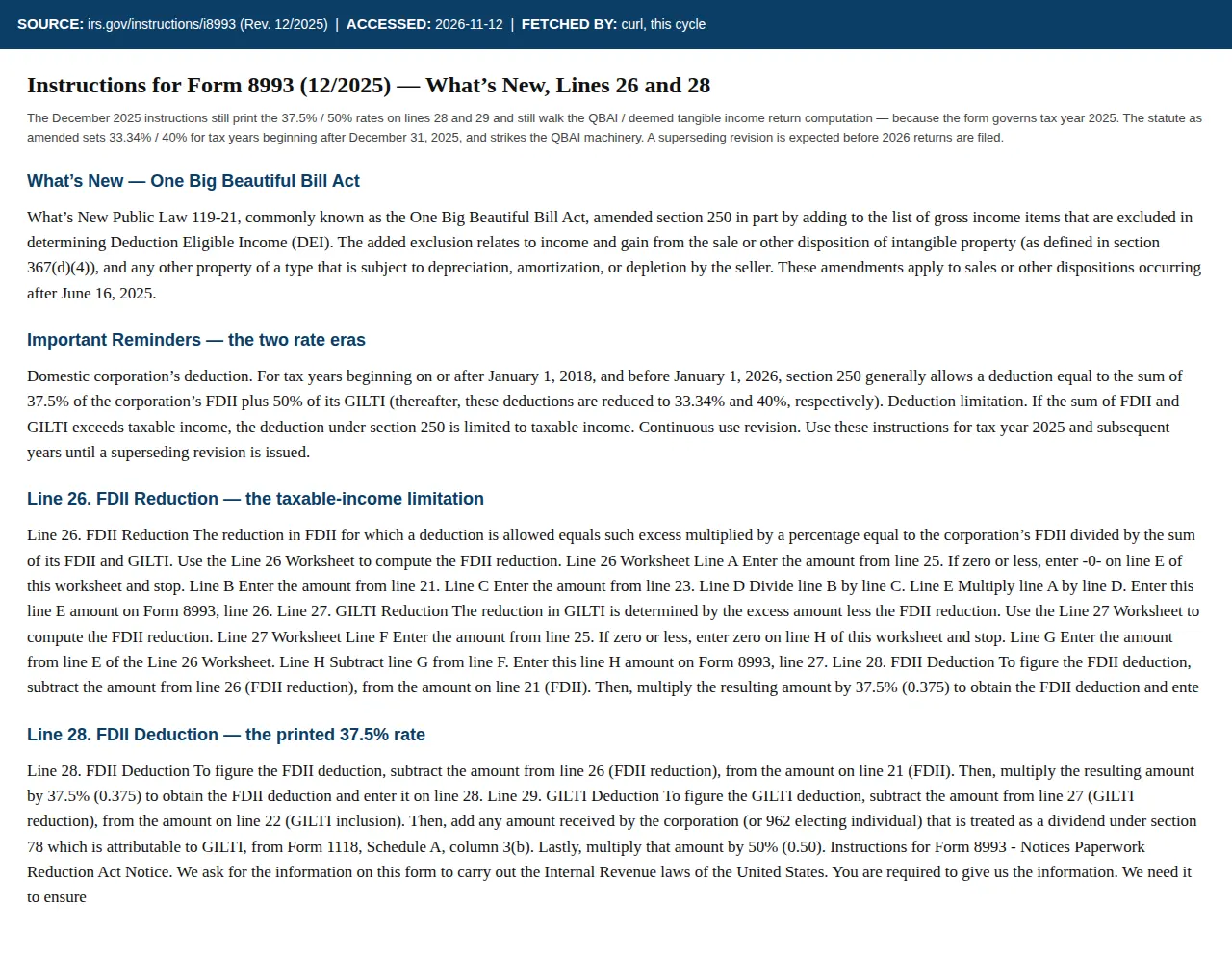
File 2025 on the printed lines and plan 2026 on the amended statute. No superseding revision had been published as of November 12, 2026. Do not apply the 33.34 percent rate to a 2025 return or file a 2026 return on the printed 37.5 percent rate and the QBAI lines.
Founder & CEO Insight — Enow A. Jovial
Execution checklist
- [x] Confirm the filer is a domestic C-Corp or a section 962 electing individual — REITs, RICs, and S-Corp filers cannot claim it.
- [x] Pull Form 1120, line 11 into line 1, work lines 2a through 2h, and check the zero floors.
- [x] Compute QBAI quarter by quarter on section 168(g) bases, apply the dual-use ratio, and carry the partner's share from Schedule K-3.
- [x] Build Part II by column, with the foreign-use evidence for each sale and the location evidence for each service.
- [x] Take the GILTI inclusion from Form 8992, Part II, line 5, and add the section 78 gross-up from Form 1118, Schedule A, column 3(b) before the 50 percent rate.
- [x] Enter lines 28 and 29 on Form 1120, Schedule C; for a 2026 year, check for a superseding Form 8993 revision before filing.
Form 8993 rewards the corporation that can prove, line by line, that its income is deduction eligible, that its tangible return has been subtracted, and that its foreign sales are genuinely for foreign use. The deduction is large — \$14.5 million on \$100.0 million of gross income in the worked example — Keep the workpapers by line and the tax year in front of you: the form as printed is a 2025 form, and the statute has moved on.