Form 8990 decides how much of your business interest you may deduct this year and how much you must carry forward. The statute behind it, 26 U.S.C. § 163(j), caps the deduction at business interest income plus 30 percent of adjusted taxable income plus floor plan financing interest. For 2025 the computation changed: the One, Big, Beautiful Bill Act restored the depreciation, amortisation, and depletion add-back to adjusted taxable income. This playbook works the form from the December 2025 revision, line by line, with a reproducible example showing the old rule and the new rule side by side.
Who must file, and who is exempt
The Instructions for Form 8990, revised December 2025, state the filing population plainly: a taxpayer with business interest expense, a disallowed business interest expense carryforward, or current-year or prior-year excess business interest expense from a partnership must generally file. A pass-through entity that allocates excess taxable income or excess business interest income to its owners must file even with no interest expense of its own.
The exemption is the first test to run, and it is a gross-receipts test. A taxpayer is not required to file if it is a small business taxpayer under the § 448(c) test and has no excess business interest expense from a partnership. The thresholds, set by the Code at a $25 million base and indexed annually, are:
| Tax years beginning in | § 448(c) threshold | Authority |
|---|---|---|
| 2023 | $29 million | Rev. Proc. 2022-38 |
| 2024 | $30 million | Rev. Proc. 2023-34 |
| 2025 | $31 million | Rev. Proc. 2024-40 |
| 2026 | $32 million | Rev. Proc. 2025-32 |
The test averages gross receipts over the three prior tax years, with related entities combined into one test. A business averaging $30.67 million over 2023–2025 is exempt for its 2025 return; if 2026 receipts push its three-year average to $33 million, the exemption is gone for 2026.
Four trades or businesses are excepted from the limitation entirely, regardless of size: the trade or business of providing services as an employee, an electing real property trade or business, an electing farming business, and certain regulated utility businesses. The elections are the trap — an electing real property trade or business escapes § 163(j) but must use the alternative depreciation system for its property, a permanent trade, not a one-year election.
The form map: Part I in four sections
Form 8990, revised December 2025, is three pages. Part I is completed by every taxpayer subject to § 163(j); Schedules A and B are completed first when the taxpayer is a partner or shareholder of a pass-through entity.
| Section | Lines | What it computes |
|---|---|---|
| Section I — Business Interest Expense | 1–5 | Total business interest expense for the year |
| Section II — Adjusted Taxable Income | 6–22 | ATI, the number the 30% applies to |
| Section III — Business Interest Income | 23–25 | Interest income that raises the ceiling |
| Section IV — Limitation Calculations | 26–31 | The deductible amount and the carryforward |
Section I starts with current-year business interest expense on line 1, excluding floor plan financing interest, then adds disallowed carryforwards from prior years on line 2 — except for partnerships, which handle carryforwards through Part II — plus any partner's excess business interest expense treated as paid in the current year on line 3, and floor plan financing interest on line 4. Line 5 is the total. Section III is short: business interest income on line 23 plus excess business interest income from pass-through entities on line 24, totalled on line 25. Section IV is where the limitation lands: line 26 is 30 percent of ATI, line 27 carries business interest income, line 28 carries floor plan financing interest, line 29 is the ceiling, line 30 is the amount deductible this year, and line 31 is the disallowed amount carried forward.
The statute behind the ceiling is 26 U.S.C. § 163(j)(1), and its text is worth reading once, because the form is only its arithmetic:
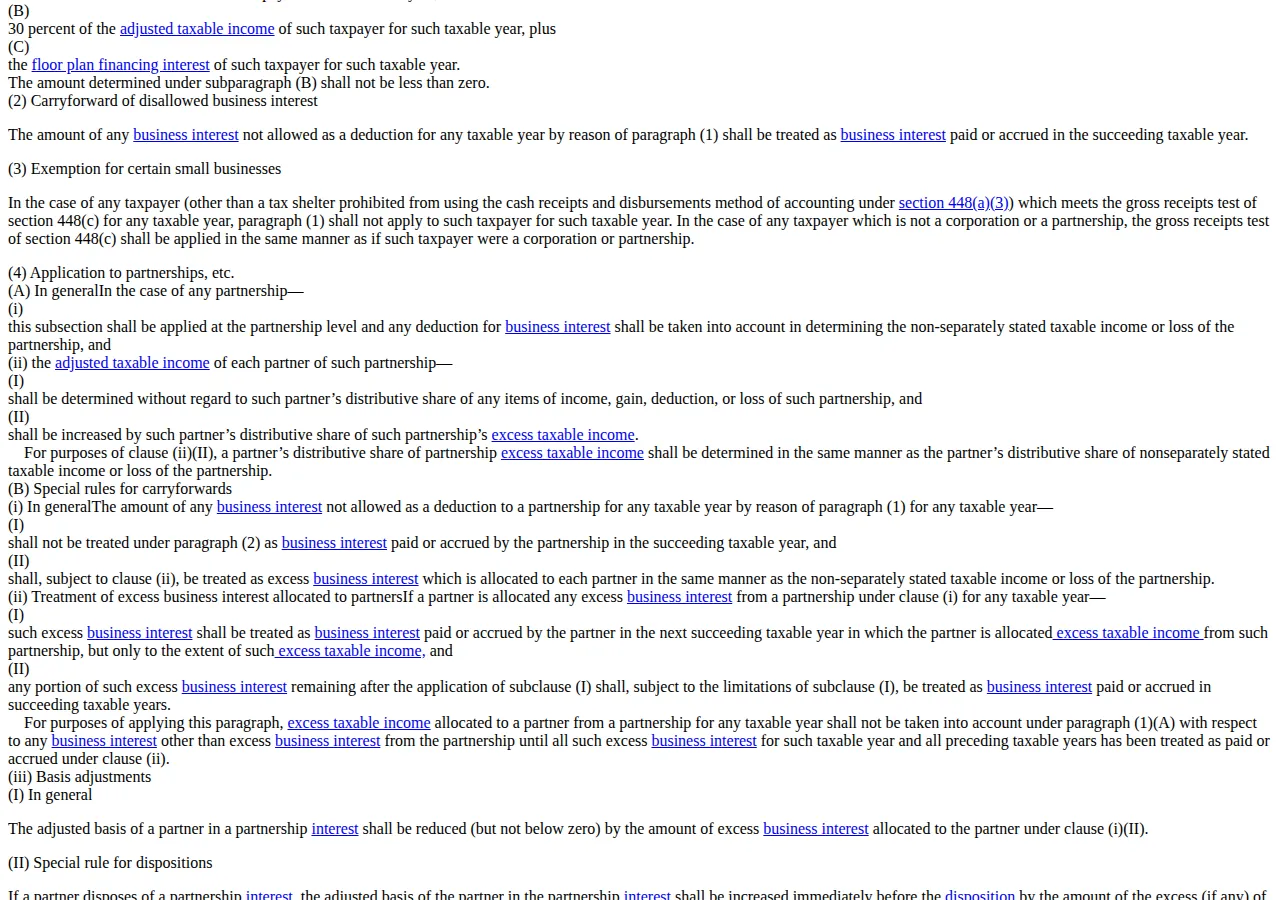
Section 163(j)(2) carries the disallowed amount forward, treating it as business interest paid or accrued in the succeeding year. Section 163(j)(3) holds the small-business exemption for taxpayers meeting the § 448(c) gross-receipts test. Section 163(j)(4) applies the limitation at the partnership level and pushes excess business interest and excess taxable income out to the partners — the mechanics that fill Schedules A and B.
Building adjusted taxable income, line by line
ATI is the number that decides the deduction, and Section II is where most filing errors live. Line 6 is tentative taxable income — regular taxable income computed without applying the § 163(j) limitation. Lines 7 through 15 are additions, made only if the amount was taken into account on line 6: non-business losses (7), business interest expense (8), NOL under § 172 (9), QBI under § 199A (10), depreciation, amortisation, or depletion (11), pass-through loss items (12), other additions (13), partner excess taxable income from Schedule A (14), and S-corp excess taxable income from Schedule B (15). Line 16 totals the additions. Lines 17 through 20 are reductions: non-business income (17), business interest income (18), pass-through income items (19), and other reductions (20), totalled on line 21. Line 22 combines them:
Two details decide real returns. First, if line 22 is zero or less, enter zero — the limitation then rests entirely on business interest income and floor plan financing interest — except that a CFC group member with negative ATI reports the negative amount. Second, line 11 is the line that changed. For tax years beginning after 2024, P.L. 119-21, the One, Big, Beautiful Bill Act, amended § 163(j) to allow the add-back of depreciation, amortisation, or depletion when computing ATI. From 2022 through 2024 those deductions were not added back, which shrank ATI and tightened the limit; the December 2025 form reinstates the add-back, and ATI returns to an EBITDA-like measure. For tax years beginning after 2025, capitalised interest is generally included in the limitation (except §§ 263(g) and 263A(f)), ATI excludes CFC inclusions under §§ 951(a), 951A(a), and 78, and floor plan financing now includes trailers and campers designed for temporary living quarters.
The worked example: new rule vs old rule
A C-Corp with a single trade or business files its 2025 return. Its numbers, all taken from the return before § 163(j):
| Line | Item | Amount |
|---|---|---|
| 6 | Tentative taxable income | $2,000,000 |
| 8 | Add back: business interest expense | $900,000 |
| 11 | Add back: depreciation, amortisation, depletion | $600,000 |
| 16 | Total additions | $1,500,000 |
| 21 | Total reductions | $0 |
| 22 | Adjusted taxable income | $3,500,000 |
| 26 | 30% of ATI | $1,050,000 |
| 27 | Business interest income (line 25) | $50,000 |
| 28 | Floor plan financing interest | $0 |
| 29 | Limitation ceiling | $1,100,000 |
| 1 | Current-year business interest expense | $1,400,000 |
| 5 | Total business interest expense | $1,400,000 |
| 30 | Deductible this year | $1,100,000 |
| 31 | Disallowed, carried forward | $300,000 |
The $300,000 on line 31 is not lost: it goes on next year's line 2 — except for partnerships, which carry it to Part II, line 32. Under the 2022–2024 rule, with no line 11 add-back: ATI is $2,900,000, the ceiling is $920,000, and the disallowed amount is $480,000. The restored add-back lets this company deduct $180,000 more interest in 2025 — the entire practical consequence of the OBBBA change, in one number. A 2024 form used for a 2025 return understates the deduction by exactly the 30 percent of depreciation that line 11 now restores.
Test the deduction ceiling before you commit to a financing structure with our tax estimator. Our § 163(j) limitation guide covers the statute, and our Schedule K-1 playbook works the partner-level reporting Schedules A and B feed into.
Partnerships and S corporations: Schedules A and B
The partnership rules are where Form 8990 earns its reputation: the limitation is applied twice, once at the partnership level and again at the partner level. Schedule A reports for each partner the excess taxable income, excess business interest income, and excess business interest expense, and the partner completes Part I from those allocations: excess taxable income into line 14, excess business interest income into line 24, excess business interest expense treated as paid this year into line 3.
The ordering rule traps filers: a partner's excess business interest expense is treated as paid in the next year only to the extent the partner is allocated excess taxable income that year; any remainder carries to succeeding years under the same limit. The partner's outside basis is reduced — but not below zero — by the excess allocated, and increased again immediately before a disposition of the partnership interest. A partner can hold a growing pile of excess business interest that only becomes deductible as the partnership generates excess taxable income, so the K-1 must be read every year. S-Corps follow the same shape through Schedule B; our Form 1120-S vs 1120 corporate return playbook covers the return those schedules attach to.
Controlled foreign corporations: the 2026 changes
A U.S. shareholder of an applicable controlled foreign corporation that has business interest expense, a disallowed carryforward, or is part of a CFC group must generally apply § 163(j) to the CFC and attach a Form 8990 with each Form 5471. For a CFC group, an additional Form 8990 is filed for the group, unless a safe-harbor election is made, in which case only the group form is required. The 2025 return is the last one filed under the old treatment — plan the 2026 computation on the new rules.
Founder & CEO Insight — Enow A. Jovial
Failure modes worth naming before you file
- The wrong vintage. The December 2025 revision is the one for 2025 returns, and the line 11 add-back is the difference that matters.
- Forgetting line 2. The disallowed amount from last year's line 31 belongs on this year's line 2. A carryforward that is never entered is a deduction that is never taken.
- The partnership line-2 error. Partnerships do not use line 2. Their disallowed interest flows through Part II and Schedule A to the partners. Entering it on line 2 double-counts it.
- Negative ATI mishandled. Line 22 at zero or less is entered as zero, except for CFC group members, who report the negative.
- Aggregation ignored. The gross-receipts test combines related entities; testing each subsidiary separately and claiming the exemption invites the IRS to unwind the return.
- The electing real property trap. Electing out of § 163(j) trades the interest limit for alternative depreciation system treatment. Price both sides before electing.
- Floor plan financing overclaimed. Only dealers may add it on lines 4 and 28; general working-capital interest belongs on line 1.
Filing checklist
- Run the § 448(c) test. Average gross receipts for the three prior years against $31 million for 2025 or $32 million for 2026; aggregate related entities.
- Confirm the form vintage. Form 8990 revised December 2025, with the line 11 depreciation add-back, for 2025 returns.
- Build ATI. Line 6, additions 7–15, reductions 17–20, ATI on line 22; zero if negative.
- Compute the ceiling. Line 26 is 30 percent of line 22; add business interest income on line 27 and floor plan financing on line 28; total on line 29.
- Deduct and carry forward. Line 30 is the deductible amount; line 31 is the disallowed amount, carried to next year's line 2.
- Complete Schedules A and B first if pass-through. Allocations come before Part I.
- Track the partner-level pile. Excess business interest becomes deductible only as excess taxable income is allocated; read the K-1 every year.
- Attach and retain. Keep the carryforward schedule with the return file so next year's line 2 is never guessed; hand your CPA the EIN, the prior-year carryforward, and a CSV of the ATI worksheet reconciled to GAAP.