Form 8975 is the return where a US multinational group hands the IRS its whole map: one form, one Schedule A per jurisdiction — every constituent entity, its tax residence, its country of organization, its main business activity, and the aggregates: revenue, profit, tax paid, tax accrued, stated capital, accumulated earnings, headcount, tangible assets. The IRS then exchanges the data automatically with the tax authorities of the jurisdictions in the report. Every figure below is from the Instructions for Form 8975 (December 2020), 26 U.S.C. § 6038, or Treas. Reg. § 1.6038-4, read November 16, 2026.
The threshold test: $850 million, measured last year
The trigger has three parts, and all three must hold: the filer is a U.S. person and the ultimate parent entity of a U.S. MNE group, and the group's annual revenue for the immediately preceding reporting period was $850 million or more. Treas. Reg. § 1.6038-4(h) states the exception: no reporting is required below $850,000,000 in the immediately preceding reporting period.
The measurement year matters more than the filing year. A group with $900 million in the preceding period files with the current return even if current-year revenue falls to $700 million. A group with $840 million files nothing, even crossing $1 billion this year — the obligation attaches next year. Exactly $850 million files: the instructions say $850 million or more.
| Test | Rule | Authority |
|---|---|---|
| Revenue floor | $850,000,000, preceding period | Instructions; Reg. § 1.6038-4(h) |
| Reporting period | 12-month applicable-financial-statement period | Instructions |
The reporting period is the 12-month period of the group's applicable financial statement — a certified audited statement — ending with or within the tax year; with no annual applicable financial statement, it is the 12-month period ending on the last day of the tax year. The $850 million is consolidated group revenue, not the parent's standalone revenue: Schedule A line 1b reports related-party revenue separately and line 1c totals both.
Who counts as the ultimate parent
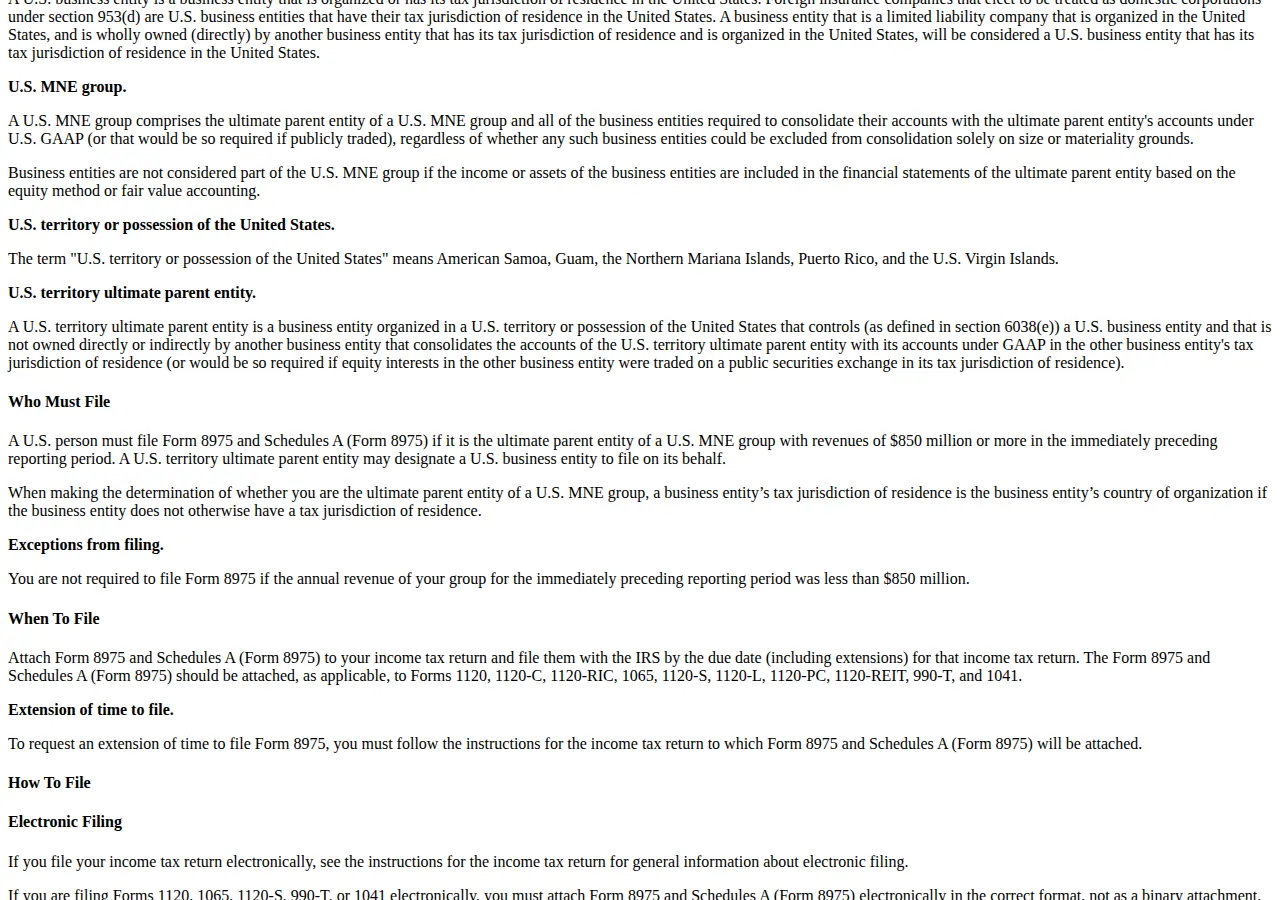
A U.S. MNE group comprises the ultimate parent entity and all business entities required to consolidate their accounts with the parent's under U.S. GAAP — or that would be so required if the parent were publicly traded — regardless of whether any could be excluded from consolidation solely on size or materiality grounds. A subsidiary excluded from the audited statements for materiality is still a constituent entity. Equity-method and fair-value entities are not part of the group.
A business entity is generally any entity recognized for federal tax purposes that is not properly classified as a trust, plus disregarded single-owner entities and PEs with separate financial statements. A C-Corp, S-Corp, or LLC parent can each be an ultimate parent; the test is consolidation and control, not entity type. Control comes from § 6038(e): ownership of stock with more than 50 percent of the combined voting power or total value of all classes of stock, and control chains through tiers. A U.S. territory ultimate parent may designate a U.S. business entity it controls to file on its behalf, using reporting-role code SUR instead of ULT.
Form 8975 line by line
Form 8975 itself is short: identification at the top, Part I, and an optional Part II. At the top, enter the reporting period, check the amended-report box if amending, and enter the number of Schedules A attached — at least one per jurisdiction.
| Line | Entry | Notes |
|---|---|---|
| Top | Reporting period, amended box, number of Schedules A | At least one per jurisdiction, including the US |
| 1a | Legal name of the filer | The reporting entity |
| 1b | Reporting-role code | ULT parent; SUR designee |
| 1c | Employer identification number (EIN) | The filer's EIN |
| 2, 3a–3c | Legal address | Street and suite or unit |
| 4 | Common name of the group | Only if different from 1a |
Part II is where the filer explains what the numbers cannot: a narrative description of the group's business operations and structure, or an overall assumption or convention that might affect the report.
Schedule A line by line
A separate Schedule A is filed for each tax jurisdiction in which one or more constituent entities is tax resident. A tax jurisdiction is a country, or a non-country jurisdiction with fiscal autonomy. The jurisdiction field is mandatory and takes a two-letter code from IRS.gov/CountryCodes — US for the United States, X5 for stateless. Codes in the IRS list that are not valid OECD codes for exchange must not be entered; use the larger sovereignty's code or OC. Part I reports the aggregates for all constituent entities listed in Part II.
| Line | Aggregate for the jurisdiction | What counts |
|---|---|---|
| 1a | Revenues, unrelated parties | Sales, services, royalties, interest, premiums |
| 1b | Revenues, related parties | Transactions with other constituent entities |
| 1c | Total revenues | Line 1a + line 1b |
| 2 | Profit or loss before income tax | — |
| 3 | Income tax paid, cash basis | Cash taxes + withholding |
| 4 | Income tax accrued | Current income tax expense only; no deferred taxes or uncertain-tax provisions |
| 5 | Stated capital | Stays with the legal entity owner |
| 6 | Accumulated earnings | A PE's earnings are its legal entity owner's |
| 7 | Employees, full-time equivalent | Year-end, average, or any basis |
| 8 | Tangible assets, net book value | Excludes cash, intangibles, financial assets |
Revenue and profit both exclude dividends treated as such in the payor's jurisdiction, distributions from fiscally transparent entities, and imputed or deemed dividends. The filer must maintain records supporting the information, but need not create reconciliation records to any return or statement.
Part II lists every constituent entity resident in the jurisdiction, one row each. Line 1 is the full legal name with its domestic legal-form designation; a permanent establishment is named as the owner entity followed by " - (PE)". Line 2 is the entity role: CBC801 ultimate parent, CBC802 reporting entity, CBC803 both. Line 3 is the TIN used by the tax administration of the jurisdiction of residence, mandatory for every entity; with no TIN, enter NOTIN, and line 4 is the country of organization if different. Line 5a is the main business activity, at least one of codes CBC501–CBC513: R&D, IP, purchasing, manufacturing, sales, administrative services, internal group finance, regulated financial services, insurance, holding shares, dormant, other. Paper filers are limited to three activity codes; the rest go in Part III.
All amounts on Schedule A must be in U.S. dollars. Foreign-currency amounts are translated under U.S. GAAP; any other rate must be stated in Part III. Test the FX conversion arithmetic in our Multi-Currency Exchange Rate Converter before the numbers are locked into the return.
The stateless example, worked
The instructions carry a worked example for the hardest allocation: fiscally transparent entities with no tax jurisdiction of residence. US Corp, the ultimate parent, owns 90 percent of partnership P1, which owns 80 percent of partnership P2. Both partnerships are stateless; each earns $100 of revenue with no expenses, and neither creates a permanent establishment anywhere. US Corp earns $100 of its own revenue.
The stateless Schedule A shows $200: P1's $100 and P2's $100, each once. The United States Schedule A shows $262: US Corp's own $100 plus its $162 allocation. The rule applies at every tier: an owner includes its share of a stateless entity's revenue and profit in the owner's jurisdiction of residence. Check that the jurisdiction totals sum to the group's consolidated revenue before filing — the form performs no cross-footing.
Filing mechanics: attach, never file alone
Form 8975 and its Schedules A must be filed with the income tax return of the ultimate parent for the tax year in or within which the reporting period ends — never separately.
- Confirm the trigger: measure the group's revenue for the immediately preceding reporting period against $850 million, on the consolidated GAAP basis.
- Map the group: list every constituent entity, its tax jurisdiction of residence, and its country of organization — including materiality-excluded subsidiaries.
- Build one Schedule A per jurisdiction: aggregate lines 1a–8, and list every constituent entity in Part II.
- Attach electronically in the correct format: filers of Forms 1120, 1065, 1120-S, 990-T, or 1041 must attach Form 8975 and Schedules A electronically in the correct format, not as a binary attachment.
- Paper filers take the extra step: mail a copy of page 1 to Internal Revenue Service, Mailstop 4950, 1973 N. Rulon White Blvd., Ogden, UT 84201.
- Amend completely or not at all: file an amended Form 8975 with an amended tax return, with all Schedules A — including any that have not changed — and the amended-report box checked.
Extensions follow the host return: there is no separate Form 8975 extension. Sibling information returns follow the same logic: our Form 5471 playbook shares the § 6038 penalty regime, and our § 482 transfer-pricing playbook covers the arm's-length methods the CbC data tests.
The penalty regime: § 6038(b) and § 6038(c)
Penalties under section 6038(b) may apply for failure to report the information required on this form. Section 6038(b)(1) imposes $10,000 for each annual accounting period with a failure; § 6038(b)(2) adds $10,000 for each 30-day period, or fraction thereof, after a 90-day period following the Secretary's notice. The increase is capped at $50,000: the dollar penalty tops out at $60,000 per period.
Example — the 200-day failure. Notice day 0; failure 200 days; first 90 grace. Remaining 110 days ÷ 30 = 3.67, so 4 periods (fractions count): 4 × $10,000 = $40,000. Total $50,000 for that period.
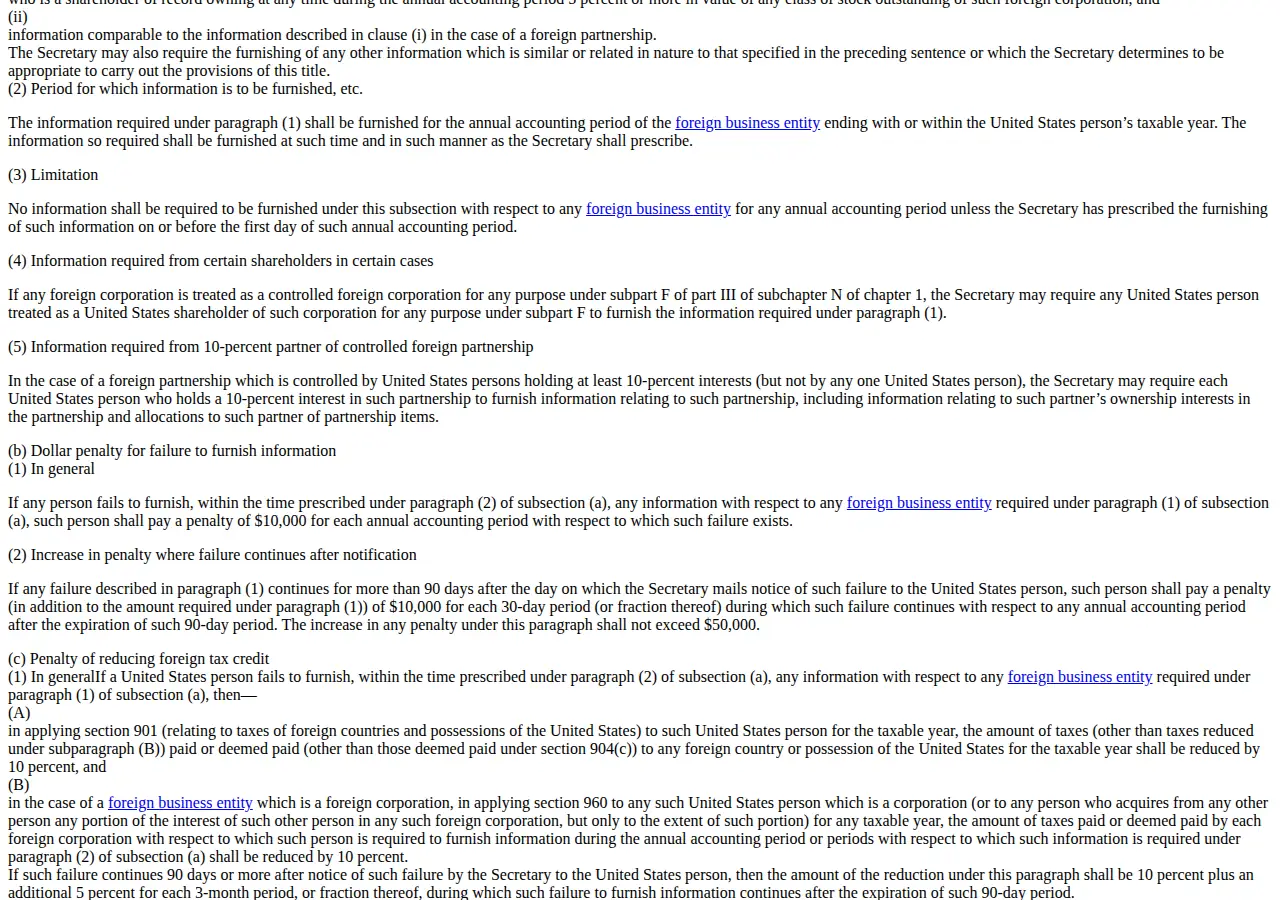
Section 6038(c) is the second penalty. A failure to furnish reduces the foreign tax credit under § 901 by 10 percent of the foreign taxes paid or deemed paid for the taxable year; if the failure continues 90 days or more after notice, the reduction rises to 10 percent plus 5 percent for each 3-month period, or fraction thereof, after the 90-day period. Each reduction is limited to the greater of $10,000 or the foreign entity's income.
Example — the credit cut. A group paid $2,000,000 of foreign taxes creditable under § 901; the failure continues 7 months after notice. Grace is 3 months; the remaining 4 months are two 3-month periods, so the reduction is 10% + 2 × 5% = 20%. Lost credit: $2,000,000 × 20% = $400,000.
The OECD exchange: why the numbers leave the country
Country-by-country reporting is an OECD Base Erosion and Profit Shifting project; Form 8975 is the United States' implementation. The information is exchanged using the OECD country code list based on ISO 3166-1, which is why Schedule A takes a two-letter code. The IRS exchanges each group's report with the jurisdictions where the group operates, and those jurisdictions use the aggregates as the risk screen for transfer-pricing audits.
The CbC report determines no tax by itself, but it tells every tax authority where to look. The transfer-pricing documentation is the answer to the question the CbC report raises. Our § 482 transfer-pricing playbook runs those methods and the § 6662(e) protection for contemporaneous documentation.
Founder & CEO Insight — Enow A. Jovial
Who should not file, and where the edges are
Do not file if the group's revenue for the immediately preceding reporting period was less than $850 million — a voluntary filing hands every jurisdiction a data set it did not ask for. A group with no foreign constituent entity should confirm with a CPA whether it is a U.S. MNE group at all. An LLC, S-Corp, or C-Corp parent is treated the same way — the test is consolidation and control, not entity type. A group approaching the threshold should build the Schedule A process now.
Filing checklist
- [x] Measure the trigger and map the group: preceding-period consolidated revenue against $850 million; every constituent entity, its tax jurisdiction, country of organization, and PE with separate statements.
- [x] Build Schedule A per jurisdiction: lines 1a–8, all in USD; list entities in Part II with name, role, TIN or NOTIN, country, activity codes.
- [x] Attach to the parent's return: e-file in the correct format; paper filers mail page 1 to Ogden, UT.
- [x] Calendar the notice clock: the 90-day grace period starts the day the IRS mails a failure notice.
- [x] Reconcile the map to the documentation: CbC aggregates and transfer-pricing documentation must agree in every jurisdiction.