HSA vs FSA vs HRA: The Health-Account Head-to-Head Playbook
Three accounts pay your medical bills with pre-tax dollars, and they are not three versions of the same thing. The HSA is a bank account you own, that grows tax-free and follows you from job to job. The FSA is a one-year spending envelope your employer hands you in January and mostly takes back in December. The HRA is your employer's money, spent on your medical bills. Elect $3,400 to an FSA and spend only $1,500, and $1,220 of it can vanish on December 31.
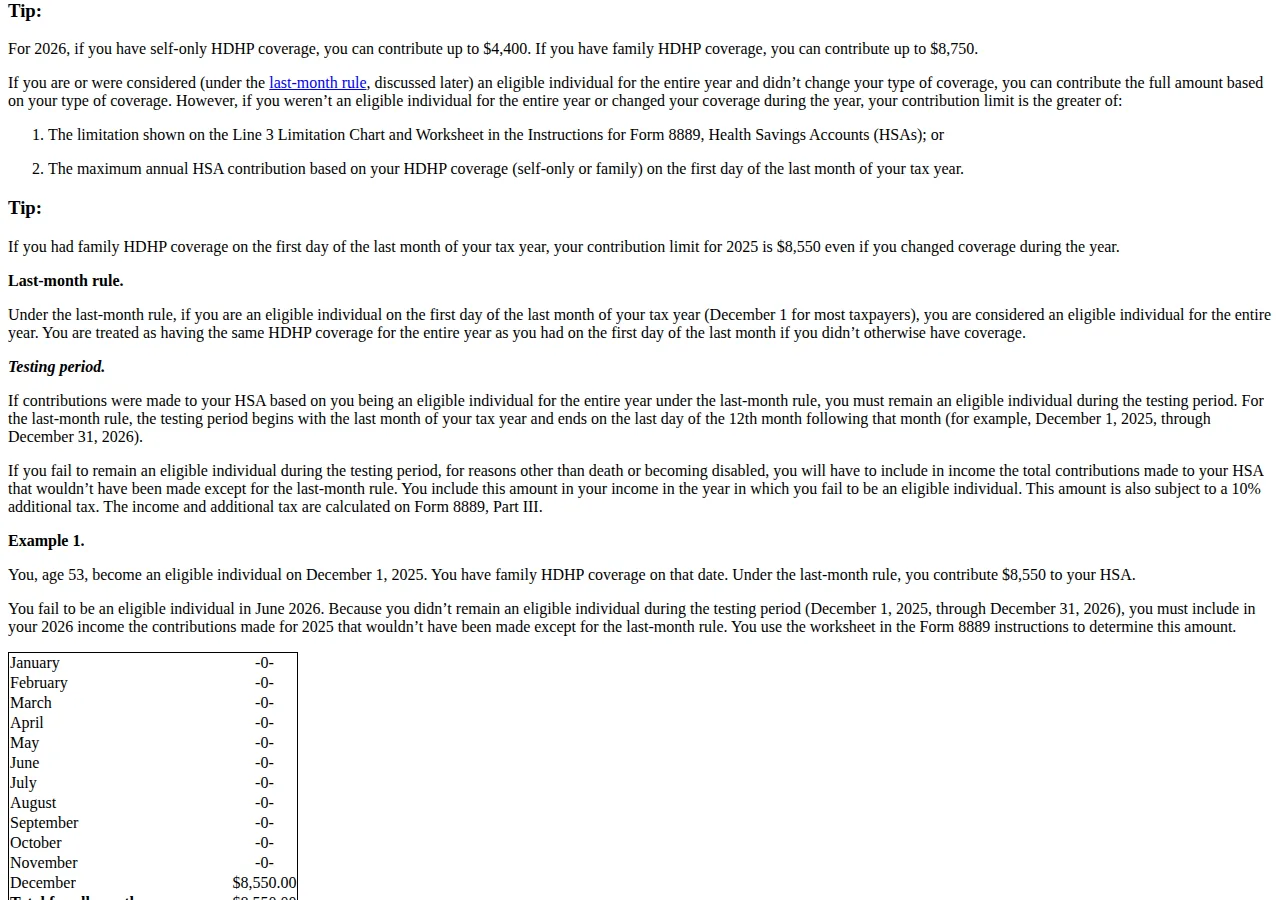
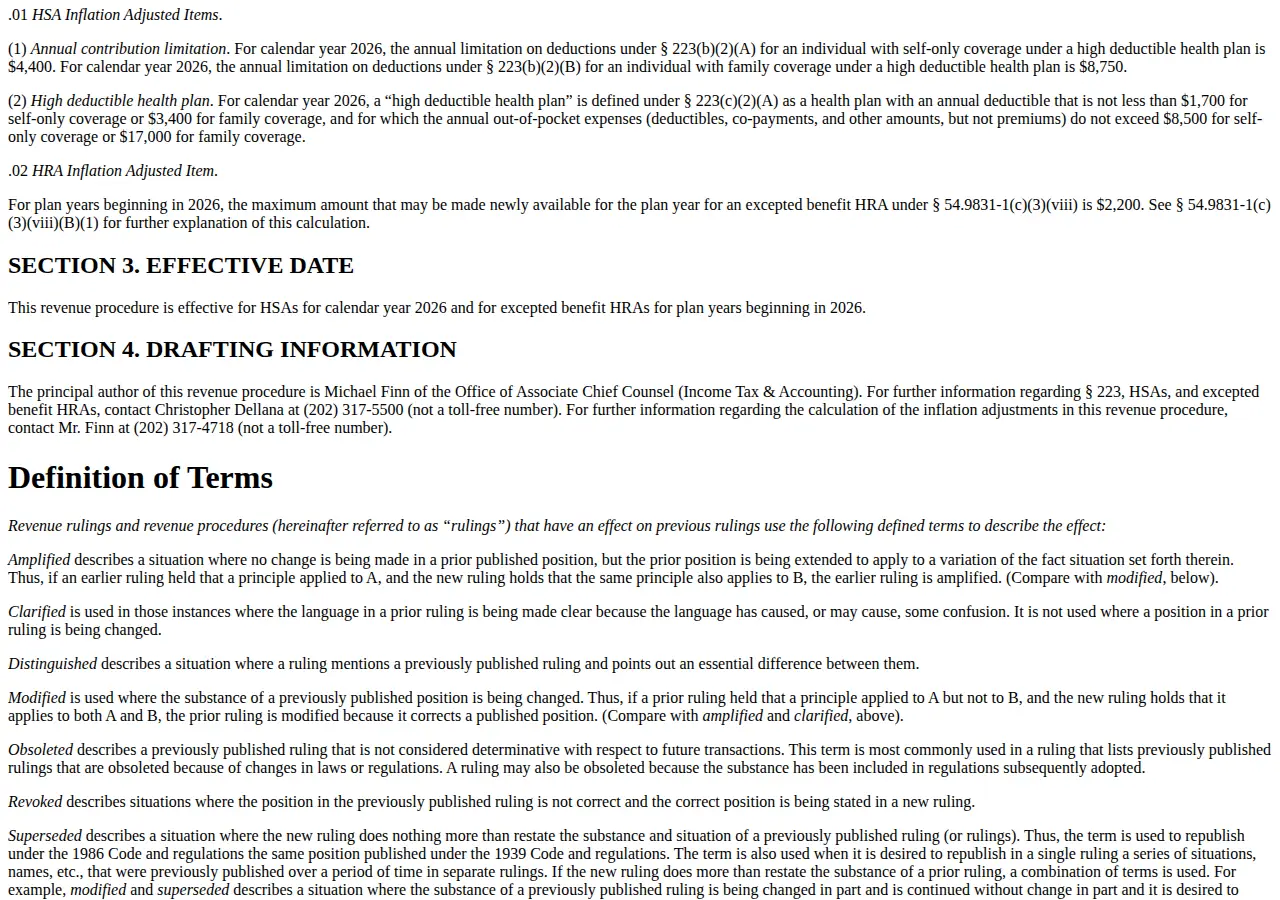
The 2026 limits, from the IRS itself
| Limit | 2026 | 2025 | Authority |
|---|---|---|---|
| HSA contribution, self-only | $4,400 | $4,300 | Rev. Proc. 2025-19 |
| HSA contribution, family | $8,750 | $8,550 | Rev. Proc. 2025-19 |
| HSA catch-up, age 55+ | $1,000 | $1,000 | 26 U.S.C. § 223(b)(3) |
| HDHP minimum deductible | $1,700 / $3,400 | $1,650 / $3,300 | Rev. Proc. 2025-19 |
| HDHP out-of-pocket maximum | $8,500 / $17,000 | $8,300 / $16,600 | Rev. Proc. 2025-19 |
| FSA salary-reduction limit | $3,400 | $3,300 | Rev. Proc. 2025-32, § 4.15 |
| FSA maximum carryover | $680 | $660 | Rev. Proc. 2025-32, § 4.15 |
| QSEHRA reimbursement cap | $6,450 / $13,100 | $6,350 / $12,800 | Rev. Proc. 2025-32, § 4.63 |
| Excepted benefit HRA, new money | $2,200 | $2,100 | Rev. Proc. 2025-19, § 2.02 |
Two 2026 changes from the One, Big, Beautiful Bill Act: bronze and catastrophic Affordable Care Act plans now count as high deductible health plans (§ 223(c)(2)(H)), and a direct primary care arrangement no longer disqualifies you if fees stay under $150 a month self-only or $300 a month family (§ 223(c)(1)(E)). Telehealth waivers are permanently safe (§ 223(c)(2)(E)).
The triple tax advantage, worked
The HSA is the only account in the U.S. tax code taxed zero times: money goes in pre-tax, grows tax-free, and comes out tax-free for medical expenses. Work it for a family contributing the full $8,750 through payroll at a 22 percent bracket:
The FICA saving is the part most people miss. Cafeteria-plan contributions skip Social Security and Medicare tax; direct contributions save only the income tax — $1,925, not $2,594.38 — because the FICA was already withheld. The same $8,750 at 24 percent saves $2,769.38 through payroll. Run the tax estimator on your own bracket: the payroll route is worth $669.38 a year to a family at the full contribution.
The HSA, in depth
Eligibility is a monthly test. You must be covered by a qualifying HDHP on the first day of the month, and your limit is one-twelfth of the annual limit for each eligible month — unless the last-month rule applies. Under it, if you are eligible on December 1, you may contribute the full annual amount — but you must stay eligible through December 31 of the following year, or the excess comes back into income plus a 10 percent additional tax. Publication 969 works its own example — a 53-year-old eligible December 1, 2025, contributes the full $8,550 family limit, then loses eligibility in June 2026: the monthly limitation is $8,550 ÷ 12 = $712.50, so $7,837.50 goes back into 2026 income, plus $783.75 of additional tax.
The day you enroll in Medicare, your contribution limit becomes zero — including retroactive enrollment, so contributions made during a backdated coverage period become excess contributions (§ 223(b)(7)). If you are 65 and still working, check your Medicare enrollment date before contributing a dollar for that year. The catch-up is $1,000 for anyone 55 or older at year-end, and it is statutory, not inflation-adjusted (§ 223(b)(3)). A married couple both 55 or older under family coverage can put away $10,750 in 2026 — but each spouse's catch-up must go into that spouse's own HSA, because there is no joint HSA.
Distributions are where the HSA's discipline shows. Spend on qualified medical expenses and the distribution is tax-free, with no annual withdrawal requirement. Spend on anything else before 65 and the withdrawal is ordinary income plus a 20 percent additional tax (§ 223(f)(4)). A $2,000 non-qualified withdrawal at a 22 percent bracket costs $440 of income tax and $400 of additional tax, so you keep $1,160. After 65 the 20 percent tax disappears and the account behaves like a traditional IRA: medical withdrawals stay tax-free, anything else is taxed as ordinary income. The Form 1099-SA guide covers how distributions are reported. Owners underuse the once-in-a-lifetime IRA-to-HSA funding distribution and rollovers: 60 days to move money between HSAs once per 12-month period, with trustee-to-trustee transfers unlimited. One restriction: the HSA cannot pay insurance premiums, except long-term care insurance, COBRA, coverage while receiving unemployment compensation, and Medicare premiums after 65 (not Medigap).
The FSA, in depth
The FSA's defining feature is the calendar. You elect an amount before the plan year starts — $3,400 at most for 2026 — and the election is locked for the year. Then use-it-or-lose-it takes over. At year-end, unspent money is forfeited unless the plan provides a carryover of up to $680 or a grace period of up to two and a half months to spend the remainder. A plan may offer one or the other, never both (Notice 2013-71), and the employer may set a lower carryover than the $680 maximum.
Work the forfeiture. Elect $3,400, incur $1,500 of qualified expenses in the year, and hold a carryover plan: $1,900 is unspent, $680 carries into next year, and $1,220 is forfeited. The tax saved on the election was $3,400 × 29.65% = $1,008.10, but the forfeited $1,220 was money that would have been $858.27 in your pocket after tax if you had never elected it — $1,220 × (1 − 29.65%). The safe rule: elect no more than expected spending plus $680 on a carryover plan. Elect $3,400 and spend $2,720, and the $680 remainder is exactly the carryover cap — zero forfeited.
The FSA's one genuine advantage is uniform coverage: the full annual election is available from day one, regardless of how much has been withheld. A $2,000 dental bill in February is reimbursable in full although only about $566.67 has been withheld by then ($3,400 ÷ 12 × 2 months) — the employer fronts the difference. It cannot pay health insurance premiums or long-term care, and if you leave your job mid-year the unspent balance is generally gone — the FSA is not portable.
The HRA, in depth
The HRA is the employer's account in every sense. The employer funds it, sets the maximum reimbursement, decides whether unused money carries forward, and keeps the balance when you leave — unless the plan is a retiree HRA or COBRA continuation applies. Your contribution is zero by law: no salary reduction, no employee money of any kind. Reimbursements are tax-free. Self-employed people are not eligible for FSAs or HRAs.
There is no statutory cap on a general HRA — the employer can fund $500 or $50,000. The caps live in the special variants. A Qualified Small Employer HRA caps reimbursements at $6,450 self-only and $13,100 family in 2026 (Rev. Proc. 2025-32, § 4.63). An excepted benefit HRA — the small top-up alongside a group plan — may make only $2,200 newly available per plan year in 2026.
The HRA's one structural advantage over the FSA: it can pay health insurance premiums and long-term care coverage. The cash-out trap: if the plan lets unused reimbursement be paid to you in cash at year-end, on termination, or to your beneficiary at death, then every distribution that year is included in your income.
The stacking rules: what can coexist with an HSA
A general-purpose health FSA or HRA that pays qualified medical expenses disqualifies you from HSA contributions — the HSA requires you to bear the deductible yourself. Four arrangements can coexist: a limited-purpose FSA or HRA that pays only dental, vision, and preventive care; a suspended HRA that pays nothing during the suspension; a post-deductible FSA or HRA that pays nothing until the HDHP minimum deductible is met; and a retiree-only HRA that pays only expenses incurred after retirement. A grace-period FSA is compatible only if the FSA balance at the end of the prior plan year is zero. The trap: keep a general-purpose FSA while switching to an HDHP, and your HSA contributions for those months are zero.
Worked example — the HSA as a retirement account
The same $4,400 a year for 30 years, at a 6 percent return, in an HSA versus a taxable brokerage account, at a 22 percent bracket:
Contributions total $132,000, growth is $215,856.02, tax saved on contributions alone is $29,040. The taxable account starts smaller — $4,400 of pay, after 22 percent income tax and 7.65 percent FICA, leaves $3,095.40 a year — and its 6 percent return is taxed at 22 percent every year, so it compounds at 4.68 percent:
The HSA ends $153,152.15 ahead. Spend it on medical care and the whole $347,856.02 is tax-free. Spend it after 65 on anything else and it is taxed at 22 percent, leaving $271,327.70 — still $76,623.83 ahead.
The decision table
| Decision factor | HSA | Health FSA | HRA | Authority |
|---|---|---|---|---|
| Who funds it | You, employer, anyone | You, via salary reduction | Employer only | Pub. 969 |
| 2026 annual limit | $4,400 / $8,750 (+$1,000 at 55+) | $3,400 employee salary reduction | No cap (general); $6,450 / $13,100 QSEHRA; $2,200 EBHRA | Rev. Proc. 2025-19; Rev. Proc. 2025-32 |
| Tax on the way in | Deductible; skips FICA via payroll | Skips income + FICA tax | Excluded from income; no FICA | § 223(a); § 125(a); Pub. 969 |
| Growth | Tax-free | None — spent in the year | None — employer holds it | § 223(e)(1) |
| Unspent money | Rolls forward forever | Forfeited except $680 carryover / 2.5-month grace | Carries forward only if the employer allows | Pub. 969; Notice 2013-71 |
| Portable | Yes — yours for life | No — lost on leaving | No — employer's money | Pub. 969 |
| Pays insurance premiums | No (except LTC, COBRA, Medicare 65+) | No | Yes | § 223(d)(2)(B); Pub. 969 |
| Requires | HDHP ($1,700 / $3,400) | Employer cafeteria plan | Employer plan | § 223(c)(2) |
| After 65 | Like a traditional IRA | N/A — annual account | N/A — employer account | § 223(f)(4)(C) |
Operator boundaries: who should pick which, and who should avoid each
Take the HSA on a qualifying HDHP if you can fund it through payroll and your horizon is longer than one year. A family that can pay the $3,400 deductible from cash flow still has $5,350 of the $8,750 limit spare. Avoid it on Medicare, with a general-purpose FSA or HRA, or with a deductible below $1,700 self-only — a $1,200 deductible is not an HDHP.
Take the FSA for predictable, same-year spending — orthodontics, a planned surgery, regular prescriptions — with no HDHP. Elect expected spending plus $680 and it is pure tax saving. Never elect the full $3,400 on a guess: every dollar above expected spending plus the carryover is a bet against December 31.
Take the HRA as it comes: it is your employer's offer, not your choice. A QSEHRA's $6,450 self-only cap decides whether the offer covers your premiums. An HRA alongside an HDHP must be limited-purpose, post-deductible, or suspended — a general-purpose HRA next to an HDHP costs you the HSA. The high-yield savings comparison covers where to park cash outside these accounts, and the 529 plan guide covers the other tax-advantaged bucket families fund alongside them.
The enrollment checklist
- Confirm HDHP status: deductible ≥ $1,700 self-only / $3,400 family; out-of-pocket ≤ $8,500 / $17,000.
- Check for disqualifying coverage: general-purpose FSA or HRA, a spouse's non-HDHP plan, Medicare.
- Fund the HSA through payroll to capture the 7.65 percent FICA saving.
- Contribute the full $4,400 / $8,750 if cash flow allows; add $1,000 catch-up at 55+.
- Size any FSA election at expected spending plus $680 — never $3,400 on a guess.
- Confirm whether the FSA offers carryover or grace period before you elect.
- Keep receipts and a distribution log for every tax-free distribution.
- Run the break-even calculator on your bracket before open enrollment closes.
Founder & CEO Insight — Enow A. Jovial
The HSA answers "how do I pay for care for the rest of my life." The FSA answers "how do I pay for the care I already know I need this year." The HRA answers "what will my employer pay for." Match the account to the question, check the 2026 limits before open enrollment, and never let a general-purpose FSA sit next to an HDHP.