IRS Form 8865: The Foreign Partnership Return Playbook
IRS Form 8865: The Foreign Partnership Return Playbook
A U.S. person who owns an interest in a foreign partnership does not get to wait until the income arrives to tell the IRS about it. Form 8865 reports the partnership, the partner's share of its income, and any property moved into it — due whether or not the partnership ever sends cash to the United States.
Three Code sections feed into this one form: section 6038 for controlled foreign partnerships, section 6038B for property transfers, and section 6046A for acquisitions, dispositions, and interest changes.
The three statutes behind one form
| Statute | What it reports | Penalty for failure | Authority |
|---|---|---|---|
| 26 U.S.C. § 6038 | Information on a controlled foreign partnership | 10,000 dollars per year, plus 10,000 dollars per 30 days after notice; 50,000 dollar cap | 26 U.S.C. § 6038(b) |
| 26 U.S.C. § 6038B | Transfers of property to a foreign partnership | 10 percent of fair market value, plus gain recognition; 100,000 dollar cap | 26 U.S.C. § 6038B(c) |
| 26 U.S.C. § 6046A | Acquisitions, dispositions, and changes in interest | 10,000 dollars, plus 10,000 dollars per 30 days after notice; 50,000 dollar cap | 26 U.S.C. § 6679(a) |
A foreign partnership is one not created or organized in the United States or under U.S. state law: a Delaware partnership with foreign operations is domestic and files Form 1065, while one organized abroad is foreign even if every partner is American. A U.S. person is a citizen or resident, a domestic partnership, a domestic corporation, or a non-foreign estate or trust.
The four categories of filers
Filing only the Category 3 schedules as a Category 1 filer is an incomplete return, penalized like no return at all.
Category 1. A U.S. person who controlled the partnership at any time in the tax year — control means more than a 50 percent interest in capital, profits, or deductions or losses. If several qualify, only one files: the one with a controlling interest in capital or profits. The filer completes item F, and the single return must contain all the information each Category 1 filer would have filed; each non-filer attaches a "Controlled Foreign Partnership Reporting" statement to its return. Schedules: page 1, A, A-1, A-3, B, K, K-1, K-2, K-3, L, M-1, M-2, N, D, plus G and H for a 721(c) partnership.
Category 2. A U.S. person who owned 10 percent or more at any time in the tax year while the partnership was controlled by U.S. persons each owning at least 10 percent. If the partnership had a Category 1 filer at any time that year, no one is a Category 2 filer. Schedules: page 1, A, A-3, N, K-1, K-3.
Category 3. A U.S. person who contributed property in the tax year to a foreign partnership for an interest — a section 721 transfer — if either the person owned at least 10 percent directly or constructively immediately after the contribution, or the value contributed plus other property from that person or a related person in the prior 12 months exceeds 100,000 dollars. Schedules: page 1, A, A-1, A-3, O, plus G and H for section 721(c) property.
Category 4. A U.S. person with a reportable event under section 6046A: an acquisition, a disposition of any portion of an interest, or a substantial change in proportional interest. Each applies only at the 10 percent threshold: an acquisition or disposition counts only if the person holds at least 10 percent before or after the event. A proportional interest can change without any sale: another partner withdraws, or the agreement shifts profit shares. Schedules: page 1, A, A-3, P, plus G and H for a 721(c) transferor.
Who does not have to file
A U.S. person whose only connection is constructive ownership from another U.S. person need not file if the form is filed by another Category 1 filer or a direct partner — but the indirect partner must still attach the "Controlled Foreign Partnership Reporting" statement to its return.
A contribution below both Category 3 tests is outside the form: an 8 percent interest for property worth 90,000 dollars, with no other contributions in the 12-month window, triggers neither test. The same contribution at 110,000 dollars would trigger Category 3 even at 8 percent, because the dollar test is independent of the percentage test.
Schedule K-1: how the partner's share is computed
Schedule K-1 (Form 8865) reports the partner's share of income, deductions, and credits, for direct partners only. Under section 702, each partner takes into account separately its distributive share, with the character of each item determined as if the partner had realized it directly.
Take a stated example: a partnership earns 400,000 dollars of ordinary income, 40,000 dollars of interest, and pays 30,000 dollars of foreign taxes, and a U.S. partner holds 25 percent:
The 100,000 dollars is taxed in the year the partnership earns it, whether or not cash is distributed: the tax follows the allocation, not the cash. The 7,500 dollar foreign tax share is the partner's portion of the taxes available — and exactly what the section 6038 penalty can shrink.
When to file and the filing sequence
Form 8865 is attached to the filer's income tax return and filed by that return's due date, including extensions; file the 2025 form with the return for the tax year beginning in 2025. A filer with no return to file submits Form 8865 separately, when and where the return would have been due. For a partnership filer, the Form 1065 due date controls: the 15th day of the third month after the tax year ends — March 15 for a calendar-year partnership. Section 6046A(c) separately requires the return by the 90th day after the person becomes liable to file it.
Gather the identifiers before filing: the partnership's EIN, each U.S. partner's SSN or ITIN, and the filer type — an LLC taxed as a partnership, an S-Corp, or a C-Corp — plus the GAAP books behind Schedules B and K for the CPA reviewing the return.
For each foreign partnership, one form per partnership:
- Identify the partnership's tax year, confirm the entity is foreign, and test all four categories, checking constructive ownership under section 267(c).
- If several Category 1 filers exist, agree which one files, and prepare the "Controlled Foreign Partnership Reporting" statement for each non-filer.
- Gather the income statement, balance sheet, and transaction records for Schedules B, K, and N, plus transfer documents for O and P.
- Complete Schedule K-1 for each direct U.S. partner and Schedule K-3 for the international detail, checking that the shares add to the totals.
- Attach the form to the filer's return and file by the return's due date, including any extension. If the form is later found incomplete, file a corrected Form 8865 with an amended return, mark "corrected" at the top, and attach a statement explaining the changes.
The section 6038 penalty, in worked dollars
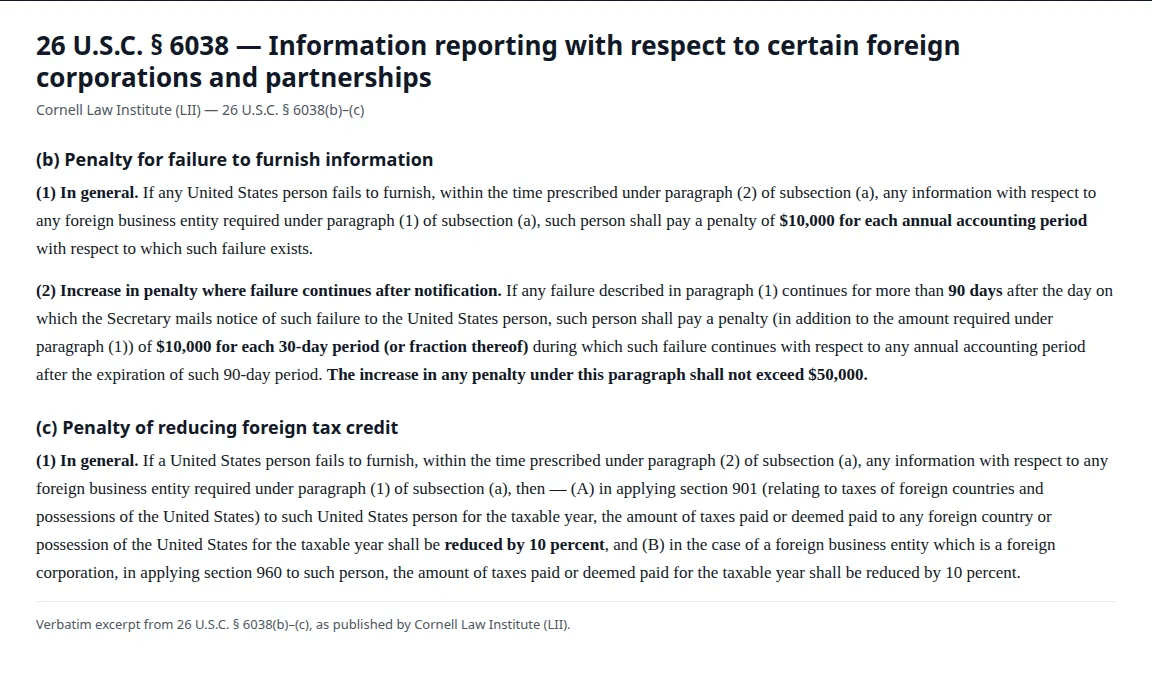
Section 6038(b)(1) charges 10,000 dollars for each annual accounting period for which the information is not furnished on time. If the failure continues more than 90 days after the IRS mails notice, section 6038(b)(2) adds 10,000 dollars for each 30-day period, or fraction, after the 90-day period — capped at 50,000 dollars additional, so the maximum for one partnership for one year is 60,000 dollars.
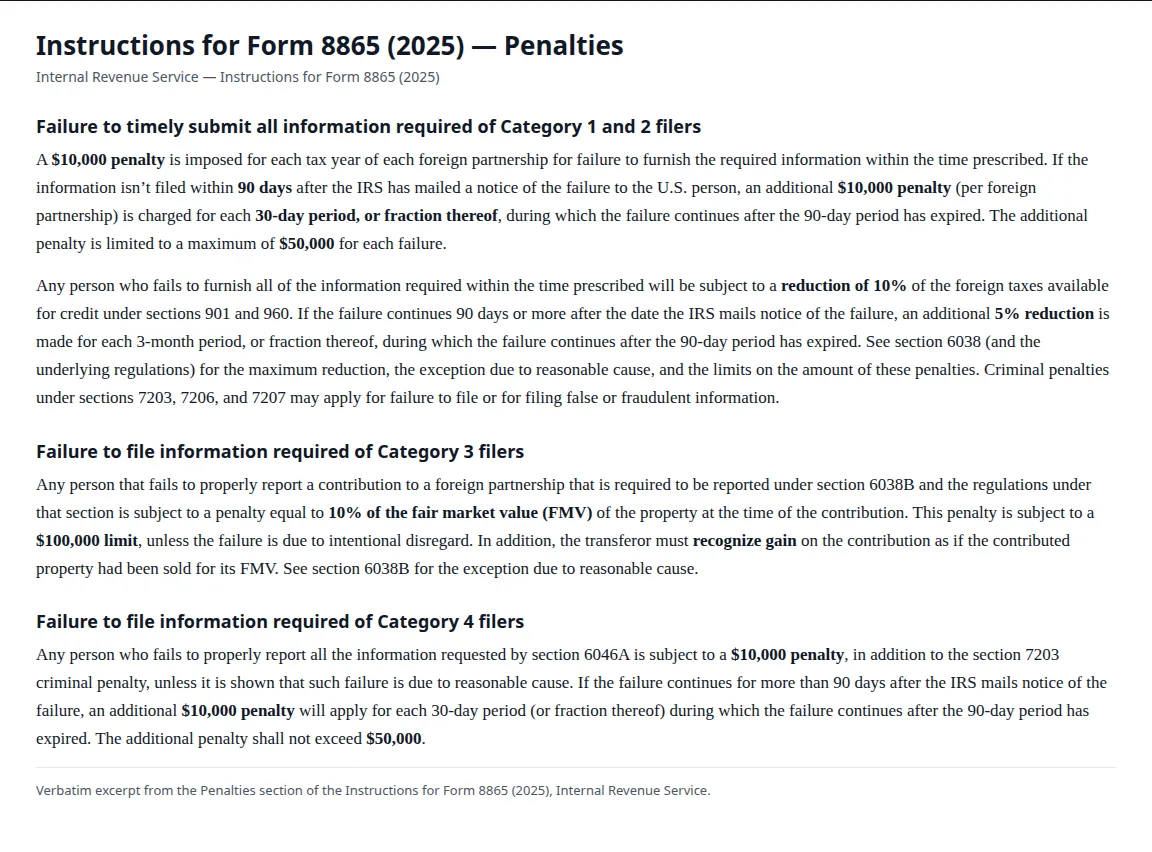
Take a Category 1 filer who misses one partnership year. After notice and the 90-day grace period, the failure continues 200 more days — six full 30-day periods plus a 20-day fraction, and a fraction counts as a full period, so seven periods are charged:
The clock is per partnership, so the same delay across three partnerships is 180,000 dollars at the cap. Reasonable cause is the only escape: section 6038(c)(4)(B) treats the deadline as no earlier than the last day reasonable cause existed.
The dollar penalty is not the whole cost: section 6038(c) cuts the foreign tax credit by 10 percent of the foreign taxes available, growing 5 percent per 3-month period after the 90-day notice period. A partner with 80,000 dollars available loses 8,000 dollars at once, and 16,000 dollars if the failure runs two more 3-month periods:
The reduction is capped at the greater of 10,000 dollars or the entity's income for the year, and reduced by any dollar penalty already imposed for the same period.
Section 6038B: transfers of property
Section 721 says no gain or loss is recognized on a contribution of property to a partnership. Section 6038B is the price of that nonrecognition when the partnership is foreign: the transfer must be reported, and if it is not, the statute takes the gain back. The duty applies only if the transferor holds at least 10 percent immediately after the transfer, or the value transferred — plus property from the person or a related person to the same or a related partnership in the prior 12 months — exceeds 100,000 dollars.
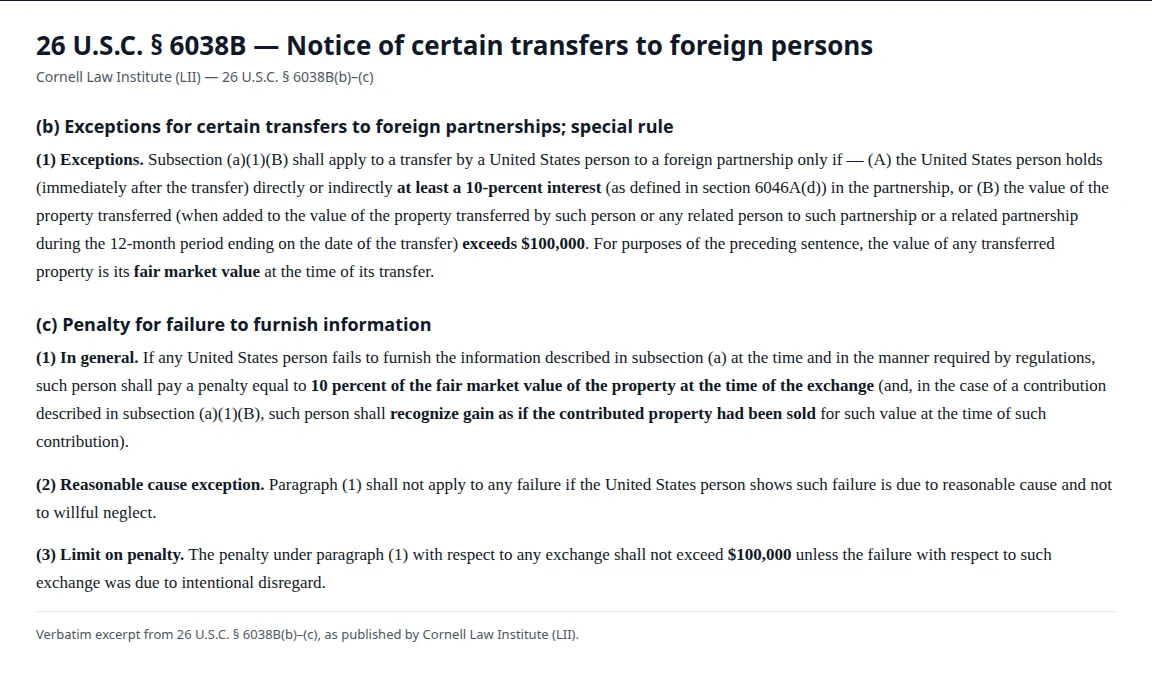
The penalty is severe in a way the section 6038 penalty is not: the transferor pays 10 percent of fair market value at transfer, and must recognize gain as if the property had been sold for that value — capped at 100,000 dollars per exchange unless the failure was due to intentional disregard.
Take a stated example: land worth 500,000 dollars with a 320,000 dollar basis, contributed for a 40 percent interest and not reported. The built-in gain is 180,000 dollars:
On the stated assumption of a 20 percent rate on the recognized gain — an assumption, not a statutory rate — the tax is 36,000 dollars, for a combined cost of 86,000 dollars on a transfer that would have been tax-free if reported:
The transferor's basis in the partnership interest rises by the recognized gain, so the tax is not double-counted later.
Section 6046A and the Category 4 penalty
Section 6046A requires a return from any U.S. person who acquires an interest, disposes of any portion of one, or whose proportional interest changes substantially — each at the 10 percent threshold. The penalty sits in section 6679(a)(1): 10,000 dollars for failure to file at the time provided, unless the failure is due to reasonable cause. Section 6679(a)(2) adds the same escalation as section 6038: 10,000 dollars for each 30-day period, or fraction, after the 90-day period following IRS notice, capped at 50,000 dollars additional. Criminal penalties under section 7203 can also apply.
A person who qualifies under both Category 3 and Category 4 for one contribution need not report the same transaction twice: report it under Category 3 and the Category 4 reporting is excused.
Section 721(c), Form 8838-P, and the Form 8838 distinction
A contribution of appreciated property to a partnership with a related foreign partner and 80 percent or more U.S. ownership is a section 721(c) partnership, and the gain deferral method lets the transferor defer the gain — if Form 8865 is filed with Schedules G and H, and Form 8838-P, the consent to extend the time to assess tax under the gain deferral method. The consent extends the assessment period so the IRS can collect the deferred gain if an acceleration event occurs; noncompliance can itself trigger one.
Form 8838 — without the "-P" — is a different consent, for gain recognition agreements under section 367 when property moves to a foreign corporation. The Form 8865 filer who needs a consent files Form 8838-P.
Founder & CEO Insight — Enow A. Jovial
Complete its schedules, attach the form to the return, and keep the valuation and the K-1 workpapers. The IRS Form 8832 entity classification election playbook decides whether the foreign entity is a partnership at all, the IRS Form 8938 FATCA foreign financial assets playbook covers the separate individual reporting of the same holdings, and the tax estimator can carry the K-1 income into an estimate before the return is prepared.