Form 720 is the quarterly return for federal excise taxes — taxes collected not on income, but on specific things: gallons of fuel removed from a terminal, seats sold on a domestic flight, tanning sessions, and other transactions Congress chose to tax at the point of sale or use. If your business removes the fuel, sells the ticket, or collects the tax from the customer, you are the filer, and the return is due four times a year. The tax is usually invisible to the end customer, but the deposit clock runs every two weeks, not every quarter.
Who files — and who does not
You file Form 720 if you are liable for any tax listed in Part I or Part II: the position holder who removes taxable fuel from a terminal, the airline or charter operator that collects air transportation tax, the communications provider, the manufacturer of taxable sporting goods, the tanning salon that collects the 10% tax, or the health plan sponsor that owes the PCORI fee. The end consumer never files.
Heavy vehicle use tax is Form 2290; fuel credits for off-highway or farm use go on Form 4136 or Form 8849. Part I liability of $2,500 or less for the quarter means no deposits — pay with the return — but Schedule A is still required.
Founder & CEO Insight — Enow A. Jovial
The rate table: what Form 720 actually taxes
| Tax (Form 720 line) | Rate | Authority |
|---|---|---|
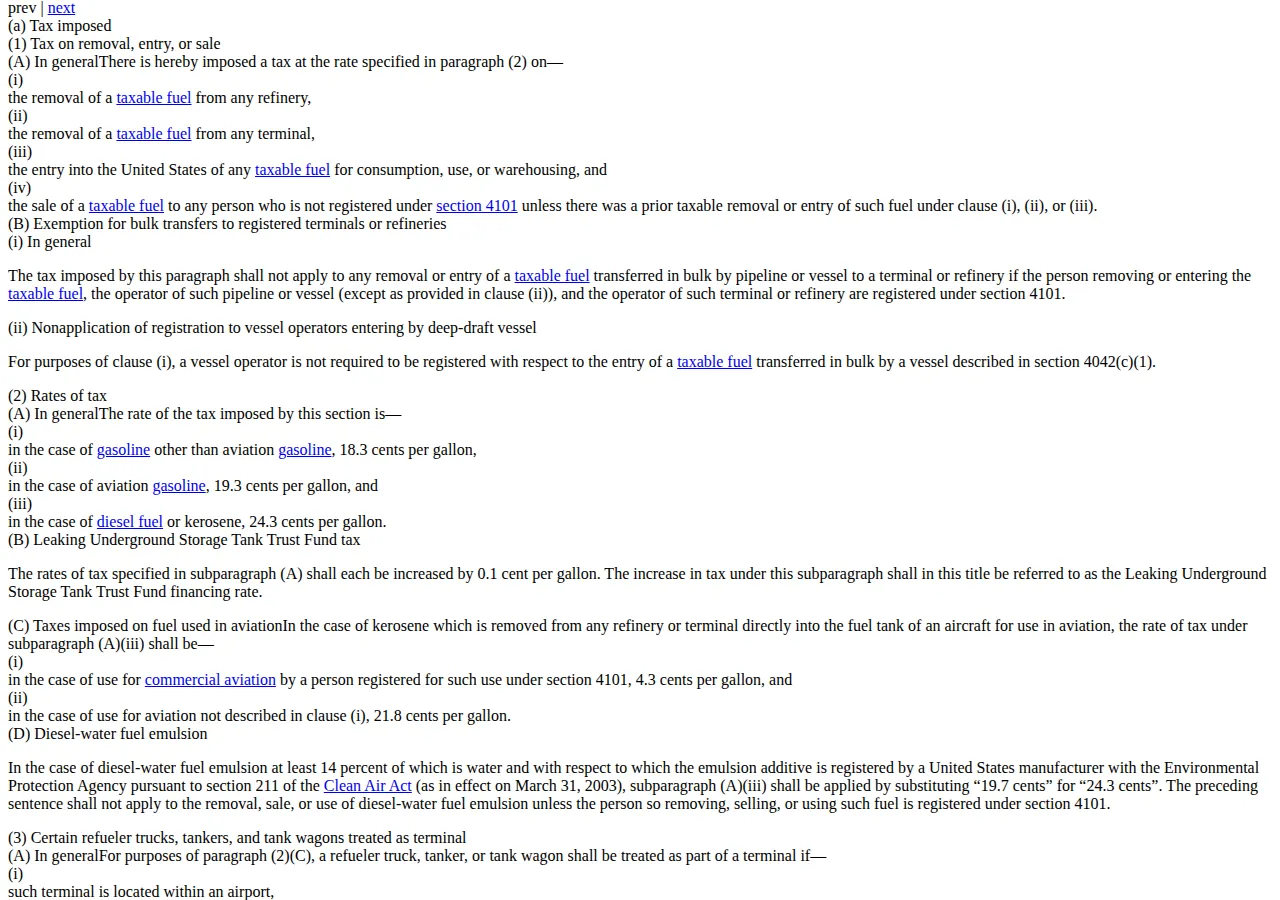
| Gasoline (IRS No. 62) | $0.184 per gallon | 26 U.S.C. § 4081(a)(2)(A)(i) + LUST |
| Diesel / kerosene (IRS No. 60 / 35) | $0.244 per gallon | 26 U.S.C. § 4081(a)(2)(A)(iii) + LUST |
| Aviation gasoline (IRS No. 14) | $0.194 per gallon | 26 U.S.C. § 4081(a)(2)(A)(ii) + LUST |
| Kerosene for aviation (IRS Nos. 69 / 77) | $0.219 noncommercial / $0.044 commercial | 26 U.S.C. § 4081(a)(2)(C) + LUST |
| Fractional ownership fuel surtax (IRS No. 13) | $0.141 per gallon | 26 U.S.C. § 4043 |
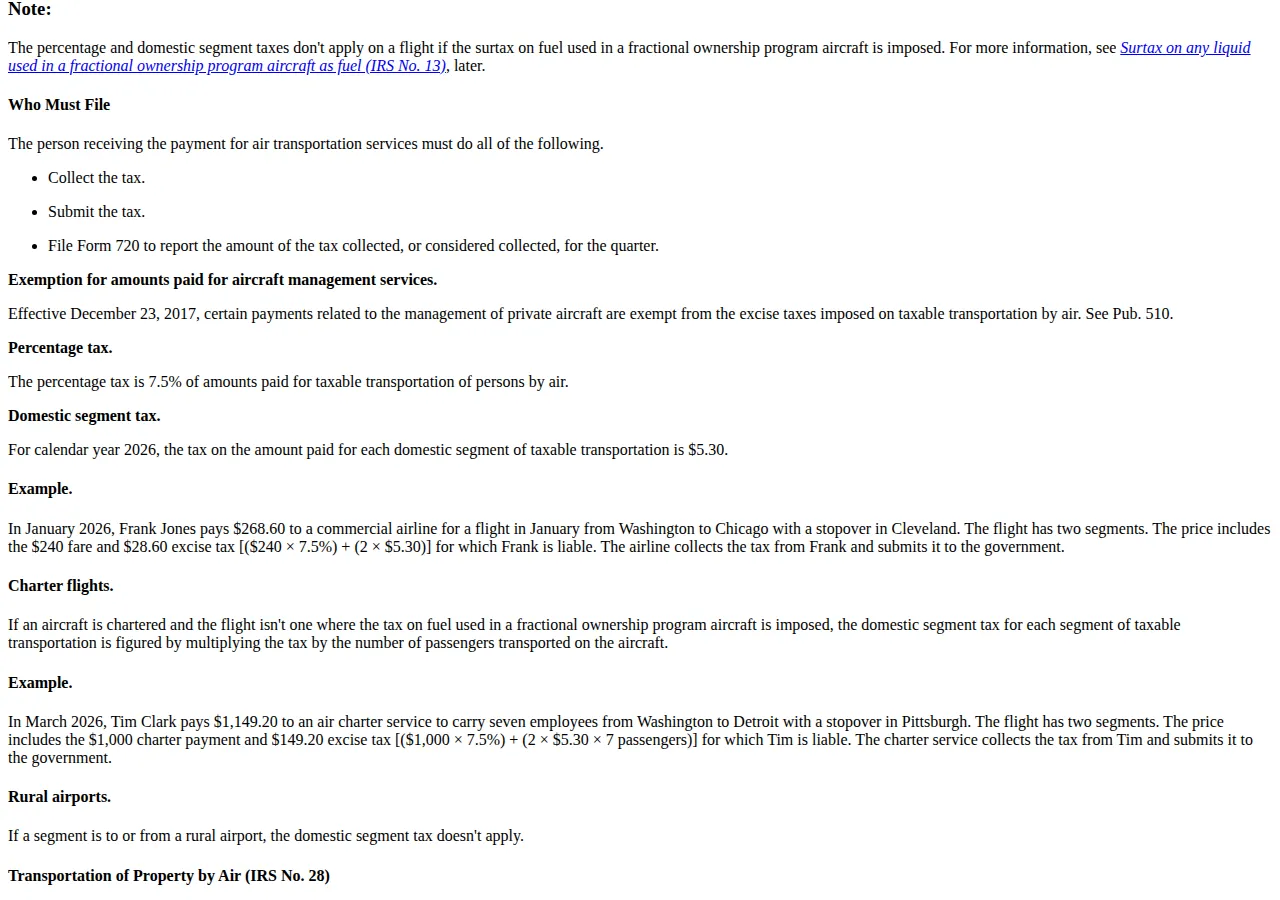
| Air transportation, persons (IRS No. 26) | 7.5% of fare + $5.30 per segment (2026) | 26 U.S.C. § 4261(a)–(b) |
| International air facilities (IRS No. 27) | $23.40 per person (2026) | 26 U.S.C. § 4261(c) |
| Air transportation, property (IRS No. 28) | 6.25% of amount paid | 26 U.S.C. § 4271 |
Fuel taxes: where the money is collected
Section 4081 imposes the tax at the earliest of removal from a refinery or terminal, entry into the United States, or sale to a person not registered under § 4101. The person who pays is the position holder — the refiner, importer, or terminal operator. Bulk transfers to a registered terminal or refinery are exempt, so the tax attaches once, at the terminal rack; § 4081(e) refunds tax already paid on a prior removal.
A fleet operator never files Form 720 for the diesel in its tanks: the tax was collected upstream and sits in the pump price. Section 4041 is the backstop: diesel sold to the owner or operator of a diesel-powered highway vehicle or train, taxed at the § 4081 diesel rate. Diesel in trains is taxed at zero after December 31, 2006; § 6427(b)(1) bus fuel at 7.3 cents per gallon; school-bus and intracity fuel untaxed.
Air transportation: three taxes on one ticket
Section 4261 imposes three taxes. The percentage tax is 7.5% of the amount paid for taxable transportation. The domestic segment tax is $3.00 per segment in the statute, indexed every year — $5.30 for 2026. The international facilities tax is $12.00 per person in the statute, indexed to $23.40 for 2026 — $11.70 for Alaska or Hawaii segments, departures only.
A segment is one takeoff and one landing. A connecting itinerary pays once per leg; a round trip counts as two trips. The segment tax does not apply at a rural airport — under 100,000 departing commercial passengers in the second preceding calendar year, and more than 75 miles from another airport, receiving essential air service subsidies, or not connected by paved roads. And § 4271 adds a fourth tax for cargo: 6.25% of the amount paid, reported as IRS No. 28.
Worked example 1: a fuel terminal's quarter
Mid-Continent Fuel Terminal, a fictional § 4101-registered operator, removes 120,000 gallons of gasoline and 85,000 gallons of diesel in Q1 2026. Its Part I fuel liability is:
Deposits are required. Six semimonthly periods per quarter, and if liability accrued evenly, each carries about $7,136.67. Two deposit standards compete:
The $36,000 is the lookback quarter's net liability (Q3 2025). The safe harbor requires only $6,000 per period against $6,779.84 under the 95% rule, so the terminal deposits $6,000 each period and pays the underpayment with the return by April 30, checking line 5. In September, the additional deposit for September 16–26 must be at least 11/90 of lookback liability ($4,400.00), and the period total must reach one-sixth of lookback liability ($6,000.00).
Worked example 2: a charter operator's quarter
The IRS's own examples confirm the air-tax arithmetic: a $240 fare over two segments owes ($240 × 7.5%) + (2 × $5.30) = $28.60, and a $1,000 charter for seven employees over two segments owes ($1,000 × 7.5%) + (2 × $5.30 × 7) = $149.20. Now scale it to a quarter. A small charter operator sells $245,000 of domestic fares and flies 1,200 domestic segments in the first quarter of 2026:
That is $4,122.50 per semimonthly period, so each deposit must be at least 95% of the period's liability — $3,916.38 — unless the safe harbor gives a lower number. Air carriers usually deposit under the alternative method, on taxes included in amounts billed or tickets sold, keeping a separate account.
The deposit rules, in full
The regular method covers every Part I tax except communications and air taxes deposited on the billed basis. A semimonthly period is the 1st–15th or the 16th–end of a month. Under the regular method, the deposit is due by the 14th day after the period ends — generally the 29th for the first period and the 14th of the following month for the second.
Every deposit must be at least 95% of the period's net tax liability — total liability minus Schedule C claims — unless the safe harbor applies. The safe harbor lets a filer deposit one-sixth (16.67%) of the lookback quarter's net liability per period instead. September has its own rule: for 2026, regular-method taxes for September 16–26 are due September 29, and alternative-method taxes for September 1–11 are also due September 29; the remaining September days are deposited by October 10. Deposits go through EFTPS, initiated at least one day before the due date, before 8:00 p.m. Eastern.
Schedule A, Schedule C, and Part II
Schedule A records Part I net tax liability per semimonthly period — complete it even under $2,500. Schedule C holds the claims that reduce it: credits for fuel used for nontaxable purposes and other statutory claims.
Part II holds the taxes paid with the return rather than deposited. The PCORI fee (IRS No. 133) is $3.84 per covered life for plan years ending October 1, 2025–September 30, 2026 ($3.47 the prior year), on the second-quarter Form 720 only, due July 31 the following year. A sponsor with a plan year ending December 31, 2025 and 1,250 covered lives owes:
The indoor tanning tax (IRS No. 140) is 10% of the amount paid: a salon selling $18,000 in a quarter collects and remits $1,800. The newest Part II arrival is the remittance transfer tax under § 4475 (One Big Beautiful Bill Act of 2025): 1% on certain transfers after 2025; first deposit due January 29, 2026, with limited penalty relief for Q1–Q3 2026 (Notice 2025-55).
The filing calendar
| Quarter | Period ends | Form 720 due |
|---|---|---|
| Q1 | March 31 | April 30 |
| Q2 | June 30 | July 31 |
| Q3 | September 30 | October 31 |
| Q4 | December 31 | January 31 |
The PCORI fee rides on the Q2 return.
Penalties: the deposit tiers
The failure-to-deposit penalty under 26 U.S.C. § 6656 is a percentage of the underpayment:
| Days late | Penalty |
|---|---|
| 1–5 days | 2% of the underpayment |
| 6–15 days | 5% of the underpayment |
| More than 15 days | 10% of the underpayment |
| After delinquency notice | 15% of the underpayment |
A $10,000 deposit 8 days late costs $500; 20 days late, $1,000. Failure to file under § 6651 costs 5% of the net tax per month, up to 25%; the trust fund recovery penalty is the full unpaid amount.
Common mistakes that cost real money
The most expensive mistake is treating collected excise tax as revenue. It is not yours, it is not working capital, and the trust fund recovery penalty makes the distinction personal. The second is depositing quarterly instead of semimonthly — paying in full on April 30 does not cure January, February, and March deposits. The third is the rural-airport trap in reverse: claiming the exemption for an airport over 100,000 departing passengers two years ago, or within 75 miles of a larger airport. The fourth is filing the PCORI fee on the wrong quarter — Q2 only.
File the quarter in ten steps
- Confirm taxable events. List every taxable event, with its IRS number.
- Compute liability. Apply the § 4081, § 4261, or § 4271 rate per IRS number.
- Apply Schedule C claims. Subtract claims allowed for the period.
- Test the $2,500 exception. If Part I liability is $2,500 or less, skip deposits — but complete Schedule A.
- Choose the method. Regular method for fuel; alternative method for air and communications taxes.
- Compute the safe harbor. Deposit the smaller of one-sixth of the lookback quarter's liability or 95% of the current period's.
- Make the six deposits. Through EFTPS, one day before each due date, before 8:00 p.m. Eastern.
- Apply the September rule. Split September deposits; meet the September 29 deadline.
- Complete Schedules A and C. Enter liability by IRS number; check line 5 if the safe harbor was used.
- File and keep the records. File by April 30, July 31, October 31, or January 31; keep the deposit confirmations and the lookback-quarter return.
The identifiers paragraph
For the record, when you hand this quarter to a CPA or a preparer: the return is filed under the business's EIN, and the EIN on the return must match the EFTPS enrollment or the deposits will not credit. The fuel filer is the LLC, C-Corp, or S-Corp holding the § 4101 registration; an unregistered seller cannot claim the bulk-transfer exemption. A paid preparer signs with a PTIN. Schedules A and C are part of the same return. And the GAAP books should carry the collected tax as a liability from the day it is collected, not the day the return is filed — that one choice keeps a quarter's excise tax from becoming a personal penalty.
Where this fits
Form 720 sits beside the payroll returns, not inside them. The quarterly payroll return is our IRS Form 941 quarterly payroll tax filing playbook, and the annual federal unemployment return is our IRS Form 940 FUTA annual tax playbook — FUTA is itself a federal excise tax under 26 U.S.C. § 3301. Self-employed operators should read our IRS Form 1040 Schedule C playbook alongside this one.