Form 4797 is where a business-property sale is split in two: the part that pays back the depreciation deductions as ordinary income, and the part that keeps its character as capital gain. Most filers get it wrong in the same place — they report the whole gain as capital, put a §1245 machine in Part I, or forget the five-year lookback and a net §1231 gain turns ordinary after the return is filed. Every figure below is read from the 2025 Instructions for Form 4797, the statute text at 26 U.S.C. §§1231, 1245, and 1250, or IRS Topic 409, on November 16, 2026.
Where to make first entry: the routing table
The instructions open with a routing table, and it is the whole form in miniature. The table below reproduces it, with the authority for each row.
| Property and holding period | First entry | Authority |
|---|---|---|
| Depreciable tangible property, gain, held more than 1 year | Part III, line 25 (§1245) | Instructions for Form 4797 |
| Depreciable tangible property, loss, held more than 1 year | Part I | Instructions for Form 4797 |
| Depreciable real property, gain, held more than 1 year | Part III, line 26 (§1250) | Instructions for Form 4797 |
| Depreciable real property, loss, held more than 1 year | Part I | Instructions for Form 4797 |
| Property held 1 year or less | Part II, line 10 | Instructions for Form 4797 |
| Cattle and horses held 24 months, other livestock 12 months | Part I (§1231) | 26 U.S.C. § 1231(b)(3) |
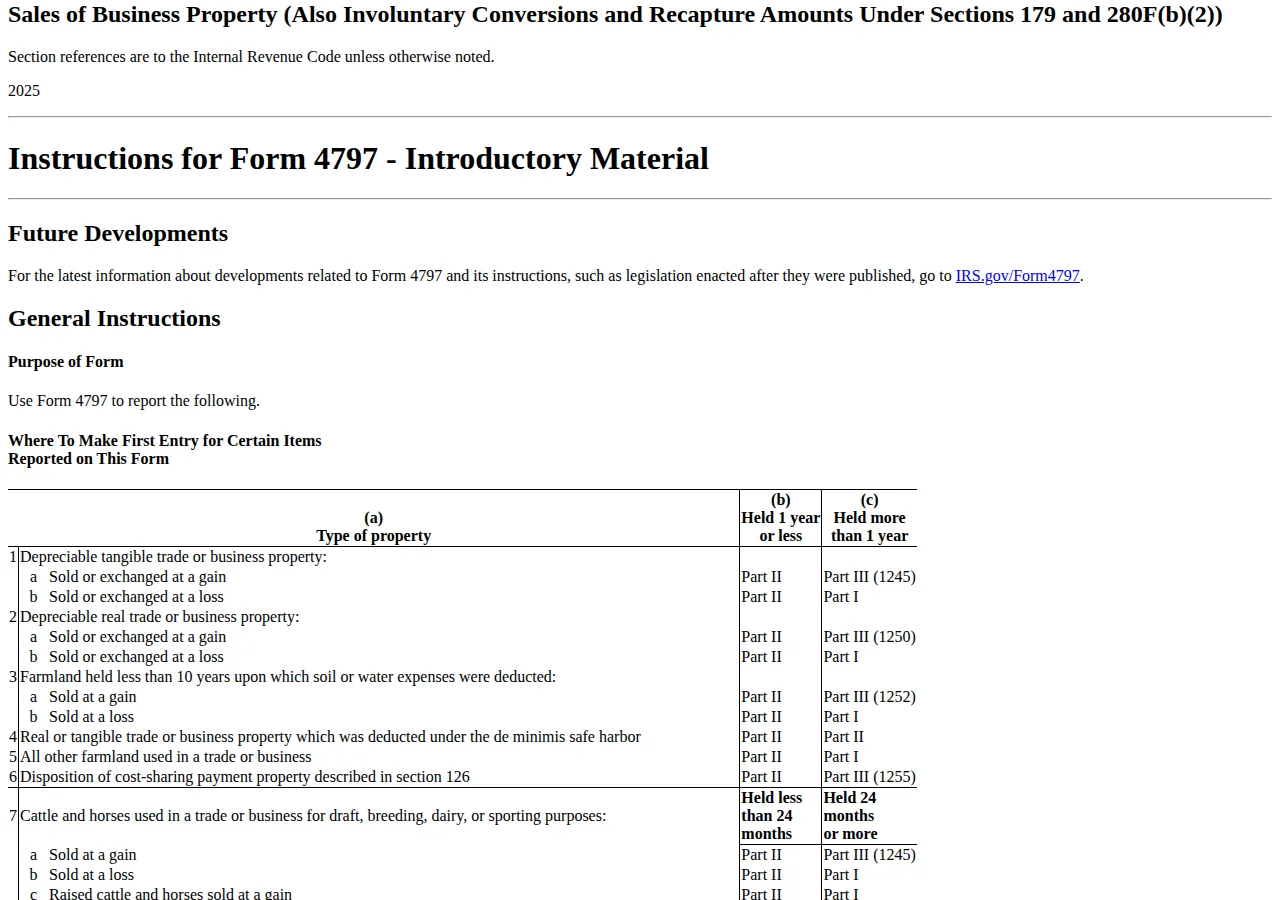
The holding-period line is the first trap: a machine held 13 months is §1231 property, the same machine held 11 months is an ordinary gain or loss on line 10. Livestock has its own clock — cattle and horses need 24 months, other livestock 12 — and farmland with soil and water conservation deductions goes to Part III under §1252 even when the land itself was held for years.
Part I: §1231 netting — the character test
Part I reports §1231 transactions that are not in Part III. Section 1231 covers real property and depreciable property used in a trade or business and held more than one year, plus timber under §631, coal and iron ore under §631(c), and involuntary conversions. It excludes inventory, property held primarily for sale to customers, self-created patents and copyrights, and US government publications.
The netting rule in §1231(a) is a single comparison, and it decides the character of every §1231 gain on the return. If the net is positive, the whole net gain is treated as a long-term capital gain and flows to Schedule D. If the net is negative, the whole net loss is ordinary. One carve-out: casualty and theft losses that exceed casualty and theft gains are kept out of the netting entirely.
Casualty and theft losses that exceed casualty and theft gains are kept out of the netting entirely — they do not drag a capital gain down to ordinary, and they do not shelter an ordinary loss.
Founder & CEO Insight — Enow A. Jovial
The five-year lookback: §1231(c)
The lookback is the rule that turns a capital gain ordinary after the fact. Under §1231(c), a net §1231 gain is treated as ordinary income to the extent of the taxpayer's nonrecaptured net §1231 losses from the five preceding taxable years. The IRS instructions carry their own worked example:
A taxpayer has net §1231 losses of $4,000 in 2020 and $6,000 in 2021, then net §1231 gains of $3,000 in 2024 and $2,000 in 2025. In 2024, $3,000 of the $10,000 of prior losses is recaptured, leaving $7,000 nonrecaptured. In 2025, the $2,000 gain is entered on line 7, the $7,000 of nonrecaptured losses on line 8, and the entire $2,000 is treated as ordinary income on line 12. Five thousand dollars of the 2021 losses remain to recapture. Line 9 is the release valve: if line 9 is greater than zero, all prior losses have been recaptured and the gain goes to Schedule D as a long-term capital gain.
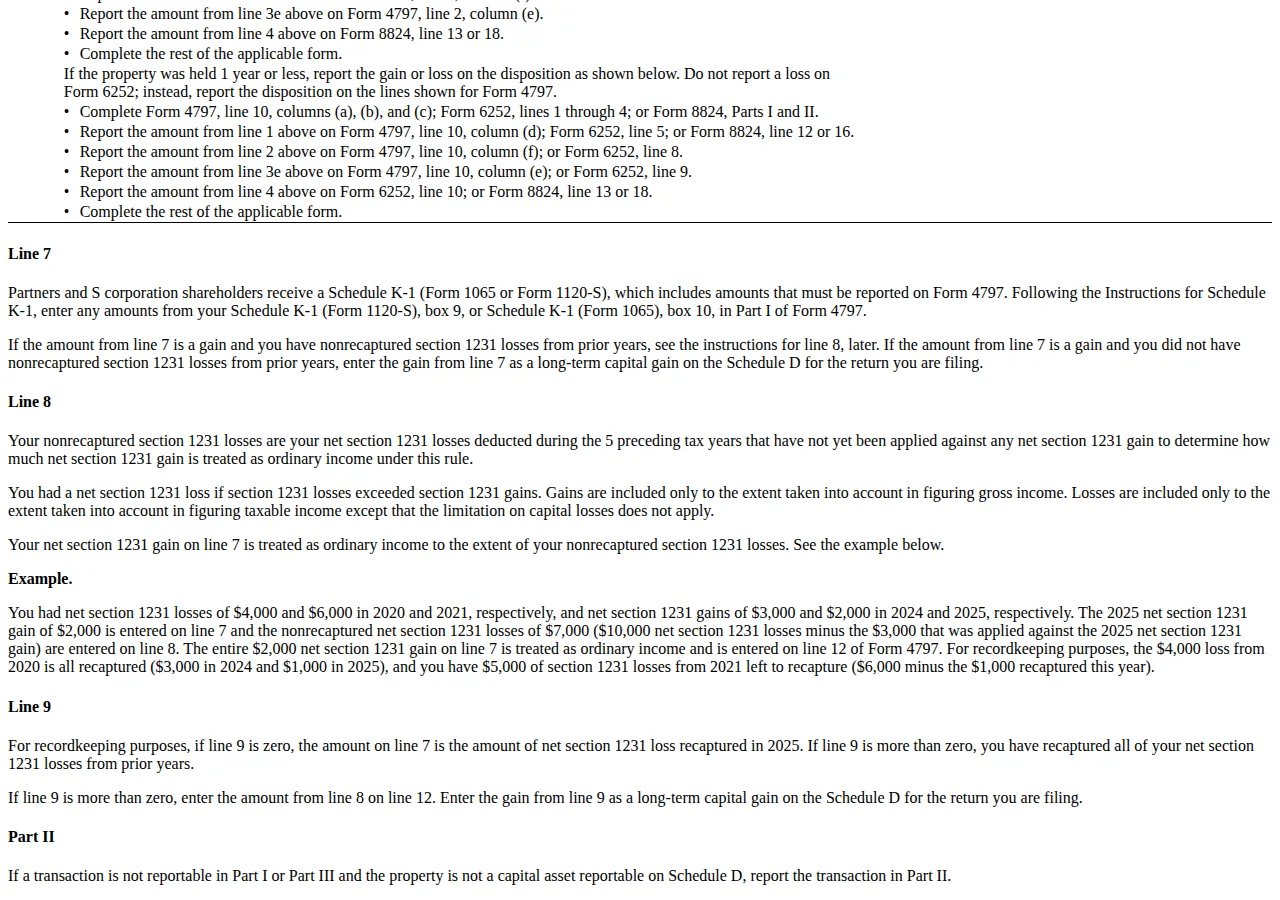
The planning rule is that §1231 losses are not free: a loss taken this year is ordinary today, but it converts up to the same amount of future §1231 gain from capital to ordinary for five years. An LLC or S-Corp that harvests a §1231 loss in December is borrowing against the character of the next sale. A CPA should run the lookback before the sale closes, because the character is fixed by the year the gain is recognized.
Part III, lines 19–24: the recapture arithmetic
Part III is where the dollars are computed. Lines 19 through 24 run the same sequence for every §1245 and §1250 disposition:
Line 20 is the gross sales price, including debt the buyer assumes and insurance reimbursements. Line 21 is the cost or other basis. Line 22 is depreciation allowed or allowable, plus §179 expense. Line 23 is the adjusted basis; line 24 is the total gain. A partner's share of §179 recapture from a Schedule K-1 maps worksheet lines 1 through 5 onto lines 19 through 24.
§1245 property: the machine example
Section 1245 covers depreciable personal property — machinery, equipment, vehicles, computers — and the recapture rule is absolute: the ordinary-income portion is the lesser of the depreciation and the total gain.
Example — the §1245 machine. A delivery van is bought for $120,000 and depreciated $90,000, leaving an adjusted basis of $30,000. It sells for $100,000. The total gain is $100,000 − $30,000 = $70,000, and the §1245 ordinary income is min($90,000, $70,000) = $70,000 — the entire gain is ordinary income on line 25, and nothing reaches §1231 as a capital gain. Had the van sold for $140,000, the total gain would be $110,000, the recapture still $90,000, and the remaining $20,000 a §1231 gain on line 9.
§1250 property: the building example
Section 1250 covers depreciable real property. Its recapture reaches only the additional depreciation — the excess of depreciation actually taken over straight-line depreciation — and for property placed in service after 1986 under MACRS, depreciation is straight-line, so additional depreciation is generally zero.
Example — the §1250 building. A rental building is bought for $500,000 and depreciated $150,000 on a straight line, leaving an adjusted basis of $350,000. It sells for $600,000. The total gain is $250,000. Additional depreciation is $0, so §1250 ordinary income is $0. The unrecaptured §1250 gain is min($150,000, $250,000) − $0 = $150,000, taxed at a maximum 25% under §1(h)(1)(F). The remaining $100,000 is long-term capital gain. Under IRS Topic 409, the 2025 thresholds are 0% up to $48,350 single, $96,700 married filing jointly, or $64,750 head of household; 15% up to $533,400, $600,050, or $566,700; and 20% above — but the unrecaptured §1250 portion never gets the 0% or 15% rate; its ceiling is 25%.
Corporations face one more layer on line 26f: §291 adds 20% of the excess of what would have been ordinary under §1245 over the §1250 amount.
Part II: property held one year or less
Part II is the short-hold part, and it is blunt: gains and losses on line 10 are ordinary, with no §1231 netting and no capital treatment. It also catches abandonments and §1244 stock: a loss on small business stock is treated as an ordinary loss up to $50,000, or $100,000 for a married couple filing jointly — the one place on the form where a stock loss escapes capital treatment. The §1244 loss is ordinary for income tax but it is not self-employment income — no SECA, no FICA — because it is a capital transaction, not a wage.
Example — the short-hold sale. Equipment is bought for $40,000, depreciated $8,000 in eight months, and sold for $36,000. The adjusted basis is $32,000 and the gain is $4,000, reported as ordinary income on line 10. Had the equipment been held 13 months, the same $4,000 would have entered Part I as a §1231 gain and, after netting, could have been long-term capital gain. Four months of holding period is the difference between ordinary and capital on the same dollars.
Installments, like-kind exchanges, and opportunity zones
Three routes change where the gain lands, and each has its own line. An installment sale under §453 reports the gain from Form 6252 on line 4 (Part I) or line 15 (Part III), year by year as payments arrive — but the recapture portion is reported in the year of sale, not spread across the installments. A like-kind exchange under §1031 reports the recognized gain from Form 8824 on line 5 or line 16; the deferred portion never touches Form 4797. A qualified opportunity fund investment defers a qualified §1231 gain if the amount is invested within 180 days of the sale, but recapture under §§1245 and 1250 may not be deferred — the instructions give a $300,000-gain example in which $75,000 is deferred and the rest is reported on Form 4797.
Two more routes deserve a line each. The §121 exclusion for a principal residence is entered on line 2 as a loss, but depreciation taken after May 6, 1997 is not excludable — the depreciation on a home office or a rental portion comes back as unrecaptured §1250 gain even when the rest of the gain is excluded. And §179 recapture fires when business use of §179 property drops to 50% or less, or the property is converted to personal use: the instructions send that recapture to Part III under §§179 and 280F(b)(2), even with no sale at all.
Filing sequence
- Identify every disposition and route it. Part III for depreciable property held more than one year, Part I for §1231, Part II for one year or less.
- Compute lines 19–24 for each Part III asset. One asset per line; do not net assets against each other.
- Split the gain on lines 25 and 26. §1245 recapture is min(depreciation, gain); §1250 recapture is additional depreciation only.
- Net Part I under §1231. Total the gains and losses, apply the casualty carve-out, then run the five-year lookback on lines 7 and 8.
- Route the special items. Installment gain from Form 6252 to line 4 or 15; like-kind gain from Form 8824 to line 5 or 16; QOF deferral off the §1231 portion only; §121 exclusion on line 2.
- Carry the results to Schedule D. Net §1231 gains go to Schedule D as long-term capital gain; net §1231 losses stay ordinary; unrecaptured §1250 gain carries its 25% ceiling with it.
Most Form 4797 errors are routing errors, not arithmetic errors: the §1245 machine filed in Part I so the recapture is never computed; the lookback never run so five years of §1231 losses sit unrecaptured; the QOF deferral applied to recapture; the §121 exclusion claimed on post-1997 depreciation; the installment recapture spread across payments instead of reported in the year of sale. Each one is a single wrong line, and each one changes the tax by thousands.
Run the numbers through the tax estimator before the sale closes — the estimator prices the recapture against the capital-gains thresholds, and the difference between a December sale and a January sale is the whole five-year lookback window.
Execution checklist
- [x] Step 1: Route every disposition. Part III, Part I, or Part II, from the instructions' table — before any math.
- [x] Step 2: Rebuild the depreciation history. Allowed or allowable, §179 included; recapture is computed on depreciation taken, not claimed.
- [x] Step 3: Compute lines 19–24 asset by asset. Do not net one asset's loss against another's gain inside Part III.
- [x] Step 4: Run the §1231 netting and the five-year lookback. Lines 7, 8, 9, and 12 in order; the lookback decides the character after the netting does.
- [x] Step 5: Split §1245 from §1250. Min(depreciation, gain) for personal property; additional depreciation only for real property; unrecaptured §1250 gain at a 25% ceiling.
- [x] Step 6: Route the special items. Form 6252 to line 4 or 15, Form 8824 to line 5 or 16, QOF deferral on the §1231 portion only, §121 on line 2.
- [x] Step 7: Keep the workpapers. Purchase contracts, depreciation schedules, the §1231 loss history for five years, and the K-1 §179 worksheet stay with the return.
Our §1245 and §1250 recapture playbook runs the statute-level recapture rules in more depth, and the installment sale playbook prices the §453 election that sends the gain to Form 6252. The §199A QBI playbook covers the related boundary: §1231 gains reported here are not qualified business income, so they do not earn the §199A deduction.