The form that follows your ESPP shares
Every pay period, your employee stock purchase plan takes a slice of your pay and buys your employer's stock at a discount at the end of the offering period. When the shares land in your name, the corporation owes you Form 3922, Transfer of Stock Acquired Through An Employee Stock Purchase Plan Under Section 423(c). It is not a tax bill — it is the record that decides, when you sell, how much of your gain is ordinary income and how much is capital gain.
The two rates are not close: ordinary income is taxed at your marginal rate, capital gain at the preferential rate. The form itself is small — eight boxes on a single page, revised April 2025 — but the numbers in those boxes carry the whole calculation. Lose the form and you lose the grant-date fair market value, which no broker statement will give you back.
Section 421(a) states the starting rule: if the transfer meets section 423(a), no income results at transfer on exercise, and no deduction is allowable to the employer. The tax waits for the sale.

The form in eight boxes
Form 3922 (Rev. April 2025, OMB No. 1545-2129) fits the whole transfer on one page. Each box holds one input to the later tax calculation, and each maps to a specific fact about your option.
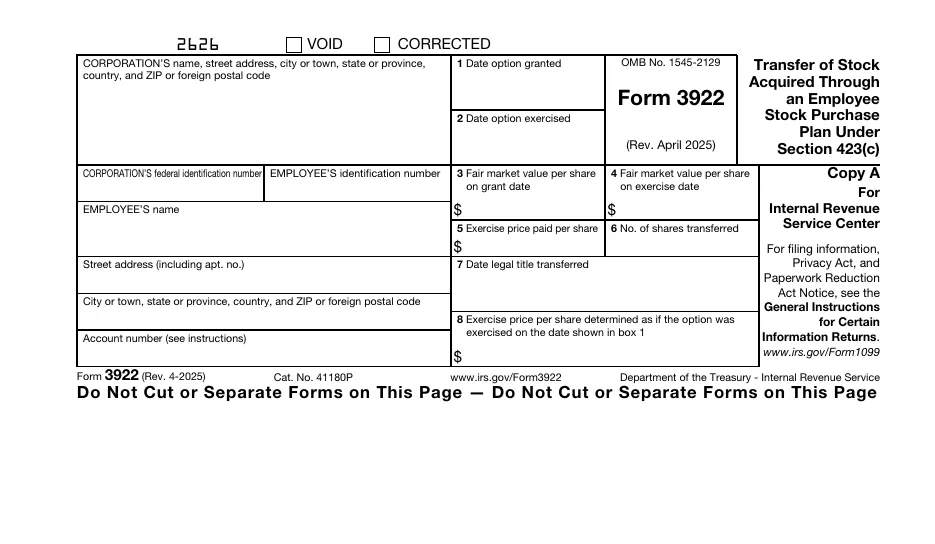
| Box | What it holds | Where the number comes from |
|---|---|---|
| 1 — Date option granted | The day the offering period opened | The plan's grant date, not the payroll deduction start |
| 2 — Date option exercised | The day the purchase executed | The purchase date at the end of the offering period |
| 3 — FMV per share on grant date | Fair market value at grant | The closing price on the grant date |
| 4 — FMV per share on exercise date | Fair market value at exercise | The closing price on the purchase date |
| 5 — Exercise price paid per share | What you actually paid | The discounted purchase price, usually 85% of the lower value |
| 6 — No. of shares transferred | Share count | Total payroll deductions divided by the exercise price |
| 7 — Date legal title transferred | When the shares became yours | The transfer date, which starts the one-year holding clock |
| 8 — Exercise price as if exercised on box 1 date | The hypothetical grant-date price | Used where the option price was not fixed at grant |
Box 8 is the one people misread: for lookback plans, where the price is the lower of the grant-date and exercise-date values, section 423(c) figures the option price as if the option had been exercised at grant.
The corporation's name, address, and EIN sit at the top left; your name, address, and identification number sit below, and Copy A goes to the IRS. If a box is wrong — most commonly box 3, where a plan administrator uses the wrong trading day — ask for a corrected form, marked CORRECTED, before filing season.
The five section 423 tests your plan must pass
Form 3922 only means what it says if the plan qualifies under section 423(b): nine requirements, five of which do the real work.
The 85% price floor. Under section 423(b)(6), the option price must be at least the lesser of 85% of the fair market value at grant or 85% at exercise. The 15% discount is the maximum, not the rule. Below 85% of either value, the plan fails section 423 and the purchase is taxed as a nonstatutory option.
The exercise window. Section 423(b)(7) caps the option's life at five years from grant where the price is set at 85% of the exercise-date value, or 27 months where it is not determinable that way. Most offering periods run six months, so the cap rarely binds.
The $25,000 annual cap. Section 423(b)(8) is the number that catches high earners: no employee may accrue rights above $25,000 of fair market value — measured at grant — per calendar year the option is outstanding, across all plans of the employer and its parents and subsidiaries. The right accrues when it first becomes exercisable, and accrued rights cannot be carried to another option.
At a $50 grant-date value, the cap allows 500 shares a year to accrue; at $250, it allows 100. Payroll deductions that would buy more than the cap allows are returned, not banked — the plan cannot let the excess roll into the next offering period.
Employment and non-transferability. Section 423(a)(2) requires employment from the grant date until three months before exercise; leave earlier and the option is not a section 423 option. Section 423(b)(9) makes the option non-transferable except by will or descent, exercisable during life only by the employee. Whether the employer is an S-Corp, a C-Corp, or an LLC taxed as a corporation, the same tests apply.
The two tax outcomes, with the math exposed
Everything on the form points at one decision: did you satisfy the holding period? Section 423(a)(1) and Publication 525 state it identically — no sale until the later of one year after transfer or two years after grant. The holding period begins the day after exercise.
Qualifying disposition: the lesser-of formula
Sell after both clocks run out and section 423(c) applies: where the option price was below 100% of the grant-date value, the ordinary income is the lesser of two numbers:
Your basis is the option price plus the ordinary income included; any further gain is capital gain, a loss is entirely a capital loss with no ordinary income, and the same lesser-of amount is included as compensation if you die owning the shares.
Publication 525 works this with a real example — Pine Company, where the option price is the lower of the grant-date and exercise-date prices. The stock was worth $25 at grant and $20 at exercise; $5 weekly deductions over 48 weeks totalled $240, buying 12 shares at $20. The $5 grant-date discount is the ceiling on the ordinary income, however high the stock climbs — which is why the discount is capped at 15% and the formula favours the long holder.
Disqualifying disposition: the discount becomes wages
Sell before either clock runs out and the treatment flips: the discount is wages in the year of disposition, added to your basis. Publication 525's example — $23 at exercise against a $20 price on 100 shares — produces $300 of wages, and on a $30 sale the remaining $700 of the $1,000 gain is capital gain:
Section 421(b) moves the income — and any employer deduction — into the year of disposition, and no amount must be withheld under chapter 24 for the increase. The wages may not appear on your W-2, so the amount is yours to report; and the broker's 1099-B will usually show a basis equal to the exercise price, not the basis increased by the ordinary income. Report the 1099-B basis as printed and you pay tax twice on the same $300. Ask your CPA how the wages are treated for FICA — the statute bars chapter 24 withholding on the increase, and the FICA answer turns on the wage character, so confirm it rather than assuming.
| Outcome | Ordinary income | Capital gain | Authority |
|---|---|---|---|
| Qualifying disposition | Lesser of (FMV at disposition − price paid) or (FMV at grant − option price) | Total gain less ordinary income | 26 U.S.C. § 423(c); Pub. 525 |
| Disqualifying disposition | FMV at exercise − price paid, as wages | Total gain less ordinary income | Pub. 525; 26 U.S.C. § 421(b) |
| Loss on sale | None | Whole loss is capital loss | Pub. 525 |
| Death while owning shares | Lesser-of amount in the final year | Balance as capital gain to the estate | 26 U.S.C. § 423(c) |
| No income at transfer | None at exercise | — | 26 U.S.C. § 421(a) |
The deadlines on both sides of the form
Form 3922 creates obligations in two directions: the corporation must furnish and file, and you must keep and report. For the 2025 tax year, the corporation files Forms 3921 and 3922 on paper by March 2, 2026, or by March 31, 2026 if e-filing, and must furnish your copy by January 31 — Publication 525 repeats the furnishing date for the employee's side.
| Obligation | Deadline (2025 tax year) | Source |
|---|---|---|
| Furnish to employee | January 31, 2026 | Pub. 525; General Instructions |
| File with IRS, paper | March 2, 2026 | General Instructions for Certain Information Returns |
| File with IRS, e-file | March 31, 2026 | General Instructions for Certain Information Returns |
| Correct a wrong form | Same filing channel, marked CORRECTED | Form 3922 instructions |
The March 2 paper date is the 2025-year figure — the February 28 date moves when it falls on a weekend — so read the current year's General Instructions each season.
If January 31 passes with no form, do not wait: Topic No. 427 says the ESPP participant should receive Form 3922, so ask the stock plan administrator, and if it never arrives, reconstruct the numbers from the grant agreement and the purchase confirmation.
What to do when the form arrives
- Match the boxes to the plan records: grant and exercise dates, boxes 3 and 4 against the closing prices, box 5 against the price charged, box 6 against the shares.
- File the form with the grant agreement: keep the paper or PDF copy with the offering documents. You will need box 3 in the year of sale, which may be years later.
- Record the basis twice: your regular-tax basis is the exercise price plus any ordinary income included on disposition; note both figures beside the share lot in your brokerage records.
- Reconcile the 1099-B at sale: if the broker shows the exercise price only, complete Form 8949 with the basis adjustment so the ordinary income is not taxed twice.
- Check the W-2 after a disqualifying sale: the employer may or may not report the wages. Either way, the amount is reportable in the disposition year.
- [x] Boxes matched: all eight boxes agree with the plan records.
- [x] Form filed with the grant agreement: stored where the sale-year return finds it.
- [x] Basis recorded: exercise price and grant-date value noted against the share lot.
- [x] 1099-B reconciled at sale: Form 8949 carries the basis adjustment.
- [x] Holding clocks diarised: the later of one year after transfer and two years after grant is calendared before any sale.
Unlike an ISO exercise, an ESPP exercise creates no alternative minimum tax preference item — Publication 525 places the AMT adjustment in the ISO section, not the ESPP section, so there is no Form 6251 adjustment to track. For the ISO side, our IRS Form 3921 incentive stock option playbook works the exercise-year AMT math; the RSU vs stock options vs ESPP equity compensation playbook puts all four instruments on one price path. If the numbers point to a large ordinary-income year, run the estimate first in the tax estimator.
Founder & CEO Insight — Enow A. Jovial
Who this does not cover
Form 3922 covers transfers under a section 423 plan. It does not cover a nonqualified ESPP — where the spread is wages at exercise and no Form 3922 is due — restricted stock units (taxed at vesting under section 83(a)), nonstatutory options (taxed at exercise), or an ISO exercise (Form 3921, with the AMT adjustment this form never triggers). A same-year sale is still a disqualifying disposition, and the discount is still wages.
If your employer runs both an ESPP and an ISO program, expect both forms in January — same layout, same eight boxes, not interchangeable. Check the title line first.