An employee exercises an incentive stock option for 1,000 shares at $12 a share when the stock is worth $30. The regular tax return shows $0 of income from the exercise. Then the alternative minimum tax return adds an $18,000 adjustment — the spread between fair market value and exercise price — and the employee owes tax on income they never received in cash. Form 3921 records every number behind that adjustment: the corporation files one per ISO exercise, and the employee needs its six boxes to compute the AMT adjustment, track the holding periods, and report the sale.
Who this guide is for, and who should stop here
This guide is for the employee who exercised an ISO in 2025 and holds the Form 3921 the corporation sent, for the founder or CFO whose C-Corp grants ISOs, and for the CPA who prepares either return.
Stop here if the option is a nonstatutory stock option (NSO) or a restricted stock unit (RSU): both are taxed as wages at exercise or vesting and never touch Form 3921. The RSU vs stock options vs ESPP playbook compares all four equity clocks on one shared grant. Stop here if the stock came through an employee stock purchase plan — that is Form 3922, not Form 3921. Stop here if the corporation never filed: the employee's AMT obligation does not wait for the paperwork.
The statute in one page
Section 422 is short and every clause in it decides money.
| Provision | Rule | Authority |
|---|---|---|
| § 422(a)(1) | No regular-tax income at exercise if no disposition within 2 years of grant and 1 year of transfer | 26 U.S.C. § 422(a)(1) |
| § 422(a)(2) | Employee from grant until 3 months before exercise (1 year, if disabled) | 26 U.S.C. § 422(a)(2) |
| § 422(b)(1)–(3) | Plan approved by stockholders within 12 months; grant within 10 years of plan adoption; exercisable ≤ 10 years from grant | 26 U.S.C. § 422(b) |
| § 422(b)(4) | Exercise price ≥ 100 percent of FMV at grant | 26 U.S.C. § 422(b)(4) |
| § 422(b)(5) | Nontransferable except by will or descent; exercisable only by the employee | 26 U.S.C. § 422(b)(5) |
| § 422(b)(6) | 10-percent owner: price ≥ 110 percent of FMV, term ≤ 5 years | 26 U.S.C. § 422(b)(6) |
| § 422(c)(2) | Disqualifying sale below exercise-date value: ordinary income limited to actual gain | 26 U.S.C. § 422(c)(2) |
| § 422(d) | ≤ $100,000 of FMV at grant first exercisable as ISOs per calendar year | 26 U.S.C. § 422(d) |
Worked math 1: the $18,000 AMT adjustment
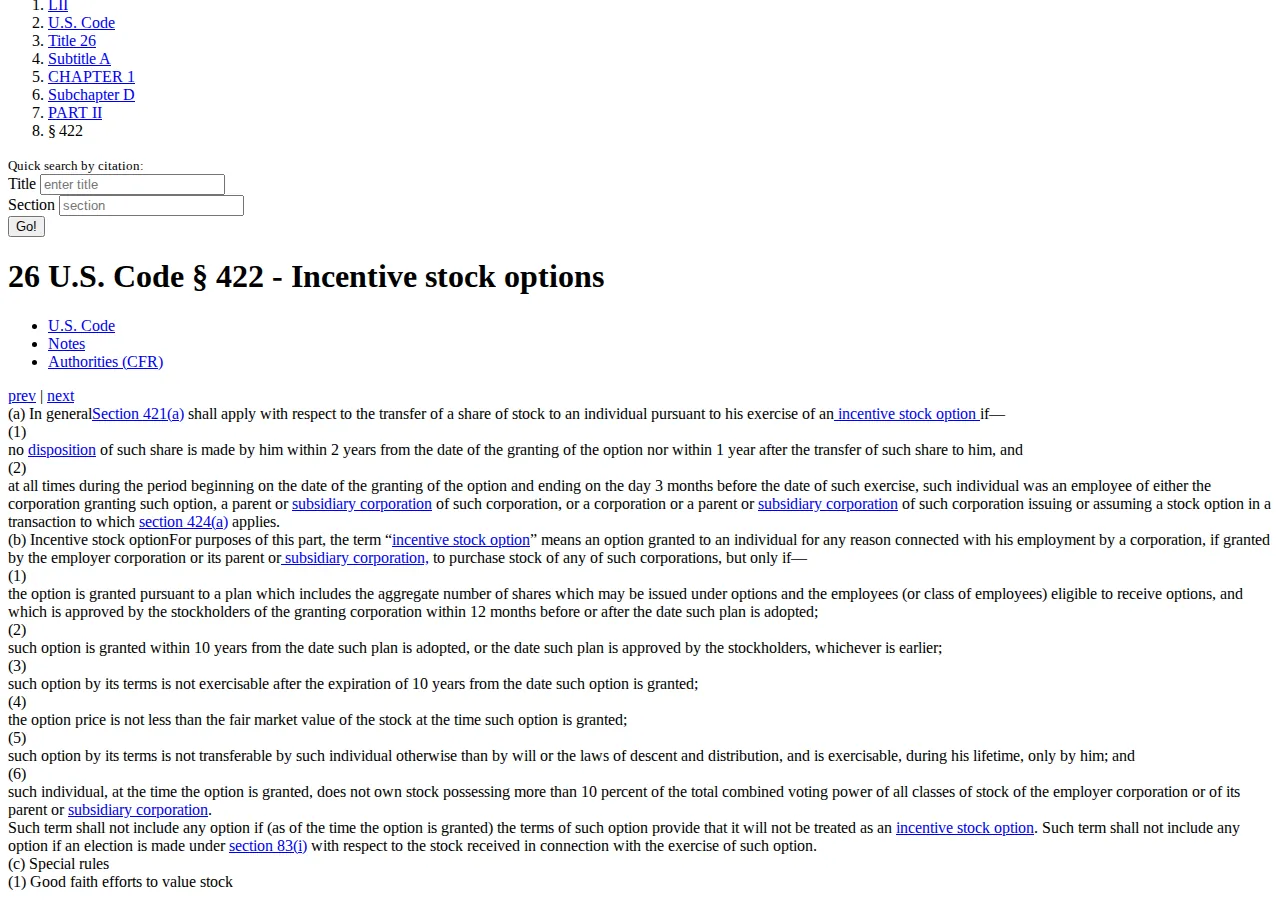
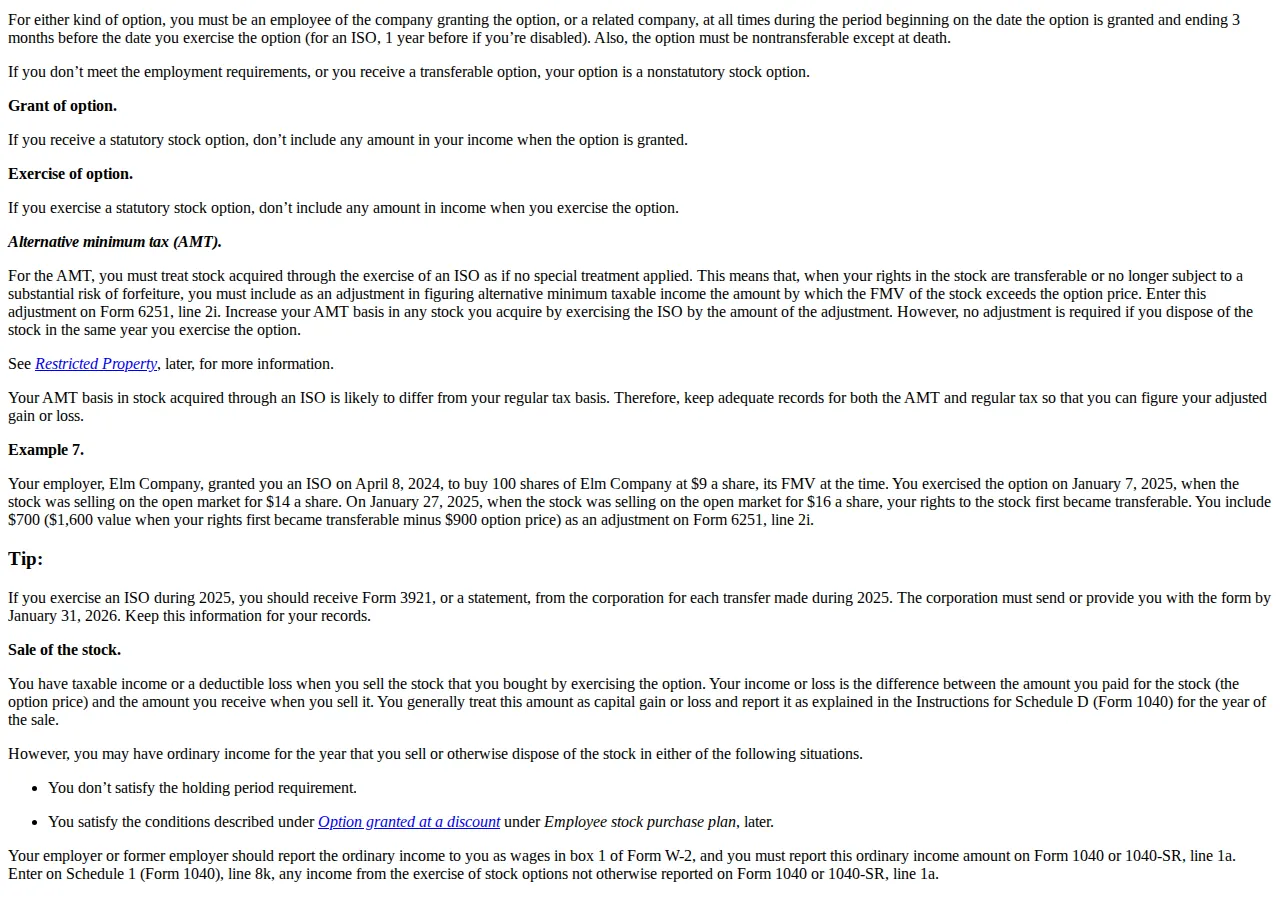
Example: Maya, a software engineer at a Delaware C-Corp, exercises an ISO for 1,000 shares on March 1, 2025 at $12 a share when FMV is $30. She pays $12,000 and holds the stock. For regular tax the exercise is invisible — $0 of income in 2025 under section 421(a). For AMT, Publication 525 states the rule: treat the stock as if no special treatment applied, and include the amount by which FMV exceeds the option price as an adjustment on Form 6251, line 2i:
The adjustment is not the tax: it is added to alternative minimum taxable income, and the tentative minimum tax is computed on the total. Isolated at the 26 percent AMT rate, the adjustment alone adds $4,680 — the isolated effect, not a quote, since the real bill depends on the full Form 6251 computation. But it surprises people: $4,680 of tax on an exercise that produced $0 of regular-tax income and $0 of cash.
IRS Publication 525 works the same mechanics on a smaller grant in its Example 7: an ISO for 100 shares at $9, exercised when the stock is $14, with rights first transferable when the stock is $16. The adjustment is $700 — $1,600 minus the $900 option price — entered on Form 6251, line 2i. The employee's AMT basis rises by the same $700, so it is not taxed twice on sale.
Worked math 2: disqualifying sale vs qualifying sale
The same grant, two sales: granted January 15, 2024 at $10; exercised March 1, 2025 at $10 when FMV is $28; 1,000 shares.
Scenario A — disqualifying disposition. Maya sells September 1, 2025 at $35 a share, six months after exercise, inside the 1-year holding period. Ordinary income is the lesser of the spread at exercise and the actual gain:
The rest of the gain is capital gain:
At 22 percent on the ordinary slice and 15 percent on the capital slice:
The employer reports the $18,000 as wages in box 1 of Form W-2.
Scenario B — qualifying disposition. Maya sells April 1, 2026 at $35 a share, more than 2 years after the January 15, 2024 grant and more than 1 year after the March 1, 2025 exercise. The entire $25,000 gain is long-term capital gain and $0 is ordinary income:
Waiting seven months past the 1-year mark saves $1,260 of federal tax on this grant — $5,010 minus $3,750 — and the saving scales with the spread. At a $180,000 spread the same seven months are worth $12,600. The trade-off is real: the stock can fall while the employee waits.
Section 422(c)(2) caps the ordinary income when the disqualifying sale loses money: a sale at $20 a share produces $10,000 of ordinary income, not the $18,000 spread. The spread is a ceiling, never a floor.
Form 3921 box by box
| Box | Contents | Used for |
|---|---|---|
| Employee name, address, TIN | The transferee; TIN is the SSN or ITIN | Whose AMT adjustment this is |
| Account number | Required only with multiple accounts for one transferee | Matching |
| Box 1 — Date option granted | The grant date | Starts the 2-year holding clock |
| Box 2 — Date option exercised | The exercise date | Starts the 1-year clock; fixes the FMV date |
| Box 3 — Exercise price per share | What the employee paid | The subtraction in every spread calculation |
| Box 4 — FMV per share on exercise date | The value on the exercise date | The spread, the AMT adjustment, the ordinary-income ceiling |
| Box 5 — Number of shares transferred | Shares actually transferred | Multiplies every per-share figure |
| Box 6 — Corporation other than transferor | Name, address, TIN of the other corporation | Parent or subsidiary stock |
The instructions for Forms 3921 and 3922, revised April 2025, state who must file: every corporation that transfers a share of stock to any person on the exercise of an ISO described in section 422(b) must file Form 3921 for each transfer made during the calendar year. "Corporation" is broad — the issuing corporation, a related corporation, any agent, any party distributing shares, and any party in control of paying remuneration for employment. One exception exists: no Form 3921 is required for an exercise by a nonresident alien employee to whom the corporation is not required to provide a Form W-2 for any year from the grant year through the exercise year. The recipient's TIN may be truncated on the payee statement under Treasury Regulation § 301.6109-4, never on the IRS copy; the payer's EIN may not be truncated anywhere.
The filing calendar and the penalty ladder
For exercises in 2025, the dates are:
| Step | Deadline | Authority |
|---|---|---|
| Furnish the statement to the employee | January 31, 2026 | General Instructions for Certain Information Returns; Publication 525 tip |
| File with the IRS on paper | March 2, 2026 | General Instructions, When To File |
| File with the IRS electronically | March 31, 2026 | General Instructions, When To File |
Section 6721 scales the penalty with lateness. For a 500-form filing:
| Timing | Penalty per return | 500 returns |
|---|---|---|
| Correctly filed within 30 days after the due date | $60 | $30,000 |
| More than 30 days late but by August 1 | $130 | $65,000 |
| After August 1, or not filed | $340 | $170,000 |
| Intentional disregard | At least $680, no maximum | $340,000 minimum |
The $60 tier is the cheapest mistake in the Code and the most common one: a corporation that discovers a missed filing in April pays $60 a form; the same discovery in September pays $340. Section 6722 carries a parallel penalty for failing to furnish correct payee statements. Reasonable cause is the only exit, and "we did not know the form existed" is not reasonable cause for a corporation that grants ISOs.
The $100,000 limit and the 10-percent owner rule
Section 422(d) caps ISO value first exercisable in any calendar year at $100,000 of fair market value measured at grant. Anything above the cap is an NSO from the start, taxed as wages at exercise.
Example: a grant of 6,000 shares at $25 FMV on the grant date, first exercisable in 2026. The ISO capacity for the year is:
Four thousand shares are ISOs; the remaining 2,000 are NSOs, even though the plan calls the whole grant an ISO. The corporation files Form 3921 only for the ISO shares and reports the NSO spread as wages. Section 422(c)(1) forgives a good-faith failure on the FMV-at-grant requirement, so a reasonable 409A valuation protects the ISO status.
The 10-percent owner rule is the other trap: an employee who owns more than 10 percent of the combined voting power at grant can hold an ISO only if the exercise price is at least 110 percent of FMV at grant and the option cannot be exercised more than 5 years after grant:
A founder holding 12 percent who receives an option at plain FMV with a 10-year term holds an NSO, not an ISO, whatever the grant letter says. See the Delaware C-Corp founder stock vesting and 83(b) timing guide and the section 83(b) election early-exercise playbook.
Recovering the AMT: Form 8801
The AMT paid on an ISO spread is not lost: it becomes a minimum tax credit, computed on Form 8801 and carried forward — but only for AMT caused by deferral items, and the ISO spread is one. AMT caused by exclusion items, such as the standard deduction, generates no credit. An employee who pays $4,680 of AMT on the exercise and later sells in a year with no AMT liability recovers the $4,680 as a credit against regular tax.
Founder & CEO Insight — Enow A. Jovial
Filing checklist
- [x] Step 1: Confirm ISO status — Plan approved by stockholders within 12 months; grant within 10 years of plan adoption; exercise price at FMV; nontransferable; 10-percent owner at 110 percent, 5-year term.
- [x] Step 2: Measure the $100,000 cap — FMV at grant times shares first exercisable this year; split the grant into ISO and NSO shares.
- [x] Step 3: Capture the exercise numbers — Grant date, exercise date, exercise price, FMV on the exercise date, shares transferred: boxes 1 through 5.
- [x] Step 4: Furnish by January 31 — Send the employee statement for each 2025 exercise; truncate the recipient TIN on the statement only.
- [x] Step 5: File by March 2 on paper, March 31 e-filed — With Form 1096 on paper submissions.
- [x] Step 6: Price the employee's AMT — Spread times shares on Form 6251, line 2i; track AMT basis separately; file Form 8801 for the credit.
- [x] Step 7: Calendar the holding periods — Two years from grant, one year from exercise; a sale one day early converts $18,000 of capital gain to ordinary income.
Who should not exercise yet
Do not exercise an ISO the employee cannot afford to hold: the exercise price is cash out, the AMT is cash out, and private-company stock cannot be sold to fund either. Do not exercise in December without a CPA review — the AMT adjustment lands in the exercise year. Do not assume the corporation filed Form 3921: ask for it in January, and if it never arrives, reconstruct the numbers from the grant agreement and the 409A valuation. Test the cash-flow side in the tax estimator first.