One form, forty-one credits
No business files Form 3800 to claim a credit — it files because it already claimed several. The research credit is figured on Form 6765, the clean vehicle credit on Form 8936, the investment credit on Form 3468 — each ends by pointing at Form 3800. Section 38(a) defines the credit allowed as carryforwards plus the current year business credit plus carrybacks; Form 3800 assembles, limits, and carries that sum forward.
Section 38(b) lists 41 component credits, from the investment credit under section 46 to the advanced manufacturing production credit. The clean vehicle credit from our Form 8936 playbook enters twice: Part V of Form 8936 on line 1aa, and Part II on line 1y.
Any taxpayer with a general business credit files it — a C-Corp, an S-Corp, a partnership, a sole proprietorship, or an estate or trust. The identifying number is the EIN for an entity and the SSN for an individual. Partnerships and S corporations complete the source credit form first; the credit flows to the partners on Schedule K-1, and each reports it on their own Form 3800.
The six-part map
Complete Parts III and IV first — Parts I and II consume their totals. The six parts: Part I (lines 1–6), Part II (lines 7–38), Part III (lines 1a–1zz, 2–6), Part IV (carryovers), Part V (Part III breakdowns), and Part VI (Part IV breakdowns). Part V exists for filers with more than one elective payment or transfer registration number for the same credit, or for partners and S corporation shareholders with more than one Schedule K-1 for the same credit.
Part III: the credit-by-credit lines
Part III is a ledger: each line names a source form and takes that form's credit amount — general credits on lines 1a through 1zz, the empowerment zone credit alone on line 3, and specified credits on lines 4a through 4z. Line 2 adds lines 1a through 1zz; line 5 adds lines 4a through 4z; line 6 adds lines 2, 3, and 5.
| Line | Source form | Credit |
|---|---|---|
| 1a | Form 3468, Part II | Investment credit |
| 1c | Form 6765 | Research credit |
| 1y | Form 8936, Part II | Clean vehicle credit |
| 3 | Form 8844 | Empowerment zone employment credit |
| 4b | Form 5884 | Work opportunity credit |
| 4d | Form 8586 | Low-income housing credit |
| 4i | Form 6765 (ESB) | Research credit, eligible small business |
On every Part III line, column (d) holds credits subject to the passive activity limit, column (e) holds credits not subject to it. Column (f) holds the section 6418 transfer amount — transferred out as a negative. Column (h) is the gross section 6417 elective payment amount, column (i) the amount of column (g) applied against tax in Part II, and column (j) the net amount: the smaller of column (h) or column (g) minus column (i).
Part I: credits not allowed against tentative minimum tax
Part I separates the credit pool into the part that can offset tentative minimum tax and the part that cannot. Line 1 takes the credits not subject to the passive activity limit; line 2 takes those subject to it, including Part IV, line 6, column (d). Line 3 is the portion of line 2 allowed for 2025, figured on Form 8582-CR or 8810 under section 469. Lines 4 and 5 take the non-passive carryforwards and carrybacks from Part IV, line 6, column (f). Line 6 adds lines 1, 3, 4, and 5 — the total available before the section 38(c) limitation.
The passive split is where most preparers lose credits they own: a credit from a passive activity — a rental LLC in which the owner does not materially participate — sits in column (d) and can only offset passive-activity tax, while a credit from an active trade or business sits in column (e) and offsets any tax.
Part II, Section A: the section 38(c)(1) limitation
Section 38(c)(1) caps the credit at net income tax minus the greater of tentative minimum tax or 25 percent of net regular tax above 25,000 dollars — lines 7 through 17: line 7 is regular tax, line 8 is alternative minimum tax, line 10c subtracts the credits that rank ahead, line 11 is net income tax, line 12 is net regular tax, line 13 is 25 percent of the excess over 25,000 dollars, line 14 is tentative minimum tax, line 15 is the greater of lines 13 and 14, line 16 is line 11 minus line 15, and line 17 is the smaller of line 6 and line 16.
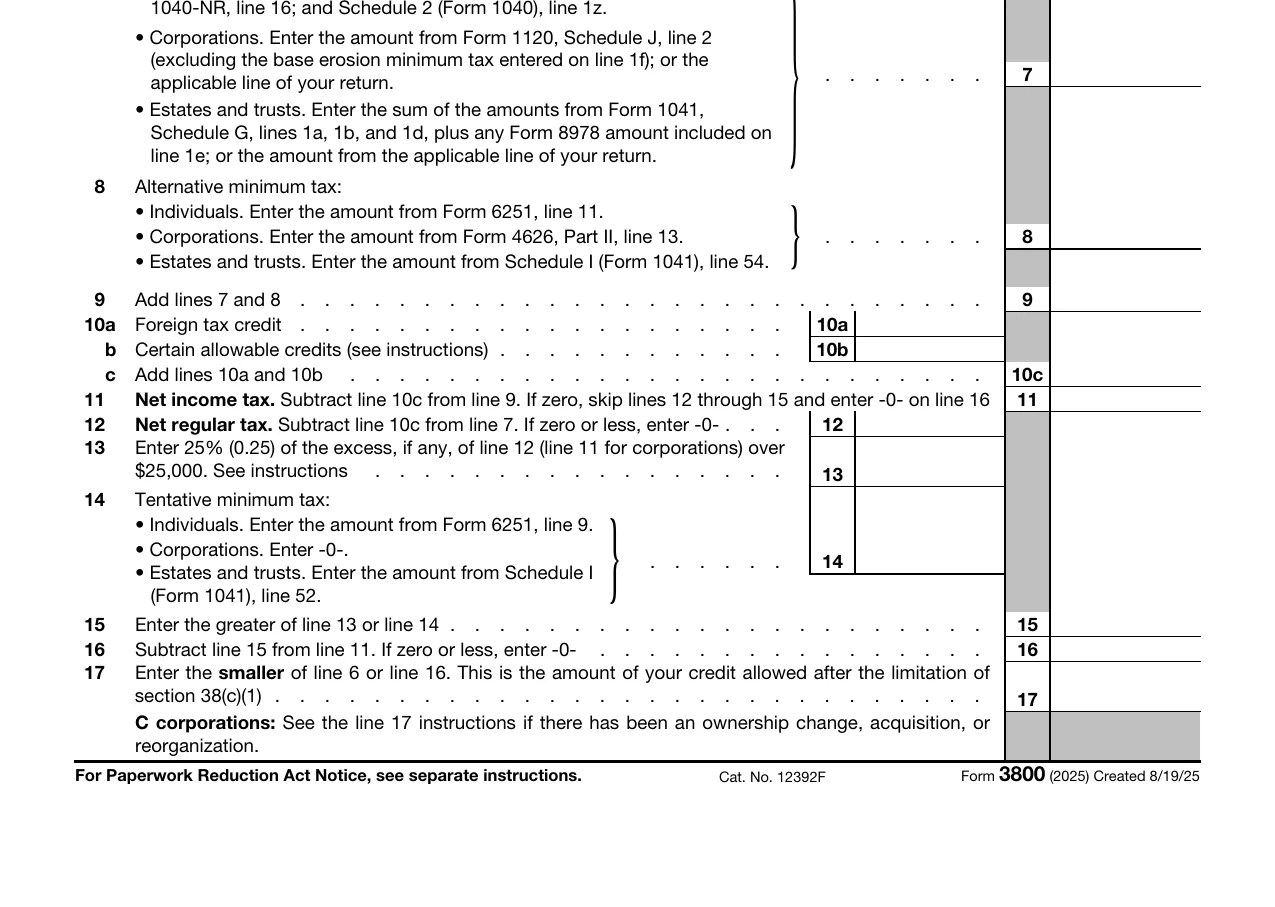
Example A — the limitation binds. A C-Corp has regular tax of 180,000 dollars, no alternative minimum tax, a foreign tax credit of 10,000 dollars, and a Part I, line 6 total of 210,000 dollars — a 120,000-dollar research credit, a 60,000-dollar investment credit, and a 30,000-dollar carryforward. Net income tax and net regular tax are 170,000 dollars. The 25 percent floor:
Tentative minimum tax for a corporation is zero, so line 15 is 36,250 dollars, line 16 is 133,750 dollars, and line 17 is the smaller of the pool and 133,750 dollars:
The corporation uses 133,750 dollars this year and carries 76,250 dollars back 1 year and forward 20 years. The 25 percent floor binds most profitable companies; for a married individual filing separately, the figure drops to 12,500 dollars, and for a controlled group the 25,000 dollars is apportioned under section 1563(a).
Part II, Section B: the empowerment zone credit
Section 38(c)(2) runs the empowerment zone employment credit separately, with 75 percent of tentative minimum tax substituted for tentative minimum tax. Lines 18 through 26 run it; line 26 is the smaller of the room left after line 17 and the credit available. General credits that already filled the room leave nothing extra that year, and the unused portion carries forward under section 39.
Part II, Section C: the specified-credit escape
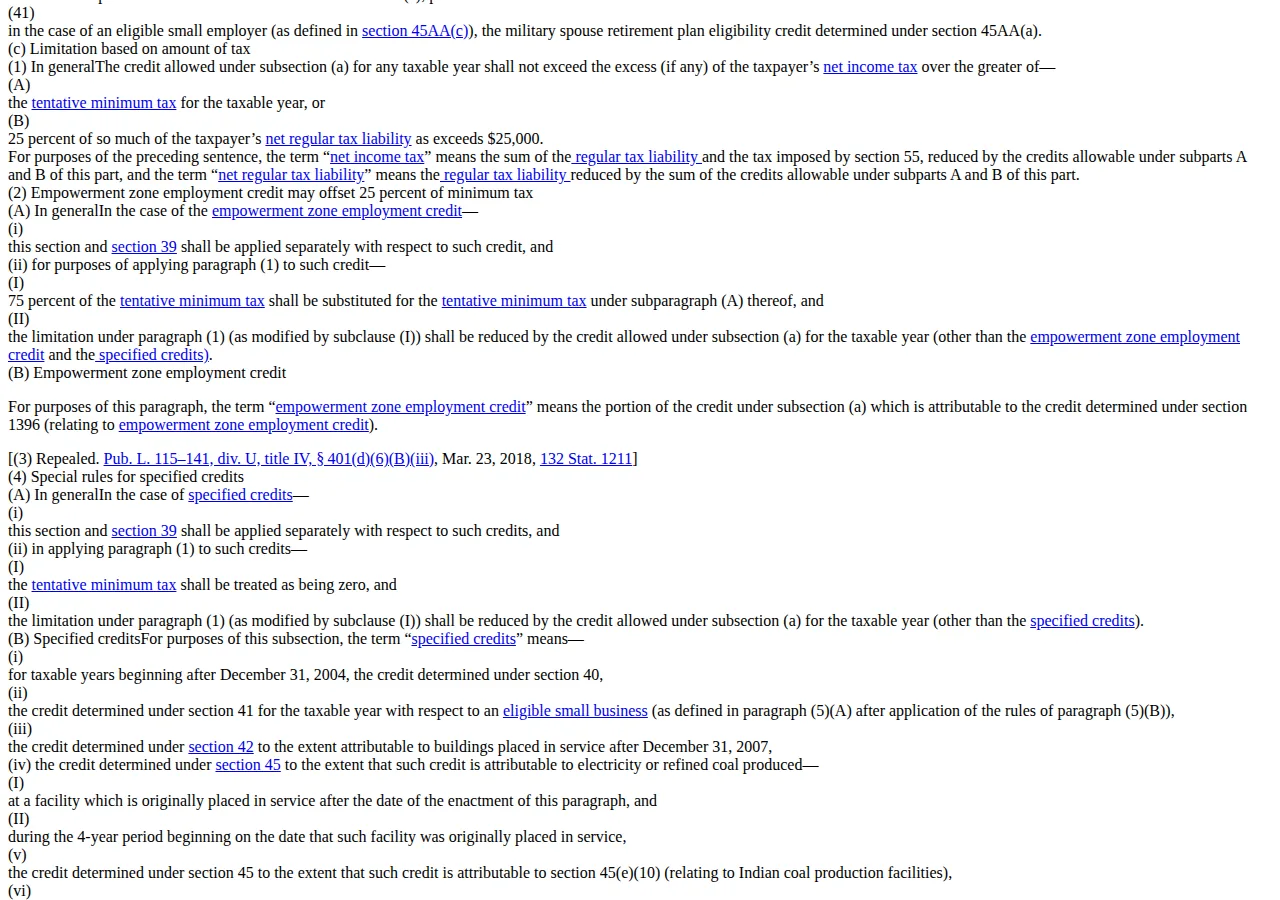
Section 38(c)(4) is the most valuable paragraph on the form: for specified credits, sections 38 and 39 are applied separately, tentative minimum tax is treated as zero, and the limitation is reduced by the credit already allowed — a second pass at tax room the general credits could not reach.
The twelve specified credits in section 38(c)(4)(B) are sections 40, 41 (eligible small business only), 42 (post-2007 buildings), 45 (first-4-year facilities; Indian coal), 45B, 45G, 45R, 45S, 48, 47 (post-2007 expenditures), and 51.
Example B — the second pass. Same corporation: net income tax 170,000 dollars, line 13 of 36,250 dollars, a general pool of only 50,000 dollars, all allowed on line 17, plus a 90,000-dollar specified credit from Form 5884, line 4b. Line 27 is 133,750 dollars; line 28 is 50,000 dollars; line 29 leaves 83,750 dollars of room; line 36 is the 90,000-dollar specified credit. Line 37 is the smaller of lines 29 and 36:
The corporation uses 133,750 dollars in total, but 83,750 of it is specified credit that would have been stranded had the two pools been tested together. The unused 6,250 dollars carries forward.
Eligible small business. Under section 38(c)(5)(A), an eligible small business is a corporation whose stock is not publicly traded, a partnership, or a sole proprietorship, with average annual gross receipts for the 3 preceding taxable years of no more than 50,000,000 dollars; a partner or S-Corp shareholder qualifies only if that person meets the test.
Section D and where the credit lands
Line 38 adds lines 28 and 37, reported on Schedule 3, line 6a; on Form 1120, Schedule J, line 5c; and on Form 1041, Schedule G, line 2b. Our Schedule 3 playbook runs the full Schedule 3 map; the general business credit is the line 6a entry.
Carryback and carryforward: section 39
Under section 39(a)(1), if the carryforwards plus the current year business credit exceed the section 38(c) limitation — the unused credit year — the excess is a carryback to the preceding year and a carryforward to each of the 20 following years. The entire unused amount goes to the earliest year first under section 39(a)(2)(A).
Two credits run longer back: the marginal oil and gas well production credit carries back 5 years under section 39(a)(3), and applicable credits under section 6417 carry back 3 years under section 39(a)(4). Unused credits left after the last carryforward year expire — no second extension, no deduction for an expired credit.
Part IV is the carryover ledger: column (b) shows the latest year from which carryforwards arise — or 2026, for a carryback from 2026 to 2025; column (g) is the amount applied against tax; column (h) is the amount recaptured or adjusted; column (i) is the carryforward to 2026. Part IV, line 6, column (f) feeds Part I, lines 4 and 5 and Part II, lines 34 and 35. The corporation in Example A carries 76,250 dollars forward, used before the next year's current-year credit — section 38(d) ordering puts the oldest credit first, in section 38(b) order.
Carrying back requires an amended return — Form 1120-X for a corporation, Form 1040-X for an individual — with the computation attached. A joint return in the carryback or carryforward year requires a separate tax liability computation: figure the tax as though married filing separately, then allocate the joint tax paid in proportion to the separate liabilities. Hand the ledger to your CPA before year-end if any credit is in its final carryforward years.
Elective payment and transfer: sections 6417 and 6418
Under section 6417, an applicable entity — tax-exempt organisations, state and local governments, Tribal governments, the Tennessee Valley Authority, Alaska Native Corporations, and rural electric cooperatives — can elect to treat certain credits as a payment of tax; under section 6418, an eligible taxpayer can transfer all or part of certain credits to another taxpayer for cash.
Both elections require pre-filing registration. The transfer amount rides in Part III, column (f) — transferred out as a negative — and the elective payment amount rides in column (h), with the net in column (j). A credit converted to a payment does not enter the section 39 ledger. A transferee that is a noncorporate taxpayer, a personal service corporation, or a closely held corporation must apply sections 38 and 469 and file Form 8582-CR or 8810.
Run Form 3800
- Complete every source form first, then sort the credits into Part III lines — Form 6765, 8936, 3468, 8586, 5884; general on lines 1a through 1zz, empowerment zone on line 3, specified on lines 4a through 4z — splitting passive column (d) from non-passive (e).
- Reconcile the Part IV ledger: prior-year column (i) becomes this year's opening carryforward, credit by credit.
- Complete Part I, then run Part II — Section A on lines 7 through 17, on net regular tax, not gross tax; Section B if Form 8844 is present; then Section C for specified credits, the second pass with tentative minimum tax at zero.
- Report line 38 and record the carryforward: Schedule 3, line 6a for an individual; Form 1120, Schedule J, line 5c for a corporation; Form 1041, Schedule G, line 2b for an estate or trust. Part IV, column (i) is next year's opening balance; file the amended return for any carryback year, with the computation attached.
- [x] Passive column (d) split from non-passive (e).
- [x] Section 38(c)(1) floor worked on net regular tax.
- [x] Specified credits run through Section C.
Failure modes
Wrong pool: general and specified credits are tested separately; lumping them strands specified credit Section C would have allowed. No Part IV record: the carryforward exists only if Part IV records it, credit by credit — an aggregate on line 6 with no Part VI breakdown cannot be traced. Transfer without registration: the section 6418 and section 6417 elections require pre-filing registration; without it, the credit stays with the transferor. Payroll double-count: research credit elected against FICA under section 41(h) must come out of the carryforward — it is not available twice.
Founder & CEO Insight — Enow A. Jovial
Finish the source forms, sort the credits into Part III, reconcile the Part IV ledger, run Part I, apply the Section A limitation, give the specified credits their Section C pass, report line 38, and record the carryforward — then check the result in our tax estimator.