IRS Form 3520: The Foreign Trust and Large Foreign Gift Reporting Playbook
The form that follows the money offshore
Form 3520 is the return the IRS uses to watch money cross the border into and out of foreign trusts. It is not a tax return: no tax is computed on it, and a gift reported on it is generally not taxable income. It forces disclosure: who created the trust, who funded it, who owns it, who took money out, and who received a large foreign gift. Section 6048 splits that job into three duties plus a fourth for large gifts; section 6677 prices a miss at 35 percent.

Who must file: the four doors into Form 3520
The Instructions for Form 3520 (12/2025) map each filer to a part of the form. A separate Form 3520 is filed for each foreign trust. Page one carries the SSN or ITIN, or the EIN for an entity or estate.
Part I is for the responsible party: the grantor creating an inter vivos trust, the transferor moving property in, or the executor of a decedent whose death is itself a reportable event. Part II is for the U.S. person treated as owner of any part of a foreign trust under sections 671 through 679, even with no transactions. Part III is for the U.S. person who received a distribution, including a loan of cash or marketable securities or the uncompensated use of trust property. Part IV is for large gifts or bequests received from foreign persons.
A foreign bank account means the FBAR and possibly Form 8938, not Form 3520. Foreign corporation shares mean Form 5471; a foreign single-member LLC means Form 5472. Form 3520 starts where a trust sits between the U.S. person and the assets, or where a foreign person hands the U.S. person a large gift. Our Form 8938 FATCA playbook covers the asset-reporting side and our Form 5471 playbook the foreign-corporation side.
Part I: reportable events and the 90-day notice
Section 6048(a)(1) sets the clock: written notice to the Secretary on or before the 90th day after any reportable event. Section 6048(a)(3) defines a reportable event as the creation of a foreign trust by a U.S. person, a transfer of money or property to one, including by reason of death, and the death of a U.S. citizen or resident who owned part of a foreign trust or had part of one in the gross estate. The notice states the amount and identifies the trust, trustees, and beneficiaries.
Two exceptions matter. Section 6048(a)(3)(B)(i) exempts a transfer for consideration of at least fair market value, so a genuine FMV sale is not a reportable event — but some FMV transfers must still be reported, including transfers for qualified obligations and transfers of appreciated property without full gain recognition. Section 6048(a)(3)(B)(ii) exempts deferred compensation arrangements and section 501(c)(3) trusts. Rev. Proc. 2020-17 and Rev. Proc. 2014-55 add narrow relief for tax-favored retirement trusts and Canadian RRSPs and RRIFs, but not for any other reporting obligation. The responsible party is the grantor, the transferor, or the executor.
Section 679: the grantor-trust rule that taxes the transferor
Section 679 is the reason a foreign trust rarely shelters income. Section 679(a)(1) treats a U.S. person who transfers property to a foreign trust, other than a section 501(c)(3) trust, as owner of the portion attributable to that property if there is a U.S. beneficiary that year. The trust's income, deductions, and credits on that portion flow onto the transferor's return under sections 671 through 679.
Transfers by reason of death are exempt, as are transfers for consideration of at least fair market value, with section 679(a)(3) stripping out obligations of the trust and related persons — a note from the trust itself does not count as payment. Section 679(a)(4) catches the immigrant case: a nonresident alien who transfers property to a foreign trust and acquires a U.S. residency starting date within five years is treated as transferring the property on that date.
A U.S. transferor with a U.S. beneficiary reports the trust's income yearly and completes Part II annually, even with no transactions. The assets need not produce cash: phantom income is taxed whether or not anything was distributed.
Part II: the U.S. owner and Form 3520-A
Section 6048(b)(1) imposes two duties on the U.S. owner: submit the prescribed information, and ensure the trust files a return with a full accounting, the U.S. agent's name, and the prescribed information — and furnishes it to each U.S. owner and distributee. That return is Form 3520-A.
Form 3520-A is due by the 15th day of the 3rd month after the trust's tax year ends — March 15 for a calendar-year trust. If the trust does not file it, the U.S. owner must attach a substitute to Form 3520 by the due date, checking the substitute box. A substitute filed to the best of the owner's ability by April 15 is considered timely filed. The owner must also send copies of the Foreign Grantor Trust Owner Statement and Beneficiary Statement to the U.S. owners and beneficiaries by that date.
Section 6048(b)(2) is the enforcement lever: unless the trust authorizes a U.S. person as its limited agent for sections 7602, 7603, and 7604 — records, testimony, and summonses — the amounts the U.S. person must take into account are determined by the Secretary.
Part III: distributions, loans, and the accumulation trap
Section 6048(c)(1) requires any U.S. person receiving a distribution during the tax year to report the trust's name, the aggregate distributions, and the prescribed information. The instructions widen the net: a loan of cash or marketable securities, or the uncompensated use of trust property, is a reportable distribution whether or not taxable — including a third-party loan guaranteed by the trust. A distribution taxable as compensation is excepted if reported as compensation income — FICA and SECA follow the compensation character.
Section 6048(c)(2) turns a paperwork failure into a tax bill: without adequate records, the distribution is an accumulation distribution includible in the distributee's gross income. For section 668 purposes the applicable number of years is one-half of the number of years the trust has been in existence, with the interest charge following.
Worked example — a distribution with no records. A U.S. beneficiary receives $300,000 from a twelve-year-old foreign trust; the trustee sends no statement. Under section 6048(c)(2) the $300,000 is an accumulation distribution; under section 668 the applicable number of years is one-half of twelve — six years — with interest on the tax; with a complete statement it would have been taxed once.
Part IV: large foreign gifts — the $100,000 line and the $20,573 line
Section 6039F(a) starts with a $10,000 threshold, adjusted for cost of living by section 6039F(d), and the IRS applies the result in two ways. Part IV requires reporting above $100,000 received from a nonresident alien individual or a foreign estate, including related persons, treated as gifts or bequests; or above the section 6039F threshold amount from foreign corporations or foreign partnerships. For tax years beginning in 2026, Rev. Proc. 2025-32 sets that threshold at $20,573. Gifts from related foreign persons, or where one acts as nominee for another, must be aggregated.
Section 6039F(b) defines a foreign gift as any amount received from a non-U.S. person and treated as a gift or bequest, excluding qualified tuition and medical transfers and distributions disclosed under section 6048(c). The $100,000 and $20,573 figures are reporting thresholds, not tax thresholds: the gift is generally not taxable income. What is due is the form — and the penalty for silence is 5 percent of the gift per month, up to 25 percent, under section 6039F(c)(1)(B). Gifts from covered expatriates are different: section 2801 taxes them, reported on Form 708.
The boundary: Form 3520 vs Form 8938 vs FBAR
The three regimes overlap in subject matter and diverge in every detail; filing one never satisfies another.
| Form | What it reports | Trigger threshold | Due date | Penalty | Authority |
|---|---|---|---|---|---|
| Form 3520 | Foreign trust transactions and large foreign gifts | $100,000 individual gift; $20,573 entity gift (2026) | April 15; June 15 abroad; Oct. 15 extended | Greater of $10,000 or 35% of gross reportable amount | Sections 6048, 6039F, 6677 |
| Form 8938 | Specified foreign financial assets | $50,000 year-end / $75,000 anytime, single filer in the U.S. | With the income tax return | Up to $10,000, plus $10,000 per 30 days, max $60,000 | Section 6038D |
| FBAR (FinCEN Form 114) | Foreign financial accounts | Aggregate over $10,000 at any time | April 15, automatic extension to Oct. 15 | Up to $10,000 non-willful; greater of $100,000 or 50% if willful | 31 U.S.C. section 5314; 31 CFR 1010.350 |
A Form 3520 distribution does not appear on Form 8938 unless the beneficiary also holds a specified foreign financial asset, and an FBAR account does not discharge the Form 3520 duty inside a trust. The FBAR threshold is an aggregate: two accounts over $10,000 combined must both be reported. Our Form 5472 playbook covers the fourth regime founders meet most often, and the tax estimator sizes a penalty's cash cost in advance.
Worked example — the section 6677 penalty ladder
A U.S. founder transfers $2,000,000 of listed securities to a foreign trust in March 2026 and files nothing. Under section 6677(c)(1) the gross reportable amount is $2,000,000, and the initial penalty is the greater of $10,000 or 35 percent:
The IRS mails a notice of failure. The founder does nothing for 120 days after the 90-day window expires, and section 6677(a) adds $10,000 for each 30-day period thereafter:
The aggregate is capped at $2,000,000. Under section 6048(b) the rate would have been 5 percent, or $100,000.
Worked example — the unreported foreign gift. A U.S. resident receives $240,000 from her father, a nonresident alien, in 2026 and files nothing. The gift exceeds the $100,000 threshold, and the section 6039F penalty runs at 5 percent per month:
The penalty assessed is $60,000, on a gift that owed no tax. Reasonable cause is the only defence, and section 6677(d) states that a foreign jurisdiction penalizing disclosure is not reasonable cause.
The clock: April 15, June 15, October 15
Form 3520 is due on the 15th day of the 4th month after the tax year ends — April 15 for a calendar-year individual, generally the same day as the income tax return. Two extensions are easy to confuse. A U.S. citizen or resident living and working outside the United States and Puerto Rico, or on military duty there, gets until June 15. An individual with a return extension gets until October 15 — the 15th day of the 10th month. The same dates apply to a Form 3520 for a U.S. decedent or estate.
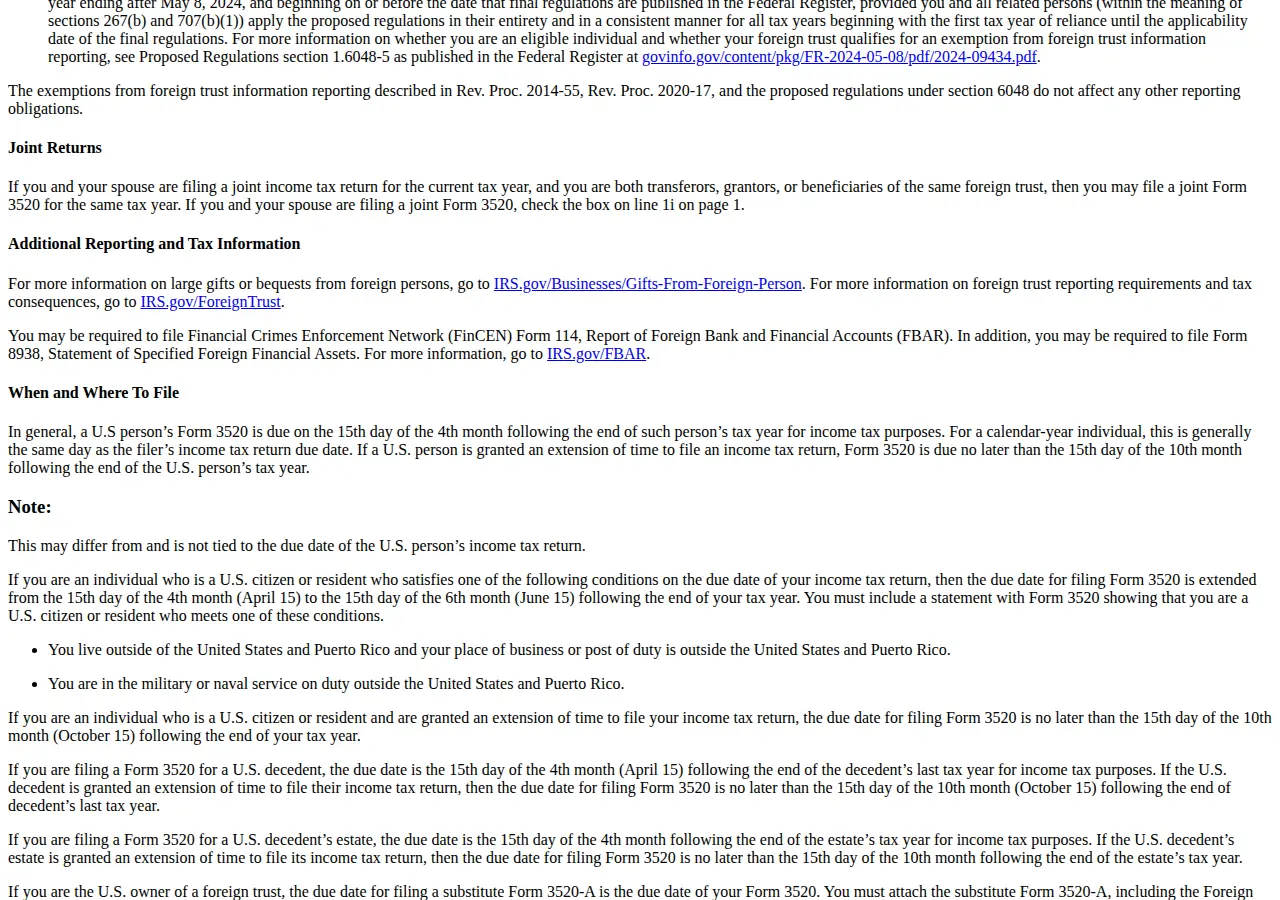
The 90-day notice is a different clock from the April return. The form goes to a different address: Internal Revenue Service Center, P.O. Box 409101, Ogden, UT 84409. The trust's Form 3520-A was due March 15 — the substitute attached to the April return is the cure when the trust missed it.
Founder & CEO Insight — Enow A. Jovial
The execution checklist
- Step 1 — Map every trust, transfer, distribution, and foreign gift.
- Step 2 — File the 90-day notice. For each reportable event, give written notice within 90 days: amount, trust, trustees, beneficiaries.
- Step 3 — Test section 679 before the transfer. With a U.S. beneficiary, the transferor is taxed on the trust's income.
- Step 4 — Appoint a U.S. agent and demand the statements. Get the Foreign Grantor Trust Owner and Beneficiary Statements.
- Step 5 — Calendar March 15. Form 3520-A is due from the trust; if it does not arrive, prepare a substitute.
- Step 6 — Test Part IV twice. Aggregate related-person gifts: over $100,000 from an individual or estate, over $20,573 from a corporation or partnership in 2026.
- Step 7 — Complete Parts I through III with attachments. Attach financial statements reflecting accumulated income under U.S. principles; a CPA will reconcile them to the trust's books.
- Step 8 — File by April 15, June 15, or October 15. Check box 1k if an extension applies; mail to P.O. Box 409101, Ogden, UT 84409.
- Step 9 — Keep the records that defeat the accumulation rule. Beneficiary statements and trust accountings keep a distribution out of throwback treatment.
- Step 10 — Write the reasonable cause statement before it is needed. Document the cause, reliance, and corrective filing. A foreign secrecy law is not reasonable cause.