IRS Form 2290: Heavy Highway Vehicle Use Tax Playbook
A truck that weighs 55,000 pounds or more cannot legally run on a public highway until its owner has filed Form 2290 and paid the Heavy Highway Vehicle Use Tax (HVUT). The tax is small — $100 to $550 a year per truck — but the stamped Schedule 1 that comes back is the document a state office asks for before it registers the truck.
Form 2290 covers July 1, 2026, through June 30, 2027, and is due by the last day of the month after first use — a July first use means August 31, 2026. The tax is imposed by 26 U.S.C. § 4481, the weight is figured under the Instructions for Form 2290, and late penalties come from 26 U.S.C. § 6651.
The rate table: $100 to $550, set by weight
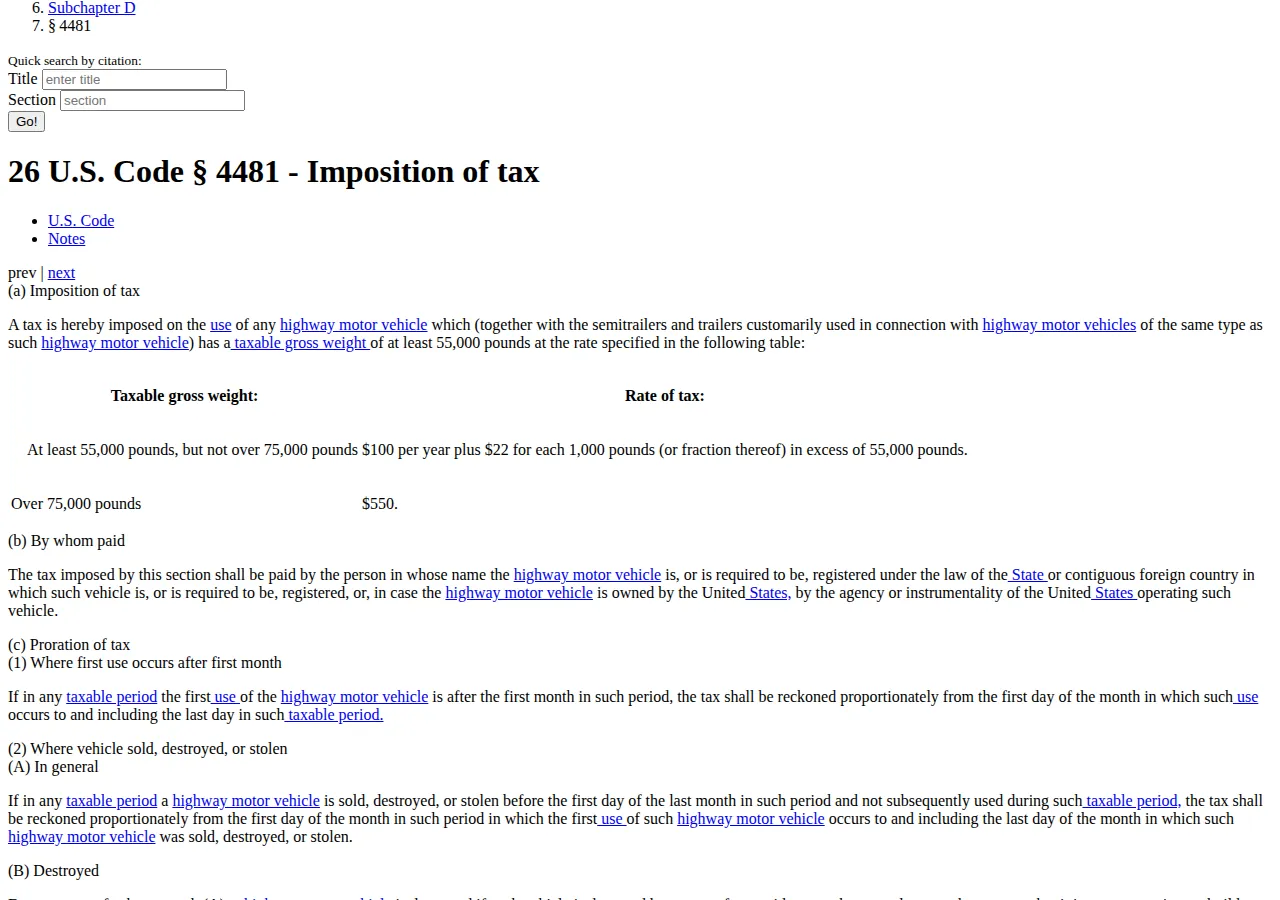
Section 4481(a) taxes any highway motor vehicle of at least 55,000 pounds taxable gross weight: $100 a year plus $22 for each 1,000 pounds, or fraction, over 55,000 up to 75,000, and a flat $550 over 75,000. Form 2290 turns that into 22 categories, A through V, plus W for suspended vehicles.
| Category | Taxable gross weight | Annual tax | Logging vehicles | Authority |
|---|---|---|---|---|
| A | 55,000 pounds | $100 | $75 | 26 U.S.C. § 4481(a); Form 2290 p. 2 |
| F | 59,001–60,000 pounds | $210 | $157.50 | Form 2290 p. 2 |
| V | Over 75,000 pounds | $550 | $412.50 | 26 U.S.C. § 4481(a); Form 2290 p. 2 |
A 60,000-pound truck is category F, and the formula and the table agree:
A truck at 54,999 pounds owes nothing; at 55,000 pounds it owes $100.
Founder & CEO Insight — Enow A. Jovial
How taxable gross weight is actually figured
Taxable gross weight is not the number on the door sticker. Under the Instructions it is three numbers added: the actual unloaded weight of the vehicle fully equipped for service, the actual unloaded weight of any trailers or semitrailers customarily used with it, and the weight of the maximum load customarily carried. A bus is figured differently: its unloaded weight fully equipped plus 150 pounds for each seat.
Three rules catch owners out. First, "fully equipped for service" includes the body, all accessories, all attached equipment, and a full supply of fuel, oil, and water — but not the driver, and not special equipment mounted for handling, protecting, or preserving cargo, such as a crane. Second, a trailer counts as customarily used if the vehicle is equipped to tow it, whether or not it is hitched. Third, the weight declared to the state sets a floor: if any state required a declaration of gross weight in a specific amount, the taxable gross weight must be no less than the highest gross weight declared in any state.
The filing calendar: first use sets the deadline
Form 2290 is filed for the month the truck is first used on a public highway during the period, and is due by the last day of the month after that month. First use includes driving the truck home from the dealer.
| First used in | File and pay by | Line 1 date |
|---|---|---|
| July 2026 | August 31, 2026 | 202607 |
| November 2026 | December 31, 2026 | 202611 |
| December 2026 | February 1, 2027 | 202612 |
The pattern runs through June 2027, when first use is due August 2, 2027. If a due date falls on a Saturday, Sunday, or legal holiday, the return is due the next business day. Trucks first used in different months need separate returns.
A filing extension of up to six months is available by letter to the IRS in Florence, Kentucky, but it does not extend the time to pay. The return must be filed under an employer identification number (EIN) — a Social Security number will not work. A single-member LLC files under the LLC's own EIN, not the owner's SSN — a disregarded entity cannot use the owner's taxpayer identification number for this return.
Proration: a truck first used after July pays for the months left
Section 4481(c)(1) reckons the tax proportionately from the first day of the month of first use through June 30, printed as Table I for ordinary vehicles and Table II for logging vehicles. A truck first used in November has eight months left, so it pays eight-twelfths of the annual tax.
Both figures match Table I. Table II gives the logging version: a logging truck over 75,000 pounds first used in November pays $275.00, saving $91.67 against $366.67. The IRS prints the same arithmetic in its own example: Linda paid the full $550 for an 80,000-pound truck on July 2, 2026; John bought it on September 9 and drove it home the next day. His tax runs October 1 through June 30 — nine months — so he pays nine-twelfths of $550, or $412.50, due October 31, a Saturday, so November 2, 2026.
Logging vehicles: the 25 percent cut has two conditions
Section 4483(e) cuts the tax by 25 percent for a logging vehicle, and both conditions must hold: the truck's exclusive use during the period is transporting products harvested from a forested site, to and from a point on that site, and the truck is registered under state law as a highway motor vehicle used in the transportation of harvested forest products.
Suspension: the 5,000-mile rule, and what breaks it
A truck expected to run 5,000 miles or less on public highways during the period pays no tax: report it in category W and list its VIN on Schedule 1. For an agricultural vehicle the limit is 7,500 miles, and farm miles do not count — only highway miles do. A vehicle counts as agricultural when more than half of its use by mileage is for farming and it is registered as a farm vehicle for the entire period.
Under § 4483(d), the suspension ceases the moment highway use passes 5,000 miles — 7,500 for an agricultural vehicle. The full tax for the period becomes due: file an amended Form 2290, check the Amended Return box, write in the month the limit was crossed, and file by the last day of the month after that month.
Two details catch owners out. First, the mileage limit applies to total highway miles during the period regardless of how many owners the truck had — a buyer inherits the seller's miles. Second, selling a suspended truck does not end the suspension: the seller must give the buyer a statement with both parties' names, addresses, and EINs, the VIN, the sale date, and the odometer readings at the start of the period and at sale. If the seller fails to furnish that statement, the seller stays liable for the tax too.
Schedule 1: the stamped proof that registers the truck
Schedule 1 is the part of Form 2290 that most owners need. File both copies; the IRS stamps one and returns it as the proof of payment a state requires before it registers a taxable vehicle. United States Customs and Border Protection requires the same proof for a Canadian or Mexican vehicle entering the United States.
A return reporting and paying tax on 25 or more vehicles must be filed electronically under § 4481(e) — suspended category W vehicles do not count toward the 25 — and once an e-filed return is accepted, the stamped Schedule 1 can be available within minutes, carrying an IRS watermark instead of a rubber stamp.
Credits and refunds: sold, destroyed, stolen, or barely driven
Line 5 of Form 2290 is where money comes back. Claim a credit for tax paid on a vehicle sold, destroyed, or stolen before June 1 and not used during the rest of the period, or on a vehicle used 5,000 miles or less — 7,500 for agricultural vehicles — during the prior period. The credit cannot exceed the tax on line 4; any excess goes to Form 8849, Claim for Refund of Excise Taxes, Schedule 6, which is also the form for a refund of an overpayment from a mistake in tax liability.
Take Linda's truck again: she paid $550, used the truck for three months, then sold it. Three months of use is the April column of Table I, $137.50 for category V. Her credit is the tax paid minus the tax for the months used:
Nine months unused, nine-twelfths of $550 — the same $412.50 John paid as the buyer. A low-mileage claim works differently in time: the credit for a truck used 5,000 miles or less cannot be claimed until after the period ends, on the first Form 2290 filed for the next period. Our quarterly estimated tax payments guide covers the income-tax side of the same discipline.
Weight increases and the amended return
Check the Amended Return box for exactly two reasons: the taxable gross weight of a vehicle increased during the period and the vehicle moved into a new category, or a suspended vehicle crossed the mileage limit. Do not check it for any other reason. A weight increase is common when a truck's maximum load customarily carried grows, and the additional tax is the difference between the new category and the old one in the partial-period table for the month the increase happened.
That is Table I, October column: category V at $412.50 minus category F at $157.50. File the amended return, with a copy of the worksheet for each vehicle, by the last day of the month after the month the weight increased.
Penalties: what late costs, in percentages
The Instructions carry no penalty rates — only the reasonable-cause relief procedure. The rates live in § 6651: failure to file adds 5 percent of the tax for each month or part of a month late, up to 25 percent; failure to pay adds 0.5 percent per month, up to 25 percent. When both apply in the same month, the filing addition is reduced by the payment addition, so the combined rate is 5 percent a month, capped at 25 percent. Interest accrues on top under § 6601 from the due date. A fraudulent failure to file raises the rate to 15 percent a month, capped at 75 percent.
Five months late on the same $550 tax, both penalties running, hits the 25 percent cap: $137.50 in additions.
Fleet math: three trucks, one return
Two 80,000-pound tractors and one 60,000-pound straight truck, all first used in July:
Buy the second tractor in November instead, and its tax falls to the Table I November figure, $366.67:
The November purchase saves $183.33 against the full-period bill. For the excise-tax cousin of this return, see our Form 720 quarterly federal excise tax playbook, and for the payroll-tax side, our Form 940 FUTA annual tax playbook.
Execution checklist: file Form 2290 in one pass
- Step 1 — Get the EIN first. An EIN is required; a Social Security number (SSN) will not work.
- Step 2 — Weigh the truck honestly. Add unloaded weight, trailer weight, and maximum load, then use the highest gross weight declared to any state.
- Step 3 — Find the category and the tax. A 60,000-pound truck is category F at $210; an 80,000-pound truck is category V at $550. Cut 25 percent only for a qualifying logging vehicle.
- Step 4 — Price the months. First use after July means Table I: a November first use pays eight-twelfths, so a category V truck pays $366.67.
- Step 5 — File by the last day of the month after first use. July first use means August 31, 2026; November first use means December 31, 2026. E-file at 25 or more.
- Step 6 — Keep the stamped Schedule 1 with the truck. It is the registration proof; keep the return, the Schedule 1, and the mileage records for at least three years.
- Step 7 — Claim credits on time. Sold, destroyed, or stolen before June 1 goes on line 5 of the next Form 2290 or Form 8849 Schedule 6; low-mileage claims wait until after June 30, 2027.
Form 2290 is a small tax with an outsized gate: $550, and without the stamped Schedule 1 the truck does not get plates. The owners who pay the least weigh the truck once, file in the month of first use, suspend the trucks that barely run, and claim the credits the form offers. The tax is due in full with the return — installments were repealed in 2004. Pay it, stamp it, file it, drive.