IRS Form 1099-DA Crypto Broker Reporting Playbook
Before 2025, a customer who sold crypto on a United States exchange received no Form 1099-DA.
The customer still owed tax on the gain, but no broker statement arrived to match against it.
That gap closed on January 1, 2025.
Brokers that take possession of customer digital assets must now report the sale on Form 1099-DA, Digital Asset Proceeds From Broker Transactions.
For sales effected on or after January 1, 2026, the broker must also report basis for covered securities.
Founder & CEO Insight — Enow A. Jovial
What Form 1099-DA is
Form 1099-DA is the broker information return for digital asset sales.
The authority is 26 U.S.C. § 6045, as amended by the Infrastructure Investment and Jobs Act.
Treasury Decision 10000, published July 9, 2024, put it into operation.
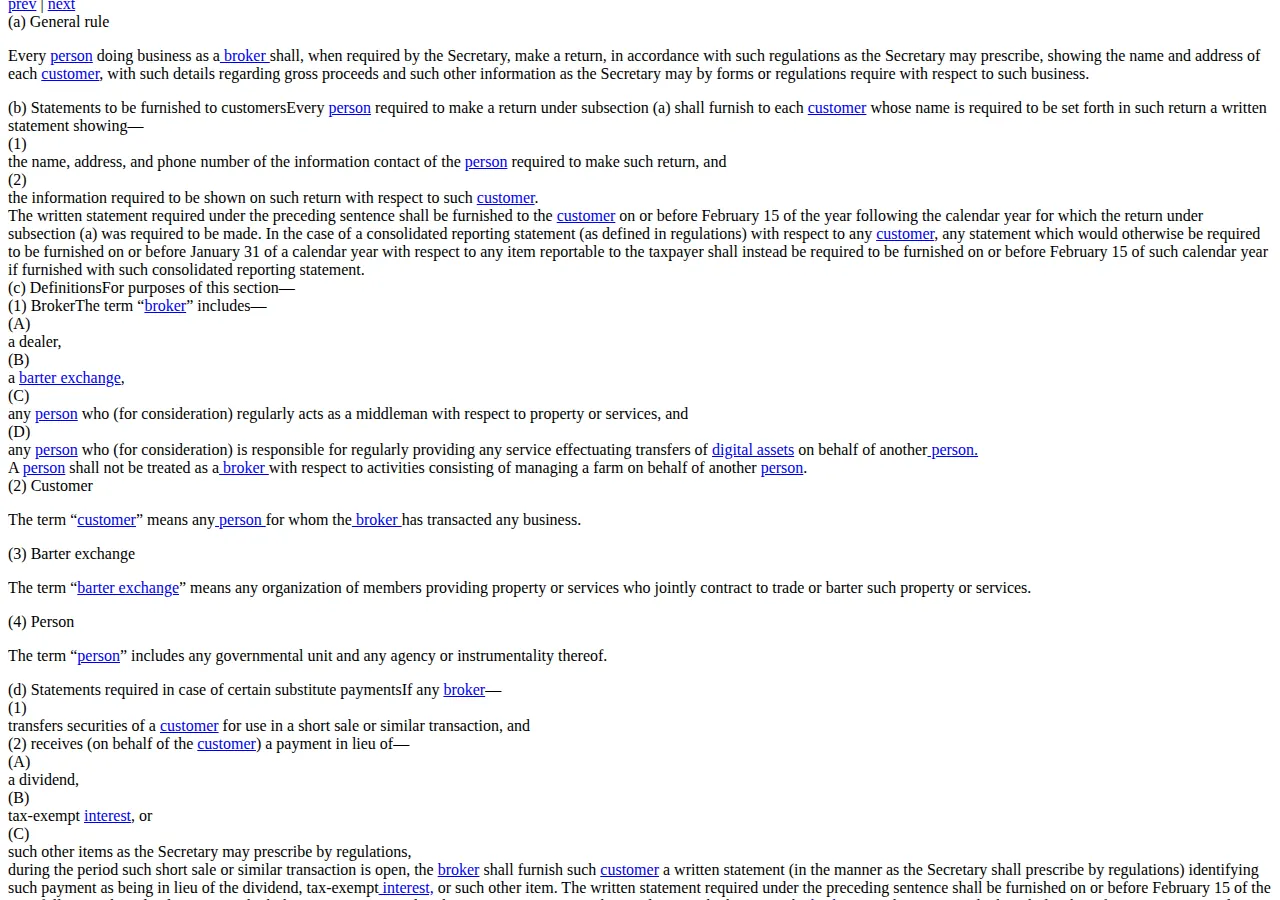
Section 6045(a) requires a broker to report each customer name and address and the gross proceeds of sales the broker effects.
Section 6045(g) adds basis for a covered security: adjusted basis, and whether the gain or loss is long-term or short-term under section 1222.
A digital asset is any digital representation of value recorded on a cryptographically secured distributed ledger, such as a blockchain, that is not cash.
Who counts as a broker
The broker definition is the first control in the operation, because it decides who files at all.
The 2026 Instructions add the filing test: a broker is any person who, in the ordinary course of a trade or business, stands ready to effect sales of digital assets to be made by others.
That covers a person that regularly offers to redeem digital assets it created or issued, and a person that effects dispositions as an agent, a dealer, or a digital asset middleman.
The middleman category reaches past a trading platform.
It includes a person who accepts digital assets as payment for securities, commodities, futures, options, or broker services.
Two kinds of operator sit outside the definition: a person solely engaged in proof-of-work or proof-of-stake validation, and a person only providing hardware or software that lets users control private keys.
The final regulations likewise impose no reporting on decentralized or non-custodial brokers that do not take possession of the assets being sold.
The phased rollout: 2025, 2026, and after
The reporting phases in over two calendar years, and the year of the sale decides what the broker must report.
For each digital asset sale effected for a customer in 2025, the broker must complete Form 1099-DA, but is not required to report basis.
The broker may voluntarily report basis for 2025 sales, and faces no penalties under section 6721 or 6722 for errors in basis information voluntarily reported.
For sales effected after 2025, the broker must report basis for covered securities.
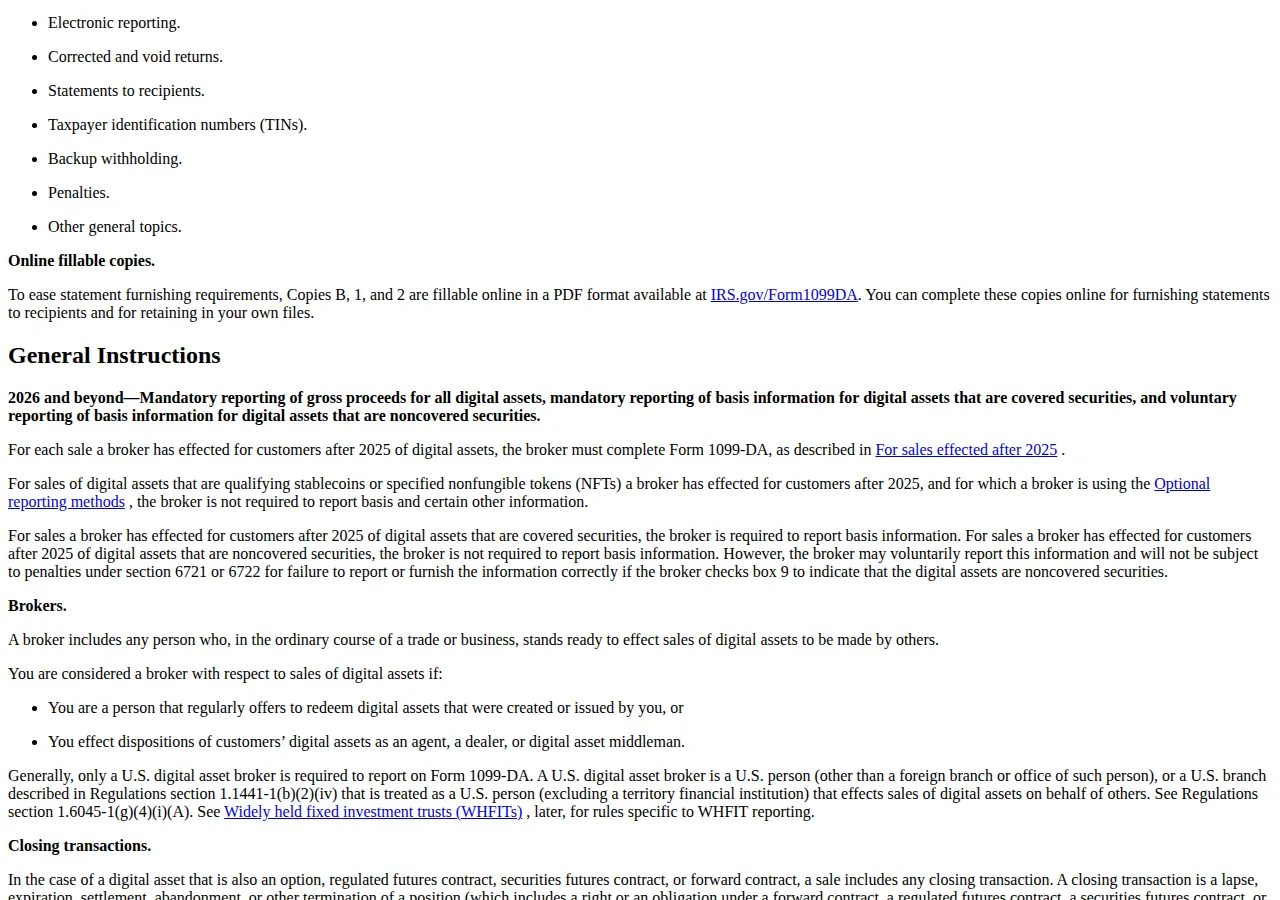
The IRS states the same two steps on its Digital Assets page: gross proceeds for transactions effected on or after January 1, 2025, and basis on certain transactions effected on or after January 1, 2026.
Covered securities and noncovered securities
The covered-security line decides whether basis is mandatory, voluntary, or absent.
A covered security is a digital asset acquired after 2025 for cash, stored-value cards, different digital assets, or other property or services the broker must report, in an account for which the broker provided custodial services, and held there until the broker effects the disposition.
Customer Bill bought units of digital asset ABC in April 2022, April 2026, and August 2026.
The broker reports the sale on three separate 2027 Forms 1099-DA: one for the August 2026 units with short-term gain or loss, one for the April 2026 units with long-term gain or loss, and a third for the April 2022 noncovered units.
If box 9 is checked, the broker does not have to complete boxes 1d, 1g, 1h, 1i, and 6, and does not have to check box 2.
If the broker does not check box 9, the broker faces penalties under sections 6721 and 6722 for errors in those boxes even when reporting a noncovered security.
The de minimis thresholds
Three small-sale thresholds sit inside the 2026 instructions, and each one works differently.
A PDAP broker is not required to report a customer's PDAP sales if they are 600 dollars or less for the year.
If the customer PDAP sales exceed 600 dollars, all of that customer sales must be reported.
A broker using the optional method for qualifying stablecoins is not required to report designated sales if the customer aggregate gross proceeds, after allocable transaction costs, do not exceed 10,000 dollars for the year.
How to file Form 1099-DA, box by box
The filing operation runs in a fixed order: identify the broker, identify the customer, classify each lot, price the sale, then complete the boxes.
Box 1a carries the asset code, box 1b the name, box 1c the number of units, box 1d the date acquired, box 1e the date sold, and box 1f the proceeds.
Box 1g carries cost or other basis, box 1h accrued market discount, and box 1i the wash sale loss disallowed.
Box 2 is checked if basis is reported to the IRS, box 3a records the proceeds reported to the IRS, and box 3b is checked for a qualified opportunity fund.
Box 4 carries federal income tax withheld, and box 5 is checked if the loss is not allowed based on box 1f.
Box 6 shows gain or loss, box 7 is checked if only cash proceeds were paid, box 8 if the broker relied on customer-provided acquisition information, and box 9 if the asset is a noncovered security.
Enter the gross proceeds from the sale: cash, the value of services, digital assets, or other property received in exchange for the disposed assets.
The broker must reduce the proceeds by digital asset transaction costs, including fees, commissions, and transfer taxes related to the sale.
Box 1g carries the adjusted basis of any digital asset sold, unless the asset is a noncovered security and the broker checks box 9 and chooses not to complete box 1g.
A blank box 1g and a zero box 1g mean different things.
A broker filing 10 or more information returns must file electronically.
Form 1099-DA may not be filed through the FIRE System; it must be filed electronically through IRIS, the IRS free online portal for information returns.
A United States individual gives a Social Security Number (SSN) on Form W-9, a business entity gives an Employer Identification Number (EIN), and a resident alien who cannot get a Social Security Number gives an Individual Taxpayer Identification Number (ITIN).
A foreign customer completes the applicable Form W-8 instead, and the broker uses the W-8 to decide whether the customer is an exempt foreign person under Regulations section 1.6045-1(g)(4).
An LLC that has not elected corporate treatment is reported under its owner rules, while an LLC that elected corporate treatment, an S-Corp, and a C-Corp are each reported as the corporation they elected to be.
One carve-back applies: the broker must still file for the sale of a covered security by an S-Corp that acquired it after 2012.
A CPA who reviews the file checks the TIN against the name on the W-9 or W-8, checks the entity classification against the books kept under GAAP, and checks the FICA and SECA treatment separately, because payroll tax and self-employment tax run on different rails and neither belongs on a 1099-DA.
Which form for which sale
The boundary between Form 1099-DA and its neighbours decides the filing.
| Sale | Form to file | Authority |
|---|---|---|
| Digital asset sale by a United States broker that takes possession | Form 1099-DA | 26 U.S.C. § 6045(c)(1)(D) |
| Digital asset that is also a security (dual classification) | Form 1099-DA, not 1099-B, subject to three exceptions | 2026 Instructions, Coordination; Reg. § 1.6045-1(c)(8) |
| Section 1256 contract on a digital asset | Form 1099-B, aggregate basis | 2026 Instructions, Coordination |
| Stock or security that is not a digital asset | Form 1099-B | 26 U.S.C. § 6045(a) |
| Payment through a third-party settlement organization | Form 1099-K | 26 U.S.C. § 6050W |
The IRS Form 1099-NEC contractor reporting playbook runs the payer side for service payments, and the IRS Form 1099-K payment app reporting threshold playbook runs the settlement-organization side.
To price the tax behind a sale before filing, run the numbers through the tax estimator.
The gain math, worked twice
Take a covered security bought in a custodial account in March 2026 and sold in September 2027.
The sale fetched 42,500 dollars, the adjusted basis was 31,200 dollars, and the transaction costs were 180 dollars.
The gain is proceeds minus basis minus costs.
The result, 11,120 dollars, is the gain the broker reports in box 6 and the customer carries to Form 8949.
Backup withholding runs at 24 percent.
Customer Alex sold digital assets with a basis of 1,000 dollars for proceeds of 600 dollars, a loss of 400 dollars.
Alex had repurchased 75 units inside the wash-sale window, so 300 dollars of the loss is disallowed and reported in box 1i.
The disallowed 300 dollars is added to the basis of the newly purchased 75 units, and the allowed loss is 100 dollars.
Penalties, corrections, and relief
Section 6721 sets the penalty for failure to file a correct information return, and the ladder rewards fast correction.
The statute base amounts are 250 dollars per return.
The amount falls to 50 dollars per return when the failure is corrected within 30 days of the required filing date, and to 100 dollars per return when corrected on or before August 1.
The annual caps in the statute are 500,000 dollars for corrections within 30 days, 1,500,000 dollars for corrections by August 1, and 3,000,000 dollars otherwise.
Lower caps apply to a person whose average annual gross receipts for the most recent three taxable years do not exceed 5,000,000 dollars: 175,000 dollars, 500,000 dollars, and 1,000,000 dollars on the same three rungs.
Intentional disregard sits above the ladder: the penalty is 500 dollars per return or, if greater, 5 percent of the aggregate amount required to be reported correctly for a return required under section 6045(a).
Notice 2025-33 gives transitional relief from backup withholding for all transactions in 2025 and 2026, and for 2027 for a customer from whom the broker obtains the TIN and submits the name and TIN to the IRS TIN-matching program.
Cross-border, real estate, and tokenized securities
Generally only a United States digital asset broker must report.
The broker must decide whether each customer is a United States person, an exempt foreign person, or a foreign person subject to withholding.
For a foreign recipient, the broker requests the applicable Form W-8 rather than a Form W-9.
A real estate reporting person who knows, or ordinarily would know, that digital assets were used by the buyer to make payment is a digital asset middleman for that payment.
From closing dates on or after January 1, 2026, that person must report the fair market value of the digital assets paid by the buyer and received by the seller.
A tokenized security is an asset whose offer and sale is registered with the United States Securities and Exchange Commission, other than an asset treated as a security solely as an investment contract.
A dual classification asset that is a tokenized security is reported on Form 1099-DA, not Form 1099-B, unless one of the three regulatory exceptions applies.
Execution checklist
- Confirm broker status under section 6045(c)(1)(D): possession, standing ready to sell, or acting as a PDAP, kiosk operator, or middleman.
- Collect a Form W-9 with an SSN or EIN from each United States customer, or the applicable Form W-8 from each foreign customer, and run the TIN through TIN matching.
- Tag every lot at acquisition: covered only when acquired after 2025, in a custodial account, and held there until disposition.
- Record basis at acquisition for every covered lot, and keep transfer-in records in boxes 12a and 12b.
- Apply the de minimis tests per customer: PDAP at or under 600 dollars, stablecoins at or under 10,000 dollars, NFTs at or under 600 dollars.
- Price each sale for box 1f as gross proceeds reduced by fees, commissions, and transfer taxes.
- Split one sale into separate Forms 1099-DA by lot type: short-term covered, long-term covered, noncovered with box 9, and first sales.
- Complete box 6 under section 1222, report the wash sale disallowance in box 1i, and check box 8 when customer information was received.
- Withhold 24 percent in box 4 when backup withholding applies, report it on Form 945, and claim Notice 2025-33 relief only where it applies.
- Furnish the recipient statement by February 17, 2026 for 2025 sales, file on paper by March 2, 2026 or electronically by March 31, 2026, through IRIS.
- Reconcile every Form 1099-DA to Form 8949 before filing: box 1f proceeds, box 1g basis, and the box 6 gain or loss.
- Correct fast: inside 30 days for the 50-dollar base rate, on or before August 1 for the 100-dollar base rate, with the CORRECTED box checked.
HSA distributions report through a different form: see our IRS Form 1099-SA HSA distributions playbook.