IRS Form 1040-X: The Amended Return Playbook
Form 1040-X is the only way to fix a filed individual return: it corrects a previously filed Form 1040, 1040-SR, or 1040-NR, changes amounts the IRS already adjusted, makes a carryback claim, or records certain elections after the deadline. One form, three columns, one hard clock — miss the § 6511 window and the refund is gone.
When to amend — and when to leave the return alone
Amend when something on the filed return is wrong in a way that changes filing status, income, deductions, credits, or tax liability — the IRS test in Topic No. 308: "file an amended return if there's a change in your filing status, income, deductions, credits, or tax liability."
Do not amend for everything. The IRS corrects certain errors itself — a math slip, a missing schedule it can compute — and may accept a return without certain required forms. In those instances, Topic 308 says plainly, "there's no need to amend your return."
File Form 1040-X only after the original return has been filed. You may amend the same year more than once if each filing is timely; Column A of the second amendment carries the amounts from the first amended return, not the original.
> [!KEY TAKEAWAY]
> Amend only when the correction changes tax. A return the IRS already corrected needs no amendment.
The deadline: 26 U.S.C. § 6511, the 3-year/2-year rule
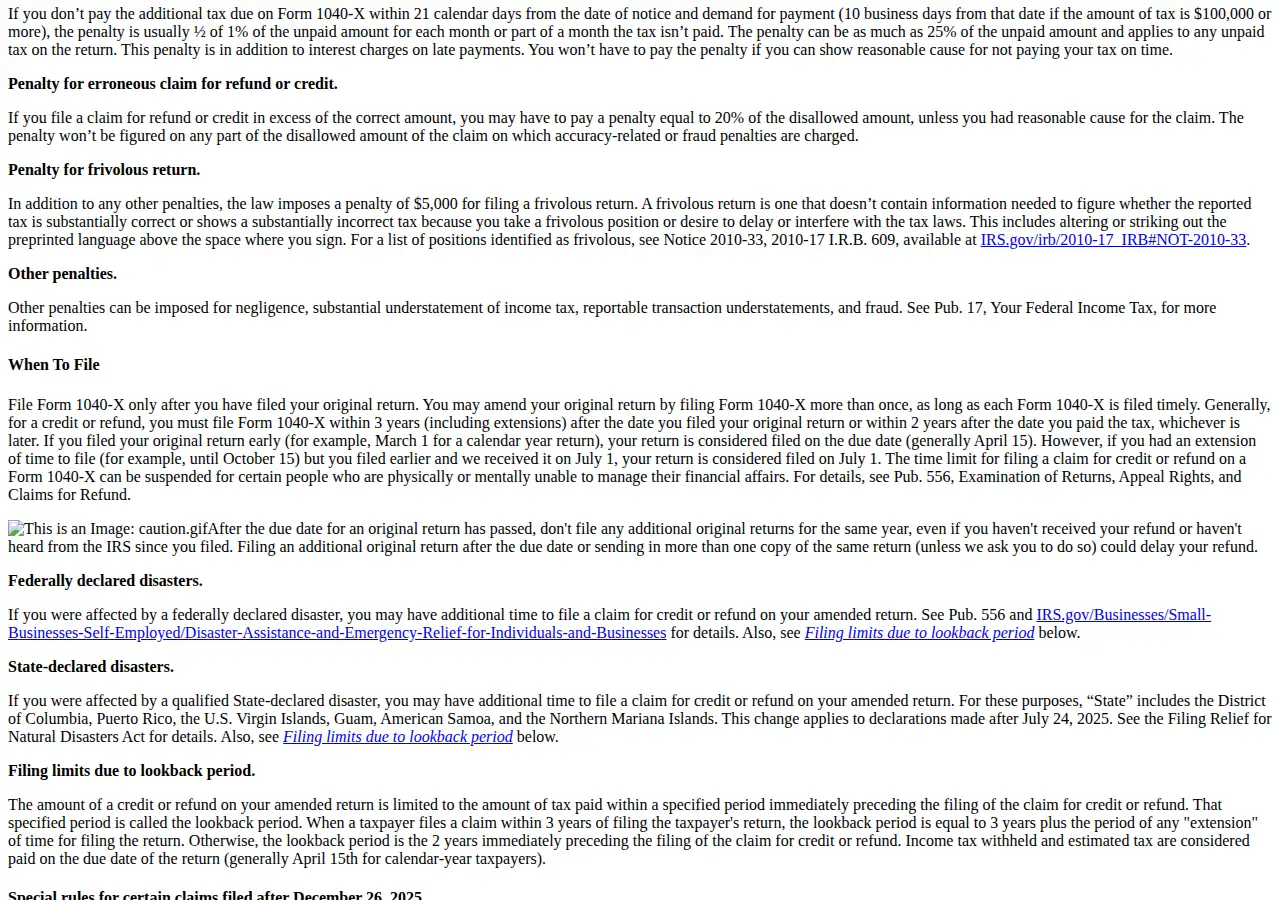
The refund window is statutory, not administrative. Section 6511(a) states the claim "shall be filed by the taxpayer within 3 years from the time the return was filed or 2 years from the time the tax was paid, whichever of such periods expires the later" — repeated in the same terms by the Instructions for Form 1040-X (December 2025 revision).
The deadline is the later of two dates:
$
\text{Refund deadline} = \max(\text{filing date} + 3\text{ years}, \text{payment date} + 2\text{ years})
$
Two rules set the start date. A return filed early counts as filed on the due date — file March 1 and it counts as filed April 15, with withholding deemed paid the same day. With an extension to October 15, a return received July 1 counts as filed July 1.
Worked example, 2023 tax year. Return filed March 1, 2024: treated as filed April 15, 2024. The 3-year deadline is April 15, 2027; withholding is deemed paid April 15, 2024, so the 2-year deadline is April 15, 2026. The later date governs: April 15, 2027 — file one day late and the claim is barred, even if the IRS owes the money. With an extension to October 15, 2024, the same return received July 1, 2024 counts as filed July 1, 2024, moving the 3-year deadline to July 1, 2027. Extensions move the refund deadline with them.
> [!WARNING]
> The 3-year clock runs from the treated filing date, not the mailing date. File after the later of the two § 6511 dates and the refund is barred — the IRS cannot pay it even if the correction is plainly right.
!IRS Form 1040-X instructions refund window
The lookback: filing on time is not enough
Meeting the deadline is necessary, not sufficient. Section 6511(b)(2) caps the amount: file within the 3-year period and the refund cannot exceed the tax paid in the 3 years plus any extension period immediately preceding the claim; file outside it, inside the 2-year payment window, and the cap is the tax paid in the 2 years preceding the claim.
That distinction bites when tax was paid late. A return filed April 15, 2024 with a 6-month extension, claimed April 15, 2027, has a lookback of 3 years plus 6 months — tax paid from October 15, 2023 onward is recoverable. File the same claim July 1, 2027 — now past the 3-year window, but inside the 2-year window that runs from an August 15, 2025 balance payment — and only tax paid in the 2 years before July 1, 2027 counts; tax paid in 2023 stays with the Treasury. Two different clocks — and the lookback is the one that quietly shrinks the refund.
Special windows save refunds others write off: a bad debt or worthless security gets 7 years from the return's due date under § 6511(d)(1) — one discovered in 2026 for tax year 2020 can still be claimed until April 15, 2028; a foreign tax credit gets 10 years under § 6511(d)(3); an NOL or capital-loss carryback gets 3 years after the due date, including extensions, of the loss-year return under § 6511(d)(2).
Superseding vs amended: the same form, two different returns
The distinction turns on one fact: has the filing due date passed? If you owe additional tax and the due date has not passed, file Form 1040-X — or a corrected Form 1040 — and pay by the due date without regard to extensions, and you avoid penalties and interest; that return replaces, or supersedes, the original. A due date on a Saturday, Sunday, or legal holiday shifts to the next business day.
File after the due date and the return is an amendment, not a superseding return. Do not include interest or penalties on Form 1040-X; the IRS adjusts them. The difference is money: a superseding return filed before April 15 with payment stops interest from accruing; an amendment filed April 16 pays interest from the original due date.
| Route | When it applies | Interest and penalties | Authority |
| --- | --- | --- | --- |
| Superseding return (1040-X or corrected 1040) | Filed and paid by the due date, without regard to extensions | Avoided if paid by the due date | Topic No. 308 |
| Amended return (1040-X) | Filed after the due date, inside the § 6511 window | Interest accrues from the original due date; the IRS adjusts it | Topic No. 308; Instructions for Form 1040-X |
| Do nothing | IRS corrects the error itself, or no status / income / deduction / credit / tax change | None — but verify the IRS actually corrected it | Topic No. 308 |
| Form 1045 tentative refund | NOL, credit, or claim-of-right carryback where speed matters | Faster tentative refund; file within 1 year after the end of the loss year | Instructions for Form 1040-X |
The form: Columns A, B, C and Parts I–III
Form 1040-X is a reconciliation, not a fresh return. Column A carries the amounts as originally filed or previously adjusted; Column B the net increase or decrease; Column C the corrected amounts — A plus B equals C, line by line, and the IRS checks it. Complete only the lines that change.
Complete Part I only if the dependent claim changes; Part II, Explanation of Changes, is where the amendment is won or lost: state the reason for each change in plain language, line by line, with the document behind it. "Correcting Schedule D" is not an explanation; "Adding $4,200 of long-term capital loss from the corrected 1099-B issued March 3, 2026" is. Part III, Direct Deposit, exists only for e-filed returns.
Filing status has its own limits: you cannot change from a joint return to separate returns after the due date, but changing from separate to joint is permitted — both spouses then become jointly liable, and Part II must state "Changing the filing status."
Carryback claims: NOLs, capital losses, and credits
A carryback is an amendment that reaches backward: a net operating loss, capital loss carryback, unused credit, or foreign tax credit from a later year is carried back by filing Form 1040-X for each year it is carried to, with "Carryback Claim" at the top of page 1. The deadline is 3 years after the due date, including extensions, of the loss-year return — 10 years, without extensions, for a foreign tax credit.
The timing comparison decides the form. Form 1045, Application for Tentative Refund, must be filed within 1 year after the end of the loss year — a much shorter fuse, but a tentative refund, processed faster. Form 1040-X gives 3 years but moves at amended-return speed: 8 to 12 weeks, sometimes 16. A 2025 loss with an extended return due October 15, 2026 means a Form 1045 deadline of December 31, 2026 and a Form 1040-X deadline of October 15, 2029.
Two NOL details: the refund excludes self-employment tax on line 10, and generally no interest is paid on an NOL refund processed within 45 days of receipt. Attach the NOL computation (Schedule A, Form 1045) and any carryover (Schedule B, Form 1045).
A corrected Schedule D is usually the document behind a capital-loss carryback — see the IRS Form 1040 Schedule D capital gains playbook. For a harvested loss, the wash-sale rules decide whether it survives: see the tax-loss harvesting and wash-sale playbook.
E-filing, direct deposit, and tracking
Form 1040-X can be filed electronically with tax filing software to amend Forms 1040, 1040-SR, and 1040-NR. E-filing changes three things: delivery — since February 2023, an e-filed Form 1040-X for tax year 2021 or later may request direct deposit, while paper filers wait for a check; payment — an e-filer who owes can authorize an electronic withdrawal (direct debit) at filing; and signature — a Self-Select PIN or Practitioner PIN plus prior-year AGI, never the AGI from an amended return, with any issued IP PIN in full.
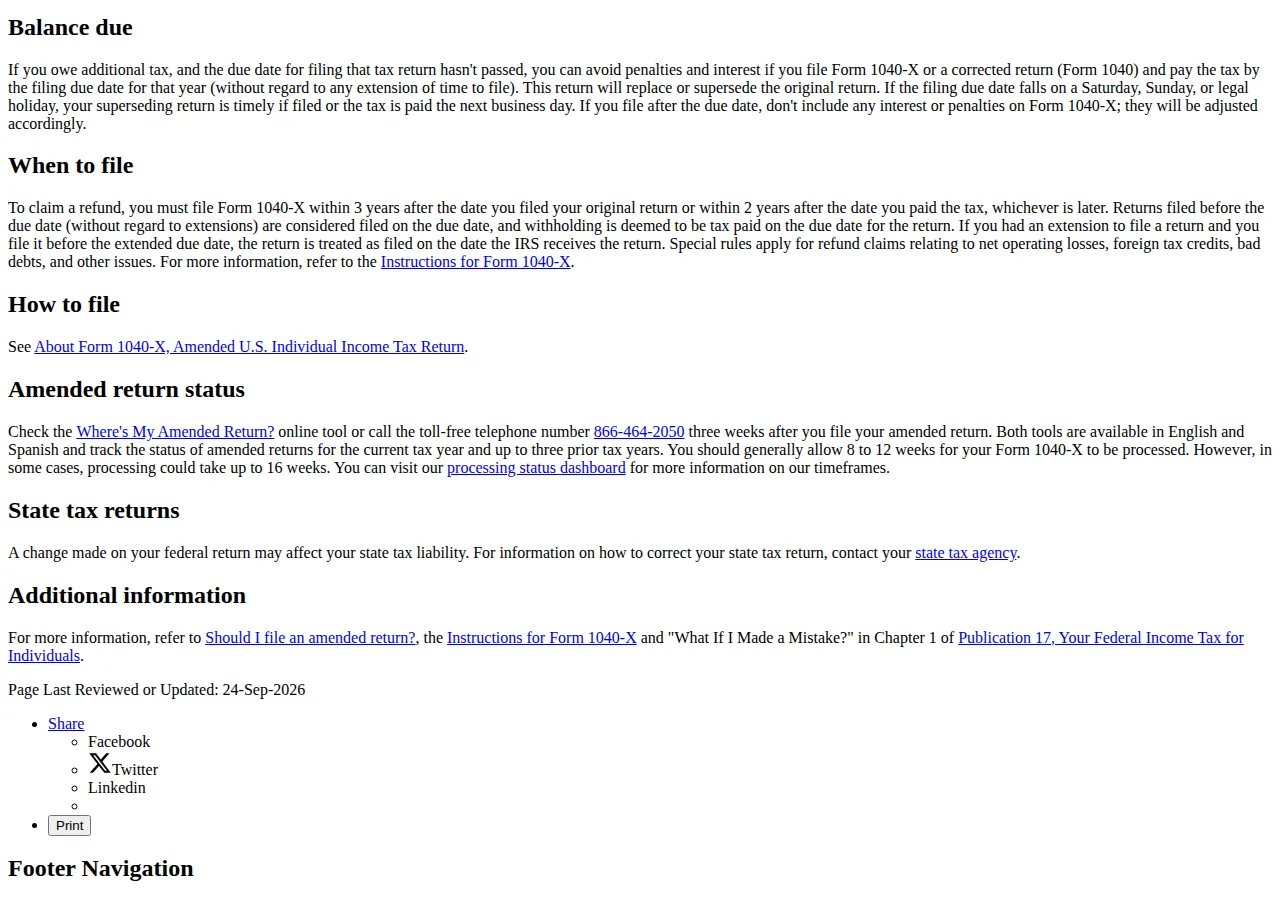
Processing stays manual either way: allow 8 to 12 weeks, up to 16 in some cases, and a mailed return can take up to 3 weeks just to appear in the system. Check Where's My Amended Return? or call 866-464-2050 three weeks after filing; the tool tracks the current tax year and up to three prior tax years.
!IRS Topic 308 processing times
The refund math, worked
The refund is the difference between the tax on the filed return and the tax on the corrected return, plus interest the IRS figures:
$
\text{Refund} = \text{Tax}_{\text{original}} - \text{Tax}_{\text{corrected}} + \text{Interest}_{\text{IRS}}
$
Take a taxpayer who discovers $6,000 of unclaimed deductible expenses after filing. Taxable income falls by $6,000. At an assumed 22 percent marginal rate — an assumption for this illustration, not an IRS figure — the tax falls by:
$
\text{Tax saved} = \$6{,}000 \times 0.22 = \$1{,}320
$
The refund is $1,320 plus whatever interest the IRS computes, provided the claim is filed inside the § 6511 window and the tax was paid within the lookback period. If the tax was paid more than 3 years plus the extension period before the claim, the lookback caps the refund at zero even though the deduction is real. The arithmetic runs in reverse for an underpayment: $6,000 of unreported income at 22 percent is $1,320 owed, plus interest from the original due date.
Confirm the corrected tax first with the tax estimator. A second wrong number is a second amendment.
> [!TIP]
> File the amendment for the year with the largest refund first when several years are affected — the 3-year clock expires year by year.
Who should NOT amend
Not every correction is worth an amendment. Do not amend when the IRS already corrected the error — check the notice first — and do not chase a refund smaller than the cost of preparing it correctly; a $40 refund needing a corrected Schedule D, a new 1099-B, and a Part II explanation is a loss. Do not amend a return under examination without coordinating with the examiner. Do not amend to change filing status from joint to separate after the due date, or a year whose § 6511 window has closed — the claim is barred.
Filing Form 1040-X, step by step
1. Confirm the window: compute both § 6511 dates — 3 years from the treated filing date, 2 years from the payment date — file before the later one, and check the lookback too.
2. Gather the corrected documents — the revised 1099, K-1, W-2c, or schedule. Do not amend from memory.
3. Complete only the lines that change: Column A from the filed or adjusted return, Column B the net change, Column C the corrected amount.
4. Write Part II line by line, naming the document behind each change and the date it arrived.
5. For a carryback, write "Carryback Claim" at the top of page 1 and attach the NOL computation (Schedule A, Form 1045) and any carryover (Schedule B, Form 1045).
6. Choose the route: e-file for direct deposit (tax year 2021 or later) or paper with a check. If you owe, authorize the electronic withdrawal or pay in full.
7. If the federal change affects state tax, file the corrected state return. Then track it: Where's My Amended Return? or 866-464-2050, three weeks after filing; allow 8 to 12 weeks, up to 16.
Mistakes that cost the refund
Four errors account for most of the avoidable loss: filing after the § 6511 deadline, amending a year the IRS already corrected, putting the original-return amounts in Column C instead of Column A, and writing a Part II explanation that names no document. Two more: forgetting the state return, and amending from joint to separate after the due date — barred outright.
One more timing trap is current. The One Big Beautiful Bill Act added § 174A for domestic research and experimental expenditures: certain small business taxpayers may elect to deduct unamortized amounts paid or incurred in tax years beginning after 2021 and before 2025, and a taxpayer who already filed must amend to make the election — by July 6, 2026, under Rev. Proc. 2025-28, a hard date, not a § 6511 window.
> [!FOUNDER]
> "An amended return is a second chance with a deadline attached. The taxpayers who lose money are not the ones who made the mistake — everyone makes one — they are the ones who find it in year four and discover the statute already closed the door. Find the error, check the clock, then file."
> — Enow A. Jovial, Founder & Chief Executive Officer