One good harvest should not be taxed as if every year were a good harvest
A corn grower can lose money for three years and then clear a bumper crop in the fourth, but the tax code taxes each year on its own: the bumper year is taxed at the top of the rate schedule while the lean years used only the 10 and 12 percent brackets. Schedule J (Form 1040), the election under 26 U.S.C. § 1301, fixes that mismatch — it does not move income between years, it taxes part of this year's farm income at the rates of the three prior years.
The election in one paragraph: section 1301(a)
Section 1301(a) states the computation in two parts:
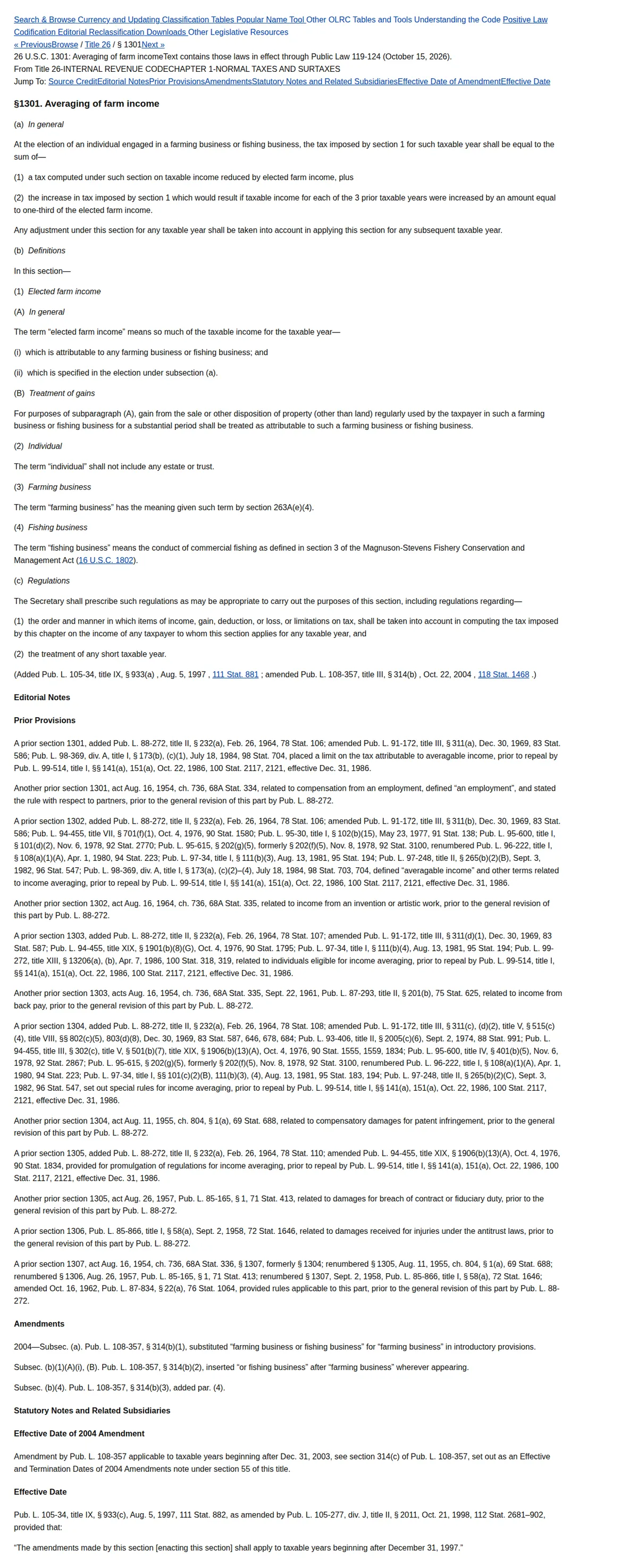
Under 26 CFR 1.1301-1, the reduction and the one-third additions are hypothetical — they exist only inside the computation, and actual taxable income for every year is untouched.

Who can elect — and who cannot
The gate is the form of the taxpayer, not the size of the farm: Publication 225 states who qualifies — an individual engaged in a farming business as a sole proprietor, a partner in a partnership, or a shareholder in an S corporation. Employee services are disregarded, except that an S corporation shareholder may count compensation attributable to the farming business and a crew member paid by a share of the catch counts as engaged in a fishing business. Publication 225 prints the exclusion in one sentence: corporations, partnerships, S corporations, estates, and trusts cannot use income averaging.
Two relaxations matter: the farmer need not have farmed or fished during any base year, and filing status may differ between the election year and the base years — a farmer married filing jointly in the election year who filed as single in the base years still averages, using the single rate schedule for those years. A farming business is cultivating land or raising or harvesting any agricultural or horticultural commodity; contract harvesting of someone else's crop and merely buying and reselling plants or animals are not.
Elected farm income: what counts, and what does not
Elected farm income, or EFI, is the year's taxable income from farming or fishing that the farmer designates on Schedule J, line 2a. Electible farm income is the ceiling — farm and fishing income and gains minus farm and fishing deductions and losses. Two caps bind it: EFI cannot exceed taxable income, and EFI from net capital gain cannot exceed total net capital gain. Farm and fishing income combine, and a farm loss nets against fishing income; the regulation's Example 3 takes $200,000 of fishing income less a $60,000 farm loss to $140,000.
Three exclusions decide most borderline cases: gain or loss from the sale of land is never farm income for averaging, nor is gain or loss from the sale of development rights, grazing rights, and other similar rights. Gain or loss from selling other farm property counts only if the property was regularly used in the business for a substantial period; property always used solely in the business is deemed to meet both tests.
The election need not cover the whole amount — line 2a can hold less than all farm taxable income. The regulation's examples show the ceiling at work: $200,000 of farm ordinary income less $50,000 of farm expenses gives $150,000 of electible farm income, and $100,000 less a $23,000 allowable farm capital loss gives $77,000.
| Choice | What it does | When it wins | Authority |
|---|---|---|---|
| Elect all electible farm income | Moves the full farm spike into the base years, one-third each | Base years all lean, with deep unused 10 and 12 percent brackets | Instructions for Schedule J, line 2a; § 1301(a) |
| Elect part of it | Fills the base years' low brackets exactly, leaves the rest at current-year rates | One base year was strong, or the spike is large enough to push a base year into the 22 percent bracket | Instructions for Schedule J, line 2a tip; 26 CFR 1.1301-1(a)(2) |
| Do not elect | Tax the spike at current-year rates | All three base years were high-income years | § 1301(a) (election is optional) |
The line-by-line sequence
Schedule J has 23 lines. Line 1 is taxable income from Form 1040, line 15; line 2a is the elected farm income; lines 2b and 2c carve out the net capital gain and unrecaptured section 1250 gain portions of EFI, if any; line 3 subtracts line 2a from line 1. Line 4 figures the tax on line 3 on the 2025 Tax Table, Tax Computation Worksheet, or Qualified Dividends or Schedule D worksheet. Each base-year block is built the same way: line 5 is 2022 taxable income, line 6 is line 2a divided by 3, line 7 adds them, and line 8 figures the tax on line 7 on the 2022 schedules printed in the instructions. Lines 9 through 12 repeat the pattern for 2023, and lines 13 through 16 for 2024. Line 17 adds lines 4, 8, 12, and 16. Lines 19, 20, and 21 enter the section 1 tax actually figured for 2022, 2023, and 2024; line 22 adds them; line 23 subtracts line 22 from line 17 and is entered on Form 1040, line 16. If a base year used Schedule J, use the adjusted figure from that earlier Schedule J (a 2024 Schedule J feeds line 5 from its line 11, line 9 from its line 15, and line 13 from its line 3).
Worked example: a $90,000 spike averaged over three lean years
Take a fictional single filer, a grain farmer in Iowa, for 2025: never used Schedule J before, no capital gain inside EFI, 2025 taxable income of $150,000, elected farm income of $90,000, and base-year taxable incomes of $20,000 for 2022, $35,000 for 2023, and $28,000 for 2024. Line 3 is $150,000 minus $90,000, or $60,000; line 6 is $90,000 divided by 3, or $30,000, added to each base year. Line 4 is the tax on $60,000 at the 2025 single rates — 10 percent to $11,925, 12 percent to $48,475, 22 percent to $103,350: $1,192.50 plus $4,386.00 plus $2,535.50, a total of $8,114.00. Each base-year block adds $30,000 to the base income and measures the tax increase:
Each base-year tax uses that year's own schedule: 2022 single — 10 percent to $10,275, 12 percent to $41,775, 22 percent to $89,075; 2023 single — 10 percent to $11,000, 12 percent to $44,725, 22 percent to $95,375; 2024 single — 10 percent to $11,600, 12 percent to $47,150, 22 percent to $100,525. Line 17 adds the four computed taxes, line 22 adds the three taxes actually paid, and line 23 is the difference:
Without the election, the tax on $150,000 at 2025 single rates is $1,192.50 plus $4,386.00 plus 22 percent of $54,875 ($12,072.50) plus 24 percent of $46,650 ($11,196.00): $28,847.00. The saving is $28,847.00 minus $22,849.00, or $5,998.00 — an effective rate of 15.23 percent on the $150,000 instead of 19.23 percent. Run the same numbers through the tax estimator and the gap is the same: the saving comes entirely from the base years' unused 12 percent brackets. The farm-income side is covered in the irs-form-1040-schedule-f-farm-income-playbook, where the $90,000 is first reported.
Capital gains inside elected farm income
When EFI includes net capital gain, the form splits it out: line 2b is the EFI portion treated as net capital gain, capped at the smaller of total net capital gain or the business's net capital gain, and line 2c is the smaller of line 2b or the unrecaptured section 1250 gain. Each base year's rates then apply to an equal portion of each type of income, allocating one-third of line 2b — and one-third of line 2c, if any — to each base year through the Schedule D Tax Worksheet. A base year with a capital loss carryover does not reduce the EFI allocated to it. The regulation's Example 5 shows the split: $70,000 of electible farm income as $10,000 of capital gain and $60,000 of ordinary income.
What averaging does not touch
The election changes one number — the section 1 tax for the election year — and leaves everything else where it was. It is disregarded in computing tentative minimum tax and the regular tax under section 55, though it counts toward regular tax liability under section 53(c); Publication 225 notes the election may still reduce total tax even when AMT is owed. For 2025 the unmarried AMT exemption is $88,100, phasing out from $626,350 — run Form 6251 without the election. Self-employment tax is untouched: no effect on FICA, FUTA, withholding, or net earnings from self-employment, so Schedule SE is figured on the full farm profit. The irs-form-1040-schedule-se-self-employment-tax-playbook covers that layer. Section 1231 netting, NOL carryovers, and net capital loss carryovers are all determined before the EFI subtraction.
What the election costs, and what it leaves behind
Electing is a trade-off, not a free saving: every dollar of EFI added to a base year is taxed at that year's marginal rate, so the saving shrinks as the one-third additions fill the base years' low brackets. In the worked example the marginal dollar lands at 22 percent in a base year against 24 percent in the election year, which is why the instructions say it may pay to elect less than the full amount. The saving is income tax only — self-employment tax is figured under SECA on net earnings from self-employment, so Schedule SE is unchanged.
The form of the business decides who can elect: an S-Corp shareholder elects as an individual on their own return, a partner in a farm partnership — including a multi-member LLC taxed as a partnership — elects their own share, and a C-Corp cannot elect, so the same farm income inside a C-Corp gets no averaging. Run the draft return past your CPA before January 15 — the right EFI amount is only visible on a completed draft.
Averaging and the estimated-tax calendar
Schedule J is filed with the return, but its benefit is decided months earlier, at the estimated-tax payment date. A qualified farmer — at least two-thirds of gross income from farming in the current or prior year — owes no estimated tax if the return is filed and all tax paid by March 2, 2026, or if withholding will reach 66 2/3 percent of the 2025 tax or 100 percent of the 2024 tax. Otherwise the farmer makes one required annual payment by January 15, 2026, figured on the Form 1040-ES worksheet at 66 2/3 percent of the current-year tax or 100 percent of the prior-year tax; miss both dates and the penalty is figured on Form 2210-F.
The 66 2/3 percent safe harbor is measured against the total tax on the 2025 return — the Schedule J line 23 figure carried to Form 1040, line 16. In the worked example the target drops from $28,847 to $22,849, so 66 2/3 percent of it drops from $19,231 to $15,233, a $3,998 smaller payment for the same safe harbor. But the election must be decided before January 15, 2026 to use that lower target. The quarterly-estimated-tax-payments-1099 guide covers the general estimated-tax rules that apply when the two-thirds test is not met.
The 12-step execution checklist
- Pull the three base-year returns. 2022–2024 Forms 1040, lines 15 and 16; Form 4506 for copies, 4506-T for transcripts.
- Figure electible farm income. Farm income and gains minus farm deductions and losses; apply both caps.
- Strip out the exclusions: land-sale gain and development, grazing, and similar rights.
- Test the base years: if all three were high-income years, stop — the election saves nothing.
- Choose the EFI amount. Run the form at the full and partial amounts and elect the figure that fills the low brackets.
- Split capital gains: complete lines 2b and 2c; plan on the Schedule D Tax Worksheet per base year.
- Rebuild any zero or negative base year on its Taxable Income Worksheet.
- Complete lines 1 through 23 on each base year's own rate schedule.
- Check the AMT: run Form 6251 without the election.
- Set the estimated-tax figure. Use the Schedule J tax for the 66 2/3 percent safe harbor, or plan the March 2, 2026 file-and-pay route.
- File Schedule J with the return; line 23 goes on Form 1040, line 16. Keep the return for 2026–2028 averaging.
- Diary the change window: change or revoke on an amended return inside the 3-year / 2-year claim period.
Founder & CEO Insight — Enow A. Jovial