IRS Form 1040 Schedule F: The Farm Income Playbook
A Schedule F is not a Schedule C with a barn. It is a separate form with its own income lines, loss limits, and estimated-tax calendar — and, for 2025, a new equipment write-off landscape from the One Big Beautiful Bill Act. A farmer who files farm income on Schedule C, or treats a crop-insurance check like ordinary receipts, does not have a rounding problem — the return is wrong in a way the IRS can price line by line. This playbook runs one farm through Schedule F from line 1 to line 34, prices the equipment decision, applies the 2025 loss limits, and sets the estimated-tax calendar.
Who this is for — and who should stop here
This guide is for a sole proprietor, a single-member LLC taxed as a sole proprietor, or a farm partner reporting on Schedule F and Schedule SE. It is not for a cash-rent landlord — that income belongs on Schedule E — nor for a C corporation farm, which files Form 1120. It is not a substitute for a CPA review when a loss exceeds six figures or a syndicate is involved.
> [!FOUNDER]
> "The tax year is decided in the field months before it is decided on paper. Track every load ticket, every 1099, and every equipment invoice as the season runs, and the Schedule F defends itself. Reconstruct it in March, and it negotiates against you."
> — Enow A. Jovial, Founder & Chief Executive Officer
Schedule F lines 1 through 9: where every farm dollar lands
Schedule F, Part I, is the cash-method income statement; accrual farmers use Part III, carried to line 9. Line 9, gross farm income, is the sum of lines 1c, 2, 3b, 4b, 5a, 5c, 6b, 6d, 7, and 8 — the right-column amounts only. A dollar on the wrong line rarely changes the total, which is why the error is cheap to make and expensive when reclassified.
| Line | What goes here |
| :--- | :--- |
| 1a–1c | Purchased livestock and resale items sold, less cost or basis |
| 2 | Raised livestock, produce, grains, and other products sold |
| 3a–3b | Cooperative distributions (1099-PATR); taxable amount on 3b |
| 4a–4b | Government agricultural program payments; taxable amount on 4b |
| 5a–5c | CCC loans: proceeds under election (5a), forfeited loans (5b) |
| 6a–6d | Crop insurance and federal disaster payments; taxable amount on 6b |
| 7 | Custom hire (machine work) income |
| 8 | Other income: bartering, cancelled debt, fuel-tax refunds, hedging |
| 9 | Gross farm income: sum of the right-column lines |
Three lines carry decisions that cannot be undone casually. Line 5a lets a farmer elect to report CCC loan proceeds as income in the year received; otherwise the proceeds are not income until sale or forfeiture. Line 6c lets a farmer with 2025 crop damage elect to include eligible insurance proceeds in 2026 income — but the election covers all eligible proceeds.
Part II, lines 10 through 32, holds the expenses, including depreciation and section 179 on line 14. Line 33 totals them; line 34 subtracts line 33 from line 9. A profit flows to Schedule 1, line 6, and Schedule SE; a loss stops at line 36, the at-risk check.
> [!KEY TAKEAWAY]
> Line 9 is not "total farm receipts." It is a defined sum of right-column amounts after basis, after the taxable-amount splits, and after the elections on lines 5a and 6c. Reconcile every 1099 first: 1099-PATR to 3a, 1099-G to 4a, 1099-MISC crop insurance to 6a.
Worked example: one profit year, line by line
Take a corn and soybean operation: feeder cattle sold for 60,000 dollars against a 12,000 dollar basis (line 1c: 48,000); raised crops, line 2: 142,000; cooperative distributions, line 3b: 6,400; program payments, line 4b: 18,500; crop insurance, line 6b: 22,000; custom hire, line 7: 9,800; other income, line 8 (fuel-tax refund): 3,300.
$
\text{Line 9} = 48{,}000 + 142{,}000 + 6{,}400 + 18{,}500 + 22{,}000 + 9{,}800 + 3{,}300 = 250{,}000
$
Line 33 expenses total 162,000 dollars: feed 21,400; seeds 16,200; fertilizer 14,800; fuel 9,600; repairs 7,300; labor 28,500; insurance 6,100; rent 18,000; depreciation and section 179, line 14: 31,200; other 8,900.
$
\text{Line 34} = 250{,}000 - 162{,}000 = 88{,}000
$
The 88,000 dollar net farm profit goes to Schedule 1, line 6, and Schedule SE. Self-employment tax runs on 92.35 percent of net earnings, at 12.4 percent Social Security and 2.9 percent Medicare — 15.3 percent combined, before any wage-base cap (IRS Topic No. 554).
$
\text{SE tax} = 88{,}000 \times 0.9235 \times 0.153 = 81{,}268 \times 0.153 = 12{,}434
$
One-half, 6,217 dollars, is deductible on Schedule 1. The Schedule C self-employed profit and loss playbook produces the same 15.3 percent arithmetic — the difference is which form the income belongs on. Schedule C has no lines 3b, 4b, 5c, or 6b.
Farm income or not: the decision table
The most common Schedule F error is classification, and it runs both ways.
| Income | Correct reporting | Authority |
| :--- | :--- | :--- |
| Raised crops or livestock sold | Schedule F, line 2 | Schedule F (Form 1040) 2025, Part I |
| Crop-share rent with material participation | Schedule F, line 2 | Instructions for Schedule F, Part I |
| Cash rent of pastureland, flat charge | Schedule E, Part I | Instructions for Schedule F (Schedule E cross-reference) |
| Custom machine work for neighbours | Schedule F, line 7 | Instructions for Schedule F, line 7 |
| Crop insurance proceeds | Schedule F, lines 6a–6b | Instructions for Schedule F, lines 6a–6d |
| Sale of farmland or a farm building | Form 4797 / Schedule D | Capital-asset sale; see the Schedule D capital gains playbook |
The cash-rent row costs landlords money: flat-charge pasture rent is Schedule E income, exempt from self-employment tax. The crop-share row is its mirror: once the landlord materially participates, the same land produces Schedule F income.
Entity form: the same farm, a different return
A farm's entity form decides the return. A single-member LLC taxed as a sole proprietor files Schedule F under the owner's SSN, or under the LLC's EIN. Elect S-Corp status and the farm files Form 1120-S instead: the owner takes a salary subject to FICA, and only the salary bears payroll tax. A C-Corp farm files Form 1120 at the 21 percent entity rate, with no SECA tax on the owner. A loss that survives at-risk and passive rules becomes a net operating loss (NOL) carryover under section 461(l).
Section 179 and bonus depreciation on farm equipment in 2025
The One Big Beautiful Bill Act (P.L. 119-21) rewrote the 2025 equipment math in two moves, per Publication 225's "What's New for 2025." First, the section 179 limit rose to 2,500,000 dollars, reduced dollar-for-dollar above 4,000,000 dollars of property placed in service; the SUV cap is 31,300 dollars. Second, the 100 percent bonus allowance is restored for qualified property acquired and placed in service after January 19, 2025.
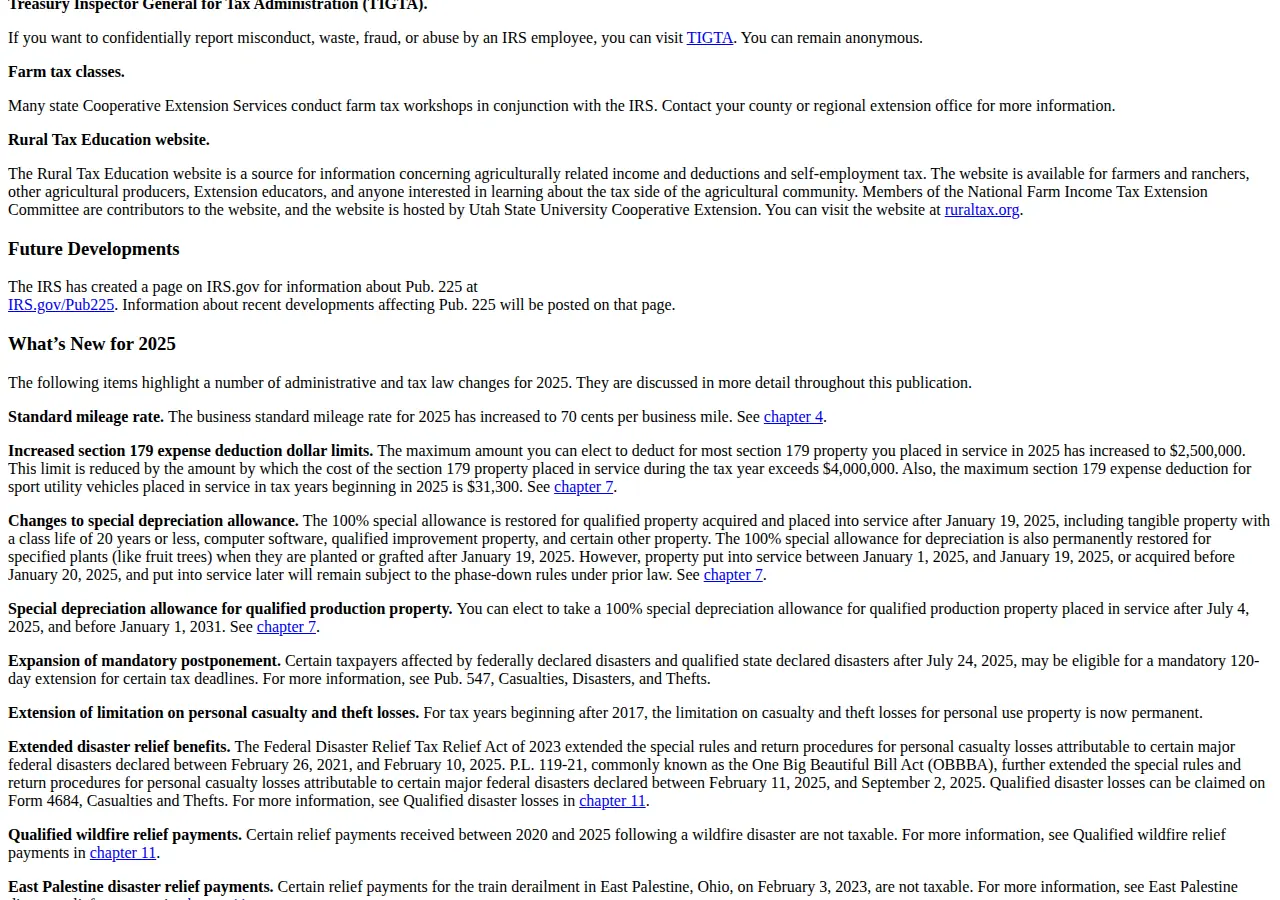
Section 179, at 26 U.S.C. section 179(b), states the same limits — plus an income limit bonus lacks: the deduction cannot exceed taxable income from the business, with the excess carried forward. Take a 185,000 dollar tractor placed in service in March 2025, on a farm with 90,000 dollars of taxable income before section 179:
$
\text{Section 179 allowed} = \min(185{,}000,\ 90{,}000) = 90{,}000;\quad \text{carryover} = 95{,}000
$
Section 179 alone strands 95,000 dollars into next year. Electing section 179 for 90,000 dollars and 100 percent bonus on the rest deducts the full 185,000 dollars in 2025. Ordering: section 179 first, then bonus, then MACRS.
The phase-out still binds at scale — a farm placing 4,350,000 dollars in service loses 350,000 dollars of limit:
$
\text{Limit} = 2{,}500{,}000 - (4{,}350{,}000 - 4{,}000{,}000) = 2{,}150{,}000
$
And the date trap is real: property acquired before January 20, 2025, and placed in service after 2024 stays on the old 40 percent phase-down. A tractor acquired in December 2024 and placed in service in February 2025 gets a 74,000 dollar bonus allowance on a 185,000 dollar cost.
> [!WARNING]
> Section 179 recapture follows the equipment: if business use of listed property falls to 50 percent or less during its recovery period, the excess deduction returns to income on Schedule F, line 8, via Form 4797.
> [!TIP]
> Run the section 179 versus bonus choice before December 31. Section 179 needs taxable income; bonus does not. A farm expecting a loss year should lean on bonus.
The farm-loss limits: section 461(j) is suspended, section 461(l) governs
Most farm guides quote section 461(j) as if it were live; it is not live for 2025. Section 461(j) limits excess farm losses — deductions above farm gross income plus a threshold — but only for a non-C-corporation taxpayer who received an applicable subsidy: a direct or counter-cyclical payment under Title I of the 2008 Farm Bill, or a Commodity Credit Corporation loan. The threshold is the greater of 300,000 dollars (150,000 dollars married filing separately) or the prior five years' farm income over deductions.
But 26 U.S.C. section 461(l)(1)(A) provides that for any taxable year beginning after December 31, 2017, and before January 1, 2027, subsection (j) "shall not apply." For 2025, the operative limit is section 461(l), the excess business loss limitation, covering all noncorporate taxpayers and all trades or businesses. Publication 225 states the 2025 threshold: deductions exceeding gross income and gains plus 313,000 dollars, or 626,000 dollars on a joint return. The excess becomes a net operating loss carryover, computed on Form 461.
Work it: a farm with 486,000 dollars of gross income and 912,000 dollars of deductions in 2025 — a 426,000 dollar loss:
$
\text{Excess} = 912{,}000 - (486{,}000 + 313{,}000) = 912{,}000 - 799{,}000 = 113{,}000
$
113,000 dollars is disallowed for 2025 and carried forward as a net operating loss (NOL); the allowed loss is 313,000 dollars — exactly the threshold. Had section 461(j) applied, the disallowance would have been 126,000 dollars; the suspension is worth 13,000 dollars here. For 2026 the threshold drops to 256,000 dollars (512,000 dollars joint, Revenue Procedure 2025-32), and the same facts would disallow 170,000 dollars:
$
\text{Excess (2026)} = 912{,}000 - (486{,}000 + 256{,}000) = 170{,}000
$
Ordering matters: the at-risk and passive activity rules apply before the excess business loss computation — a loss that fails at-risk never reaches section 461(l). Schedule F's line 34 instructions say exactly that.
Estimated tax for farmers: one payment, two-thirds, March 1
Farmers get the most forgiving estimated-tax calendar in the Code, and the easiest to forfeit by missing one date. Under 26 U.S.C. section 6654(i), a farmer makes one required installment, due January 15 of the following year, at 66⅔ percent instead of 90 percent. The test is a bright line: farm gross income must be at least 66⅔ percent of total gross income — current year or preceding year.
!26 U.S.C. section 6654(i): the farmer rule — one installment, January 15, 66 2/3 percent
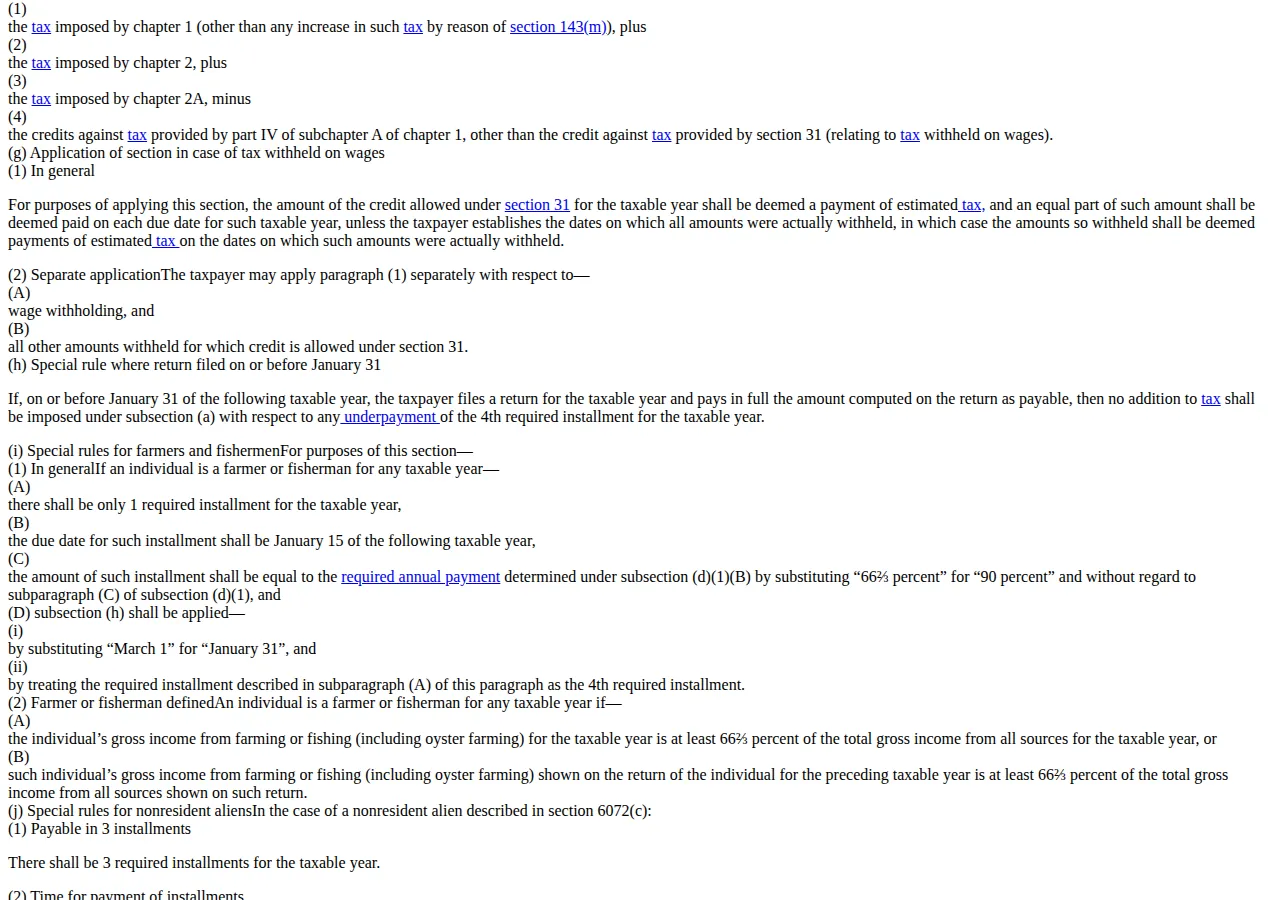
Publication 225 works the test: in Example 2, a farmer with 120,000 dollars of gross farm income against 164,500 dollars total — about 73 percent — qualifies. Count every income source.
The March 1 rule is the second half: a qualified farmer who files and pays all tax due by March 1 owes no estimated-tax penalty, even with no estimated payment made. For 2025, Publication 225 puts the date at March 2, 2026, because March 1 falls on a Sunday. Miss it without a January 15 payment and Form 2210-F computes the penalty.
Suppose the farm's total 2025 income tax — an assumed figure — is 18,900 dollars. The required annual payment under the farmer rule is:
$
\text{Required payment} = 18{,}900 \times \frac{2}{3} = 12{,}600
$
One payment of 12,600 dollars, due January 15, 2026. A non-farmer with the same bill would owe 90 percent — 17,010 dollars — in four installments: the farmer saves 4,410 dollars and three deadlines; March 1 filing removes the payment entirely. Price the installment through the quarterly estimated tax guide and the Self-Employed Tax & Quarterly Estimator before January 15.
The five-step filing sequence
1. Reconcile the 1099s. 1099-PATR to 3a, 1099-G to 4a, 1099-MISC crop insurance to 6a.
2. Price the equipment before December 31. Section 179 first, then 100 percent bonus; the worked tractor takes the full $185,000 only because it was acquired after January 19, 2025.
3. Run the loss gauntlet in order. At-risk on line 36, passive on Form 8582, excess business loss on Form 461.
4. Test the farmer rule. One installment of 66⅔ percent by January 15, 2026 — $12,600 on the worked return's assumed $18,900 bill — or file and pay in full by March 2, 2026.
5. Attach the forms. Form 4562 for depreciation and section 179; Schedule SE for the $12,434 self-employment tax.
The filing-season checklist
Who should not use this playbook as written
A farming syndicate — interests offered under securities registration, or over 35 percent of losses allocable to limited partners or limited entrepreneurs — faces section 461(i); get professional advice before claiming the loss. Note: the section 461(j) suspension ends for tax years beginning on or after January 1, 2027.
Schedule F rewards the operator who treats it as a system: income lines with elections, equipment with a date trap, a loss limit with an expiring suspension, and one tax deadline.