Index Funds vs ETFs vs Mutual Funds: The Cost, Tax, and Trading Playbook
With $100,000 you can buy the entire United States stock market three ways and pay $15 a year, $30 a year, or $500 a year. The market is the same. The difference is the wrapper, which decides the fee, the tax bill, and the trading rules. Every figure below was read from the fund companies and the regulators on 11 November 2026.
An index fund is a strategy: a fund that tracks an index instead of paying a manager to pick stocks. An ETF and a mutual fund are structures: the machinery that holds the strategy. Vanguard sells the same total-market index as the ETF VTI and the mutual fund VTSAX. The question is which structure carries the strategy at the lowest total cost for your account.
The three structures in one table
| Feature | Index mutual fund | ETF | Actively managed mutual fund |
|---|---|---|---|
| What it is | Tracks an index; bought from the fund company | Tracks an index; bought on an exchange | A manager picks holdings |
| Pricing | Once a day, at net asset value after close | All day, at a moving market price | Once a day, at net asset value |
| Minimum | $3,000 (VTSAX); $0 (FXAIX, SWPPX) | One share: VOO $689.28, VTI $369.48 | Often $1,000 to $3,000 |
| Expense ratio | 0.015% to 0.04% in this guide | 0.03% for VTI and VOO | 0.50% industry average |
| Tax in a taxable account | Good for index funds | Usually strongest, via in-kind redemptions | Weakest: trading creates distributions |
The active column is the price of not indexing: the industry-average mutual fund ratio is 0.50 percent and the ETF ratio 0.23 percent, both printed on Vanguard's pages with Vanguard and Morningstar as sources, as of 31 December 2025.
What an index mutual fund is
An index mutual fund pools money from many investors and buys the stocks of an index in the same proportions the index holds them. You buy from the fund company or a broker; your order fills once a day at the net asset value calculated after the market closes. You never see a live price or set a limit order. What you get instead is exact dollar-amount investing: $500 every payday buys $500 of the fund.
VTSAX, Vanguard's Total Stock Market Index Fund, charges 0.04 percent a year and asks for $3,000 to start. Fidelity's FXAIX charges 0.015 percent with no minimum. Schwab's SWPPX charges 0.02 percent with no minimum, and Schwab's total-market SWTSX charges 0.03 percent with no minimum. The Fidelity figures are corroborated-secondary: Fidelity's site refused every fetch, so the 0.015 percent and $0 minimum rest on three independent reads that agree, one citing Fidelity's summary prospectus dated 29 April 2026.
What an ETF is
An ETF holds the same kind of basket, but its shares trade on a stock exchange like a company's shares. You buy through a broker during market hours, at a price that moves second by second, and you can use market, limit, and stop orders. FINRA puts it plainly: mutual funds must price their shares at net asset value each business day, typically after the exchanges close, while ETFs trade like individual stocks throughout the day — what FINRA calls intraday liquidity.
That flexibility costs you whole shares, and the market price can sit above or below net asset value: VOO's premium or discount was 0.03 percent on 10 November 2026. That day VTI was $369.48 a share and VOO $689.28. Without fractional shares, $10,000 buys 14 whole shares of VOO for $9,649.92, leaving $350.08 in cash; 27 shares of VTI cost $9,975.96, leaving $24.04. A $10,000 order into VTSAX or FXAIX invests the full $10,000.
The cost math: a worked example of what each fund charges per year
An expense ratio is a percentage of the balance, charged every year and taken out of returns before you see them. The arithmetic is one line.
The cheapest fund costs $1.50 a year at $10,000, $15 at $100,000, $75 at $500,000; the average mutual fund, $50, $500, and $2,500. The full table, recomputed from the published expense ratios:
| Fund | Expense ratio | $10,000 | $100,000 | $500,000 |
|---|---|---|---|---|
| FXAIX (Fidelity 500 Index) | 0.015% | $1.50 | $15.00 | $75.00 |
| SWPPX (Schwab S&P 500 Index) | 0.02% | $2.00 | $20.00 | $100.00 |
| VTI (Vanguard Total Stock ETF) | 0.03% | $3.00 | $30.00 | $150.00 |
| VOO (Vanguard S&P 500 ETF) | 0.03% | $3.00 | $30.00 | $150.00 |
| SWTSX (Schwab Total Stock Index) | 0.03% | $3.00 | $30.00 | $150.00 |
| VTSAX (Vanguard Total Stock Index) | 0.04% | $4.00 | $40.00 | $200.00 |
| Industry-average ETF | 0.23% | $23.00 | $230.00 | $1,150.00 |
| Industry-average mutual fund | 0.50% | $50.00 | $500.00 | $2,500.00 |
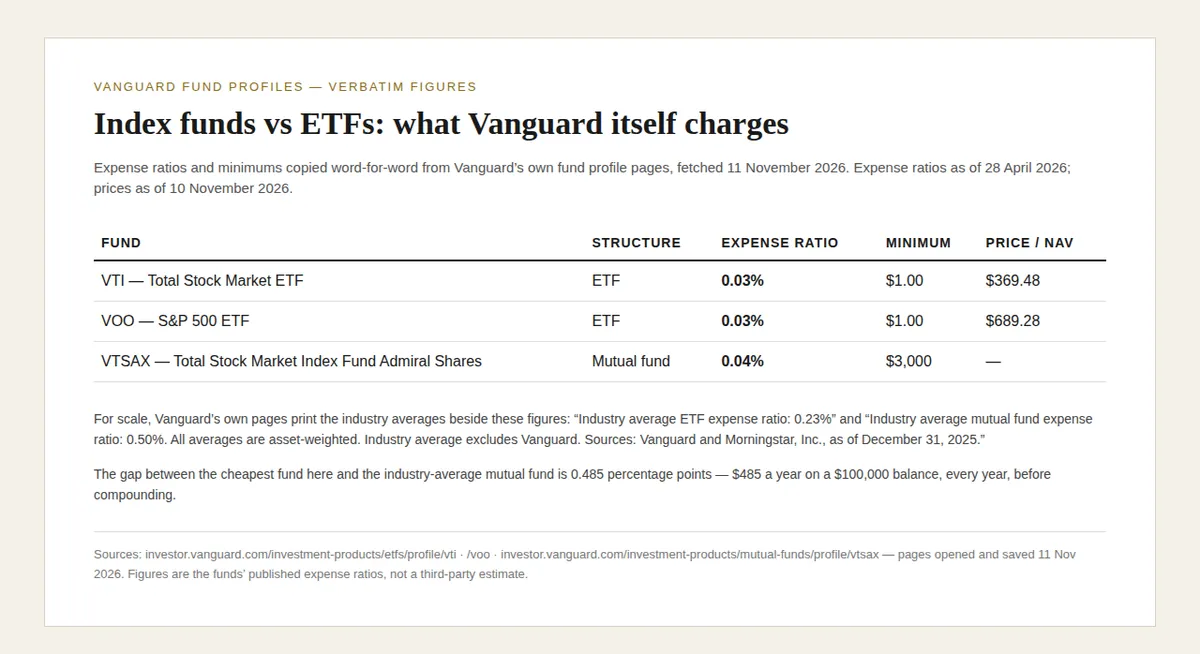
The gap to the industry average is the story: FXAIX saves $48.50 a year against the average mutual fund at $10,000, $485.00 at $100,000, and $2,425.00 at $500,000. The gap between the cheap funds is small: FXAIX versus VTSAX is 2.5 basis points, worth $125 a year on $500,000. One basis point is 0.01 percent — $1 a year per $10,000.
The saving compounds: every fee dollar not paid stays invested. Take a $100,000 lump sum at a flat 7 percent gross return, minus the expense ratio, held 30 years with no contributions or withdrawals.
Recomputed in Python: FXAIX $758,030.59; VTI $754,848.64; VTSAX $752,734.51; average ETF $713,636.87; average mutual fund $661,436.62. The cheapest fund ends $96,593.97 ahead of the average mutual fund; VTI, $93,412.02 ahead; FXAIX, $3,181.95 ahead of VTI. The 7 percent return is an illustration assumption, not a forecast. The ordering never changes: the lower fee always ends ahead at the same gross return.
Minimums and the first dollar
Minimums decide who can start. VTSAX asks for $3,000, a real barrier for an investor with $500. The ETFs ask for one share — $369.48 for VTI, $689.28 for VOO — lower than $3,000. Fidelity and Schwab removed the barrier: FXAIX, FSKAX, SWPPX, and SWTSX carry no minimum, and Schwab's page says so plainly, "no minimum investment required." FSKAX, Fidelity's total-market fund, charges 0.015 percent with a $0 minimum — corroborated-secondary, like FXAIX.
Under $3,000, the Vanguard mutual fund is closed to you; choose a no-minimum Fidelity or Schwab fund, or an ETF bought in whole or fractional shares. Over $3,000, the minimum stops deciding anything and the expense ratio takes over. A $0 minimum is worth nothing if the fund charges 0.50 percent.
Trading mechanics: when you can trade, and what price you get
A mutual fund order placed at 10 in the morning and one at 3:45 in the afternoon both fill at the same price: the net asset value calculated after the market closes. An ETF order fills during market hours at the price on the screen, and a limit order lets you name your price. That control is real, and mostly unused by long-term investors: the gap between a 10 a.m. fill and a 4 p.m. fill on any one day is noise next to the fee gap above.
Three mechanics still matter. First, the bid-ask spread: an ETF has one, a mutual fund does not, because the mutual fund transacts at net asset value. The spread on VTI or VOO is small, but it is a cost on every trade; no verified spread figure was available from a primary page this cycle, so none is printed here. Second, the premium or discount: an ETF's market price can drift from net asset value; VOO's drift was 0.03 percent on 10 November 2026. Third, automation: mutual funds accept automatic dollar-amount purchases with no share arithmetic, the default inside many workplace retirement plans. ETFs need a broker with fractional shares and recurring orders to match that.
Tax efficiency: where the ETF earns its keep
When investors redeem mutual fund shares, the fund may sell holdings to raise cash; if those sales produce gains, the fund must distribute them, and every remaining shareholder owes tax even if they sold nothing. ETFs avoid much of this through creation and redemption: large institutions exchange baskets of securities for ETF shares, and redemptions are typically paid in kind with securities rather than cash, so the fund can remove low-cost holdings without selling them. The SEC states it directly: because many ETFs buy and sell portfolio securities in in-kind exchanges rather than for cash, they typically have fewer capital gains distributions, and thus lower taxes, than mutual funds. FINRA adds that ETFs give investors more control over their tax liability, because the investor chooses when to sell.
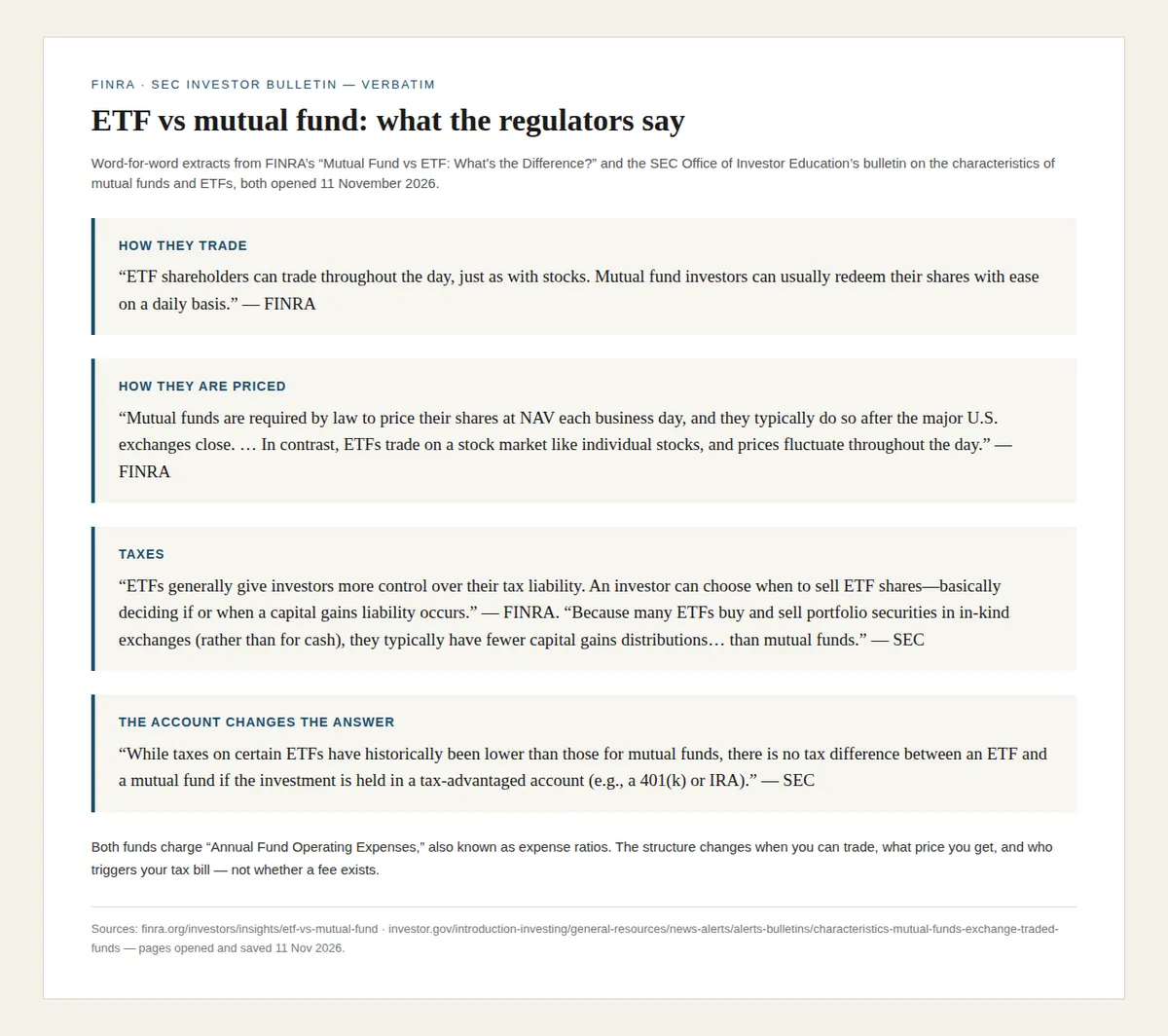
Two limits keep this honest. First, index mutual funds are already tax-efficient — low turnover means few realized gains — so the tax gap between an index ETF and an index mutual fund is far smaller than the gap to an active fund. Second, the account can erase the gap entirely: the SEC states there is no tax difference between an ETF and a mutual fund held in a tax-advantaged account such as a 401(k) or IRA. Inside a Roth IRA — or an LLC or S-Corp brokerage account — the choice between VTI and VTSAX is about minimums and automation, not tax. The Roth IRA vs traditional IRA contribution limits playbook works through which account fits which saver. In a taxable account, the ETF's in-kind mechanism is a genuine edge. Dividends are taxed the same either way: both structures pay out the dividends their holdings produce.
The decision table
| Your situation | Pick | Why | Authority |
|---|---|---|---|
| Taxable account, $500,000, buy and hold | VTI, FXAIX, or FSKAX | Lowest fees; ETF adds a tax edge | Vanguard 0.03%; Fidelity 0.015% corroborated; SEC bulletin |
| Taxable account, $500 to start | FXAIX, FSKAX, SWPPX, or SWTSX | No minimum; full balance invested | Schwab "no minimum"; Fidelity $0 minimum corroborated |
| IRA or 401(k), automatic monthly purchases | Index mutual fund | Tax gap disappears; dollar-amount automation wins | SEC: no tax difference in tax-advantaged accounts |
The account and the balance decide more than the ticker. A large taxable balance rewards the ETF's tax mechanism; a retirement account rewards the mutual fund's automation; a small balance rewards the $0 minimum. Check the transaction fee first: it punishes the wrong venue even when the fund is cheap.
Who should avoid each structure
Avoid the ETF if you invest a fixed dollar amount every payday at a broker without fractional shares: leftover cash and manual share arithmetic will quietly undo the fee advantage. Avoid the ETF if you trade on emotion: intraday liquidity opens both ways. Avoid the index mutual fund if your balance is under its minimum and you refuse to use Fidelity or Schwab: the $3,000 gate is real, and waiting is worse than starting now at $0. Avoid the active fund if you cannot name the edge that justifies 0.50 percent a year against an index charging 0.015 to 0.04 percent. Avoid any fund if you have not checked your broker's transaction fee, and avoid arguing ETF versus mutual fund inside a Roth IRA, where the SEC says the tax difference does not exist. The Series I bonds vs Treasury bills playbook covers what belongs in a taxable account and what belongs in a sheltered one.
Founder & CEO Insight — Enow A. Jovial
The execution checklist
- Name the account first: taxable, IRA, or 401(k). In an IRA or 401(k) the ETF's tax edge does not apply.
- Check the balance. Under $3,000, use a $0-minimum fund — FXAIX, FSKAX, SWPPX, or SWTSX.
- Write down the expense ratio you pay today. Above 0.10 percent, find the cheaper version above.
- Run your annual cost: balance times expense ratio. At $100,000, 0.50 percent is $500 a year; 0.015 percent is $15.
- Check your broker's transaction fee before buying an outside mutual fund. One purchase fee can exceed a year of expense-ratio saving.
- Turn on automatic investing on payday. The mutual fund does this natively; the ETF needs recurring orders or fractional shares.
- Run the 30-year check with the ROI calculator: $100,000 at 7 percent gross, minus your expense ratio, for 30 years.
- Revisit once a year, when new prospectus figures are out, and keep the cost-basis record as a CSV for your CPA. Switching inside an IRA costs nothing in tax.