A founder hiring for the first time faces three names that look like three products and bill in three completely different ways. Indeed sells attention by the click: a sponsored job is an auction. ZipRecruiter sells a subscription per job slot: a flat monthly rate, quoted privately, with no public rate card at all. Glassdoor sells something else entirely: it no longer sells job postings as a standalone product. Glassdoor LLC merged into Indeed, Inc. on July 1, 2026, and job posting has run through Indeed since 2020. A guide that prices a Glassdoor job post in 2026 is pricing a product that does not exist. What you actually buy from Glassdoor is employer branding, on a separate annual contract, while the job itself is bought from Indeed.
The decision in one table
| Attribute | Indeed | ZipRecruiter | Glassdoor | Authority |
|---|---|---|---|---|
| Free tier | 3 free posts a month, 30 days each | Free trial for a few days, then paid | Free employer profile | Indeed pricing page / ZipRecruiter plans page / glassdoor.com/employers |
| Paid model | Sponsored Jobs, pay per click | Monthly subscription per job slot | No standalone posting product since 2020 | Vendor pages + independent Nov 2026 reads |
| Published entry price | From $5/day or $150/month | No published rate card | Posting runs through Indeed | Indeed pricing page / employer-reported 2026 tiers |
| Reported real cost | ~$25/day enforced floor per posting (buyer-reported, not published) | Standard ~$299–$399/mo, Premium ~$419–$519/mo, Pro ~$719–$899/mo | Employer branding reported $15,000–$50,000 a year (common range) | Independent Nov 2026 pricing reads |
| Billing trigger | 1st of the month or at $500 spend | Monthly, or at $500, or on cancellation | Annual contract, quoted by sales | Indeed help center / ZipRecruiter checkout terms |
| Distribution | Indeed + Glassdoor — Glassdoor says the two reach 80%+ of US online job seekers | 100+ partner job boards | Your Indeed post appears on Glassdoor | glassdoor.com/employers / ZipRecruiter plans page |
| Resume database | Smart Sourcing: Standard $120/mo (30 contacts), Professional $520/mo | Premium and above, reported 25 views a month on Premium | None — branding only | Indeed pricing page / employer-reported 2026 tiers |
| What you cannot buy | A fixed price per post — it is an auction | A published rate — every account is quoted | A standalone job post | Vendor pages, Nov 2026 |
Indeed: an auction with a published floor
Indeed is the biggest job board in the United States, and its pricing is the least like a price. Posting a job is free for up to three direct postings a month, each live up to 30 days — but free visibility has faded since the March 31, 2026 policy change. The paid product is Sponsored Jobs. You set a daily or monthly budget, and Indeed charges you when a job seeker clicks your listing. Indeed's published starting point is $5 a day or $150 a month, and that floor has not changed. What has changed is what employers actually pay: employer pricing guides consistently report an enforced minimum near $25 a day per posting since July 2025. Indeed does not publish that figure, so treat it as buyer-reported and verify it in your own account — but budget the $25, not the $5.
ext{One role, 30 days, published floor} = 30 imes $5 = $150
ext{One role, 30 days, reported enforced floor} = 30 imes $25 = $750
Two mechanics catch first-time buyers. First, the daily budget is an average, not a cap: a week can spend up to 7.5 times your daily budget, so a $25-a-day posting can bill $187.50 in a heavy week. Second, Indeed bills on the 1st of the month or when your account reaches $500 of spend, whichever comes first — a small employer sponsoring three roles can hit the $500 threshold mid-month and be charged twice. The pay-per-application model that older guides still quote was retired on December 18, 2023; today the engine is pay-per-click (CPC), with some qualifying jobs billed per started application automatically. The number that matters, the cost per application, is not on any pricing page: employers consistently report $15 to $50 per completed application, and clicks run about $0.10 to $5 each depending on the role and the city.
Smart Sourcing is Indeed's separate resume-database product: Standard costs $120 a month with 30 contacts, or $4 a contact, and Professional costs $520 a month. It is the only part of Indeed with a fixed monthly price.
ZipRecruiter: a flat slot, quoted in private
ZipRecruiter does not publish employer prices. Every account is quoted individually by industry, location, company size, and slot count, and the price appears inside the sign-up flow, not on a rate card. What employers report paying in 2026 clusters into three tiers: Standard at about $299 to $399 a month per job slot, or about $16 a day; Premium at about $419 to $519 a month, or about $24 a day; and Pro at about $719 to $899 a month, with no daily rate offered. Those figures are buyer-reported across multiple independent November 2026 reads, and they agree — but they are not ZipRecruiter's numbers, and your quote will differ by market. New employers get a free trial for a few days, then pay the monthly rate per active job slot.
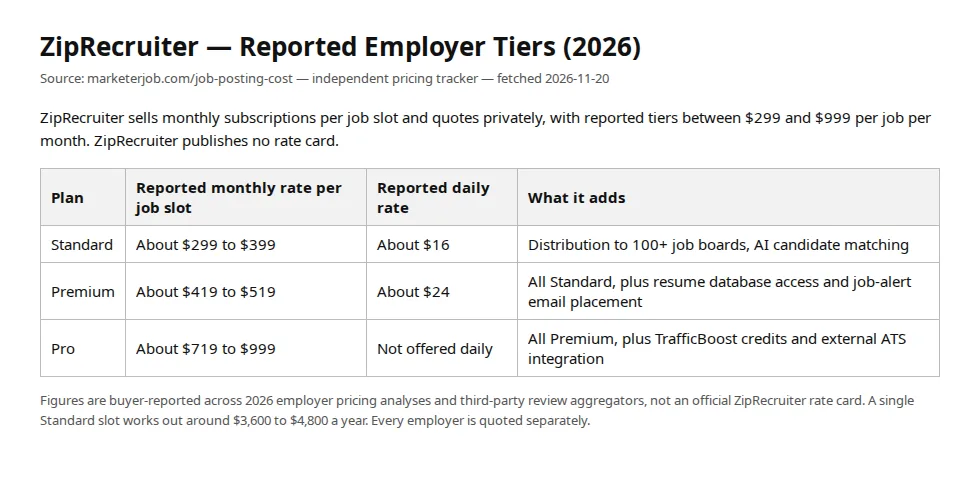
The product is distribution: a post goes out to more than 100 partner job boards, and Invite to Apply proactively contacts matched candidates instead of waiting for them to find the post. Premium adds placement in job-alert emails and access to the resume database, reported at 25 views a month. Pro adds 3 TrafficBoost credits a month, which push a posting to the top of relevant searches, plus external ATS integration and a dedicated account manager. Billing is the same shape as Indeed's: monthly, at $500 of spend, or on cancellation, whichever comes first.
The flat rate is the honest advantage and the honest risk: a $299-a-month slot costs the same whether the role fills in four days or forty. The slot model rewards employers who hire continuously and punishes employers who hire once and stop.
Glassdoor: the third leg that is not a product
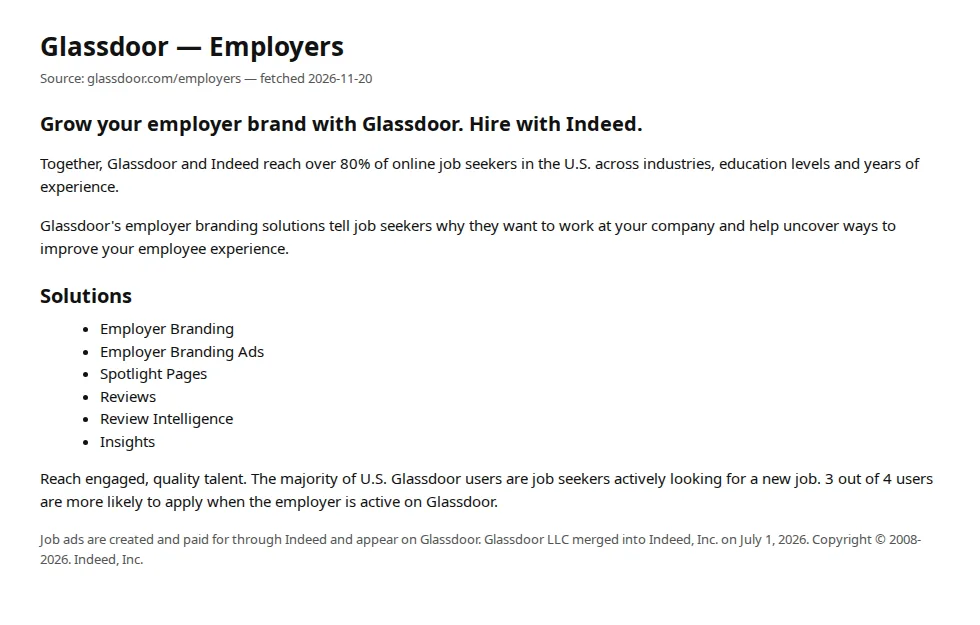
Glassdoor is the reason this comparison needs a correction, not a price table. Job Slots subscriptions stopped renewing in September 2020, and job posting moved to Indeed. Glassdoor merged its employer-branding tools with Indeed's in April 2024, and Glassdoor LLC legally merged into Indeed, Inc. on July 1, 2026. Today there is no Glassdoor job post to buy: employers create and pay for job ads through Indeed, and eligible jobs show up on Glassdoor as well. Glassdoor puts it plainly on its own employers page — hire with Indeed, and together the two reach over 80% of online job seekers in the United States.
What Glassdoor does sell is employer branding, on a separate annual contract. A basic company profile is free. The paid products are the Enhanced Profile, the Employer Branding Hub, Spotlight Pages, Brand Ads, and Review Intelligence — a premium company page, targeted brand ads, and deeper analytics on what candidates think of you. Independent pricing trackers report branding contracts at $10,000 to $100,000-plus a year, commonly $15,000 to $50,000. That is a different purchase from a job post by two orders of magnitude, and it answers a different question: not how to fill this role, but why a candidate would pick you.
The math: one role, five roles, and the cost per hire
Run one role for 30 days. On Indeed at the published floor, the month costs $150; at the reported enforced floor of $25 a day, $750. On ZipRecruiter Standard at the reported rate, $299 to $399. On Glassdoor, the incremental posting cost is $0, because the Indeed post appears there for free. The published floor makes Indeed look five times cheaper than ZipRecruiter; the reported floor makes it roughly twice as expensive. Both numbers are true; the budget that survives is the second one.
ext{One role, Indeed, reported floor} = 30 imes $25 = $750
ext{One role, ZipRecruiter Standard} = $299 ext{ to }$399
Now run the cost per hire: employers report $15 to $50 per completed application on Indeed. A role that draws 20 applications costs $300 to $1,000 in click spend before anyone is interviewed, and the application is not a hire: the interview and the offer are separate costs. The boards sell applications, not employees, and the CPA (cost per application) is the number to watch — the cost per hire is the CPA divided by the fraction of applicants who are actually qualified.
ext{Cost to fill one role (20 applications)} = 20 imes $15 ext{ to }$50 = $300 ext{ to }$1{,}000
Five roles over 90 days flips the ranking: on Indeed at the $5-a-day published floor, five postings for 90 days cost $2,250; at the reported $25-a-day floor, $11,250. On ZipRecruiter Pro at the reported $719 to $899 a month, three months cost $2,157 to $2,697 — and Pro covers five or more active job slots. At the published floor Indeed wins; at the enforced floor ZipRecruiter Pro wins by roughly $8,500. That is the whole decision for a company hiring five people at once.
ext{Five roles, 90 days, Indeed at $25/day} = 5 imes 90 imes $25 = $11{,}250
ext{Five roles, 90 days, ZipRecruiter Pro} = 3 imes $719 ext{ to }$899 = $2{,}157 ext{ to }$2{,}697
Run your own hire volume through the profit calculator before you commit to a quarter.
Who should pick which — and who should pick none
Pick Indeed when you hire one role at a time and want the largest audience, and you accept that the price is an auction: set the daily budget and kill the sponsorship the day the role fills. Pick ZipRecruiter when you hire continuously and want a predictable monthly number per slot, with distribution to 100-plus boards. Pick Glassdoor's branding products when candidates find you and do not apply — the problem is the reviews, not the posting, and a $15,000-a-year branding contract is cheaper than a year of unfilled roles.
Pick none of the three as a standalone strategy for senior or specialist seats. The boards are volume channels; a senior hire comes from a search, a referral, or a direct approach — and a cross-border hire needs an EOR, not a job board. the Greenhouse vs Workable vs Lever ATS pricing playbook prices the ATS that tracks the applicants once they arrive, the BambooHR vs Justworks vs TriNet PEO and HRIS pricing playbook prices the HR platform that employs them afterwards, and the Deel vs Remote vs Oyster EOR pricing playbook prices hiring the same person across a border. All three boards are B2B SaaS products, and the monthly rate is the floor, not the total.
Founder & CEO Insight — Enow A. Jovial
The hiring-week checklist
Do the first three in order, then run the rest as checks:
- Post free first: use Indeed's three free monthly posts and run the role for two weeks, recording applications per day and the qualified share, before sponsoring anything.
- Price the quarter, not the day: multiply the daily budget by the roles and the days to fill, and compare the Indeed auction total with the ZipRecruiter flat slot total at the same hire volume.
- Kill the spend on the hire date: pause the sponsorship and the slot the day the role fills — a filled role that keeps billing is the most common waste on both boards.
- [x] Check the $500 billing threshold: both boards bill early when spend hits $500, so a three-role month can charge twice.
- [x] Separate the brand from the post: if candidates find the role and do not apply, fix the Glassdoor profile and the reviews before buying more clicks.
- [x] Test the exit before you need it: confirm the slot cancels at month-end with no term, and that the resume database access ends with it — before the first paid month.
The decision is not which board is best. It is which meter matches how you hire: attention by the click, a flat slot by the month, or a brand that makes candidates come to you.