Deel vs Remote vs Oyster: EOR Pricing Head-to-Head for Founders Hiring Abroad
An employer of record (EOR) lets you hire a full-time employee where your company has no entity. The EOR is the legal employer on paper — local contract, payroll, tax withholding, benefits — while you direct the work, for the salary plus a monthly fee per employee.
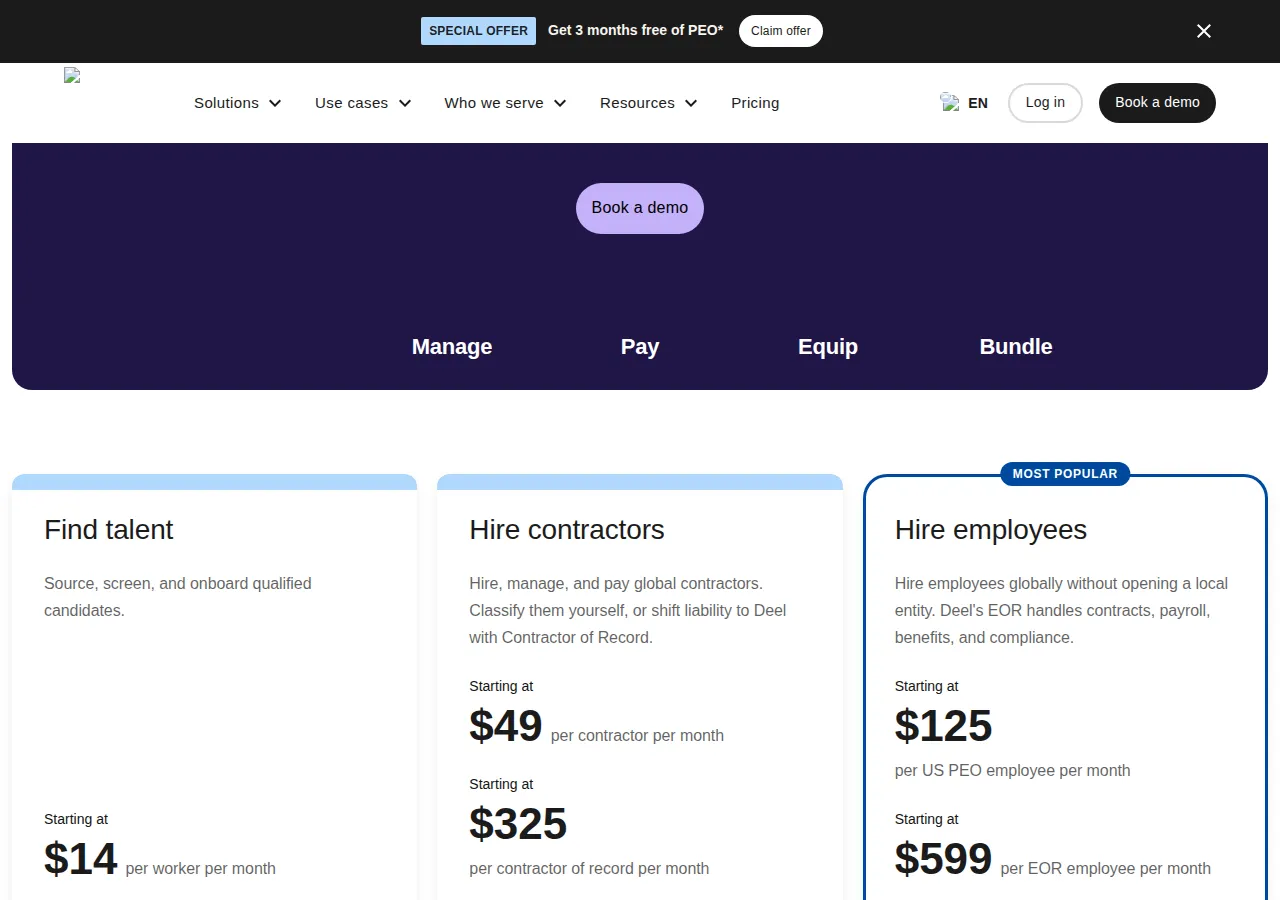
Deel and Remote open EOR at $599 per employee per month; Oyster at $699. The $100 gap is $30,000 a year at twenty-five hires — but the headline fee is only the first line of the cost. What the fee excludes, and which rail the worker belongs on, decide whether the cheapest quote is the cheapest outcome.
The three rails, defined before the prices
Three rails, not interchangeable — getting the rail wrong is the most expensive mistake in this playbook.
Employer of record (EOR). The vendor is the legal employer; the worker is a full-time employee under local law, with local benefits, paid leave, and termination protection. Use it for full-time, long-term workers under your direction.
Contractor management. The worker stays an independent contractor; the vendor handles contracts, invoicing, and payment in local currency, and you keep the classification risk. Use it for genuinely independent, project-based work — a specialist on a defined deliverable, their own schedule and tools.
Contractor of record (CoR). The vendor contracts with and pays the worker directly, taking the misclassification risk. Use it for a trial hire, a market test, or a role still settling.
A professional employer organization (PEO) is a fourth structure, not an EOR: it co-employs US workers where you already have an entity and an EIN, and creates no employment abroad. All three vendors sell a US PEO alongside EOR, cheaper because the legal problem is smaller.
> [!KEY TAKEAWAY]
> The rail follows the working relationship, not the budget. A full-time worker under your direction belongs on EOR; a contractor rail chosen to save $550 a month is a misclassification exposure wearing a discount label.
The balance-sheet stakes
Hiring abroad without an entity has two costs: the fee you can see and the liability you cannot. The fee is $599 or $699 a month. The liability is what a regulator or court assigns when the arrangement is wrong — back taxes, unpaid benefits, severance, and penalties arriving as a lump sum.
An LLC, S-Corp, or C-Corp founder faces the same question everywhere: does this worker look like an employee to the local authority? The contract does not decide it. Control does — who sets hours, who supplies tools, who bears the business risk. That is the test in the United States and, in substance, in most of the 90 to 130 countries these vendors cover.
EOR fees are an operating expense, recorded under GAAP like any payroll service cost. A contractor payment is a vendor expense, reported on Form 1099-NEC when the worker is a US person paid $600 or more in the year — the 1099-NEC contractor reporting playbook runs that filing. Misclassification also misstates FICA and SECA: an employee's Social Security and Medicare tax is withheld under FICA, while a contractor pays self-employment tax under SECA. A CPA asks which rail each worker is on first.
!Deel pricing page showing EOR at $599 per employee per month
The prices, from the vendors' own pages
Every figure below was read from the vendor's own pricing page on November 7, 2026. "Starting at" is the published floor; the final quote for a country and role can be higher, and no vendor publishes country-by-country fees.
| Vendor | EOR / month | Contractor | CoR | US PEO | Countries | Authority |
| --- | --- | --- | --- | --- | --- | --- |
| Deel | $599 starting | $49 | $325 | $125 | 130+ | Deel |
| Remote | $599 starting, annual contracts | $29 | $325 | $99 | 90+ | Remote |
| Oyster | $699 | $29 | Not listed | Not listed | 120+ | Oyster |
Deel. EOR starts at $599 per employee per month; US PEO at $125. Contractor management starts at $49 per contractor per month, Contractor of Record at $325. Deel states month-to-month pricing with no long-term commitment, cancellation at any time, and local labor law governing notice and severance. The EOR fee covers onboarding and local compliance, payroll and tax filings, benefits administration, and ongoing HR and legal support — no hidden fees, per Deel.
Remote. EOR starts at $599 per employee per month, explicitly "for annual contracts" — Remote publishes no month-to-month EOR price. Contractor Management starts at $29 per contractor per month, covers 190+ countries, and includes 1099-NEC generation. Contractor Management Plus, at $99, adds $100,000 of indemnity per contractor, capped at $1,000,000 per company. Contractor of Record starts at $325 with uncapped indemnity. US PEO starts at $99, billed in USD, requiring a US bank account. Remote states no setup or onboarding fees and no standard deposit, though it may require a refundable reserve — funds remain yours, credited or refunded when no longer needed. Remote locks its FX rate for each monthly billing cycle and shows it before payment.
!Remote pricing page showing EOR at $599 per employee per month for annual contracts

Oyster. EOR is $699 per employee per month, with annual discounts available — the page states no discount amount, so none is printed here. Global Contractors is $29 per contractor per month, free for the first 30 days, with contracts in 180+ countries and payments in 120+ currencies. People Partner Services, HR advisory, is $300 per hour. Oyster adds no extra charges for setup, onboarding, or processing terminations, but requires a refundable deposit for EOR team members; the page states no amount. Oyster's Shell assesses misclassification risk with aggregate protection up to $500,000. Oyster lists no Contractor of Record tier and no US PEO price.
> [!WARNING]
> Remote's $599 is an annual-contract price. A founder needing one hire for six months who reads $599 as month-to-month is comparing a twelve-month commitment against Deel's month-to-month $599. The exception: if the hire is permanent and the country is covered, the annual contract is the same $599 with no premium — the trap is only in assuming the terms match when they do not.
The monthly math at 1, 5, and 25 hires
Take one hire at $60,000 gross a year — $5,000 a month — and hold the salary constant so the fee is the only variable. Benefits, equity, and offboarding are excluded because no vendor publishes a per-employee benefits figure; the numbers below are the fee floor, not the all-in cost.
$
\text{Monthly cost per hire} = \text{Gross salary} + \text{EOR fee}
$
$
\text{Deel or Remote, 1 hire} = 5000 + 599 = \$5{,}599\text{ per month}
$
$
\text{Oyster, 1 hire} = 5000 + 699 = \$5{,}699\text{ per month}
$
At five hires: $27,995 a month on Deel or Remote, $28,495 on Oyster. At twenty-five hires they are $139,975 and $142,475 — an Oyster premium of $100 per head per month, $2,500 a month, $30,000 a year.
$
\text{Annual EOR fee per head} = \text{Monthly fee} \times 12
$
$
\text{Deel or Remote} = 599 \times 12 = \$7{,}188 \qquad \text{Oyster} = 699 \times 12 = \$8{,}388
$
The EOR premium over the contractor rail, per head per month, is the price of converting a contractor into an employee:
$
\text{EOR premium} = \text{EOR fee} - \text{Contractor management fee}
$
Deel: $599 − $49 = $550. Remote: $599 − $29 = $570. Oyster: $699 − $29 = $670. At five heads, that premium is $2,750 a month on Deel, $2,850 on Remote, and $3,350 on Oyster.
The Contractor of Record middle rail costs $325 a month on both Deel and Remote — $276 more than Deel's contractor management and $296 more than Remote's. It buys the vendor holding the contract and the misclassification risk, without the full employment apparatus of EOR.
Run the break-even on the break-even calculator before signing: if the annual EOR premium per head — $6,600 on Deel, $6,840 on Remote, $8,040 on Oyster — is smaller than one misclassification finding in that country, EOR is the cheaper rail.
What the headline fee excludes
Benefits. All three vendors administer benefits — health, pension, leave — but the benefits themselves cost money beyond the fee. Deel folds benefits administration into its quoted price, premiums separate. Remote describes benefits as a feature, not a price. Oyster sells benefits as an add-on with no published price.
Equity. None of the three pricing pages prices equity administration for EOR employees. If your hire gets options or RSUs, confirm in writing whether the vendor handles local securities and tax treatment or your counsel does.
Offboarding. Termination is where EOR pricing meets local law hardest. Deel states local labor law governs notice periods and severance. Oyster includes processing terminations — the processing, not the severance itself. Severance, notice pay, and any mandatory settlement are the employer's cost, set by the country, not the vendor. Budget one to three months of salary as a termination reserve, more where dismissal protection is strong.
Local taxes and mandatory contributions. The EOR fee is not the employer's tax bill. Statutory social contributions, payroll taxes, and mandatory insurance are calculated on the salary and remitted locally — not in the $599 or $699. Ask each vendor for a gross-to-net simulation for the exact country and salary before choosing on price.
Deposits and reserves. Remote may require a refundable reserve; Oyster requires a refundable deposit for EOR team members. Neither publishes the amount, and both are refundable — but they are cash out the door in month one, so ask for the figure in the quote.
The risk layer: misclassification, permanent establishment, offboarding
Misclassification. The IRS applies the common-law control test: behavioral control (does the company control what the worker does and how), financial control (does the payer control the business aspects of the job), and the type of relationship (written contracts, employee-type benefits). The test is the same in substance abroad — a worker you direct daily, on your equipment, on your schedule, is an employee to the local authority regardless of the contract's label. The US statutes are 26 U.S.C. § 3401 ("employee" for withholding) and § 3121 (for FICA). When classification is genuinely unclear, Form SS-8 asks the IRS to determine worker status.
The vendor's indemnity is the practical difference between the contractor tiers. Remote's Contractor Management Plus carries $100,000 of indemnity per contractor, capped at $1,000,000 per company. Remote's Contractor of Record carries uncapped indemnity. Oyster's Shell carries aggregate protection up to $500,000. Deel's Contractor of Record shifts liability to Deel; its contractor management tier leaves classification with you. Read the indemnity terms, not the marketing line: indemnity covers penalties from the vendor's breach of its service warranty, not every adverse finding.
Permanent establishment. Hiring through an EOR does not by itself create a taxable presence for your company in the worker's country — that is the point of the structure. But an EOR employee who signs contracts, negotiates sales, or holds themselves out as your company's representative can still create permanent-establishment exposure under the local tax treaty. The EOR solves employment law, not tax presence.
Offboarding. EOR offboarding is a legal process, not an admin task. Notice periods, severance, and protected-category rules are set by local law, and the vendor executes them — it does not waive them. The remote-employee state tax nexus playbook covers the domestic mirror: a worker's location creates tax and registration obligations whether or not you planned for them.
> [!TIP]
> Ask each vendor for the same three documents before you sign: a gross-to-net simulation for the country and salary, the termination cost schedule, and the indemnity terms in full. The vendor that answers fastest and clearest usually runs the tightest operation.
The cross-border context layer
Coverage is not a tiebreaker by itself. Deel covers 130+ countries for EOR, Oyster 120+, Remote 90+. Hiring in one country? Ask whether it is covered and at what fee — the global count is irrelevant if your country is the exception.
Currency and FX. Deel pays contractors in 120+ currencies; Oyster in 120+; Remote in 70+. Remote locks its FX rate per monthly billing cycle and shows it before payment.
Data and GDPR. An EOR holds your employee's personal data under the law of the worker's country. For EU hires, GDPR applies to the vendor's processing, and your data-processing agreement is the document that matters.
US payroll stays separate. None of this replaces domestic payroll: US employees still run through your own payroll, with quarterly Form 941 filings — the Form 941 playbook runs that filing. EOR is for the workers abroad.
The selection sequence
1. Classify the worker first. Apply the three common-law factors — behavioral control, financial control, type of relationship — before looking at any price. Employee means EOR; genuinely a contractor means contractor management.
2. Confirm the country is covered by each vendor, and at what fee.
3. Get the gross-to-net simulation for the exact salary and country from all three vendors — the fee gap is $100 a month; the statutory-contribution gap can be larger.
4. Price the full first year: salary, EOR fee, benefits, deposit or reserve, and a termination reserve.
5. Read the indemnity and termination terms for the rail you chose. CoR and Plus tiers are only worth their premium if the indemnity covers the finding you actually fear.
6. Sign month-to-month first where allowed — Deel allows it; Remote's EOR price is an annual contract — then convert to annual once the hire is proven.
> [!FOUNDER]
> "Every founder I know has priced the EOR fee and forgotten the offboarding. The $599 is the easy number. The number that hurts is the severance in a country you never read the labor code for, arriving in the same month the hire does not work out. Price the exit on the day you price the entry."
> — Enow A. Jovial, Founder & Chief Executive Officer