Greenhouse vs Workable vs Lever: The ATS Pricing Playbook for 2026
A founder with 18 employees and 12 hires planned for the year opens three pricing pages. Workable answers in one screen: Standard $299 a month. Greenhouse and Lever answer with a form: talk to sales. One real number, two sales cycles.
Workable figures come from the vendor pricing page opened on November 10, 2026. Greenhouse and Lever figures come from buyer-reported data corroborated across three or more independent 2026 reads. Math follows at 12, 25, and 100 hires a year.
Founder & CEO Insight — Enow A. Jovial
The decision in one table
| Your position | The pick | Annual cost | Authority |
|---|---|---|---|
| 18 staff, 12 hires, inbound | Workable Standard | $3,588 | workable.com/pricing |
| 18 staff, 12 hires, outbound | Lever for Startups | About $3,500 | Prepzo; 100Hires |
| 18 staff, 12 hires, structured interviews | Greenhouse Core | About $6,500 | Pin; Rework; Prepzo |
| 120 staff, 25 hires, budget first | Workable Premier (floor) | $7,188 | workable.com/pricing |
| 120 staff, 25 hires, structured hiring | Greenhouse Core | $10,000 to $15,000 | Pin, 101-250 band |
| 120 staff, 25 hires, CRM-led sourcing | LeverTRM Pro | $10,000 to $30,000 | Prepzo; 100Hires |
| 450 staff, 100 hires, compliance | Greenhouse Pro | $36,000 and up | Pin, enterprise band |
| 450 staff, 100 hires, nurture-led | Lever Enterprise | $30,000 and up | Prepzo; 100Hires |
The one vendor that publishes: Workable
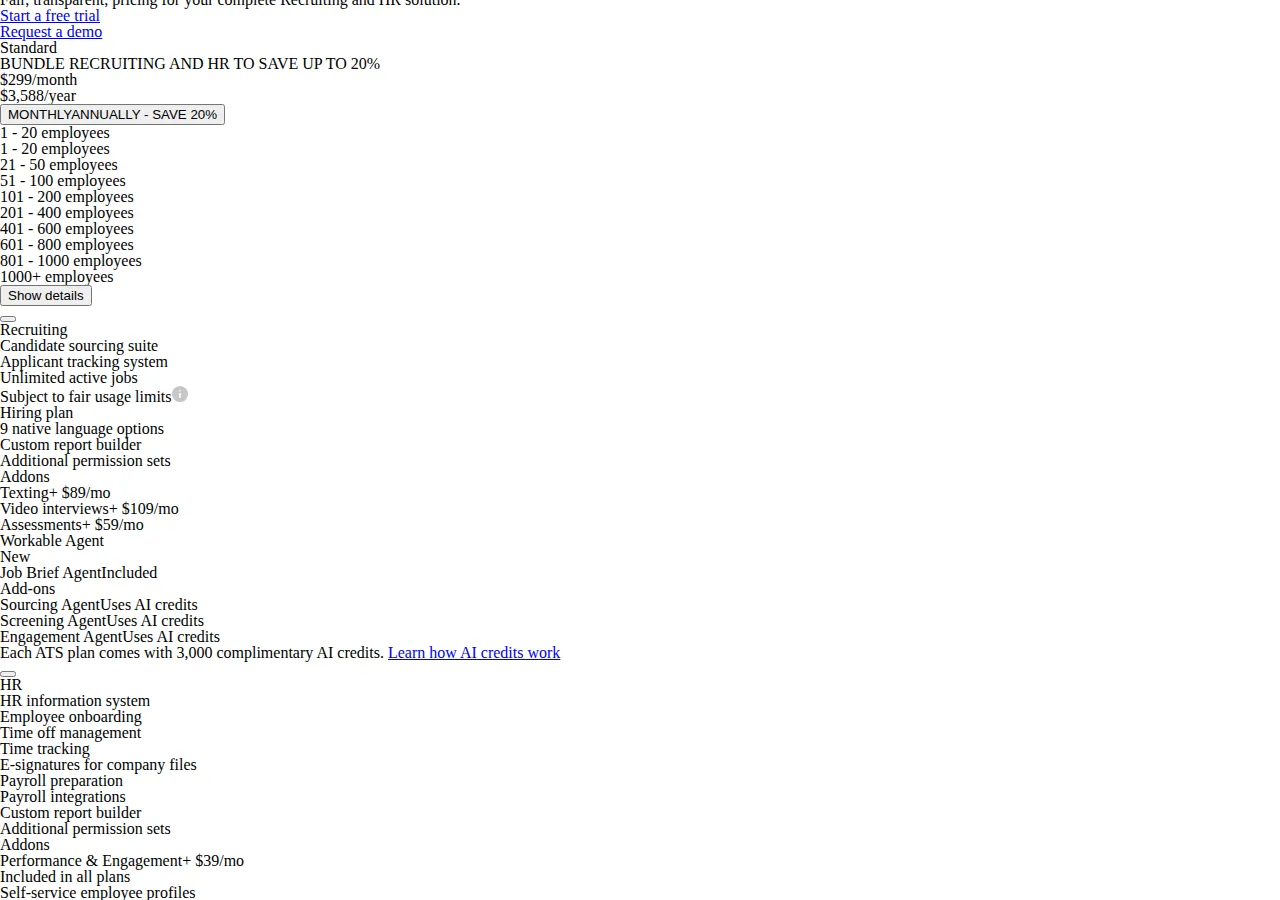
Workable is the only vendor here that lets a buyer price the product without talking to a salesperson. Its pricing page lists three plans for companies with 1 to 20 employees: Standard $299 a month ($3,588 a year), Premier $599 ($7,188), Enterprise $719 ($8,628). The page lists higher employee bands but not their prices. Every Workable figure used for the larger profiles here is therefore labeled a floor: the published 1-to-20-employee price, with the warning that your band costs more.
All three plans include the sourcing suite, the applicant tracking system, unlimited active jobs subject to fair usage limits, and a custom report builder. The tiers differ on add-ons, not on the core ATS: Standard sells texting at $89 a month, video interviews at $109 a month, and assessments at $59 a month separately, plus Performance and Engagement at $39 a month. Premier and Enterprise include them all, plus referrals.
The Workable add-on math: Premier is $48 a year
Standard plus all three recruiting add-ons is $556 a month, or $6,672 a year; Premier is $599 a month, or $7,188 a year — a $516 gap that also buys referrals, Performance and Engagement, single sign-on, and priority support.
Add Performance and Engagement at $39 a month and the comparison tightens to almost nothing: Standard with every add-on costs $595 a month, or $7,140 a year, against Premier at $7,188. The difference is $48 a year — four dollars a month — for referrals, single sign-on support, and priority support.
Need two or fewer add-ons, stay on Standard: Standard plus texting alone is $388 a month, or $4,656 a year, saving $2,532 a year against Premier. Need all three, buy Premier. Need none, Standard at $3,588 a year is the cheapest published price here. One more check: $299 times 12 equals $3,588 exactly, so there is no annual-billing discount — the "save up to 20 percent" banner refers to bundling Recruiting and HR together.
Greenhouse: the quote-only incumbent
Greenhouse does not publish pricing. Its page names three tiers — Core, Plus, and Pro, renamed from Essential, Advanced, and Expert — and its FAQ says pricing is customized; buyers should contact Greenhouse for a quote. The page does show the feature ladder: Core covers structured interviews, AI Notetaker, scheduling, and reporting. Plus adds Sourcing Automation and the BI Connector. Pro adds audit logs and a developer sandbox.
The dollar figures come from buyer data, not from Greenhouse. Pin's 2026 guide puts the median Greenhouse contract at $12,250 a year (PriceLevel buyer data, range $5,100 to $36,000); Vendr reports a higher median of $26,570 a year (range $10,207 to $74,330). The two medians disagree by $14,320 a year — more than the smaller median itself — which is why this guide never quotes a single Greenhouse price. The usable numbers are the ranges: entry Core $5,100 to $6,500 a year, Core at 101-250 employees $10,000 to $15,000, Plus and Pro $17,000 to $36,000, and Pro at 500-plus employees $36,000 to $70,000 or more a year.
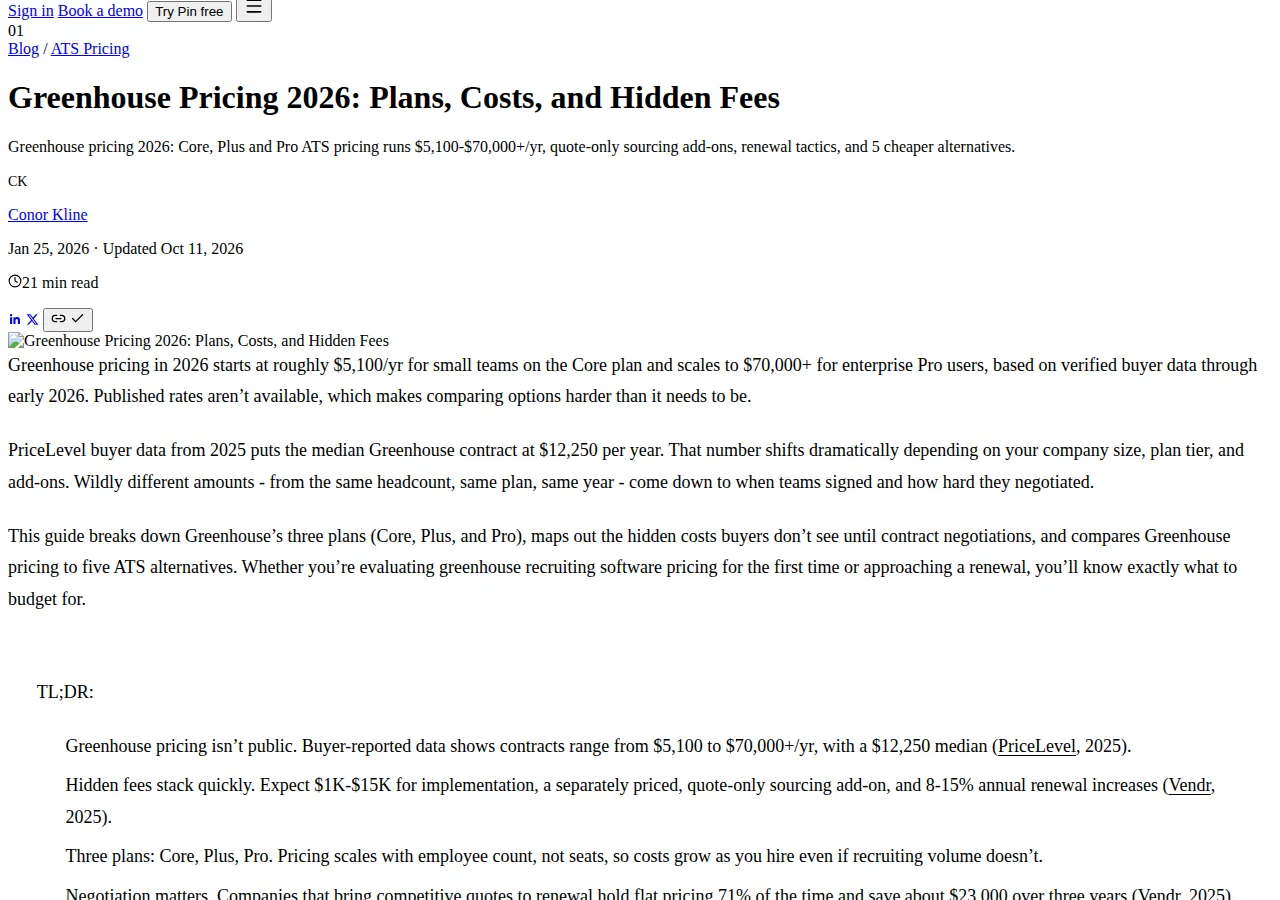
Greenhouse prices on total company employee headcount, not on recruiter seats, so the bill rises as the company grows even when hiring volume stays flat. Implementation is billed separately at $1,000 to $15,000, sourcing automation is a separate quote-only add-on, contracts are annual only with no free tier or trial, and Vendr reports renewal increases of 8 to 15 percent a year. At 15 percent, a $15,000 deal becomes $17,250 in year two and $19,837.50 in year three — $52,087.50 over three years against $45,000 flat. Get competing quotes before renewal, and ask for a 3 to 5 percent annual increase cap in the first agreement. Vendr reports competitive quotes hold flat pricing 71 percent of the time and save about $23,000 over three years.
Lever: the CRM-led challenger
Lever publishes no prices either. Its pricing page is a quote request form above the core platform: ATS and CRM in one, AI-powered screening, and unlimited AI interview transcripts. Add-ons are Candidate Insights, AI Screening by VONQ, and Onboarding.
The buyer-reported ranges are narrower than Greenhouse and cheaper at the entry point. Prepzo's 2026 Lever pricing guide puts Lever for Startups at about $3,500 a year for sub-50-employee teams, LeverTRM Pro mid-market deployments at $10,000 to $30,000 a year, and Lever Enterprise at $30,000 or more a year on custom, often multi-year contracts. 100Hires, working from Vendr marketplace data, reports a median of $15,400 a year (range $6,714 to $51,864); a 200-person company near $12,000 a year and a 500-person company near $37,000 a year. The consensus entry point is about $3,500 to $5,000 a year, and the consensus mid-market band is $10,000 to $30,000 a year.
Lever charges per user, the opposite pricing logic from Greenhouse: hiring managers, interviewers, and coordinators all consume seats. Implementation runs $2,000 to $5,000 at the lower end and can pass $20,000 at enterprise scale. Contracts are annual only, with no free plan and no public trial. Lever has been part of Employ Inc. since August 2022, alongside JazzHR and Jobvite. Capterra reviewers rate Lever 4.6 across 654 reviews, with 90 percent saying they would recommend it. Its edge is the built-in candidate relationship layer: nurture campaigns and talent pools live inside the ATS. The trade is reporting depth: switching buyers most often cite reporting that does not go deep enough, and Visual Insights dashboards reported to take hours to refresh.
The three hiring profiles, worked in full
Profile A: 18 employees, 12 hires a year, mostly inbound. Workable Standard at $3,588 a year is $299.00 per hire; Premier at $7,188 is $599.00; Enterprise at $8,628 is $719.00. Greenhouse Core at the entry anchor of $6,500 a year is $541.67 per hire. Lever for Startups at about $3,500 a year is $291.67 per hire, the cheapest entry point by $88 a year against Workable Standard.
The spread from the cheapest entry point (Lever for Startups, $3,500) to the dearest (Workable Enterprise, $8,628) is $5,128 a year; against Workable Standard it is $5,040.
Profile B: about 120 employees, 25 hires a year. Greenhouse Core at 101-250 employees runs $10,000 to $15,000 a year; the $12,500 midpoint is $500.00 per hire ($400 to $600 across the range). LeverTRM Pro runs $10,000 to $30,000 a year; the midpoint of $20,000 a year is $800.00 per hire. Workable Premier at its published floor of $7,188 a year is $287.52 per hire — a floor, since the 101-to-200 band price is not public. The gap between the Lever midpoint and the Workable floor is $20,000 minus $7,188, which is $12,812 a year.
Profile C: about 450 employees, 100 hires a year. Greenhouse Pro at $36,000 a year is $360.00 per hire. Lever Enterprise at its $30,000 floor is $300.00 per hire, and $518.64 at the top of 100Hires' Vendr range ($51,864). Workable Enterprise at its published floor of $8,628 a year is $86.28 per hire. The gap between Greenhouse Pro and the Workable floor is $36,000 minus $8,628, which is $27,372 a year.
AI screening: the metered cost nobody budgets
Workable is the only vendor here that prices its AI screening in public. Every ATS plan includes 3,000 complimentary AI credits. Screening costs 1 credit per candidate, sourcing 2, a chat session 10. Credit packs sell at 5,000 for $600, 10,000 for $1,000, and 50,000 for $4,750.
Employ Inc.'s 2025 hiring benchmarks, as reported by Rework, put the average at 257.6 applications per job. At 25 hires a year, that is 6,440 candidates screened; subtract the 3,000 free credits and 3,440 must be bought, covered by one 5,000-credit pack at $600. At 100 hires a year, the math gives 25,760 candidates and 22,760 credits to buy. Three 10,000-credit packs cost $3,000; the single 50,000-credit pack costs $4,750 and buys 27,240 credits you do not need.
Greenhouse includes its AI Notetaker in Core with no per-candidate meter disclosed. Lever includes AI-powered screening in its core platform, with AI Screening by VONQ sold as an add-on. Workable meters AI per candidate with a published price, while the other two bundle it into a negotiated contract where the AI cost is invisible — and unchallengeable at renewal.
Features, ceilings, and who should not buy what
Interview kits and scorecards appear on all three platforms. Greenhouse automates scheduling, stage transitions, and auto-reject from Plus upward; Workable automates actions, resume parsing, and self-scheduling on every plan; Lever automates nurture campaigns and AI screening, with deeper automation gated to higher tiers. Job-posting ceilings favor Workable — unlimited active jobs subject to fair usage limits on every plan — while Greenhouse and Lever tie job volume to the negotiated contract.
Greenhouse fits teams running structured hiring across dozens of roles a year. Workable fits teams under 200 employees hiring without a dedicated recruiter. Lever fits mid-market teams running outbound sourcing and nurture. Agencies should look elsewhere: none of the three is built for agency workflows. Inbound-heavy teams should not pay Lever prices for a CRM they will not use.
The execution checklist
- Count planned hires for the next 12 months — the per-hire figure decides between tiers.
- Read the Workable pricing page yourself — confirm the $299, $599, and $719 monthly figures.
- Get written quotes from Greenhouse and Lever.
- Ask for the full-year figure in writing — subscription, implementation, sourcing automation, and onboarding as separate lines.
- Negotiate a renewal cap at signing — 3 to 5 percent maximum annual increase.
- Confirm the AI meter in writing — Workable credits, Greenhouse AI by tier, Lever AI Screening by VONQ.
- Check the job ceilings — Workable unlimited jobs subject to fair usage.
- Run the add-on math for Workable — Standard plus the add-ons you need, against Premier at $7,188 a year.
- Budget implementation separately — Greenhouse $1,000 to $15,000, Lever $2,000 to $5,000.
- Set the renewal date in your calendar on signing day.
Workable wins on transparency and price at every volume here: $86.28 per hire at 100 hires a year against $360.00 for Greenhouse Pro. Greenhouse wins on structured hiring depth, and it is the pick when audit trails and a developer sandbox are requirements. Lever wins on outbound sourcing and nurture. The wrong buy is rarely the wrong product; it is the right product at the wrong tier, without the renewal cap. Get the second quote in writing, and sign the contract that names every line. For payroll, the Gusto vs Rippling vs QuickBooks employer cost playbook prices what each new hire costs after the offer is signed. For the CRM, the HubSpot vs Salesforce vs Pipedrive pricing and automation comparison runs the same per-seat math on the revenue side. For engineering, the Linear vs Jira vs ClickUp issue tracking comparison prices the tooling that receives the hire on day one.