Import and Export Tariffs: The Customs Duty Playbook
Import and Export Tariffs: The Customs Duty Playbook
A parcel worth 600 dollars used to cross the U.S. border duty-free. On August 29, 2025, that ended for every country: the same parcel now pays base duty, Section 301 additional duty, and the entry fee, about 75 dollars on a 600-dollar order. De minimis is suspended indefinitely, and the statute behind it is repealed outright on July 1, 2027. This playbook covers classification, the duty math, the entry paperwork, which tariffs stack and which are dead, drawback, and the five-year audit.
The duty stack: what a shipment actually pays
Five charges can land on one import, the first three percentages of the customs value, the transaction value, generally the price paid or payable, FOB. International freight and insurance are not dutiable for most goods, so the duty math starts from FOB, not CIF.
| Layer | Basis | Rate |
|---|---|---|
| Column 1 (MFN) duty | Customs value | 5 percent, model rate |
| Section 301 additional duty | Customs value | 7.5 percent, List 4A |
| Merchandise processing fee (MPF) | Entered value | 0.3464 percent, 34.58 floor, 670.86 cap |
| Harbor maintenance fee (HMF) | Cargo value, ocean only | 0.125 percent |
Worked example: Harbor & Pine Trading Co., a labeled illustrative model, imports 5,000 LED desk lamps from China (FOB 40,000 dollars, freight 2,800 dollars, insurance 320 dollars) at a stated 5 percent model Column 1 rate. Look up your own line at hts.usitc.gov.
Duty and fees total 5,188.56 dollars; landed cost is 48,308.56 dollars, or 9.66 dollars a unit against an 8.00-dollar purchase price, a 12.97 percent duty stack. The FY2027 MPF floor of 34.58 dollars binds below about 9,983 dollars of entered value; the cap of 670.86 dollars binds above about 193,666 dollars.
Classification first: the HTS number decides everything
Nothing else in this playbook works until the product has the right 10-digit Harmonized Tariff Schedule code: digits 1 through 6 are the international HS, digits 7 and 8 are the U.S. rate line, where the duty attaches, and digits 9 and 10 are a statistical suffix. The heading is decided by the six General Rules of Interpretation: GRI 1 (the heading terms plus the section and chapter notes, which override the heading) resolves most goods; GRI 3, essential character, decides composites and sets.
Check for a trade-remedy overlay in Chapter 99: the overlay, not the base rate, is usually the money. Get a binding ruling first: under 19 CFR Part 177, CBP issues rulings through eRulings, typically in 30 days, and prior rulings are searchable in the CROSS database of more than 250,000 rulings.
Marking is part of the same discipline: under 19 U.S.C. § 1304, every article of foreign origin must be marked, legibly, indelibly, and permanently, with the English name of its country of origin. An unmarked article pays an additional 10 percent ad valorem that cannot be remitted: 5,000 dollars on a 50,000-dollar shipment.
Entry: the two clocks and the form
Two clocks start when the goods arrive. Entry documents must be filed within 15 calendar days of arrival, or the merchandise goes to general order and storage charges begin. The entry summary, CBP Form 7501, with estimated duties, is due within 10 working days of entry or release. Shipments worth 2,500 dollars or less clear through informal entry, now dutiable since the de minimis suspension; above 2,500 dollars the entry is formal: a customs bond, a broker, and the full 7501. The importer of record must exercise "reasonable care" in entering, classifying, and valuing the merchandise, the standard that separates a duty bill from a duty bill plus a penalty.
File under the importer's EIN. An LLC, a C-Corp, or an S-Corp all clear customs the same way; the CPA books the duty as inventory cost under GAAP, paid by ACH, with the 7501 as a PDF and the entry lines as a CSV.
De minimis is gone: what the suspension changed
For decades, 19 U.S.C. § 1321 let shipments worth 800 dollars or less enter duty-free. That rule is suspended: CBP's June 2026 release states the regulations "indefinitely suspend duty-free de minimis treatment for low-value imports valued at $800 or less," and "all shipments valued at $2,500 or less are subject to applicable duties," except genuine gifts worth 100 dollars or less (200 dollars from the Virgin Islands, Guam, and American Samoa) and accompanied traveler articles.
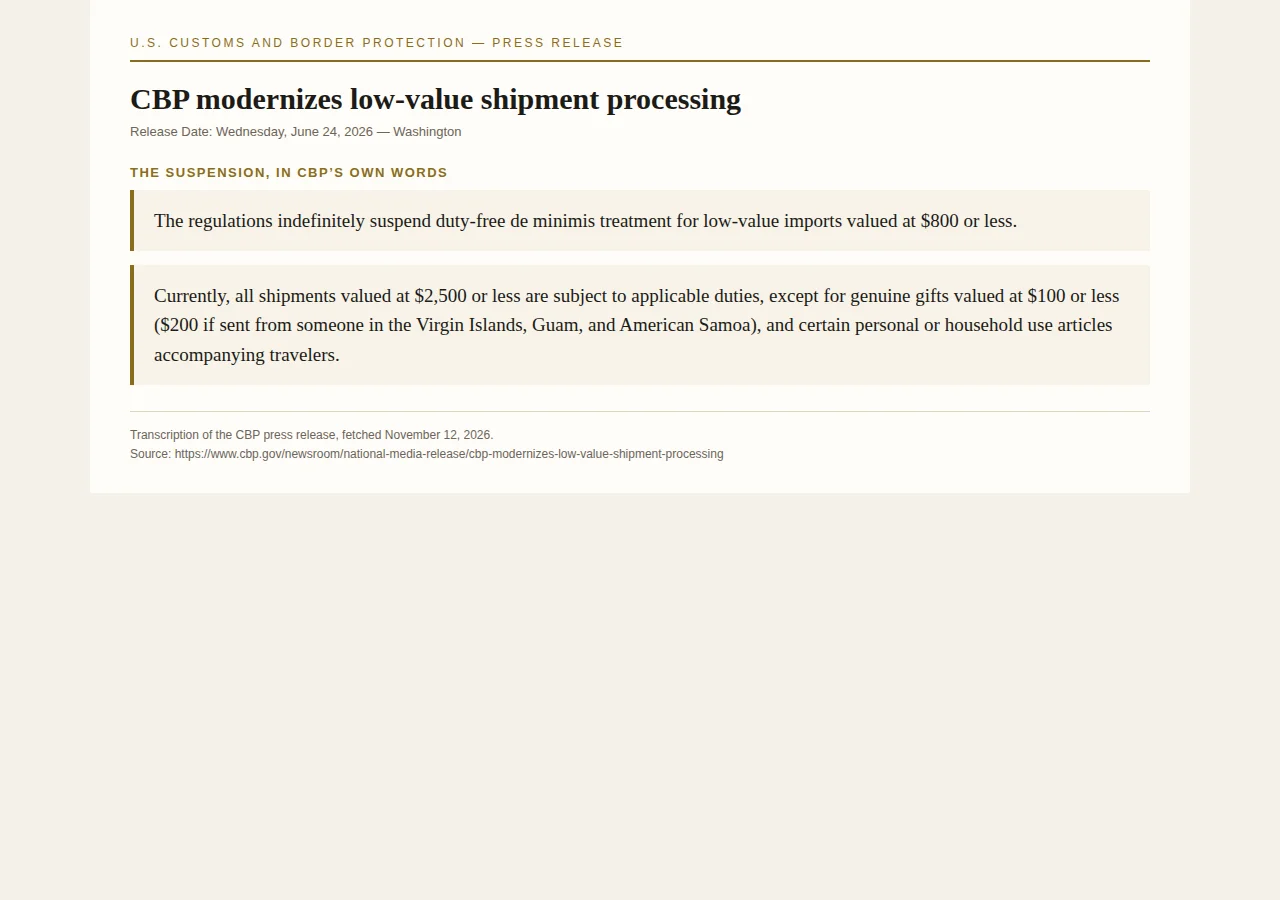
China and Hong Kong lost de minimis on May 2, 2025; every other country followed on August 29, 2025, under Executive Order 14324; the June 24, 2026 interim final rules wrote the suspension into regulation at 19 CFR 10.151; and the statute is repealed outright effective July 1, 2027, under Public Law 119-21.
The bite, on a 600-dollar parcel from China at the lamp example's model rates: before suspension, 0 dollars; after, 600 × (0.05 + 0.075) = 75.00 dollars, 12.5 percent of the parcel's value.
Section 301: the additional-duty lists
Section 301, 19 U.S.C. § 2411, directs the U.S. Trade Representative to act when a foreign practice burdens U.S. commerce. The China action adds a second duty on top of the Column 1 rate:
| List | Additional duty | Goods |
|---|---|---|
| Lists 1, 2, 3 | 25 percent | Industrial goods, machinery, electronics |
| List 4A | 7.5 percent | Consumer goods, many electronics |
| List 4B | 0 percent, suspended | Laptops, smartphones |
On a 100,000-dollar List 3 shipment at the model 5 percent rate, duty is 5,000 dollars plus 25,000 dollars of Section 301 duty, 30,000 dollars before fees. The 2024 four-year review raised the stakes: electric vehicles now carry 100 percent additional duty, semiconductors and solar cells 50 percent, lithium-ion batteries and steel and aluminum 25 percent. One hundred seventy-eight exclusions run through January 9, 2027, so check the list first: an exclusion is worth 25 points of duty.
Section 232: steel, aluminum, and copper at 50 percent
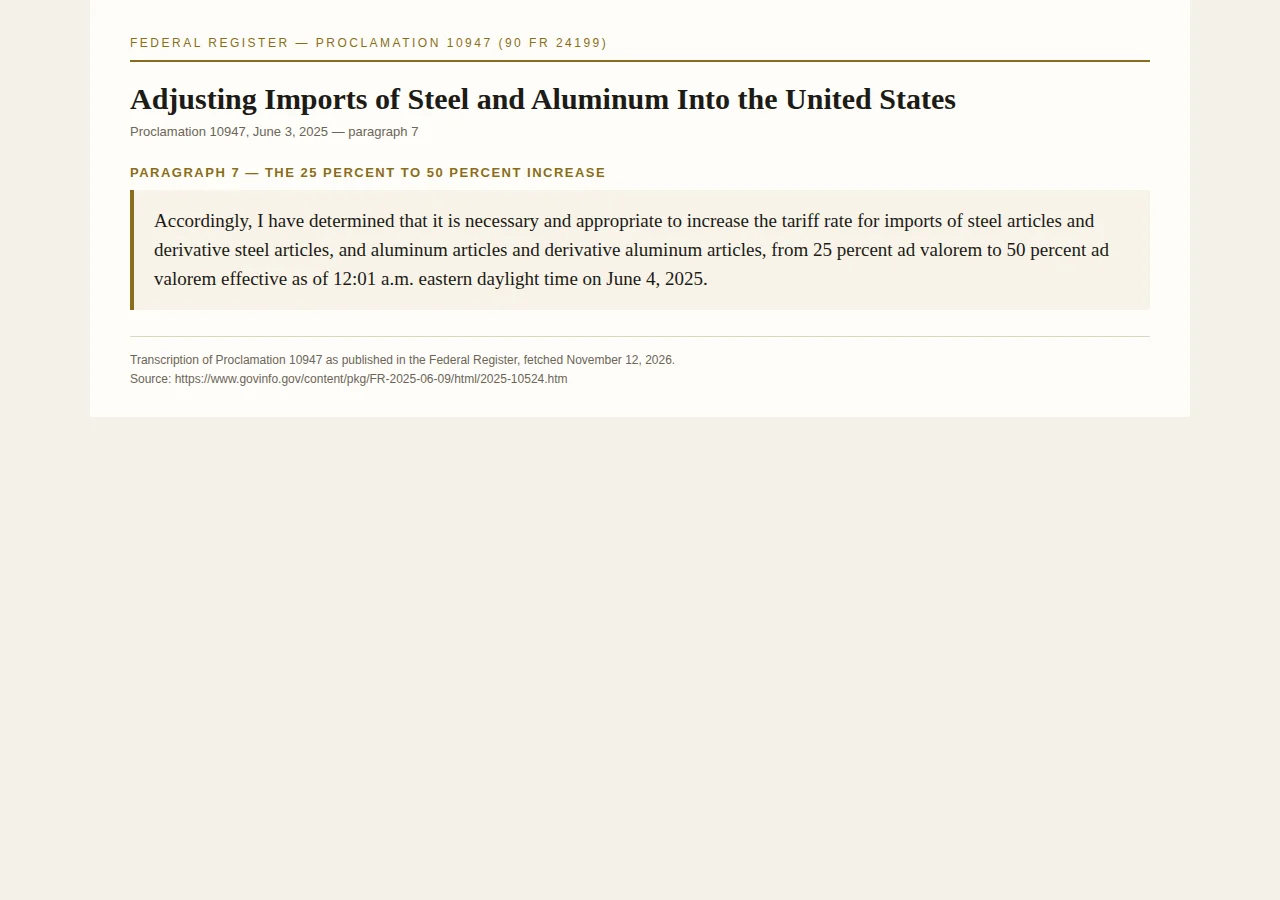
Section 232, 19 U.S.C. § 1862, is the national-security tariff: Proclamation 10947 raised steel and aluminum from 25 percent to 50 percent ad valorem, effective June 4, 2025; copper followed at 50 percent (trade-counsel reporting).
Steel brackets from Vietnam (customs value 60,000 dollars, freight 4,500 dollars, insurance 480 dollars, model Column 1 rate 5 percent): the Section 232 layer alone is 30,000 dollars; total duty and fees are 33,282.84 dollars (base 3,000 dollars, Section 232 30,000 dollars, MPF 207.84 dollars, HMF 75.00 dollars). Landed cost is 98,262.84 dollars against a 60,000-dollar purchase price. A 2026 proclamation reportedly restructured the tariff into tiers (trade-counsel reporting, not CBP guidance): confirm it before pricing on it.
The IEEPA tariffs are dead
The tariffs imposed under the International Emergency Economic Powers Act are void: on February 20, 2026, the Supreme Court held 6–3 in Learning Resources, Inc. v. Trump that IEEPA does not authorize tariffs. Executive Order 14389 ended collection the same day, CBP stopped collecting on February 24, 2026, and refunds run through the CAPE process in ACE, with Phase 1 open from April 20, 2026. Importers who paid them should file for the refund rather than write the money off.
The replacement was short-lived: a temporary Section 122 surcharge (announced at 10 percent, raised to 15 percent within days) expired on July 23/24, 2026. Section 232 and Section 301 were untouched: they rest on their own statutes. A new Section 301 duty reportedly took effect the same week: 12.5 percent on China-origin goods tied to forced-labor findings (HTS 9903.05.31); confirm it against the Federal Register before pricing it into a contract.
Duty drawback: the 99 percent refund
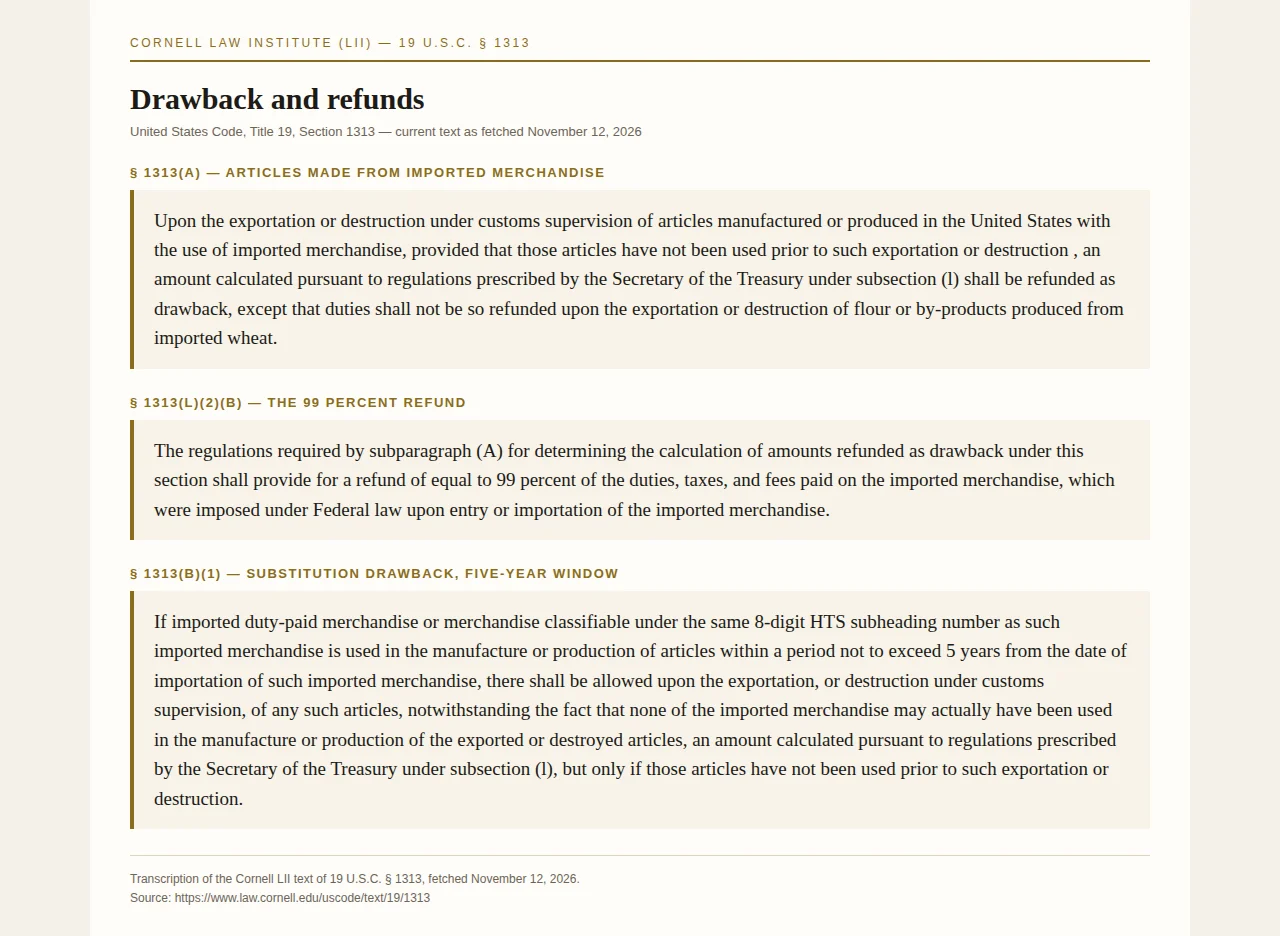
Import duty is not always a sunk cost. Under 19 U.S.C. § 1313, when articles manufactured or produced in the United States with imported merchandise are exported or destroyed under customs supervision, a drawback refund is paid, calculated under Treasury regulations. Those regulations provide a refund equal to 99 percent of the duties, taxes, and fees paid on the imported merchandise. Substitution drawback extends the same treatment to commercially interchangeable merchandise exported within 5 years under the same 8-digit HTS subheading.
On 12,500 dollars of duty paid, the refund is 12,375.00 dollars and the retained 1 percent is 125.00 dollars. The claim needs the import entry, manufacturing records, and export proof linked together; the five-year window is a hard deadline.
Free-trade agreements and the export side
Under the USMCA, goods originating in the United States, Mexico, or Canada receive preferential, usually duty-free, treatment. Origin follows the product-specific rule in Annex 4-B: wholly obtained, produced exclusively from originating materials, or meeting a tariff shift and/or regional value content test. The default threshold is 60 percent (transaction-value method) or 50 percent (net-cost method). Autos are stricter: 75 percent regional value content, plus a labor rule requiring at least 40 percent of vehicle value from production where workers earn at least 16 dollars an hour.
A finished good worth 100 dollars with 38 dollars of non-originating materials has an RVC of 62 percent and qualifies; with 45 dollars it fails at 55 percent. The claim rides on a certification of origin: no prescribed form, nine minimum data elements. A valid claim also exempts the good from the 10 percent Section 301 duty on Mexican and Canadian goods since July 24, 2026.
The export side has its own filing rule: Electronic Export Information must be filed in the Automated Export System when the goods under one Schedule B or HTS number exceed 2,500 dollars, and at any value when an export license is required, for rough diamonds, and for used self-propelled vehicles. Goods bound for Canada are exempt unless a license applies; ocean cargo filings are due at least 24 hours before loading. Filing is free through ACE AESDirect and returns an Internal Transaction Number the carrier needs; civil penalties run up to 10,000 dollars per violation. The United States imposes no general export duty: the Constitution bars taxes on exports.
The audit: five years of exposure
CBP does not audit the shipment; it audits the system. Records must be kept 5 years from the date of entry. A Focused Assessment tests internal controls and entry accuracy together. CBP completed 348 audits in the first nine months of FY2025 (Holland & Knight). Entries liquidate one year after entry, or are deemed liquidated at the importer's declared values if CBP does not act; protest within 180 days of liquidation, Post Summary Correction within 300 days of entry.
The penalty scale is where classification errors turn expensive. Under 19 U.S.C. § 1592(c):
| Culpability | Penalty cap |
|---|---|
| Fraud | Domestic value of the merchandise |
| Gross negligence | Lesser of domestic value or 4 times duties lost; 40 percent of dutiable value if no duty effect |
| Negligence | Lesser of domestic value or 2 times duties lost; 20 percent of dutiable value if no duty effect |
On a 200,000-dollar dutiable value with 15,000 dollars of duties lost, negligence caps at 30,000 dollars, gross negligence at 60,000 dollars, and fraud at the full 200,000-dollar domestic value. With no duty effect, negligence is 40,000 dollars and gross negligence 80,000 dollars. The escape hatch is prior disclosure: disclose before a formal investigation begins, under § 1592(c)(4), and the penalty is capped at duties plus interest. Once CBP opens an assessment, that window is closed.
The decision
| If you... | Do this | Authority |
|---|---|---|
| Import a new product | Get a binding ruling | 19 CFR Part 177 |
| Ship parcels under 2,500 | Price duty into the offer | CBP release, June 2026 |
| Source from China | Check the Section 301 list | 19 U.S.C. § 2411 |
| Source steel or aluminum | Price 50 percent, not 25 | Proclamation 10947 |
| Re-export imported goods | File drawback | 19 U.S.C. § 1313 |
| Find an old error | Disclose before CBP investigates | 19 U.S.C. § 1592(c)(4) |
The 7-step import sequence
- Classify: chapter notes, GRIs, binding ruling before the first shipment.
- Check the overlays: Section 301, Section 232, exclusions, USMCA.
- Price the stack before you sign the purchase order.
- Mark the goods: country of origin, legible, indelible, permanent.
- Enter on time: documents in 15 calendar days, Form 7501 in 10 working days.
- File the export side: EEI in AES for lines over 2,500 dollars, 24 hours before loading.
- Keep the file five years: entry, memo, ruling, broker instructions, drawback proof.
Founder & CEO Insight — Enow A. Jovial
Transfer pricing: the transfer pricing playbook. State tax: the sales tax playbook. Inventory: the inventory valuation playbook. Run your own numbers through the pricing calculator.