Google Workspace vs Microsoft 365: Business Pricing Playbook
Google Workspace and Microsoft 365 Business print the same three numbers: $7, $14, and $22 per user per month. The tie is real, and it is also the trap: the same headline rate buys different bundles, storage is pooled on one side and capped on the other, and AI is bundled by Google but billed by Microsoft.
Google figures come from Google's own pricing page and billing help, opened November 6, 2026. Microsoft's pages returned bot-blocked shells, so Microsoft figures are corroborated October 2026 reads (o365hq price list, checked against Xsquare and three further reads). Cancellation terms and the 300-user cap come from Microsoft Learn. Prices are US list, exclude tax.
Who this is for — and who should stop here
This guide is for a founder or operations lead choosing the suite for a team of 5 to 100 people — email, documents, meetings, storage, and AI as one monthly number — assuming every user needs a mailbox and a seat.
It is not for a team above 300 seats: both Business ranges cap at 300 users, and Enterprise pricing beyond that wall is quoted, not listed. The Zoom vs Google Meet vs Teams pricing playbook prices the video stack on its own.
> [!FOUNDER]
> "Two vendors printing the same price is not a tie. It is a dare to read the second page: what a seat is — how much storage rides with it, whether AI is inside the price or on top of it, and what happens when you try to leave. Buy the seat, not the number."
> — Enow A. Jovial, Founder & Chief Executive Officer
The price cards, tier by tier
Both vendors sell three Business tiers with the same list prices on an annual commitment.
| Vendor | Tier | Per user / month (annual) | What the tier adds |
| :--- | :--- | :--- | :--- |
| Google | Business Starter | $7.00 | Custom Gmail, 30 GB pooled, Meet 100, Gemini in Gmail |
| Google | Business Standard | $14.00 | 2 TB pooled, Meet recording for 150, Gemini in Docs, Sheets, Meet |
| Google | Business Plus | $22.00 | 5 TB pooled, Vault, eDiscovery, Meet for 500 |
| Microsoft | Business Basic | $7.00 | Web and mobile apps, Teams, Exchange email, 1 TB OneDrive |
| Microsoft | Business Standard | $14.00 | Installed desktop apps, webinar hosting, Access on PC |
| Microsoft | Business Premium | $22.00 | Intune, Entra ID P1, Defender for Business |
!Google Workspace pricing tiers
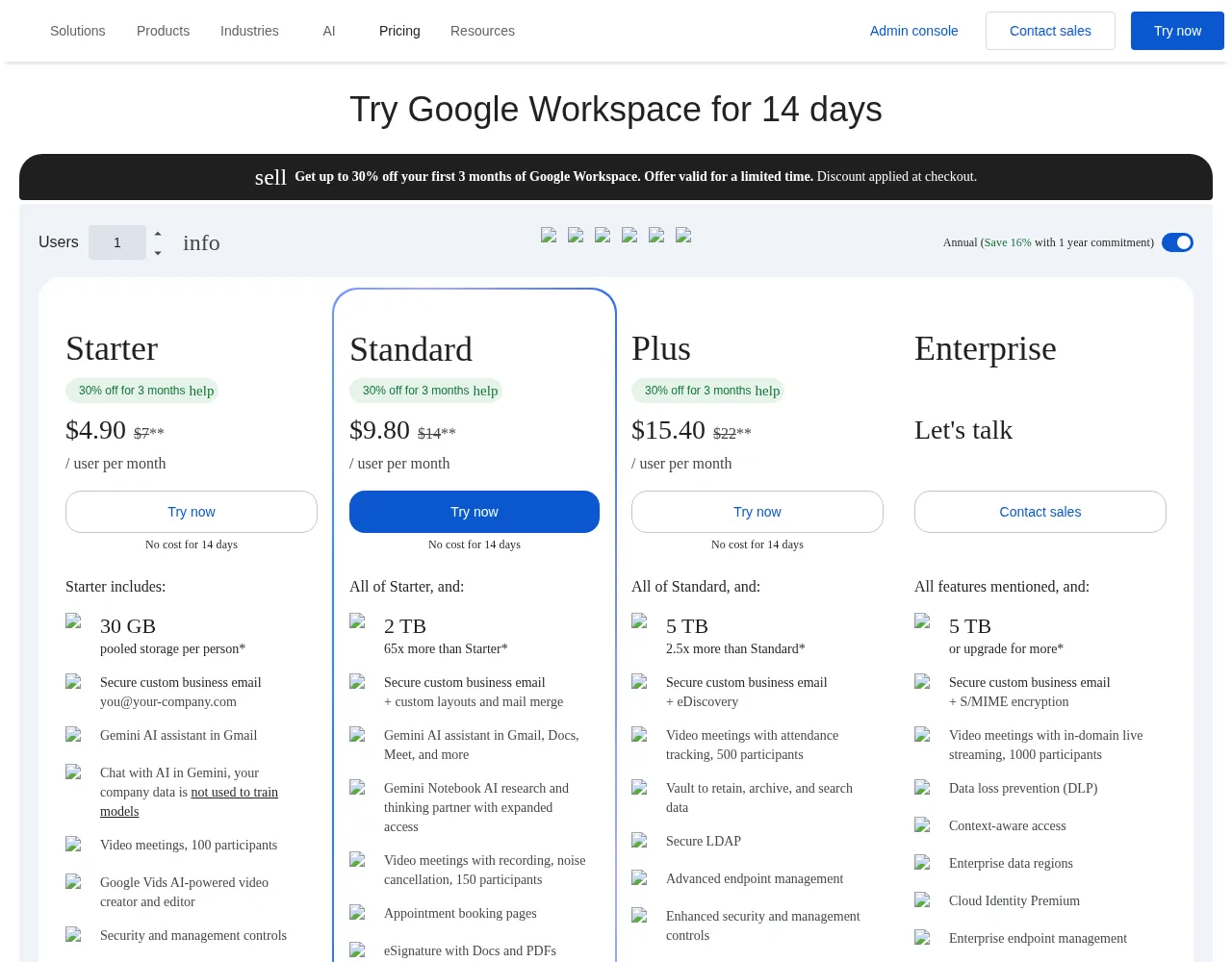
The screenshot above is Google's own pricing page: the struck-through prices are a 30 percent introductory rate ($4.90, $9.80, $15.40) running November 20, 2026 to February 20, 2027, for new customers only, on the first 20 users added. Budget the list price.
The entry tiers are not equivalents: Google Starter includes custom email and Gemini in Gmail; Microsoft Basic includes Teams and web apps but no desktop Office. The top tiers differ too: Google Plus buys storage and Vault; Microsoft Premium buys the security stack Google sells only on Enterprise.
> [!TIP]
> A user who needs desktop Office but no mailbox should take Microsoft 365 Apps for Business at $10 a seat instead of Standard at $14.
The billing-term trap: annual, flexible, monthly
Both vendors punish month-to-month billing by exactly 20 percent.
!Google flexible vs annual rates
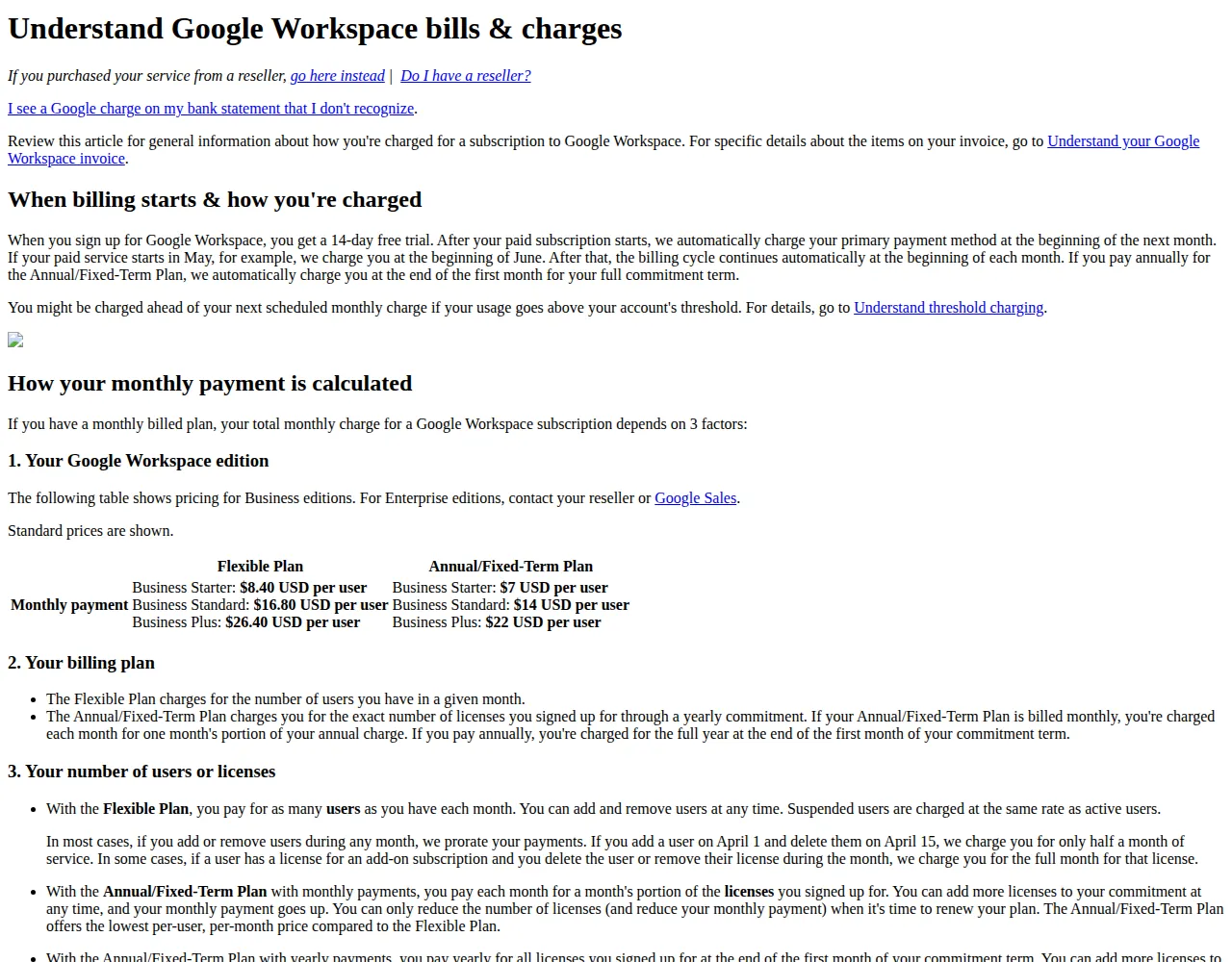
Google sells two plans. The Flexible Plan bills $8.40, $16.80, or $26.40 a seat and lets you add or remove users at any time. The Annual Plan bills $7, $14, or $22 and locks the seat count for the year — add licenses mid-term, reduce them only at renewal. Every Google plan is billed monthly.
Microsoft sells three ways to pay: annual upfront at $84, $168, or $264 per seat per year; annual billed monthly at $7.35, $14.70, or $23.10 a month; or monthly, cancellable at any month end, at $8.40, $16.80, or $26.40 a month.
!Microsoft 365 October 2026 list prices
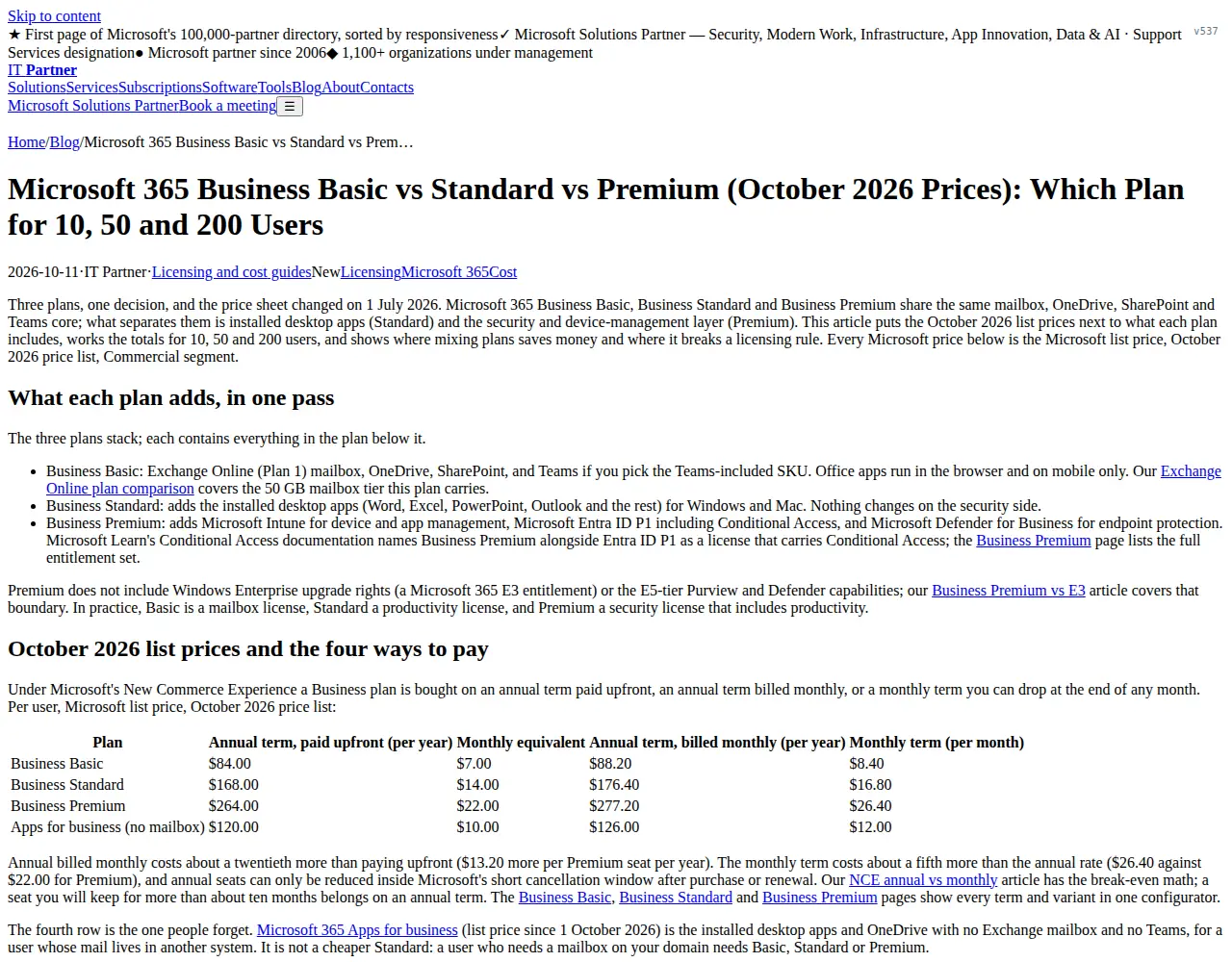
The table above is the October 2026 commercial price list as tabulated by o365hq — Microsoft's own page returned a bot-blocked shell, so this independent read is the evidence for the Microsoft figures here.
The penalty for refusing a commitment, on the Standard tier at 25 seats:
$
\text{Month-to-month penalty} = 25 \times (\$16.80 - \$14.00) = \$70.00 \text{ per month} = \$840 \text{ per year}
$
At 100 seats the penalty is $280 a month, $3,360 a year. Microsoft's middle option softens it: annual billed monthly at 25 Standard seats costs $367.50 against $350. Ten months on a monthly term costs the same as twelve months on annual — if a seat will last ten months or more, commit.
> [!WARNING]
> Microsoft's cancellation window is seven days, not thirty. Microsoft Learn states you can only cancel and receive a prorated credit or refund within seven days after the start or renewal of a subscription. After that, you turn off recurring billing and keep access to the end of the term — and an annual subscription paying monthly keeps charging for the remainder of the term. Count the seats you will still have in month eleven before you sign, not the seats you have today.
Storage: pooled against siloed
Storage is where the two $14 tiers stop looking alike. Google pools storage across the organisation; Microsoft assigns it per user and it stays there.
| Storage | Google Starter | Google Standard | Google Plus | Microsoft (all three) |
| :--- | :--- | :--- | :--- | :--- |
| Cloud drive | 30 GB pooled per user | 2 TB pooled per user | 5 TB pooled per user | 1 TB OneDrive per user |
A 25-seat Standard team holds 50 TB of shared Drive on Google; a 100-seat team holds 200 TB, and one user can hold the team's entire video archive while another holds almost nothing. Microsoft's 1 TB is a per-user ceiling: a user with 1.2 TB hits the wall while a colleague's 900 GB sits unused. The mailbox is separate on Microsoft's side — 50 GB of Exchange per user — while Gmail draws from the same Google pool.
At $14, Google ships twice the storage per seat and lets the team share it. If your heaviest three users hold more than 1 TB each, Microsoft's ceiling forces a storage add-on.
The AI line: Gemini bundled, Copilot billed
Google folded Gemini into Workspace in early 2025 and retired the old $20 and $30 Gemini add-ons in March 2025. The assistant inside Gmail, Docs, Sheets, and Meet now rides inside the $7, $14, and $22 list prices — Starter gets Gemini in Gmail; Standard and Plus get it across Docs, Sheets, Slides, Drive, Meet, and Chat. There is no AI line on a Google invoice. Gemini Enterprise is a different product — a standalone agent platform from $21 a seat — not the assistant inside Docs, and its price should never be added to a Workspace quote.
Microsoft sells Copilot two ways, at two different prices for the same assistant.
!Copilot Business pricing table
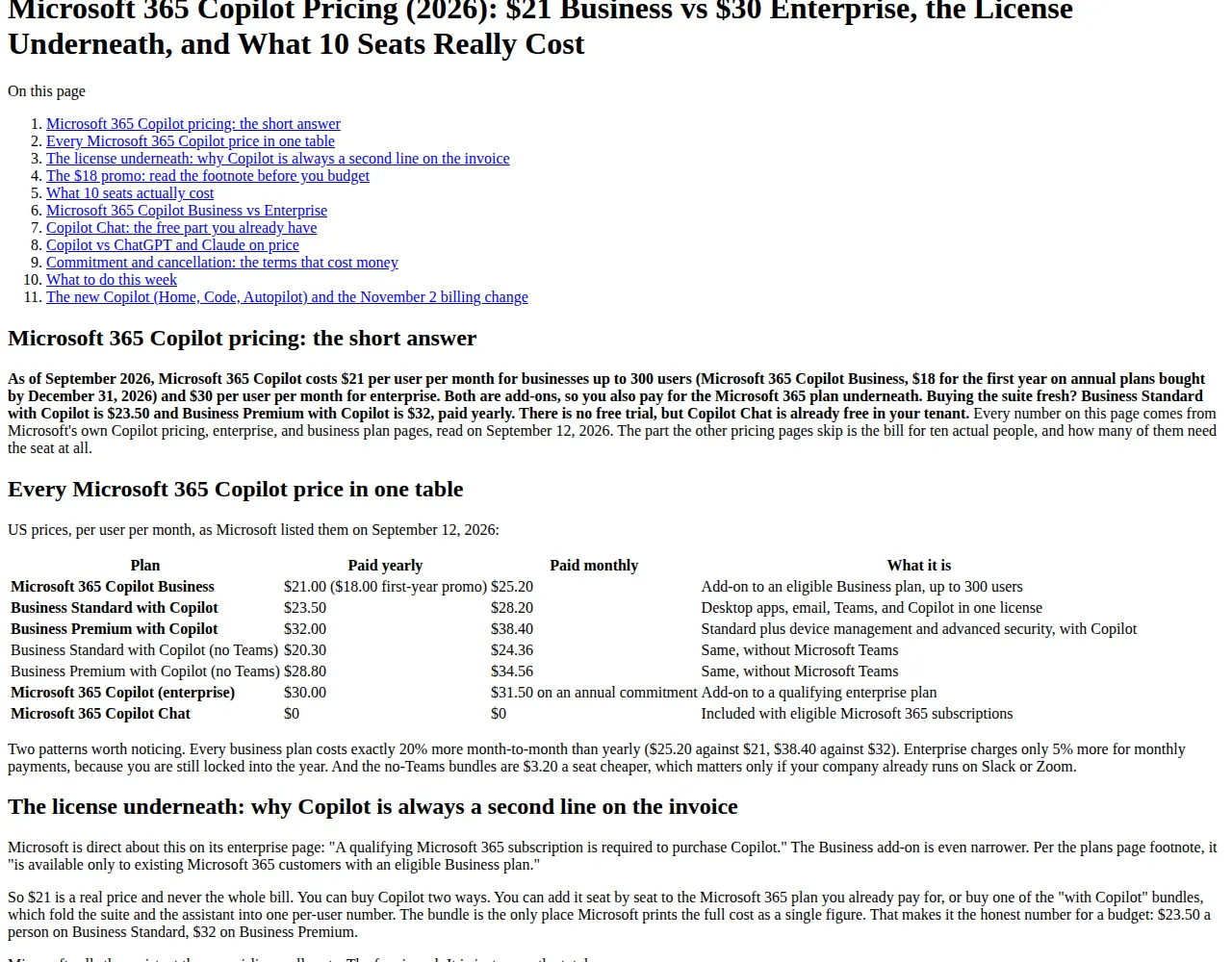
The table above is the September 2026 read of Microsoft's Copilot pricing. The Copilot Business add-on is $21 a seat a month on an annual plan — $18 in the first year on annual plans bought by December 31, 2026 — or $25.20 month to month, on top of a qualifying plan paid separately. The enterprise add-on is $30 a seat, $31.50 billed monthly. The bundle SKUs, permanent since July 1, 2026, change the comparison: Business Standard with Copilot is $23.50 a seat, and Business Premium with Copilot is $32. The bundle replaces the plain license.
| AI route | Per seat / month (annual) | What it is |
| :--- | :--- | :--- |
| Google Gemini, any Business tier | $0 marginal — bundled | Gmail on Starter; Docs, Sheets, Meet on Standard/Plus |
| Copilot Business add-on | $21.00 ($18 first year) | Add-on to an eligible Business plan |
| Standard with Copilot bundle | $23.50 | Suite plus AI in one license |
| Premium with Copilot bundle | $32.00 | Suite plus AI in one license |
The bundle adds Copilot for $9.50 over plain Standard and $10 over plain Premium; the add-on costs $21. A new buyer on the add-on route pays $11.50 a seat a month more than the bundle for the same assistant on Standard — $287.50 a month at 25 seats, $3,450 a year, for nothing. The add-on exists for tenants who already hold the base plan, because Microsoft prices it as an upgrade for existing tenants; a fresh purchase should take the bundle.
> [!KEY TAKEAWAY]
> At the Standard tier, Google's AI costs $0 on top of the $14 seat; Microsoft's costs $9.50 on the bundle or $21 on the add-on. Price the AI before you price the suite — it is the only line where the two vendors are not tied.
The decision table
| Question | Google Workspace | Microsoft 365 Business |
| :--- | :--- | :--- |
| Desktop Office apps | Web apps only | Standard $14 and up; Apps for Business $10 |
| AI assistant cost | $0 marginal, bundled | $9.50 bundle / $21 add-on (Standard) |
Profile A: 5 seats, annual billing
Five seats is the smallest honest team, and both vendors charge the same at every tier before AI: 5 × $7 = $35 a month ($420 a year) at entry, 5 × $14 = $70 ($840 a year) at Standard, 5 × $22 = $110 ($1,320 a year) at the top tier. Add AI and the tie breaks: five Standard seats with Copilot cost $117.50 a month on the bundle and $175 on the add-on route; Google Standard with Gemini stays $70.
Profile B: 25 seats, annual billing
$
\text{25 seats} \times \$14.00 = \$350.00 \text{ per month} = \$4,200 \text{ per year (Standard, either vendor)}
$
On the add-on route, 25 seats cost 25 × ($14.00 + $21.00) = $875.00 a month.
$
\text{25 seats, Microsoft Standard with Copilot bundle} = 25 \times \$23.50 = \$587.50 \text{ per month}
$
The AI gap at 25 Standard seats is $525 a month on the add-on route ($6,300 a year) and $237.50 a month on the bundle ($2,850 a year). In the promo first year the add-on gap narrows to $450 a month ($5,400 a year) — then the $18 rate expires. At the top tier, Premium with Copilot is 25 × $32 = $800 a month against Google Plus at 25 × $22 = $550: a $250 monthly gap, $3,000 a year.
Profile C: 100 seats, annual billing
At 100 seats, base Standard is still tied at $1,400 a month, $16,800 a year.
$
\text{100 seats, Microsoft Standard with Copilot bundle} = 100 \times \$23.50 = \$2,350.00 \text{ per month}
$
On the add-on route, 100 seats cost 100 × $35.00 = $3,500.00 a month.
The bundle route costs $950 a month more than Google Standard, $11,400 a year; the add-on route costs $2,100 a month more, $25,200 a year. Choosing the bundle over the add-on at 100 seats saves $1,150 a month, $13,800 a year. Storage is 200 TB pooled on Google Standard against 100 TB siloed on Microsoft.
The breakeven: when Microsoft wins anyway
Microsoft wins on three conditions. First, installed desktop Office: if the team cannot work in browser apps, Google has no $14 answer and Microsoft Standard at $14 is the only in-scope tier. Second, the security stack: Premium's Intune, Entra ID P1, and Defender for Business are worth $8 a seat over Standard; if the team would otherwise buy device management separately, Premium at $22 undercuts it. Third, the no-Teams discount: a team already running Slack or Zoom saves $3.20 a seat on the Standard with Copilot bundle without Teams ($20.30 against $23.50), and Basic without Teams drops to $5.40.
If the team's files are evenly spread, under 1 TB per user, and the AI need is light, the suites are a genuine tie and the decision belongs to the tools the team already knows — Gmail against Outlook, Drive against OneDrive — not to price. The LLM API pricing playbook prices the raw model underneath both assistants, the QuickBooks vs Xero comparison applies the same per-seat method to the accounting stack, and the break-even calculator runs the same arithmetic this guide uses.
The risk layer
Three risks are priced into the decision and none appear on a pricing page. The first is the commitment lock: both vendors let you add seats mid-term and make you wait for renewal to remove them, and Microsoft's refund window is seven days — a team that signs for 25 seats and drops to 18 in month four pays for 25 until renewal. The second is the intro-rate cliff: Google's 30 percent rate ends after three months and applies to the first 20 users; Microsoft's $18 Copilot rate ends after the first year. Budget year two, not month one. The third is the AI usage meter: some advanced Copilot experiences bill on usage on top of the seat price, so the $23.50 bundle is a floor, not a ceiling, for heavy agent use.
Migration is the fourth cost and the largest: moving mail, Drive files, and shared folders is a project, not a setting — a weekend of migration tooling per 25 seats and re-shared links.
The signing sequence
Step 1 — Count mailbox users: every business-email user needs a paid seat; guests and shared mailboxes are free.
Step 2 — Pick the tier by its ceiling: desktop apps force Microsoft Standard; per-user storage over 1 TB forces Google Standard; Vault or security forces the top tier.
Step 3 — Price the AI first: Google $0 marginal; Microsoft $9.50 on the bundle, $21 on the add-on.
Step 4 — Choose the billing term by seat life: seats lasting ten months or more belong on annual; seasonal seats stay flexible.
Step 5 — Run both profiles before signing: 25-seat and 100-seat monthly totals, with and without AI, from the formulas above.