GoDaddy vs Namecheap vs Cloudflare Registrar: Domain Pricing Playbook
Founder & CEO Insight — Enow A. Jovial
A .com costs $0.01 at GoDaddy, $11.28 at Namecheap, and $11.17 at Cloudflare. All three numbers are true and all three are useless on their own, because none of them is the price you pay in year two. GoDaddy's penny is a first-year offer that requires a three-year purchase. Namecheap's $11.28 renews at $18.48. Cloudflare's $11.17 is the same in year one and year five, because Cloudflare charges what the registry charges and adds no markup.
This playbook prices .com, .net, .org, and .io at all three registrars, then runs the portfolio math at 1, 10, and 50 domains over 1, 3, and 5 years. Every figure was read this cycle from the vendor pages that loaded, or corroborated across at least two independent November 2026 price checks. GoDaddy's domains page returned Access Denied on 10 November 2026, so GoDaddy figures are corroborated-secondary; Cloudflare's pages loaded directly.
The price table: registration, renewal, transfer
Read down the renewal column, not across the first-year row. The renewal column is the price you pay every year after the promo ends, and it decides a five-year bill.
| TLD | Registrar | First year | Renewal / year | Transfer in | Authority |
|---|---|---|---|---|---|
| .com | GoDaddy | $0.01* | $22.99 | $0.01* | GoDaddy guide |
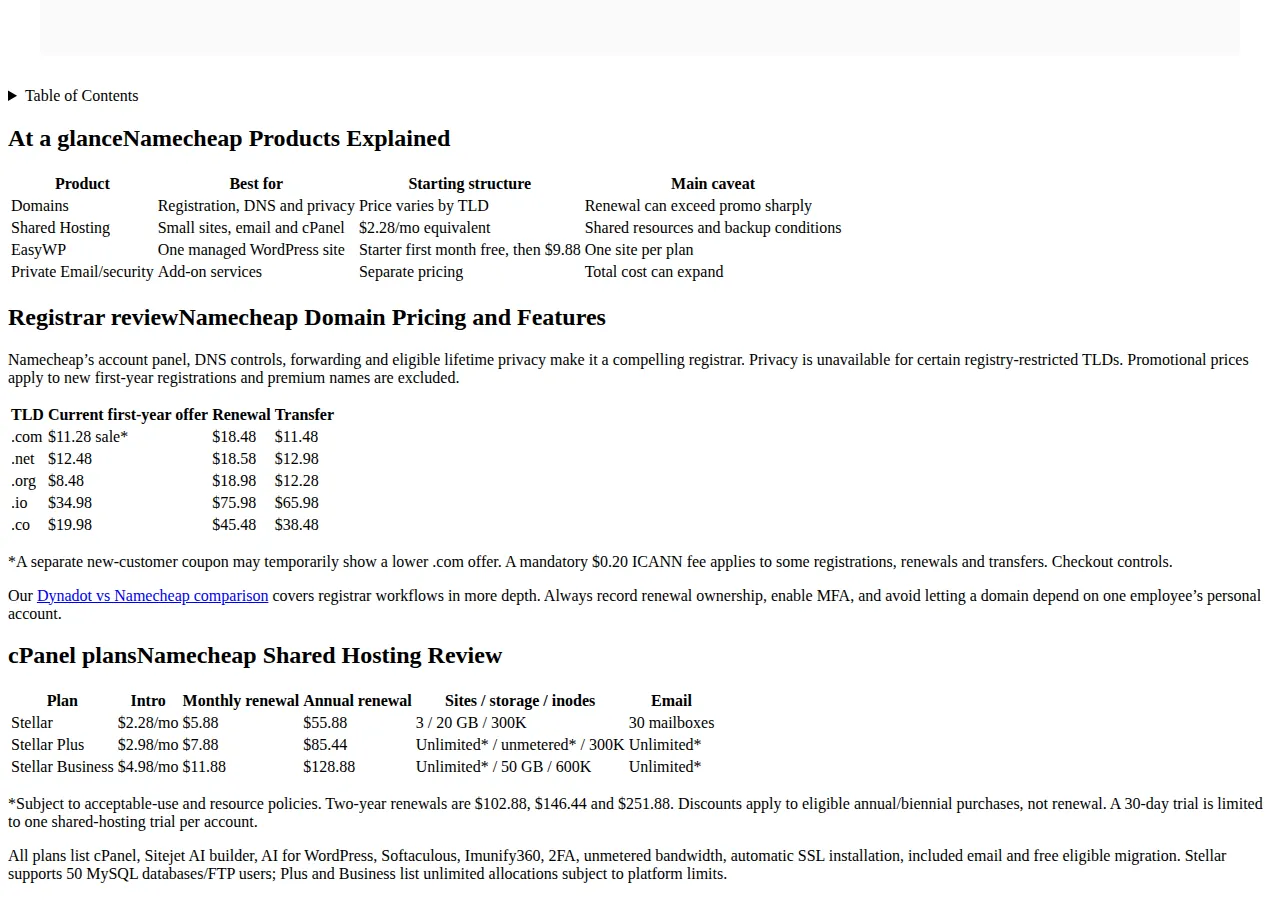
| .com | Namecheap | $11.28 | $18.48 | $11.48 | Namecheap list |
| .com | Cloudflare | $11.17 | $11.17 | $11.17 | Cloudflare page |
| .net | GoDaddy | $15.19 | $24.99 | Renewal rate | GoDaddy guide |
| .net | Namecheap | $12.48 | $18.58 | $12.98 | Namecheap list |
| .net | Cloudflare | $11.86 | $11.86 | $11.86 | Cloudflare list |
| .org | GoDaddy | $10.19 | $23.99 | Renewal rate | GoDaddy guide |
| .org | Namecheap | $8.48 | $18.98 | $12.28 | Namecheap list |
| .org | Cloudflare | $8.50 | $11.20 | $11.20 | Cloudflare list |
| .io | GoDaddy | $59.99 | $89.99 | Renewal rate | TLDSpy |
| .io | Namecheap | $34.98 | $75.98 | $65.98 | Namecheap list |
| .io | Cloudflare | $32.00 | $50.00 | $50.00 | Cloudflare list |
\* GoDaddy's $0.01 first year requires a three-year purchase: years two and three bill at $22.99 each, so the three-year total is $45.99. A separate one-year offer for new customers runs $2.99 with a promo code, or $4.99 with code GDWELCOME. Prices exclude taxes and the $0.20 ICANN fee. "Renewal rate" means GoDaddy publishes no separate transfer price for that extension.
Cloudflare is the only registrar where the renewal equals the first year on .com and .net. Namecheap's .org first year ($8.48) more than doubles at renewal ($18.98). And .io is expensive everywhere at renewal — $50.00 at Cloudflare, $75.98 at Namecheap, $89.99 at GoDaddy.
Why Cloudflare's .com costs $11.17: the wholesale receipt
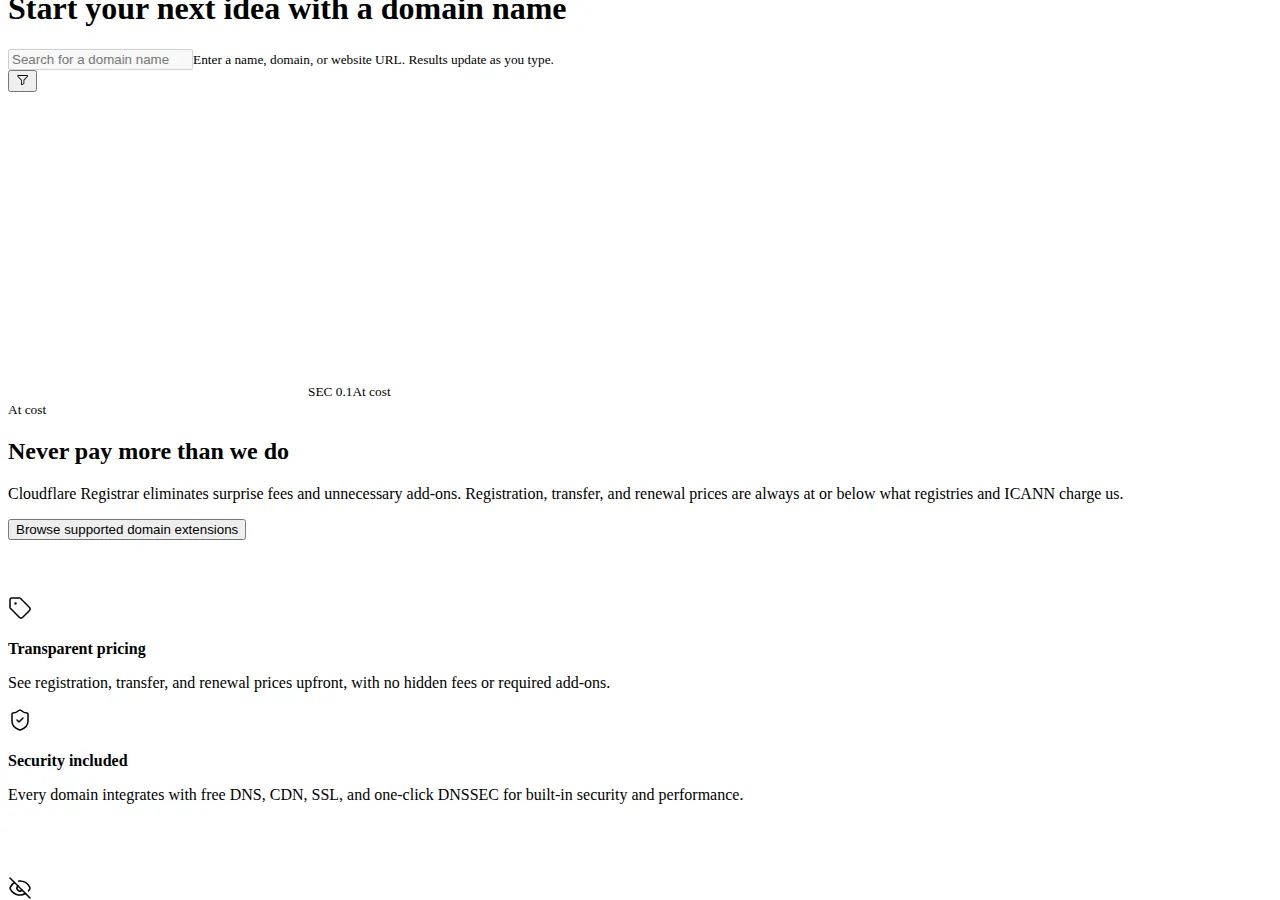
Cloudflare's price is not a discount. It is a receipt. Verisign, which runs the .com registry, charged registrars $10.26 per domain per year until 31 October 2026, then raised it to $10.97 on 1 November 2026. ICANN adds a $0.20 fee per domain-year. Add the two and you get the Cloudflare price exactly: $10.97 plus $0.20 is $11.17. Cloudflare's product page states the policy plainly: prices are always at or below what registries and ICANN charge, with no markup and no hidden fees.
At-cost does not mean fixed. When Verisign raises its wholesale fee, Cloudflare's price rises by the same amount on the same day — it moved from $10.46 to $11.17 on 1 November 2026. A retail registrar can raise its renewal whenever it likes and keep the difference. Namecheap's .com renewal shows the risk: three October 2026 reads put it at $18.48, but November reads put it at $19.98 and $20.18 including the ICANN fee. The table uses the October-verified $18.48.
Worked example 1: one .com, five years
One .com, held for five years, no add-ons. The first-year price barely matters; the renewal price does all the work. The formula is simple:
GoDaddy: $0.01 plus 4 times $22.99 is $91.97. Namecheap: $11.28 plus 4 times $18.48 is $85.20. Cloudflare: 5 times $11.17 is $55.85. The first-year gap against Cloudflare is $11.16 in GoDaddy's favor; the five-year gap is $36.12 in Cloudflare's favor. The cheapest first year becomes the most expensive five years, because four renewals outweigh one promo.
Worked example 2: ten .coms, five years — the portfolio trap
Scale it to ten .com domains. GoDaddy: $919.70. Namecheap: $852.00. Cloudflare: $558.50. Cloudflare saves $361.20 against GoDaddy and $293.50 against Namecheap over five years. At 50 .com domains the math gives $4,598.50 at GoDaddy, $4,260.00 at Namecheap, and $2,792.50 at Cloudflare, a saving of $1,806.00 against GoDaddy. GoDaddy wins year one and loses badly by year five.
Worked example 3: the mixed portfolio — five .com, three .net, two .org
Most real portfolios are mixed. Take ten domains — five .com, three .net, two .org — priced at each registrar's annual renewal rate, the steady-state cost once every promo has expired. GoDaddy: $114.95 plus $74.97 plus $47.98, a yearly total of $237.90. Namecheap: $92.40 plus $55.74 plus $37.96, a yearly total of $186.10. Cloudflare: $55.85 plus $35.58 plus $22.40, a yearly total of $113.83. Cloudflare saves $124.07 a year against GoDaddy, which is $620.35 over five years.
A single .io renews at $89.99 at GoDaddy, $75.98 at Namecheap, and $50.00 at Cloudflare. Over five years one .io costs $419.95 at GoDaddy, $338.90 at Namecheap, and $232.00 at Cloudflare. Three .io domains cost $1,259.85 at GoDaddy against $696.00 at Cloudflare. Pick .io because the name needs it, not because the first year looks cheap.
WHOIS privacy: the $0 line that used to cost money
WHOIS privacy — the service that replaces your name, address, email, and phone in the public domain record with the registrar's proxy details — costs $0.00 a year at all three registrars today. Namecheap includes it free. Cloudflare includes WHOIS redaction by default. GoDaddy includes free WHOIS privacy on domains registered with it, plus a transfer lock. GoDaddy used to sell privacy as a paid add-on, at roughly $10 to $20 a year, so a founder who bought a domain years ago may still be paying for privacy that is now free. Open your portfolio, open the add-ons section, and cancel any paid privacy line — at $10 a year times 50 domains, that is $500 a year.
Transfer economics: the move that pays for itself
A transfer is not a fee. For most generic extensions, a transfer costs one year at the new registrar's price, and that year is added to your current expiration date. Move a .com from GoDaddy to Cloudflare and you pay $11.17, your expiry moves out by a year, and every renewal after that costs $11.17 instead of $22.99 — a saving of $11.82 a year per domain, every year.
Work it for ten .com domains. The transfer costs 10 times $11.17, which is $111.70, and adds a year to each domain. Annual renewals fall from $229.90 to $111.70 — a saving of $118.20 a year, so the transfer pays for itself in under a year. Moving ten .coms from Namecheap to Cloudflare saves $73.10 a year, with renewals falling from $184.80 to $111.70.
Two locks govern every transfer. ICANN rules block a transfer within 60 days of registering a domain, of a previous transfer, or of a registrant contact change. One price check also advises waiting at least 45 days after a renewal before transferring, so the extra year is added cleanly. Your site stays live throughout the transfer.
The 7-step transfer checklist
- [x] List every domain to move, its registrar, and its expiry date — and confirm the renewal price at the destination.
- [x] Check the 60-day lock on each domain: no transfer within 60 days of registration, a previous transfer, or a contact change.
- [x] Turn off auto-renew at the old registrar, so you are not charged for a year you are about to buy elsewhere.
- [x] Unlock each domain at the old registrar and copy its authorization code (EPP code) into your list.
- [x] Start the transfer at the new registrar, enter the authorization code, and approve the confirmation email.
- [x] Confirm the new expiry date shows one year later, and that DNS, DNSSEC, and WHOIS privacy are active.
- [x] Turn on auto-renew at the new registrar, set a reminder 30 days before the next renewal, and delete the old registrar's payment method.
DNS, SSL, and the fine print that is not a price
All three include basic DNS management at no added charge, and DNSSEC — the signing that stops DNS spoofing — is free at Cloudflare, and available at GoDaddy and Namecheap. Cloudflare bundles its CDN and free SSL with every domain. GoDaddy sells SSL as a paid add-on, and its website-builder SSL renews at $119.99 a year after a free first year. Namecheap sells SSL separately too. Price SSL as its own line. There is no margin to discount at Cloudflare, so there is no published bulk program — the at-cost price is the bulk price. GoDaddy and Namecheap run promotions instead, and one November 2026 Namecheap coupon claims 38 percent off renewals. A coupon is a one-year fix on a recurring bill; the transfer is the permanent fix.
The back office: where the domain actually lives
A domain is a business asset, not a tech accessory. Register it to the company — the LLC, the S-Corp, or the C-Corp — not to a founder's personal email, and make the registrant contact a company address that survives a founder leaving. The company's EIN goes on the billing record so the renewal is a deductible business expense, and your CPA will ask for that record at year end. If the company uses an API to manage DNS — Cloudflare's API is the most complete of the three — keep the API token in the company vault, not in a shared chat. Document DNS and SSL settings alongside the domain list. ICANN requires accurate registrant details.
Who should NOT use each registrar
GoDaddy is the wrong registrar for a founder who owns more than five domains and never looks at the renewal bill: the first-year price is the best of the three and the renewal price is the worst, so every domain widens the gap between what you paid to start and what you pay to stay. It is also wrong for a team that wants a flat, predictable bill — prices vary by promotion, market, and account history. Use GoDaddy if you need one domain, one year, right now, with phone support — then set the transfer reminder for day 61.
Namecheap is the wrong registrar for a founder who wants the cheapest renewal and will not use coupons: its renewal prices sit in the middle on every extension, and the first-year discounts expire after twelve months. It is also wrong for a portfolio heavy in .io or .co, where its renewals are the steepest relative to the first year. Use Namecheap if you want free privacy, your own DNS anywhere, and frequent transfer promotions — and if you will actually use them.
Cloudflare is the wrong registrar for anyone who cannot use Cloudflare's nameservers — a hard requirement, not a preference: a domain registered at Cloudflare must use Cloudflare DNS. If your host insists on its own nameservers, if you run custom DNS for compliance reasons, or if you need an extension Cloudflare does not carry — it supports over 430 extensions, but not every niche one — register elsewhere. It is also wrong for a founder who needs phone support on a free plan; support for free accounts is thin. Use Cloudflare if you want the lowest renewal price, flat pricing, and free privacy, DNSSEC, and SSL in one place.
The decision in one table
| Your position | The move | The cost | Authority |
|---|---|---|---|
| One domain, one year | GoDaddy | $0.01, then $22.99/yr | GoDaddy guide |
| One .com, five years | Cloudflare | $55.85 over 5 years | Cloudflare page |
| 10+ domains, any mix | Cloudflare | $113.83/yr, mixed portfolio | Price table |
| Must keep your own DNS provider | Namecheap | $85.20, one .com, 5 years | Namecheap list |
| Portfolio heavy in .io | Cloudflare | $232.00, one .io, 5 years | Cloudflare list |
| Domain registered last week | Wait out the 60-day lock | $0 — patience, not a fee | ICANN rules |
Run the numbers through our profit calculator before you commit to a registrar for a portfolio of any size. Compare the decision with our VPS pricing playbook and our CDN pricing playbook. If the domain belongs to a new company, read our Delaware C-Corp formation playbook first. Then register at the registrar whose renewal price you can live with for five years, turn on auto-renew, and set the reminder.