Three AI code-completion products entered 2026, and only one can still be bought the way it was sold in January. GitHub Copilot rebuilt its pricing around a four-tier ladder and a credit meter. Tabnine was acquired by Tricentis on July 30, 2026, its pricing page now redirects to a Tricentis contact form, and it is no longer sold to new customers. Codeium no longer exists under its own name: codeium.com/pricing redirects to windsurf.com/pricing, which redirects to devin.ai/pricing, because Cognition bought Windsurf and folded the product into Devin. A buyer comparing the three on last year's prices is comparing a live product, a closed product, and a renamed one.
The three ladders as priced on November 18, 2026
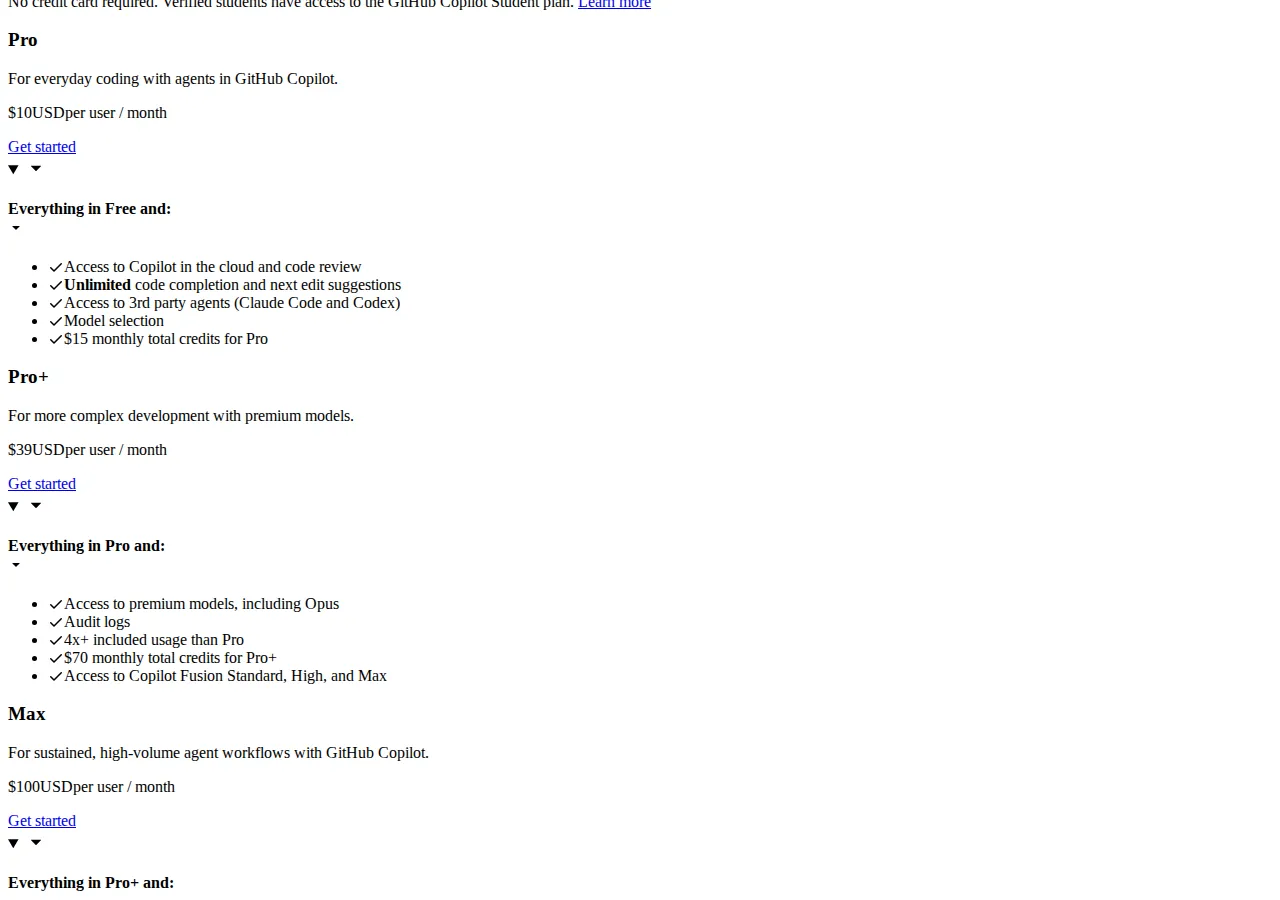
GitHub Copilot's current ladder, read from github.com/features/copilot/plans on November 18, 2026, has four tiers. Free costs $0 and includes 2,000 completions a month, access to Haiku 4.5 and GPT-5 mini, and Copilot Fusion Standard, with no credit card required. Pro costs $10 per user a month and adds unlimited code completion and next-edit suggestions, model selection, third-party agents including Claude Code and Codex, and $15 of monthly total credits. Pro+ costs $39 per user a month and adds premium models including Opus, audit logs, four times or more the included usage of Pro, $70 of monthly total credits, and Copilot Fusion Standard, High, and Max. Max costs $100 per user a month and adds priority access to new models, 2.9 times or more the included usage of Pro+, and $200 of monthly total credits. Agent mode, code review, Copilot in the cloud, Copilot CLI, and the Copilot app consume GitHub AI Credits.
Tabnine's last published ladder had two paid plans and no free tier. Code Assistant cost $39 per user per month with annual billing and included completions, chat, major IDE support, Jira integration, security controls, private deployment choices, and business-hours ticket support. Agentic Platform cost $59 per user per month with annual billing and added agents, the CLI, Coaching Guidelines, MCP tool connections, and the Context Engine. Tabnine-provided model access added consumption charges at the provider's actual rate plus a five percent handling fee; using the buyer's own models was unlimited. Tabnine had already discontinued its free plan and eliminated individual developer plans before the acquisition — the $39 entry point was enterprise-only, and is now a renewal figure for existing customers, not a price a new buyer can pay.
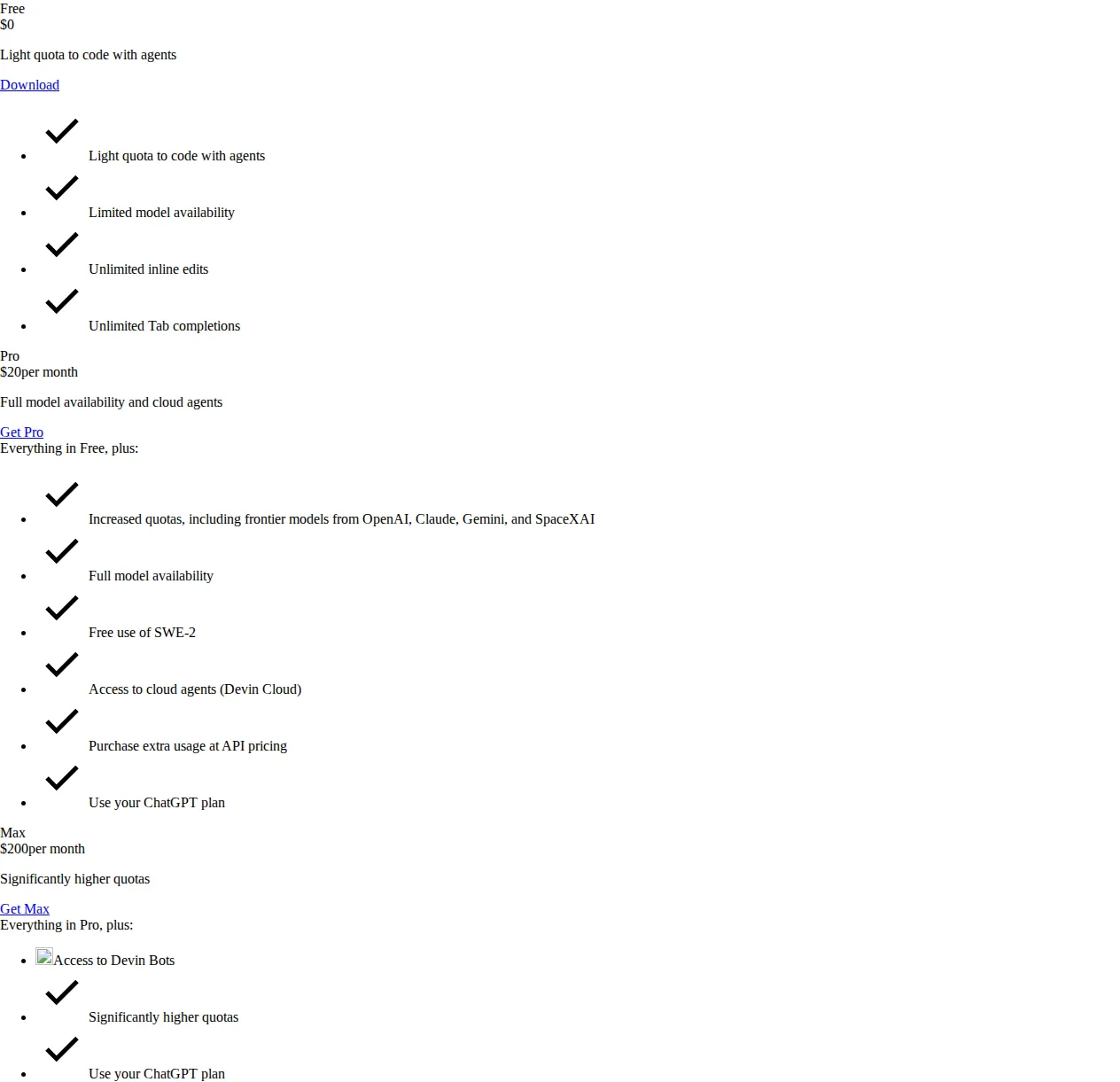
Codeium's successor, Devin, prices from devin.ai/pricing, where codeium.com/pricing and windsurf.com/pricing both redirect. Free costs $0 and includes a light quota to code with agents, limited model availability, unlimited inline edits, and unlimited Tab completions. Pro costs $20 a month and adds full model availability — frontier models from OpenAI, Claude, Gemini, and SpaceXAI — free use of SWE-2, cloud agents, and extra usage at API pricing. Max costs $200 a month and adds significantly higher quotas and access to Devin Bots. Teams costs $80 a month flat, with shared on-demand credits for up to 100 members and centralized billing. Enterprise is custom, with dedicated account management, SCIM and role-based access control, and deployment in the buyer's own virtual private cloud.
The price table, with the honesty column
| Plan | Seat price | What the seat buys | Authority |
|---|---|---|---|
| Copilot Free | $0 | 2,000 completions/mo; Haiku 4.5, GPT-5 mini | Vendor pricing page, read Nov 18, 2026 |
| Copilot Pro | $10/user/mo | Unlimited completions; $15/mo credits | Vendor pricing page, read Nov 18, 2026 |
| Copilot Pro+ | $39/user/mo | Premium models incl. Opus; $70/mo credits | Vendor pricing page, read Nov 18, 2026 |
| Copilot Max | $100/user/mo | $200/mo credits; 2.9x+ Pro+ usage | Vendor pricing page, read Nov 18, 2026 |
| Tabnine Code Assistant | $39/user/mo, annual | Completions, chat, private deployment | Last published list; vendor page now redirects |
| Tabnine Agentic | $59/user/mo, annual | Agents, CLI, Context Engine, MCP | Last published list; vendor page now redirects |
| Devin Free | $0 | Light agent quota; unlimited Tab completions | Vendor pricing page, read Nov 18, 2026 |
| Devin Pro | $20/mo | Full frontier-model access; SWE-2 | Vendor pricing page, read Nov 18, 2026 |
| Devin Teams | $80/mo flat, up to 100 members | Shared on-demand credits | Vendor pricing page, read Nov 18, 2026 |
| Devin Max | $200/mo | Higher quotas; Devin Bots | Vendor pricing page, read Nov 18, 2026 |
Two prices in that table are not live prices. Tabnine's $39 and $59 are last-published figures from before the Tricentis acquisition closed on July 30, 2026; the vendor's own pricing page now redirects to a Tricentis contact form, verified by direct request on November 18, 2026. They are kept in the table because existing Tabnine customers still renew against them — and because a buyer who finds them quoted in a 2026 review should know they cannot act on them. Everything else was read from the vendor's own pricing page on November 18, 2026.
Worked math: 5, 25, and 100 developers
Example: a five-developer team buying the entry paid tier of each live product. Copilot Pro costs 5 × $10 = $50 a month, or $600 a year. Devin Pro costs 5 × $20 = $100 a month, or $1,200 a year. Tabnine Code Assistant, at its last published price, would have cost 5 × $39 = $195 a month, or $2,340 a year — the same annual figure as Copilot Pro+, also $39 a seat. Copilot Max costs 5 × $100 = $500 a month, or $6,000 a year; Tabnine Agentic would have cost 5 × $59 = $295 a month, or $3,540 a year.
At 25 developers, Copilot Pro is $250 a month, $3,000 a year; Devin Pro is $500 a month, $6,000 a year; Copilot Pro+ and Tabnine Code Assistant are both $975 a month, $11,700 a year; Tabnine Agentic is $1,475 a month, $17,700 a year; Copilot Max is $2,500 a month, $30,000 a year. At 100 developers, Copilot Pro is $12,000 a year, Devin Pro is $24,000, Copilot Pro+ and Tabnine Code Assistant are both $46,800, Tabnine Agentic is $70,800, and Copilot Max is $120,000. Tabnine's entry seat costs 3.9 times Copilot Pro's — $39 against $10 — at every team size, because both are flat per-seat prices.
Devin Teams breaks the per-seat pattern. At $80 a month flat for shared on-demand credits for up to 100 members, a 100-member team pays $960 a year for the shared pool — $0.80 per member per month — but the credits are shared, not per-seat, so the figure only compares if usage fits inside one shared allowance. A team expecting 100 individual Pro allowances has misread the plan.
The credit meter is the real price
Copilot's seat price buys access; the credits buy premium-model work. Pro includes $15 of total credits a month, Pro+ $70, and Max $200. The step from Pro to Pro+ costs $29 more per seat and buys $55 more credits; the step from Pro+ to Max costs $61 more and buys $130 more. Pro+ carries 4.7 times Pro's credits; Max carries 13.3 times Pro's. The value of each step up, as credits per extra dollar:
A developer who lives in autocomplete and light chat may never touch the credit balance; a developer running agent mode, code review, and Copilot in the cloud all day burns credits on every interaction. The $10 tier is only a $10 tier for the developer whose premium-model usage fits inside $15 of credits.
Devin rations differently: a daily and weekly quota that refreshes automatically, with extra usage purchasable at API pricing once the included allowance is gone. The pricing page states most users will never hit the limits, and switching to smaller models — Haiku, GPT-5.2 Mini, Kimi K2.5 — extends them. Tabnine rationed by deployment instead of by meter: own-model usage was unlimited, and Tabnine-provided model access added the provider's rate plus five percent. Three rationing philosophies, three failure modes: Copilot caps the month, Devin caps the day and the week, Tabnine capped nothing.
Founder & CEO Insight — Enow A. Jovial
Privacy and deployment: Tabnine's moat, now behind a wall
Tabnine's differentiation was never price — it was deployment. It was the only credible AI coding assistant for teams whose codebase could not leave their infrastructure: flexible deployment in the cloud, a virtual private cloud, or self-hosted, with private deployment choices on the Code Assistant plan itself. That moat is why its $39 entry price survived while Copilot sold the same completions for $10. Since the Tricentis acquisition, that moat is behind a wall: Tricentis acquired Tabnine mainly for its Enterprise Context Engine, to power its own testing agents, and the Context Engine is now sold as an agent-agnostic product that works with Cursor, GitHub Copilot, and Claude Code as well as Tabnine's own agents. A team that needs private deployment today should price the Context Engine through Tricentis sales — or Copilot Enterprise and Devin Enterprise, which both offer deployment in the buyer's virtual private cloud — not $39 a seat for a product closed to new signups.
Copilot's privacy story is the mirror image: it runs in GitHub's cloud, with audit logs from Pro+ upward and model selection that lets a team steer work toward its own policies. Devin sits between the two: cloud agents by default, a virtual-private-cloud deployment on Enterprise, and the Teams plan's centralized controls. The Cursor vs Windsurf vs Claude Code AI coding assistant pricing playbook covers the agentic-editor side of this same market — Cursor, Windsurf (now Devin Desktop), and Claude Code — including the July 2025 Cognition acquisition of Windsurf and the June 2, 2026 rename, the same consolidation this guide tracks from the completion side. The OpenAI vs Anthropic vs Google LLM API pricing playbook prices the raw tokens underneath all three products, for teams deciding whether to buy the assistant or the API.
Who should buy what
A solo developer or a five-person team that wants completions and light chat should start on Copilot Free — 2,000 completions a month is a real allowance, not a trial — and move to Pro at $10 when the completions run out or the model selection matters. A team whose developers live in agent mode should price Pro+ at $39, not Pro: the $70 credit allowance is 4.7 times Pro's. A team with heavy, sustained agent workflows should price Max at $100 only after measuring a month of credit burn on Pro+.
A team that wants Codeium's completions should buy Devin Pro at $20, or start on Devin Free, where Tab completions are unlimited and only the agent quota is rationed. A team with uneven usage should model Devin Teams at $80 a month flat against 100 Pro seats at $2,000 a month — $960 a year against $24,000. A team that needs Tabnine's private deployment should contact Tricentis, not budget $39 a seat: the product is closed to new buyers.
Execution checklist
- [x] Step 1 — Name the product you can actually buy: Copilot and Devin are live; Tabnine closed to new customers on July 30, 2026.
- [x] Step 2 — Start on a free tier and measure: Copilot Free allows 2,000 completions a month; Devin Free allows unlimited Tab completions. Measure a month of real usage before paying.
- [x] Step 3 — Price the meter, not the seat: Copilot Pro includes $15 of monthly credits, Pro+ $70, Max $200. Run the team's premium-model usage through the ROI calculator before choosing.
- [x] Step 4 — Model the team size honestly: at 25 developers, Copilot Pro is $3,000 a year, Devin Pro is $6,000, and Copilot Pro+ is $11,700. Devin Teams at $80 a month flat only wins if the shared pool covers usage.
- [x] Step 5 — Settle deployment before price: if the codebase cannot leave the buyer's infrastructure, price Tricentis's Context Engine, Copilot Enterprise, or Devin Enterprise.
- [x] Step 6 — Re-check before renewal: Copilot's ladder changed from a $19 Business tier to a credit-metered Free/Pro/Pro+/Max ladder; Tabnine's pricing disappeared in September 2026.
Who should not buy any of these
A team whose developers write in an editor none of these products support should not buy a seat to find out — check the IDE list on the vendor page first. Copilot supports VS Code, Visual Studio, Xcode, JetBrains IDEs, Neovim, Eclipse, and Zed; the other two have narrower lists. A team that needs autonomous agents rather than completions should read the Cursor vs Windsurf vs Claude Code playbook instead. And a team that already owns an LLM API subscription should price the raw tokens in the OpenAI vs Anthropic vs Google API pricing playbook before buying seats.