The hire is not complete when the offer is signed
The offer letter is the handshake. Compliance starts the morning the employee shows up for pay, and it runs on three clocks that do not wait for onboarding to settle. Form I-9 Section 1 is due that first day. Section 2 — the employer examining original documents — is due within three business days. The E-Verify case, where the employer uses E-Verify, must be created by the third business day. The new-hire report goes to the state directory within twenty days. Miss one clock and the fine is per form, per employee: $288 to $2,861 for every deficient Form I-9, and $716 to $28,619 per worker for a knowing hire.
The duty is universal: every U.S. employer must complete Form I-9 for every hire after November 6, 1986, citizen or noncitizen, LLC or C-Corp. This playbook is operational guidance, not legal advice — the Handbook for Employers (M-274) is the authority when it disagrees.
The three clocks
| Clock | Deadline | Who acts | Authority |
|---|---|---|---|
| Form I-9, Section 1 | Employee completes and signs no later than the first day of work for pay | Employee | 8 U.S.C. § 1324a(b)(1); USCIS M-274 § 3.0 |
| Form I-9, Section 2 | Employer examines originals and completes Section 2 within 3 business days of the first day of work | Employer or authorized representative | 8 U.S.C. § 1324a(b)(1); USCIS M-274 § 4.0 |
| E-Verify case creation | No later than the 3rd business day after the employee starts work for pay | Employer (E-Verify participants only) | E-Verify User Manual; E-Verify MOU |
| New-hire report | Within 20 days of hire (federal guidance) to the State Directory of New Hires | Employer | 42 U.S.C. § 653a; ACF/OCSE guidance |
| Form I-9 retention | 3 years after hire, or 1 year after employment ends, whichever is later | Employer | USCIS M-274 § 10.0 |
Section 1 belongs to the employee: name, address, date of birth, Social Security number (SSN), and an attestation of employment authorization. The employee may complete it after accepting the offer, but not before — and E-Verify may never be used to pre-screen an applicant. Section 2 belongs to the employer: examine the originals in the employee's physical presence, record title, issuing authority, number, and expiration date, then sign and date. The three business days run after the first day, so a Monday start makes Section 2 due Thursday.
Lists A, B, and C — and the line you must not cross
The employee presents one document from List A, which proves both identity and employment authorization, or one document from List B plus one from List C. List A proves both (U.S. passport, Permanent Resident Card, Employment Authorization Document). List B is identity only (state driver's license, school ID, voter registration card, U.S. military card). List C is work authorization only (unrestricted Social Security card, certified U.S. birth certificate). Every document must be original and unexpired; an Individual Taxpayer Identification Number (ITIN) card is on no list.
The boundary is the part employers get wrong most often, and it is where the money is. The employer may not dictate which documents the employee presents. Requesting a specific document — a Green Card when the employee offered a driver's license plus an unrestricted Social Security card — is document abuse under 8 U.S.C. § 1324b, carrying $236 to $2,364 per individual. The same statute covers citizenship and national-origin discrimination in hiring: $590 to $4,730 per individual on a first order, $4,730 to $11,823 on a second, and $7,093 to $23,647 on later orders. The examination is limited to whether the documents reasonably appear genuine and relate to the employee.
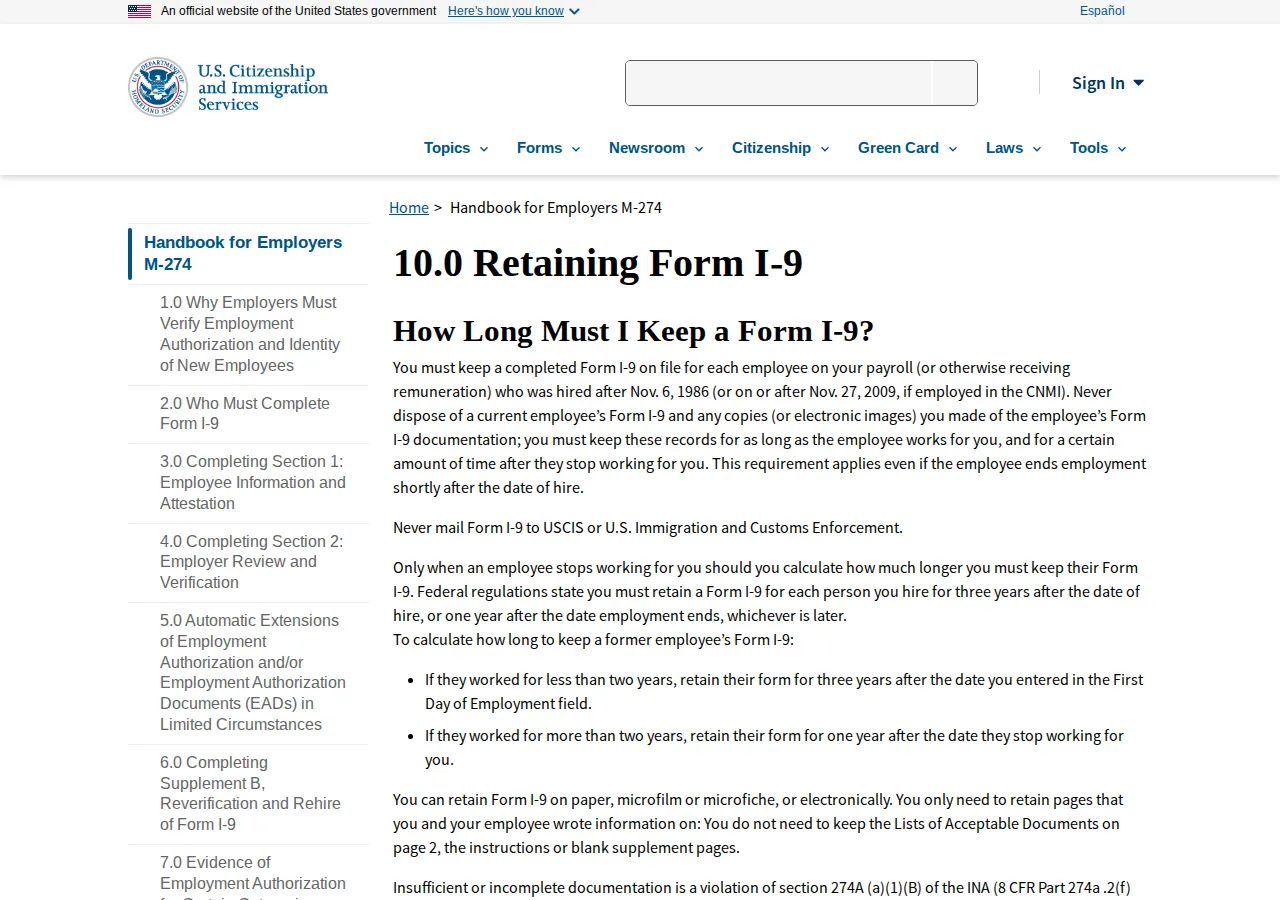
Retention is the clock most employers misjudge, because it runs past the employment. Keep a completed Form I-9 on file for each employee hired after November 6, 1986, and never dispose of a current employee's Form I-9. The Handbook gives the shortcut: if the employee worked less than two years, retain the form for three years after the first day of employment; if they worked more than two years, retain it for one year after they stop working. Never mail Form I-9 to USCIS or ICE — the form is kept by the employer and produced on inspection.
The current form is edition 01/20/25, expiring May 31, 2027. The previous edition, 08/01/23, expired July 31, 2026. Download the current Form I-9 PDF from USCIS and check the edition date before the first hire of the year.
Remote examination: the only legal video path
Remote work broke the physical-presence rule, and DHS answered with a narrow exception. The DHS-authorized alternative procedure is available only to employers enrolled in E-Verify and in good standing, and only at E-Verify hiring sites.
Four steps, all required: examine copies of the documents, front and back; hold a live video interaction with the person presenting them — a recorded video, a photograph, or a phone call without video is not the procedure; check the alternative-procedure box in the Additional Information field of Section 2, or in Supplement B for a rehire or reverification; retain a clear and legible copy. The legal basis is the DHS final rule at 88 FR 47990 and the notice at 88 FR 47749, effective August 1, 2023. A video call that skips any step is not a lawful examination.
E-Verify, end to end
E-Verify is the free federal system run by DHS and the Social Security Administration that compares the Form I-9 data against DHS and SSA records. It is a companion to Form I-9, not a replacement. At the federal level it is voluntary for most private employers. It is mandatory for federal contractors carrying the FAR E-Verify clause on contracts over $150,000 — enroll within 30 days of the award. It is also mandatory for employers of F-1 STEM OPT students, for employers under a court order, and under state mandates — Florida has required it for private employers with 25 or more employees since July 1, 2023 (SB 1718), with a $1,000-per-day fine for repeat noncompliance.
The case-creation rules are strict because the system is built to prevent screening. Create the case no later than the third business day after the employee starts work for pay. Never create a case before the offer is accepted — no pre-screening. Never run it on current employees or independent contractors: E-Verify covers new hires only. A worker you verify in E-Verify is an employee — our IRS Form 1099-NEC contractor reporting playbook covers the contractor side, and our IRS Form 940 FUTA annual tax playbook prices the federal unemployment tax that starts with the same hire.
Photo matching compares the photograph on DHS-issued documents against DHS records, and the employer performs the comparison manually when prompted. A List B document presented to an E-Verify employer must include a photograph.
The mismatch clock: ten days, then eight
A Tentative Nonconfirmation — now called a mismatch — means the Form I-9 data did not match SSA or DHS records. It does not mean the employee is unauthorized: usually a name change never reported to SSA, or a typo. Treat it as a data problem first, never as a verdict.
The employer has two clocks, both in federal government working days — Monday to Friday, excluding federal holidays. First, download and print the Further Action Notice and review it with the employee in private, within 10 federal government working days after E-Verify issues the mismatch; the employee marks whether they contest, signs and dates the English version, receives a copy, and the employer keeps the signed original with the Form I-9. Second, if the employee contests, refer the case in E-Verify; the employee then has 8 federal government working days from the referral to contact SSA at a field office or DHS at 888-897-7781 or through myE-Verify.
While the case is pending, the employer may not terminate, suspend, delay training, withhold or lower pay, or take any adverse action because the employee contests a mismatch. Only a Final Nonconfirmation supports ending employment on E-Verify grounds. If the employee does not act by the tenth federal working day, the employer may terminate and close the case. Failure to notify the employee of a Final Nonconfirmation carries $998 to $1,992.
E-Verify+ and what changes in 2026
E-Verify+ merges Form I-9 and E-Verify into one digital workflow: the employee completes the Form I-9 data and uploads document images through myUSCIS, and the employer sends a secure electronic invitation to start the case. It became available nationwide to eligible participating employers on August 26, 2025, with USCIS guidance on October 1, 2026. It is voluntary and limited to browser-based Employer Access accounts with Program Administrator access — not Web Services (API) users or E-Verify Employer Agents.
New-hire reporting: the report that does not go to the IRS
The third clock is the one employers most often miss, because it is filed with a state agency most payroll teams never see. The Personal Responsibility and Work Opportunity Reconciliation Act of 1996 (PRWORA) requires every state to operate a State Directory of New Hires, under 42 U.S.C. § 653a, to enforce child support. The report carries seven data elements — the employee's name, address, Social Security number, and first day of work, and the employer's name, address, and Employer Identification Number (EIN) — and it goes to the directory in the state where the employee works, not to the IRS.
Federal guidance sets the deadline at 20 days from the first day of work, and several states set shorter deadlines — check the directory for each state where you hire. The duty covers all employers, and it covers new hires and rehires alike: a returning employee counts as newly hired if separated for at least 60 consecutive days. States may impose civil penalties up to $25 per unreported hire, and $500 per hire if the employer and the employee conspired not to report.
The penalty math
The paperwork range compounds silently, because it is per form. Forty deficient Forms I-9 is not one violation. It is forty, and the range runs $288 to $2,861 per form under the DHS inflation-adjustment rule published January 2, 2025 (90 FR 1). No 2026 adjustment was made, so the 2025 ranges remain in effect in 2026.
ICE sets the amount using five statutory factors in 8 U.S.C. § 1324a(e)(5) — business size, good faith, seriousness, whether the individual was unauthorized, and history of previous violations — each moving the base by up to 5 percent, for up to plus or minus 25 percent in total. The knowing-hire tiers are steeper and per worker: $716 to $5,724 for a first offense, $5,724 to $14,308 for a second, and $8,586 to $28,619 for a third or later offense. Document fraud under 8 U.S.C. § 1324c runs $590 to $4,730 for a first offense and $4,730 to $11,823 for later ones. An indemnity bond is a fixed $2,861 per violation, and a pattern or practice of knowing hire carries up to $3,000 per unauthorized worker and up to six months' imprisonment under 8 U.S.C. § 1324a(f)(1), an amount the inflation adjustments do not touch.
| Violation | Range | Authority |
|---|---|---|
| I-9 paperwork, per form | $288–$2,861 | 90 FR 1; 8 CFR 274a.10(b)(2) |
| Document fraud, 1st offense | $590–$4,730 | 90 FR 1; 8 U.S.C. § 1324c |
| Document fraud, later offense | $4,730–$11,823 | 90 FR 1; 8 U.S.C. § 1324c |
| Document abuse, per individual | $236–$2,364 | 28 CFR 85.5; 8 U.S.C. § 1324b |
| Failure to notify of Final Nonconfirmation | $998–$1,992 | 28 CFR 85.5 |
| Indemnity bond, per violation | $2,861 fixed | 90 FR 1; 8 U.S.C. § 1324a(g)(2) |
Run the exposure with our pricing calculator before the self-audit.
Founder & CEO Insight — Enow A. Jovial
The execution checklist
Run it in order: Step 1 is the first-day form, Step 2 the three-day examination, Step 3 the E-Verify case, Step 4 the twenty-day report, Step 5 the retention file, Step 6 the self-audit.
- [x] Use the current edition: download the Form I-9 PDF from USCIS; edition 01/20/25, expiring May 31, 2027.
- [x] Section 1 on day one: the employee completes and signs no later than the first day of work for pay; never before the offer.
- [x] Section 2 within three business days: examine originals in person and record them; a Monday start means Thursday. Never dictate the documents.
- [x] Create the E-Verify case by the third business day: employees only, after the hire — never applicants or contractors.
- [x] Report the hire within twenty days: send the seven data elements to the State Directory of New Hires — not to the IRS.
- [x] File and retain by the clock: keep each Form I-9 three years after hire or one year after termination, whichever is later.
- [x] Self-audit on a standard operating procedure (SOP): fix substantive errors first, confirm every mismatch has a signed Further Action Notice.