The schedule is the return
A depreciation schedule is the multi-year consequence of four decisions made on the day an asset is placed in service: its class, its method, its convention, and the order in which §179, bonus depreciation, and MACRS consume its basis. Get one wrong and the error repeats every year.
The statute is 26 U.S.C. § 168; Publication 946 is the IRS operating manual for it.
> [!KEY TAKEAWAY]
> Four choices — class, method, convention, expensing order — are fixed at placed-in-service. What follows is arithmetic, not judgment.
Section 168 in one page
Section 168 divides depreciable property into two systems. The general depreciation system (GDS) is the default: accelerated methods over the recovery periods in §168(c). The alternative depreciation system (ADS) is straight line over longer periods, mandatory for tax-exempt use property, tax-exempt bond-financed property, and imported property used predominantly abroad.
Section 168(b)(1) prescribes the 200 percent declining balance method for 3-, 5-, 7-, and 10-year property, and the 150 percent declining balance method for 15- and 20-year property. Real property is straight line under both systems: 27.5 years for residential rental, 39 years for nonresidential real.
| Recovery period | GDS method | Authority |
| :--- | :--- | :--- |
| 3-, 5-, 7-, 10-year | 200% declining balance | §168(b)(1) |
| 15-, 20-year | 150% declining balance | §168(b)(2) |
| Residential rental, 27.5 years | Straight line | §168(b)(3), (c) |
| Nonresidential real, 39 years | Straight line | §168(b)(3), (c) |
| Any class under ADS | Straight line, longer period | §168(g) |
The declining balance method switches to straight line when straight line on the remaining basis over the remaining recovery period gives an equal or larger deduction. That switch is built into the Publication 946 percentage tables — but a spreadsheet schedule must program it.
Class lives
Classification decides everything downstream, because the class fixes both the recovery period and the method. Five-year property includes automobiles, taxis, buses, and trucks, qualified technological equipment, office machinery, property used in research and experimentation, and breeding and dairy cattle. Seven-year property includes office furniture and fixtures, and any property with no class life not designated elsewhere.
| Class | Recovery | Typical assets | Authority |
| :--- | :--- | :--- | :--- |
| 5-year | 5 years | Automobiles, computers, office machinery | Pub. 946, ch. 4 |
| 7-year | 7 years | Office furniture and fixtures, catch-all | Pub. 946, ch. 4 |
| 10-year | 10 years | Vessels, single-purpose farm structures | Pub. 946, ch. 4 |
| 15-year | 15 years | Land improvements, qualified improvement property | Pub. 946, ch. 4 |
| Residential rental | 27.5 years | Rental dwellings | §168(c) |
| Nonresidential real | 39 years | Office buildings, stores, warehouses | §168(c) |
Qualified improvement property — interior improvements to nonresidential real property placed in service after 2017 — is 15-year property, which makes it eligible for bonus depreciation. Computer software that is not a §197 intangible is depreciated straight line over 36 months. Land is never depreciable.
The three conventions
MACRS never gives a full first year for personal property. The half-year convention is the default: it treats property placed in service at any point in the year as placed in service at the midpoint, so year one takes half a year of depreciation and a 7-year asset takes eight tax years.
The mid-quarter convention replaces it when more than 40 percent of the total depreciable bases of MACRS property placed in service during the year was placed in service in the last three months. The test runs on aggregate bases, not asset count, and it is not optional: once triggered, every MACRS asset placed in service that year uses the mid-quarter convention. Publication 946 shows the cost: $39,000 of 7-year property with a $24,000 §179 election, placed in service October 26, takes a first-year deduction of $536 — the fourth-quarter Table A-5 rate is 3.57 percent, not the 14.29 percent Table A-1 rate.
Real property uses the mid-month convention: January placements count from the middle of the month, giving 11.5 months in year one. Publication 946 works the example: a $100,000 building over 39 years takes 2.564 percent a year, $2,564, and $2,456 in year one after the 11.5-month convention.
The sequence
Three mechanisms can consume the same dollar of basis, and the statute fixes their order. Publication 946 states it plainly: the special depreciation allowance is an additional deduction taken after any §179 deduction and before regular MACRS depreciation is figured for the placed-in-service year. Cost, minus the §179 election, minus the bonus allowance on the remainder, leaves the depreciable basis that MACRS spreads over the recovery period.
$
\text{Depreciable Basis} = \text{Cost} - \text{Section 179} - \text{Bonus Allowance}
$
$
\text{MACRS Deduction}_{t} = \text{Depreciable Basis} \times \text{Table Rate}_{t}
$
For tax years beginning in 2025 the maximum §179 deduction is $2,500,000, reduced dollar for dollar by the amount by which §179 property placed in service during the year exceeds $4,000,000 — so at $6,500,000 of placements the deduction is zero. Sport utility vehicles placed in service in 2025 are capped at $31,300. For 2026 the limits rise to $2,560,000 and $4,090,000, with the SUV cap at $32,000. §179 alone carries a business-income limit: the dollar limit is then limited again to taxable income from the active conduct of a trade or business, and the excess carries forward. Bonus depreciation has no business-income limit, which is why the order matters: thin-income businesses that elect §179 first can strand the election while bonus would have flowed through.
Bonus depreciation: two cohorts, one statute
Bonus depreciation is §168(k), and for property placed in service in 2025 it splits into two cohorts by acquisition date. Property acquired after September 27, 2017 and placed in service after December 31, 2024 and before January 1, 2026 is limited to a 40 percent allowance. Property acquired and placed in service after January 19, 2025 qualifies for the reinstated 100 percent allowance under Public Law 119-21, the One Big Beautiful Bill Act, which substituted "100 percent" for "the applicable percentage" in §168(k)(1)(A). A taxpayer with 100-percent property may instead elect 40 percent — 60 percent for long production period property and certain aircraft — for the first tax year ending after January 19, 2025.
!Section 168(k) statute text, 100 percent allowance
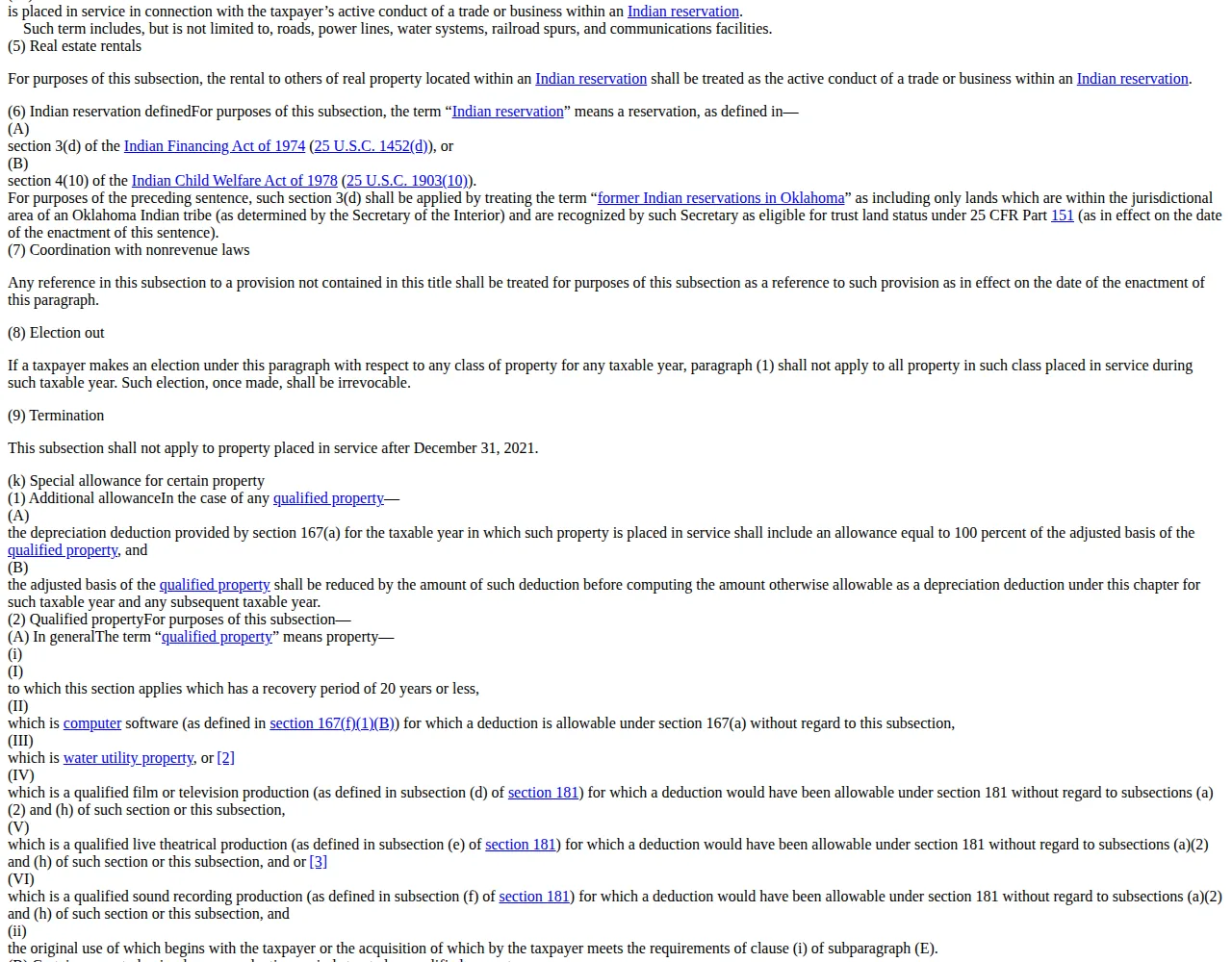
Two-track 2025: an asset bought in January and placed in service in March takes 40 percent; the identical asset bought in February takes 100 percent. Qualified property is generally property with a recovery period of 20 years or less. A building never takes bonus — only its 5-, 7-, and 15-year components do, which is why a cost segregation study exists.
Section 168(k)(7) lets a taxpayer elect out of the allowance, by class of property for the taxable year; the election is irrevocable. The reason to elect out is timing: higher income expected in later years, net operating losses worth preserving, or a state that does not conform to federal bonus. Electing out leaves the full MACRS schedule in place.
Table A-1 rates
Table A-1 in Publication 946 Appendix A covers 3-, 5-, 7-, 10-, 15-, and 20-year property under the half-year convention, using the 200 percent declining balance method with the switch to straight line built in. Year-one rates are confirmed against Publication 946 worked examples: 20 percent for 5-year property, on a $14,500 car producing $2,900, and 14.29 percent for 7-year property, on a $10,000 purchase producing $1,429. The remaining years are computed from the §168(b)(1) method and reproduce the published tables.
| Year | 5-year rate | 7-year rate |
| :--- | :--- | :--- |
| 1 | 20.00% | 14.29% |
| 2 | 32.00% | 24.49% |
| 3 | 19.20% | 17.49% |
| 4 | 11.52% | 12.49% |
| 5 | 11.52% | 8.93% |
| 6 | 5.76% | 8.92% |
| 7 | — | 8.93% |
| 8 | — | 4.46% |
A 5-year asset therefore recovers in six tax years and a 7-year asset in eight, because the half-year convention pushes the final half-year into one extra year. The 200 percent declining balance rate is 2.00 divided by the recovery period: 40 percent for 5-year property, 28.571 percent for 7-year property. The switch to straight line happens when the straight-line rate on the remaining basis equals or exceeds the declining balance rate — year five for 7-year property, where both methods give 8.93 percent.
Worked example: $100,000, two placements
Northbridge Design LLC buys $100,000 of 7-year office furniture and fixtures. The business elects no §179 deduction and elects out of bonus depreciation under §168(k)(7), to spread deductions across higher-income years.
Placed in service in March, the half-year convention applies. Year one is $100,000 times 14.29 percent, which is $14,290. Year two is $24,490, year three $17,490, year four $12,490, year five $8,930, year six $8,920, year seven $8,930, and year eight $4,460. The eight years sum to exactly $100,000.
$
\text{Year 1 (7-year, half-year)} = \$100,000 \times 14.29\% = \$14,290
$
$
\text{Total Recovery} = \sum_{t=1}^{8} \$100,000 \times \text{Rate}_{t} = \$100,000
$
Place the same $100,000 in service in October instead. The mid-quarter test triggers, because 100 percent of the year bases landed in the last three months, and the first-year rate falls to the fourth-quarter Table A-5 rate of 3.57 percent. Year one becomes $3,570 instead of $14,290 — a $10,720 difference in the first-year deduction, caused by nothing but the calendar.
!Publication 946 MACRS Worksheet, 7-year furniture, 14.29 percent
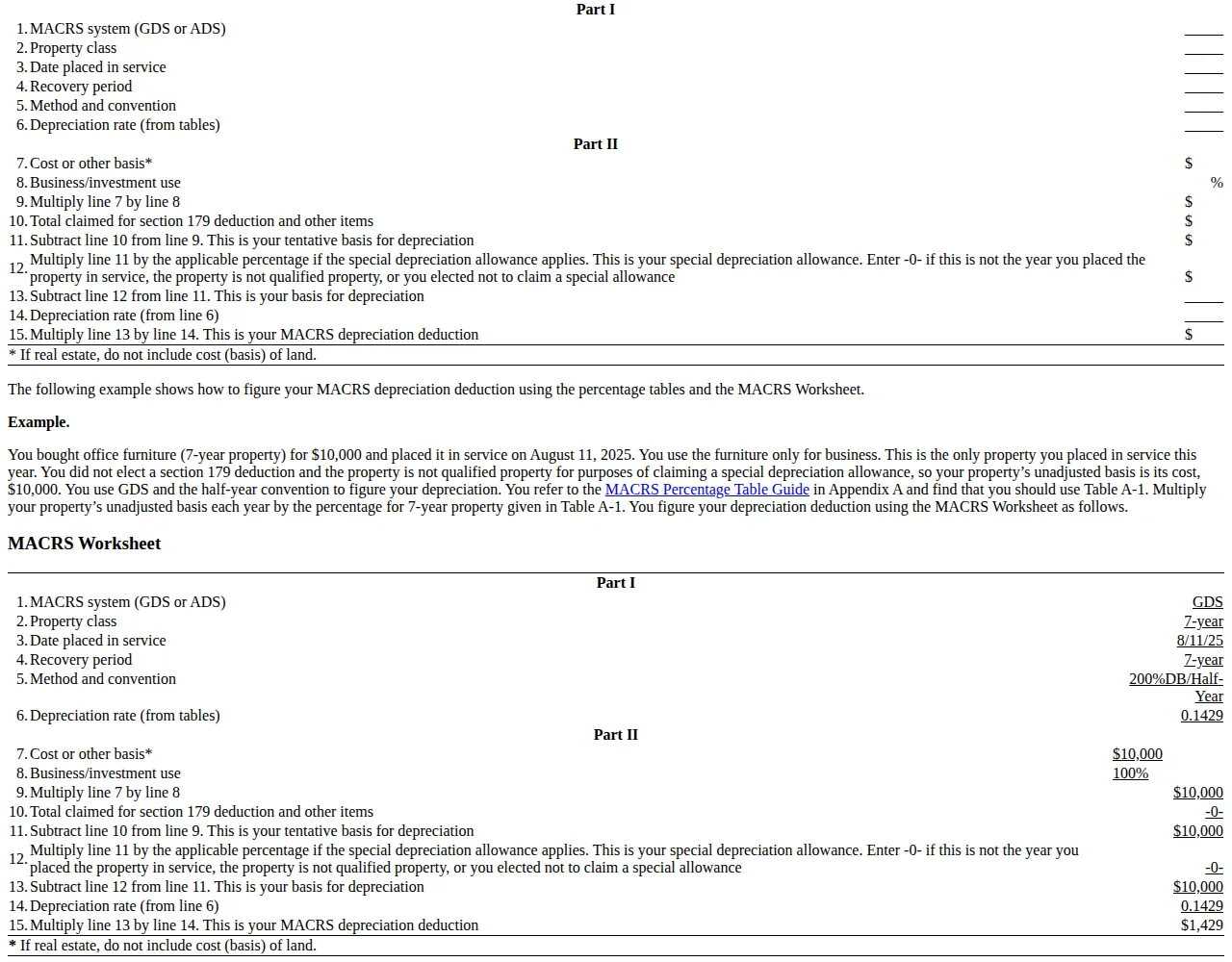
Book versus tax
The tax schedule is not the book schedule. Under GAAP the same furniture is typically depreciated straight line over its estimated useful life, while MACRS front-loads the deduction. The difference is a deferred tax liability, not a permanent saving. The register reconciles them — one asset, one cost, two lives, one disposal date.
A sole proprietor files under an SSN or the business EIN; a filer without an SSN uses an ITIN. An LLC taxed as a sole proprietorship reports on Schedule C, an S-Corp on Form 1120-S via Schedule K-1, and a C-Corp on Form 1120. FICA does not touch depreciation, but the deduction lowers the net profit that SECA taxes for a sole proprietor. A CPA review of the first schedule is cheap insurance: the class, convention, and bonus election are fixed at placed-in-service, and a correction later needs Form 3115.
> [!WARNING]
> A wrong recovery period is not a one-year mistake. Depreciation taken on the wrong class is an impermissible method of accounting, and fixing it generally requires Form 3115, Application for Change in Accounting Method, with IRS consent — not a quiet correction on the next return.
Where the schedule lands
Form 4562 is the filing surface for the whole playbook. Part I holds the §179 election. Part II holds the special depreciation allowance: line 14 for other property, line 25 for listed property. Part III holds MACRS: line 17 for prior-year assets, lines 19a through 19j for GDS, lines 20a through 20e for ADS. Listed property goes in Part V, with its own recapture rules when business use falls to 50 percent or less.
On sale, retirement, or conversion to personal use, the disposition is reported on Form 4797, and gain from depreciation taken is recaptured under §1245 for personal property or as unrecaptured §1250 gain for real property. The schedule must record the disposal date and adjusted basis, because recapture starts from those numbers.
> [!TIP]
> Run the mid-quarter test in October, not in April: add up the bases placed in service in the last three months against the year total, and time a November purchase with full knowledge of what it costs.
> [!FOUNDER]
> "A depreciation schedule is the rare tax document that rewards patience. The founders who lose money are the ones who buy in December, elect everything in year one, and then discover their income was higher in year three when the deductions are gone. Buy in the first three quarters, elect out of bonus when the later years will pay more, and let the schedule work across the whole life of the asset."
> — Enow A. Jovial, Founder & Chief Executive Officer
Who should not use this
A business with no taxable income and no carryforward strategy gains nothing from accelerating depreciation into a year with no liability, because bonus has no refund value against zero income. A business holding property predominantly outside the United States, or tax-exempt use property, must use ADS and should not build a GDS schedule at all. A business that expenses everything under §179 every year needs no multi-year schedule for those assets — but it still needs the register, because §179 property remains subject to recapture if business use falls below 50 percent. A founder who cannot state the placed-in-service date of each asset should fix the register first.
The filing sequence
1. Record the asset: description, cost, placed-in-service date, business-use percentage, land allocation.
2. Classify it: find the class in Publication 946 chapter 4; confirm the period in §168(c).
3. Choose the system: GDS by default, ADS where mandatory or elected.
4. Run the mid-quarter test: last-three-months bases over 40 percent of the year total means mid-quarter for all MACRS property.
5. Decide §179: run the dollar limit, the threshold, and the income limit; record any carryover.
6. Decide bonus: check the acquisition date against the 40 and 100 percent cohorts; decide on electing out under §168(k)(7).
7. Compute the depreciable basis: cost minus §179 minus bonus.
8. Pick the table: Table A-1 for half-year, A-2 through A-5 for mid-quarter, A-6 and A-7a for real property.
9. Build the schedule: rate times basis for each year; confirm the rates sum to 100 percent.
10. Enter it on Form 4562: Part I §179, Part II line 14 bonus, Part III MACRS.
11. Post the book entry: GAAP straight-line depreciation and the deferred tax difference.
12. File the register: keep the schedule, the invoice, and the placed-in-service evidence with the return.
A schedule built this way survives an examiner, a lender, and a sale. The capex-versus-repair boundary decides whether the cost is capitalized at all, the §179-versus-bonus comparison weighs the two expensing elections, and the Form 4562 filing playbook walks the return the schedule feeds. The tax estimator models the liability the schedule reduces.