FBAR (FinCEN Form 114) Foreign Account Reporting Playbook: The $10,000 Test, Deadlines, and Penalty Math
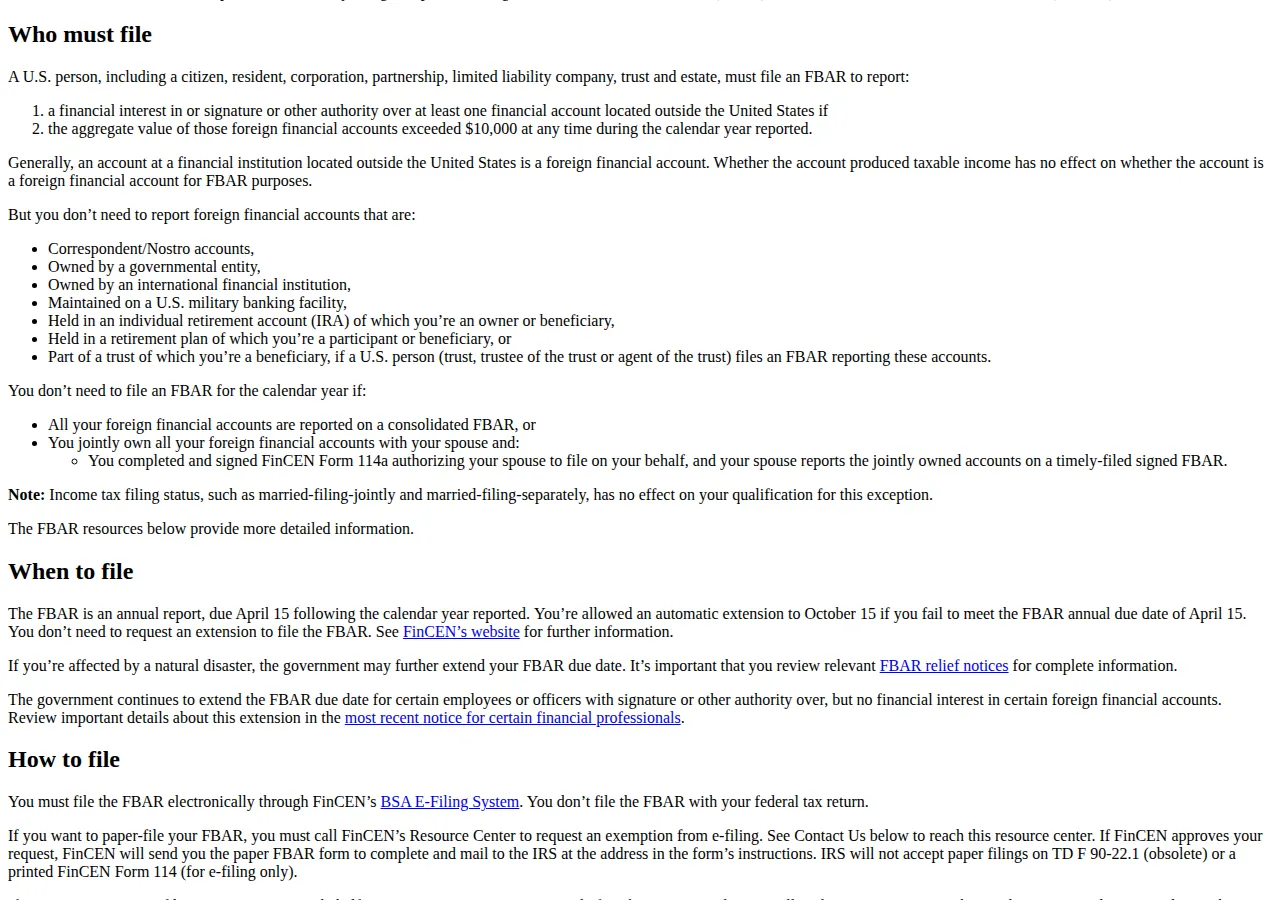
A founder holds accounts in Dubai, Singapore, and Cameroon. No single account tops $8,000. She files her U.S. tax return, reports the interest, and assumes she is done. She is not: the three accounts together cross $10,000, creating a filing duty she has never met — the FBAR, FinCEN Form 114, a Bank Secrecy Act report to FinCEN, not the IRS.
The statute in one paragraph
The authority is 31 U.S.C. § 5314, the Bank Secrecy Act provision titled "Records and reports on foreign financial agency transactions." It directs the Secretary of the Treasury to require a resident or citizen of the United States, or a person in and doing business in the United States, to keep records and file reports on relations with a foreign financial agency. The implementing regulation, 31 CFR § 1010.350, names the form: the Report of Foreign Bank and Financial Accounts, originally TD F 90-22.1, now FinCEN Form 114.
This is Title 31, not Title 26: the FBAR is an anti-money-laundering instrument, and the IRS administers the penalty machinery for FinCEN. The duty attaches to the relationship with the account, not to the income — the IRS states that whether the account produced taxable income has no effect on whether it is a foreign financial account.
Who must file, and who is exempt
"United States person" in 31 CFR § 1010.350(b) means a citizen, a resident alien under 26 U.S.C. § 7701(b), or an entity — corporation, partnership, trust, or LLC — created under U.S. law, any State, the District of Columbia, the territories, or Indian Tribes. A foreign founder who becomes a resident alien enters the filing population the year residency begins.
| Person or situation | FBAR duty | Authority |
|---|---|---|
| U.S. citizen, resident alien, or U.S. entity | File if the aggregate test is met | 31 CFR § 1010.350(a)–(b) |
| Nonresident alien, no U.S. residency | No duty on personal foreign accounts | 31 CFR § 1010.350(b) |
| Employee with signature authority, no financial interest | File unless a FinCEN notice covers you | 31 CFR § 1010.350(a), (f) |
| Spouse jointly owning all accounts with the filing spouse | Exempt if Form 114a is signed and the spouse files timely | IRS FBAR page |
| All accounts on a consolidated FBAR | Exempt for that year | 31 CFR § 1010.350(g)(3) |
The exemptions are narrow: correspondent and nostro accounts, accounts owned by a governmental entity or an international financial institution, accounts on a U.S. military banking facility, IRA and retirement-plan accounts, and trust accounts a U.S. person already reports on an FBAR. Reportable accounts under § 1010.350(c) are bank, securities, and other financial accounts: deposit and checking accounts, brokerage accounts, mutual fund shares, and insurance or annuity policies with a cash value. The institution's location decides — a foreign branch of a U.S. bank counts as foreign, a U.S. branch of a foreign bank does not.
The $10,000 aggregate test, with the math exposed
The threshold is $10,000 in aggregate value across all foreign financial accounts, measured at any time during the calendar year — not per account, not at year-end. The IRS states the rule plainly: if two accounts have a combined balance over $10,000 at any one time, both must be reported.
ext{File FBAR if } ext{Aggregate value} > $10{,}000 ext{ at any time}
Take the founder from the opening: a Dubai business account peaking at $8,000, a Singapore brokerage at $6,500, and a Cameroon savings account at $1,200. The aggregate is $8,000 + $6,500 + $1,200 = $15,700, so she files and reports all three, including the $1,200 one. Each maximum value is converted to U.S. dollars at the year-end exchange rate. Run your own aggregate before you file, and check the arithmetic with the break-even calculator.
A $9,500 account plus a $600 account is $10,100 — file. An account closed in February still counts if it crossed the line while open, and an account at zero on December 31 still counts if it peaked mid-year.
Financial interest versus signature authority
Financial interest under 31 CFR § 1010.350(e) covers the owner of record; an account held by an agent, nominee, or attorney acting for you; an entity in which you own more than 50 percent of voting power, equity, or profits; and a trust of which you are grantor or in which you hold more than 50 percent of the assets or income. An anti-avoidance rule adds a final hook: a person who creates an entity to evade the section has a financial interest in its accounts.
| Hook | What it catches | Typical holder |
|---|---|---|
| Financial interest — owner of record | Account in your name | Individual account holder |
| Financial interest — agent or nominee | Account titled to someone acting for you | Founder using a nominee holder |
| Financial interest — >50% entity | Corporation, partnership, or entity you control | Owner of a foreign subsidiary |
| Financial interest — grantor or >50% trust | Trust you created or benefit from at >50% | Settlor of a foreign trust |
| Signature authority | Power to move the money by talking to the bank | CFO, treasurer, authorized signatory |
The 25-or-more-accounts rule in § 1010.350(g) lets a person with 25 or more accounts report only the number of accounts and basic information, with details produced on request.
FBAR versus Form 8938: two filings, two thresholds
The costliest confusion here is treating Form 8938 and the FBAR as the same filing. Form 8938 is a Title 26 disclosure attached to your income tax return under 26 U.S.C. § 6038D; the FBAR is a Title 31 report filed with FinCEN. The IRS states it plainly: "The Form 8938 filing requirement does not replace or otherwise affect a taxpayer's obligation to file FinCEN Form 114." Filing one never satisfies the other.
| Item | Form 8938 (FATCA) | FBAR (FinCEN Form 114) |
|---|---|---|
| Legal basis | 26 U.S.C. § 6038D (Title 26, tax) | 31 U.S.C. § 5314; 31 CFR § 1010.350 (Title 31, BSA) |
| Filed with | IRS, attached to the tax return | FinCEN, via the BSA E-Filing System |
| Thresholds, living in the U.S. | Single $50k last day / $75k any time; joint $100k / $150k | Aggregate over $10,000 at any time |
| Thresholds, living abroad | Single $200k last day / $300k any time; joint $400k / $600k | Aggregate over $10,000 at any time |
| Failure-to-file penalty | Up to $10,000 + $10,000 per 30 days, max $60,000 | See penalty ladder below |
A single filer in the United States with $62,000 of specified foreign assets on December 31 exceeds the $50,000 Form 8938 last-day threshold and must file Form 8938 — and, because $62,000 also exceeds $10,000, must file the FBAR too. A founder with $25,000 abroad files the FBAR only. The full comparison is in the IRS Form 8938 FATCA foreign financial assets playbook; the foreign-entity reporting that travels with these filings is in the IRS Form 5471 foreign corporation reporting playbook.
Deadlines: April 15, then October 15, automatically
The FBAR is due April 15 following the calendar year reported, with an automatic extension to October 15 — no form, no request, no fee. October 15 is a hard stop: a filing after it is late.
How to file: the BSA E-Filing System
The FBAR is filed electronically through FinCEN's BSA E-Filing System — not with the federal tax return, and not mailed to the IRS. Create an account, select FinCEN Form 114, and submit. To have someone file for you, use FinCEN Report 114a. Keep it; do not submit it. File in this order:
- Gather the identifiers: the filer's TIN — SSN for an individual, EIN for an entity, ITIN for a resident alien without an SSN — plus each account's SWIFT/BIC and IBAN for the record sheet.
- Enter each account's maximum value in U.S. dollars at the Treasury year-end rate, submit FinCEN Form 114, and save the acknowledgement as a PDF.
- Have a CPA review the first filing: the engagement letter usually excludes FBARs, so confirm in writing who files.
For a founder with a foreign-owned U.S. entity, the FBAR sits alongside the entity's other foreign reporting — the Form 5472 foreign-owned single-member LLC $25,000 penalty playbook covers the disclosure that rides with the same structure.
The penalty ladder, with the math exposed
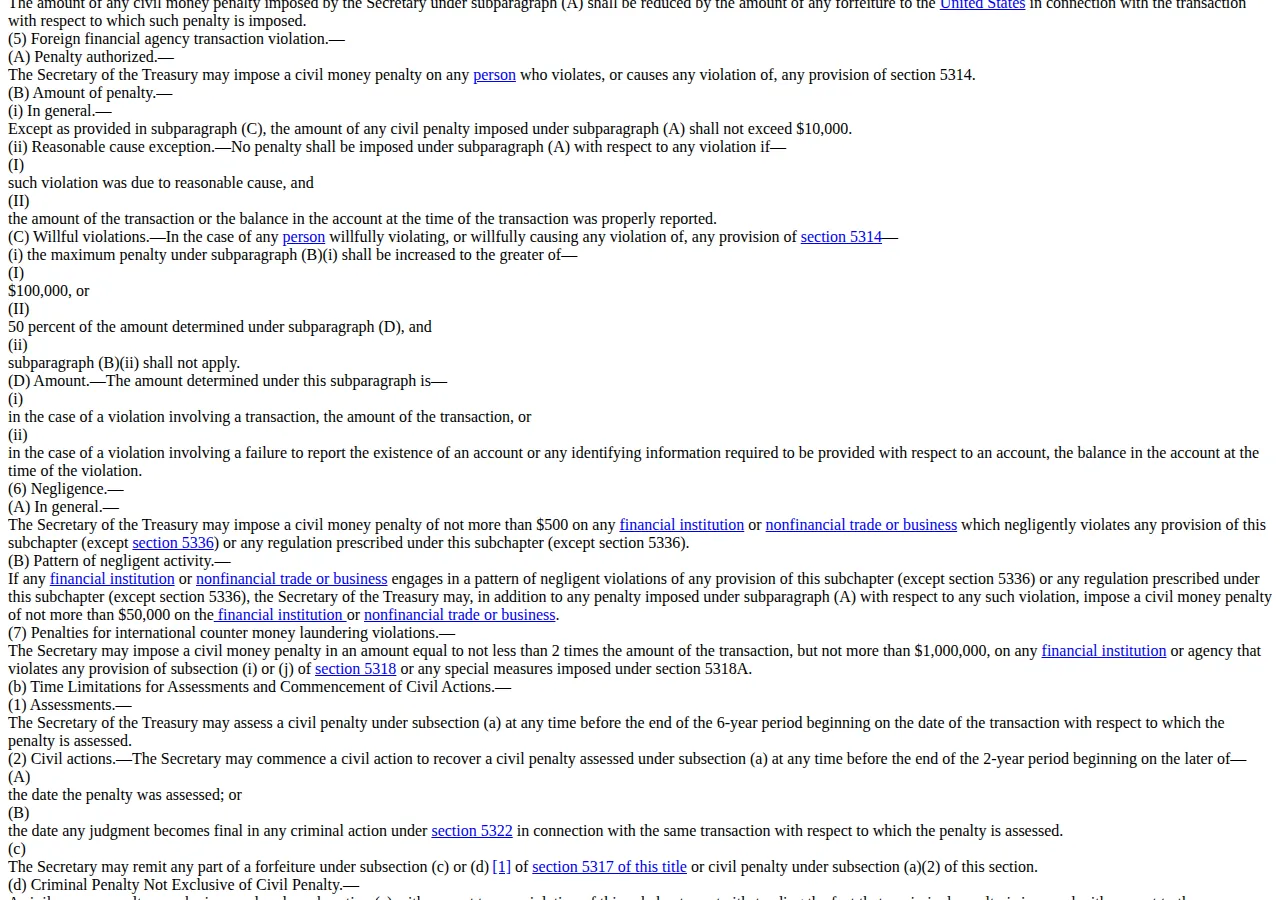
Penalties sit in 31 U.S.C. § 5321(a)(5). The statute sets the ceilings; the Federal Civil Penalties Inflation Adjustment Act moves them yearly, and FinCEN publishes the adjusted figures in 31 CFR § 1010.821. Below are the maximums for penalties assessed on or after January 17, 2025.
| Violation | Statutory ceiling (31 U.S.C. § 5321(a)(5)) | Adjusted maximum, assessed on or after Jan 17, 2025 |
|---|---|---|
| Non-willful violation | $10,000 per violation | $16,536 per violation |
| Willful violation | Greater of $100,000 or 50% of the balance | Greater of $165,353 or 50% of the balance |
| Reasonable-cause exception | No penalty if due to reasonable cause and the amount was reported | Non-willful only |
The willful formula is the one to internalize: the 50 percent prong is not a ceiling — it is a percentage of the account, applied per violation, per account, per year.
ext{Willful penalty} = max($165{,}353, 0.50 imes ext{Balance at time of violation})
ext{Non-willful penalty} = $16{,}536 imes ext{Number of violations}
Worked example one, non-willful: a founder misses three years of FBARs for two accounts, with no willfulness found. The exposure is 3 years × 2 accounts × $16,536 = $99,216 at the adjusted maximum — the ceiling is the number to plan against.
Worked example two, willful: a single account holds $400,000 at the time of the violation. Fifty percent of $400,000 is $200,000, which exceeds $165,353, so the maximum penalty for that one violation is $200,000. The penalty scales with the balance, not the tax owed.
The reasonable-cause exception in § 5321(a)(5)(B)(ii) is the only statutory off-ramp from the non-willful penalty: no penalty if the violation was due to reasonable cause and the amount was properly reported. It does not apply to willful violations. Criminal penalties may also apply to willful violations — the IRS comparison page says so without quantifying them.
Founder & CEO Insight — Enow A. Jovial
Records: five years, available for inspection
31 CFR § 1010.420 requires every person with a financial interest in or signature authority over a reportable account to retain records showing the account name, number, foreign bank name and address, type, and maximum value during the reporting period. Keep them for five years, available for inspection as authorized by law. Bank statements or a copy of a filed FBAR satisfy the rule if they contain the required information.
Execution checklist
- [x] List every foreign financial account: bank, brokerage, mutual fund, insurance or annuity with cash value, including accounts you only sign on.
- [x] Pull each account's maximum value during the year: from periodic statements.
- [x] Run the aggregate test: add the maximum values; if the total exceeds $10,000, you file and report every account.
- [x] Check the Form 8938 thresholds separately: a single filer in the U.S. at $50,000 last-day or $75,000 at any time also files Form 8938.
- [x] File FinCEN Form 114 through the BSA E-Filing System by April 15: use the automatic extension to October 15 only as a safety net.
- [x] Authorize a preparer properly: sign FinCEN Report 114a if someone files for you, and keep it.
- [x] Keep the records for five years: statements, acknowledgement, exchange rate, and maximum-value calculation per account.
Failure modes: how careful founders still get caught
Testing per account instead of in aggregate. The $9,500 account plus the $600 account is a filing. Founders who test each account against $10,000 miss it entirely.
Treating the FBAR as part of the tax return. The return is filed, the interest is reported, the FBAR is never opened. A correct return does not cure a missing FBAR.
Assuming the tax preparer filed it. Many preparers do not file FBARs, and the engagement letter often says so. The duty is personal, and the penalty lands on the filer, not the preparer.
The decision in advance
The FBAR decision is made once a year, in April, from a list of accounts and a single addition: if the total exceeds $10,000, file FinCEN Form 114 and keep the records for five years. Check Form 8938 separately — its thresholds are higher, and meeting one never satisfies the other.