Equipment Financing vs Leasing vs Cash Purchase: 2026 Decision Playbook
Founder & CEO Insight — Enow A. Jovial
A $100,000 CNC machine leaves every growing business the same choice: borrow and own it, lease it and hand it back, or pay cash and be done. The loan costs $2,027.64 a month for 60 months; the lease $1,891.54 plus a $10,000 buyout; cash $100,000 on day one. The decision is not in those numbers — it is in the year-one tax deduction, the balance-sheet treatment your lender sees, and the cash you no longer have when a customer pays late.
This playbook works the decision with one machine, one rate and one tax rate — $100,000, 8% cost of capital, the 21% federal corporate rate — so every figure can be checked. Change any input and the answer moves; the formulas show how.
The decision in one table
| Route | Monthly payment | Total paid over 60 months | You own it | Year-one shield at 21% | Authority |
|---|---|---|---|---|---|
| Equipment loan | $2,027.64 | $121,658.37 | Day one | $21,000 (full expensing) | IRS Pub. 946 (2025) |
| Lease, then buy | $1,891.54 | $123,492.53 incl. $10,000 buyout | Month 60 if you buy | $4,766.69 (payments deducted as paid) | UCC § 2A-103; FASB ASC 842-10-25-2 |
| Cash purchase | $0 | $100,000 | Day one | $21,000 (full expensing) | IRS Pub. 946 (2025) |
| SBA 504 loan | $1,050.72 | $126,086.40 over 120 months | Day one | $21,000 (full expensing) | SBA 504 program |
The loan and the cash purchase take the same $21,000 year-one shield: both make you the owner on day one and the 2026 law lets an owner expense the machine in full. The lease takes $4,766.69 in year one — 21% of the $22,698.51 paid in twelve months — and the rest arrives as payments arrive. Cheaper per month, more expensive in total, because the $10,000 residual sits unpaid until month 60.
What each route actually is
A loan is a purchase with borrowed money: you own the machine from day one and the lender holds a security interest as collateral. A lease is not a purchase — under Uniform Commercial Code Section 2A-103 it is "a transfer of the right to possession and use of goods for a term in return for consideration," and a sale is expressly not a lease; a finance lease is one where the lessor does not select, manufacture or supply the goods. You rent possession; the lessor owns the machine, and the end depends on the purchase option — $1 buyout, fair-market-value buyout, or nothing. Cash is the simplest route: you pay $100,000 with no lender and no monthly obligation, giving up the return the money would have earned — at 8%, $46,932.81 over five years, the price of illiquidity.
The worked math: one machine, three routes
The loan
The monthly payment on a $100,000 loan at 8% over 60 months:
Sixty payments total $121,658.37, so the interest cost is $21,658.37. In year one you pay $24,331.67 — $7,387.66 interest, $16,944.02 principal — leaving a balance of $83,055.99. The interest is deductible and the machine depreciable, which is where the year-one shield comes from.
The lease
The lease is priced at the same 8% over the same 60 months, with a 10% residual of $10,000 payable only if you buy at the end:
Sixty payments total $113,492.53; add the $10,000 buyout and the all-in cost is $123,492.53 — $1,834.16 more than the loan in nominal dollars. But discount every payment and the buyout at 8% and the present value is $99,999.89: the $100,000 machine. At the same cost of capital, lease and loan cost exactly the same in present-value terms — the gap is pure timing.
Cash
Cash has no payment and no interest, but an opportunity cost — $100,000 earning 8% a year for five years grows by:
That is the true cost of cash: $46,932.81 of return you will never see, against $21,658.37 of loan interest. Cash beats the loan only if idle cash earns less than the loan rate — at 4% the forgone return is $21,665.29 and the routes nearly tie. Run the number on your own return, not on a feeling about debt.
The SBA 504 route: the cheapest money for long-life equipment
For equipment with at least 10 years of useful life, SBA 504 is the lowest-cost financing most small businesses can reach: long-term, fixed-rate, up to $5 million for major fixed assets. The stack is three pieces — a bank funds about 50%, a Certified Development Company about 40% through an SBA-guaranteed debenture, the borrower about 10% down. The maximum rises to $5.5 million for manufacturers and energy projects; the down payment to 15% for a business under two years old, 20% if it is also special-purpose property.
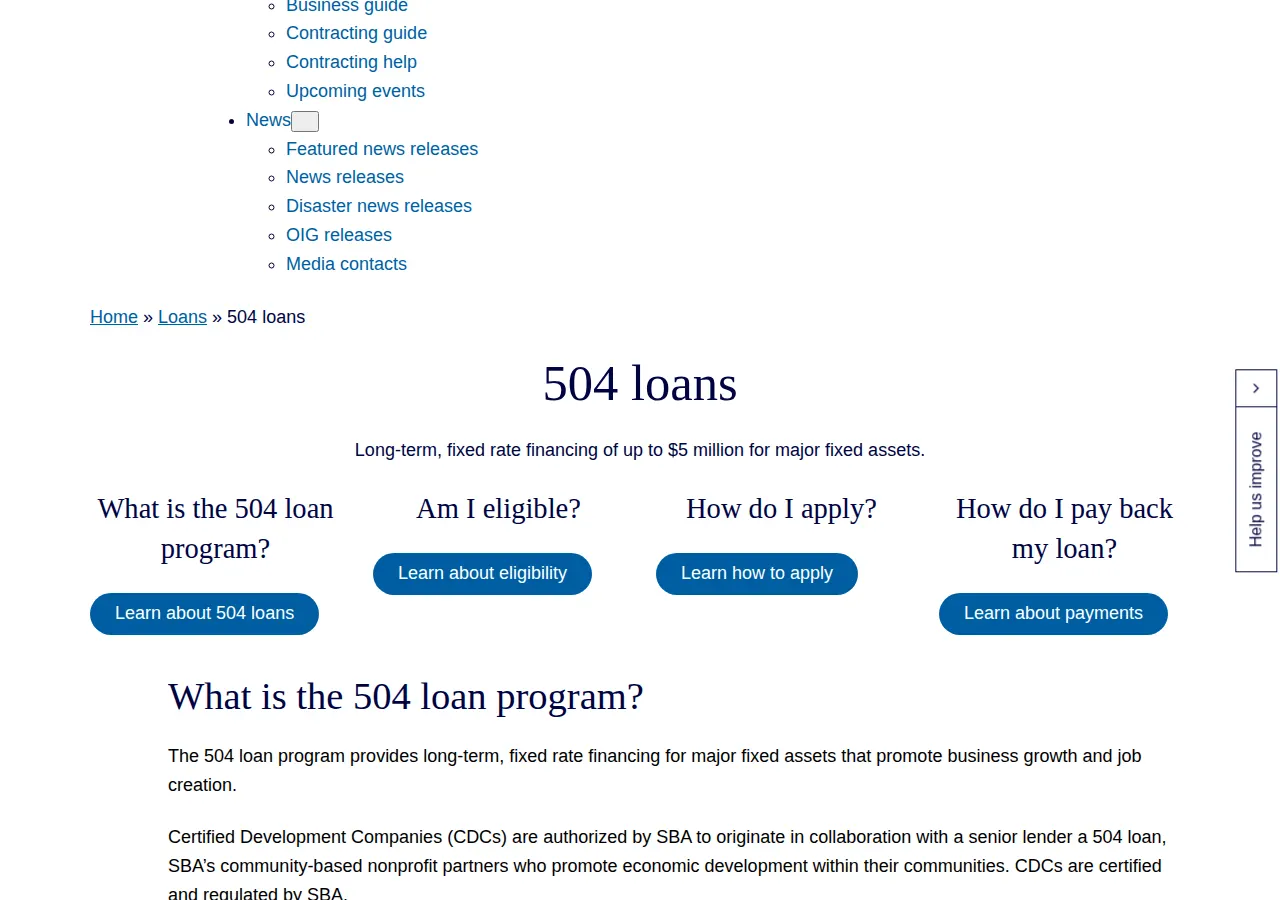
On the same machine the 504 stack is a $50,000 bank loan, a $40,000 CDC debenture and a $10,000 down payment. At 6% fixed over 10 years the CDC piece costs $444.08 a month; at 8% the bank piece $606.64, for a combined $1,050.72. Total paid over ten years: $126,086.40 on $90,000 borrowed — roughly half the conventional loan's monthly burden, but twice the term, and the machine must have 10 years of useful life. A CNC machine qualifies; a laptop fleet does not. Funding takes 30 to 90 days, so 504 fits a planned purchase, not an emergency replacement.
Conventional lenders move faster. Crest Capital finances $10,000 to $500,000 over 24 to 84 months, often with no down payment, approving loans under $250,000 the same day without tax returns. Neither Crest nor Balboa Capital publishes rates — Crest's are reported from 5% — so price any conventional quote with the present-value test.
The tax layer: 2026 is the year to own the machine
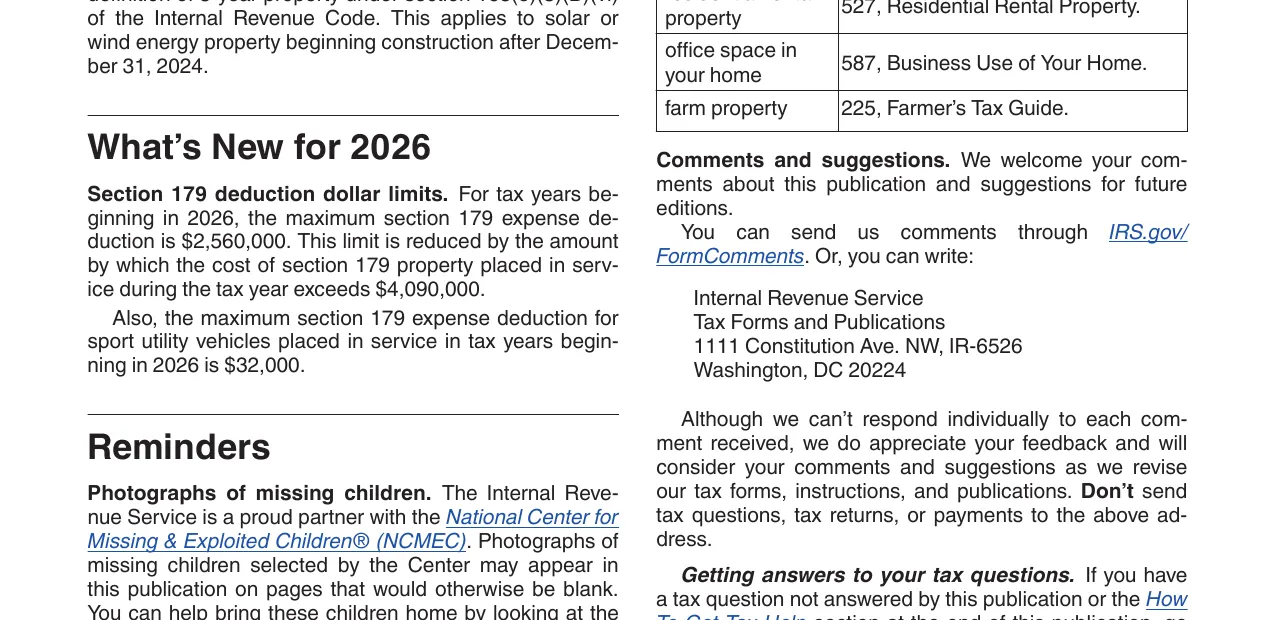
The tax law changed the answer in 2025: the One Big Beautiful Bill Act, Public Law 119-21, reinstated 100% bonus depreciation for property acquired after January 19, 2025. Publication 946 states the 2026 Section 179 limits plainly: a $2,560,000 maximum deduction, reduced by Section 179 property placed in service above $4,090,000, and a $32,000 maximum for sport utility vehicles. The 2025 figures were $2,500,000, $4,000,000 and $31,300.
The owner routes — loan and cash — can deduct the full $100,000 in year one under Section 179 or 100% bonus depreciation. At 21% the shield is $21,000. Compare the old 7-year MACRS schedule: a 14.29% first-year deduction, a $3,000.90 shield. The gap is why the 2026 law favours ownership — the deduction arrives in the same year as the cash outflow.
The lease route cannot take that shield: the lessee does not own the machine. Payments are deducted as paid — $22,698.51 in year one, a $4,766.69 shield — and the deduction stretches across the term. Over five years the lease deducts the full $113,492.53, $23,833.43 of shields at 21%, against $21,000 in year one for the owner routes. The lease eventually deducts more in nominal dollars, but a year-five shield is worth less than a year-one shield, and the owner routes also deduct $21,658.37 of loan interest. Run the present value on the shields before the tax tail wags the decision.
The accounting trap: your lease may be a loan on the books
FASB ASC 842 puts every lease longer than 12 months on the balance sheet as a right-of-use asset and a lease liability, and classification decides how the cost hits the income statement. A lease is a finance lease if it meets any one of five criteria in ASC 842-10-25-2: ownership transfers by the end of the term; a purchase option the lessee is reasonably certain to exercise; a term covering a major part of the remaining economic life (commonly 75% or more); a present value of substantially all of the fair value (commonly 90% or more); or an asset so specialized the lessor has no alternative use for it. If none is met, it is an operating lease.
| Test | Our 60-month lease | Finance lease? |
|---|---|---|
| Ownership transfers at end | No — $10,000 buyout is optional | No |
| Purchase option reasonably certain | No — fair-market buyout | No |
| Term vs economic life (75%) | 60 months of a 120-month life = 50% | No |
| Present value vs fair value (90%) | $99,999.89 of $100,000 = 100% | Yes |
| Specialized, no alternative use | No — standard CNC machine | No |
The model lease trips the present-value test: the payments are worth substantially all of the machine's fair value, so it behaves like a loan on the books — amortisation plus interest, front-loaded — even though the contract calls it a lease. That is not a reason to avoid it; it is a reason to stop believing the lease keeps debt off the balance sheet. Under ASC 842 it does not, and if your covenants cap total debt, a finance lease counts. Our lease accounting ASC 842 playbook works the journal entries.
Run the present-value test in five steps
- Get three written quotes for the same machine: a loan, a lease with the buyout in writing, a cash price with the discount stated.
- Put every route on one timeline: payments, buyout, down payment, tax shield year by year.
- Discount every future payment at the same rate — your borrowing cost or the return the cash would earn — and add the totals.
- Compare present values, not monthly payments: lowest present value wins on cost, lowest year-one cash need wins on survival.
- Re-run with the Section 179 and bonus figures for the year you buy — the tax shield changes the ranking.
Who should pick which route
Finance it when the machine will earn longer than the loan term, when you want the year-one shield, and when the payment fits inside the machine's gross margin — a machine adding $4,000 a month covers a $2,027.64 payment twice over.
Lease it when technology turns over faster than the machine wears out, when you need the upgrade path in the contract, or when preserving the $100,000 matters more than owning the asset. A business replacing its fleet every three years should never sign a 60-month lease: 60 months of a 36-month life is a finance lease on an asset you will abandon.
Pay cash when the purchase leaves six months of reserves untouched, when idle cash earns less than the loan rate, and when the machine has no resale market worth protecting. Cash is right with $400,000 in the bank and a $100,000 machine — wrong with $110,000 in the bank and the same machine.
Use SBA 504 when the equipment has 10 or more years of useful life, when you can wait 30 to 90 days, and when the monthly payment is the constraint rather than the total cost: $1,050.72 is the lowest in this playbook, but it buys ten years of obligation on a machine you must keep using.
Execution checklist
- [x] Price the machine in cash first — get the cash price in writing before any financing quote.
- [x] Run the present-value test on every quote — discount payments plus residual at your cost of capital and reject any quote above the cash price.
- [x] Confirm the Section 179 and bonus position with your CPA — the 2026 limits are $2,560,000 and $4,090,000, but your taxable income and placed-in-service date decide the claim.
- [x] Classify the lease under ASC 842 before signing — a lease tripping any of the five criteria is a finance lease on the books.
- [x] Check the SBA 504 clock — if the equipment qualifies and you can wait 30 to 90 days, the 504 stack halves the monthly payment; apply through a Certified Development Company.
- [x] Keep six months of reserves after a cash purchase — below that line, finance it instead.
- [x] Run the payment through our business loan calculator with your own rate and term before committing.
The machine earns the same revenue under all three routes. The difference is $1,834.16 of timing, a $21,000 shield in year one or spread over five, and $46,932.81 of forgone return if you pay cash. Price the quote, claim the shield, keep the reserves — and let the machine pay for itself under the route that leaves the business strongest in month 61. Our Section 179 guide works the deduction election, and our SBA 7(a) vs 504 comparison prices the two SBA programs.