The Employee Handbook Playbook: Policies That Hold Up
An employee handbook speaks for the company when no manager is in the room: a new hire reads it on day one, a supervisor before writing someone up, an investigator after a complaint, a judge when the complaint becomes a case. Most handbooks fail the third and fourth readers because they were written for the first — friendly, vague, full of promises the law does not let the company keep. This playbook covers the clauses that decide disputes — at-will, anti-harassment, pay, leave, remote work, discipline, and the signature page — for a US business with employees in California, New York, or Illinois. It is not legal advice.
Founder & CEO Insight — Enow A. Jovial
The at-will statement
In California the rule is statutory. Labor Code section 2922 provides: "An employment, having no specified term, may be terminated at the will of either party on notice to the other." The handbook should quote it, state that employment is at-will, and state that only a written agreement signed by an officer changes that status.
The danger is the sentence that quietly contradicts it: a handbook promising progressive discipline in every case, a manager calling a job "permanent," or a probationary period implying tenure can create an implied contract to terminate only for good cause. In Foley v. Interactive Data Corp., the California Supreme Court held that the parties may contract around at-will status, so the handbook itself can become the contract that limits the employer's freedom. Put the at-will statement on the first page, repeat it in the discipline section, and state the handbook is not a contract.
At-will is not a license: a termination for an unlawful reason — race, sex, disability, age, or another protected characteristic — is illegal no matter what the handbook says, and a termination violating a fundamental public policy, such as firing an employee for refusing to break the law, supports a wrongful termination claim under Tameny v. Atlantic Richfield Co.
Anti-harassment and equal opportunity
Title VII of the Civil Rights Act of 1964 and the Americans with Disabilities Act both apply to employers with fifteen or more employees for each working day in each of twenty or more calendar weeks — but write the policy to apply to everyone: a business below that line is still exposed under state law.
The anti-harassment clause needs four working parts: a definition of prohibited conduct (sex, race, color, national origin, religion, age, disability, and retaliation for complaining); a complaint procedure with more than one route — the supervisor, human resources, and a named person outside the chain of command; a prompt, impartial investigation; and corrective action with a ban on retaliation.
The procedure is the liability defense. In Faragher v. City of Boca Raton and Burlington Industries v. Ellerth (both 1998), the Supreme Court held that an employer is vicariously liable for harassment by a supervisor — unless no tangible job action resulted, in which case the employer can raise an affirmative defense: it exercised reasonable care to prevent and correct the harassment, and the employee unreasonably failed to use the complaint procedure provided. A written policy with a complaint route, training, and a documented investigation is the first half of that defense.
The Equal Employment Opportunity Commission issued harassment guidance in 2024, approved April 29, 2024; in May 2025 a federal court vacated portions of it. The Faragher and Ellerth defense is Supreme Court law and is unaffected — cite the statute and the cases, not the guidance. The National Labor Relations Act adds one more limit: section 7 protects the right to discuss pay and working conditions, so a handbook rule banning wage talk is unlawful.
Pay rules
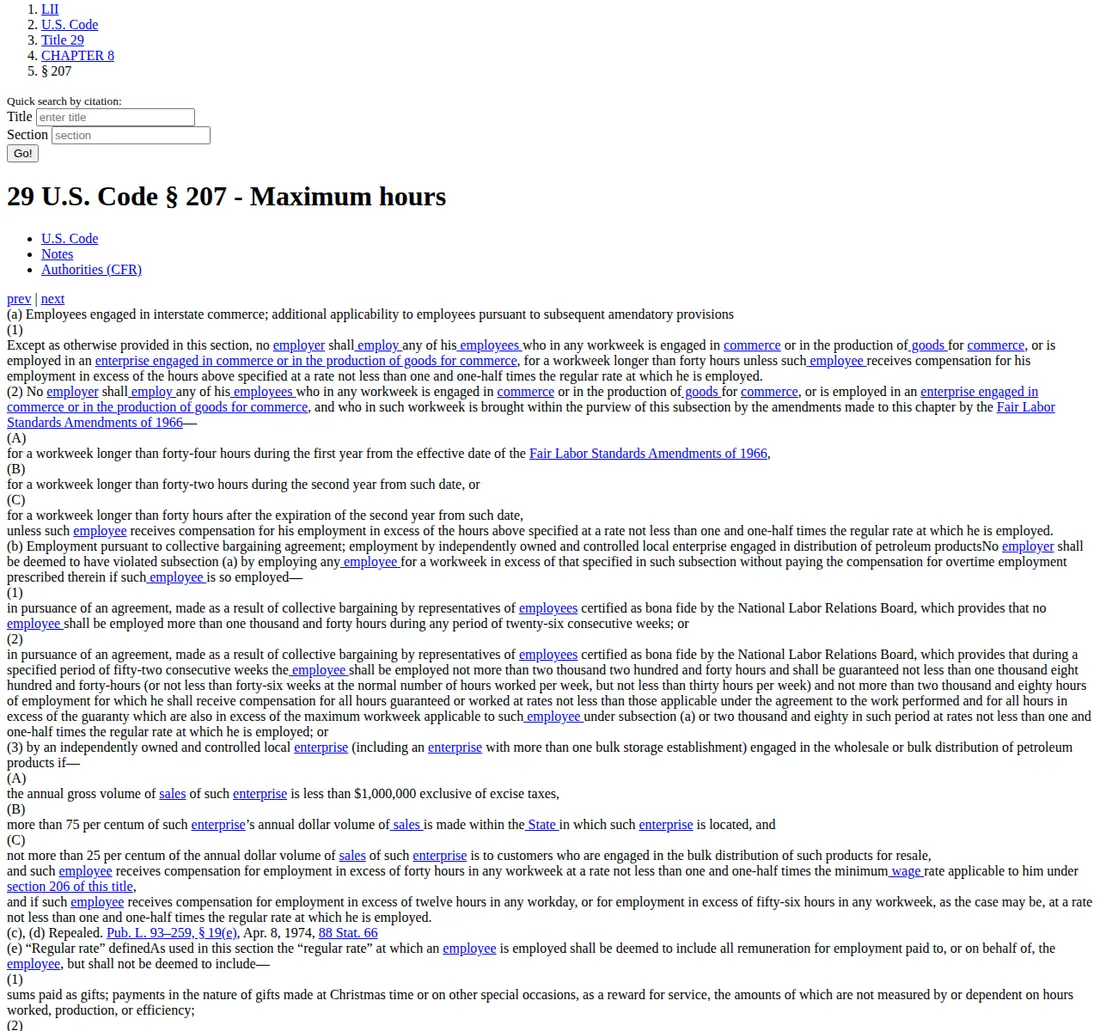
The federal minimum wage is $7.25 per hour; name the state minimum where it is higher. Overtime is the clause most handbooks get wrong by omission. The FLSA provides that no employer shall employ an employee for a workweek longer than forty hours "unless such employee receives compensation for his employment in excess of the hours above specified at a rate not less than one and one-half times the regular rate at which he is employed."
Worked example: the 50-hour week
An employee earning $25.00 per hour who works 50 hours in a week takes home $1,375.00: $1,000.00 for the first 40 hours plus $375.00 for 10 overtime hours at $37.50 each, against $1,250.00 at straight time — a $125.00 overtime premium.
California adds a daily rule: time and one-half over eight hours in a workday and over 40 in a workweek, double time over 12 in a workday and over eight on the seventh consecutive day. The same $25.00 employee earns $275.00 for a 10-hour day, $350.00 for a 12-hour day, $400.00 for a 13-hour day — the thirteenth hour is at double time, $50.00.
New York Labor Law section 195 requires a written notice at hire stating the rate of pay including the overtime rate, the basis of payment, the regular payday, and the employer's name and address; the employee signs it, the employer keeps it for six years. California Labor Code section 2810.5 requires a comparable notice at hire for non-exempt employees, with changes in writing within seven days unless the change appears on the next pay stub.
Leave: FMLA and the state sick-leave floors
The Family and Medical Leave Act gives an eligible employee 12 workweeks of leave during any 12-month period — birth or placement of a child, care for a spouse, child, or parent with a serious health condition, or the employee's own serious health condition. Eligibility has three gates: 12 months with the employer, 1,250 hours in the previous 12 months, and 50 or more employees within 75 miles. Twelve workweeks are 480 hours for a full-time employee; the 1,250-hour test is 24.04 hours per week on average — three eight-hour days a week is 1,248 hours, two short of the line. The leave is unpaid unless accrued paid leave runs at the same time, and health coverage continues.
PTO and sick leave: the accrual math
Paid time off is the employer's choice; paid sick leave is not, in the three states below. Keep them apart: PTO is a benefit the employer designs, sick leave is a floor the state sets, and merging them into one bucket without naming the statutory floor hides a right already earned.
Worked example: PTO accrual on a 15-day policy
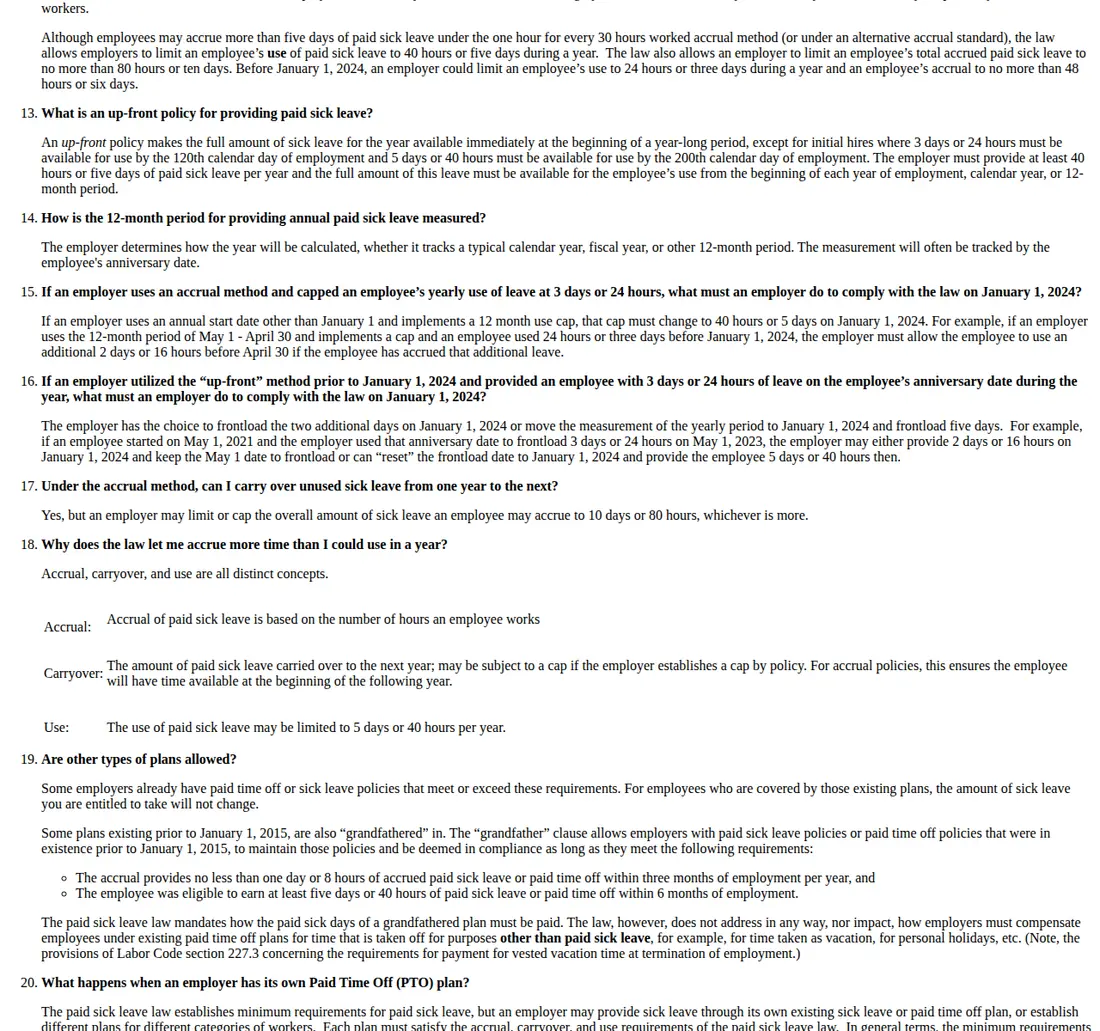
A company granting 15 days of PTO per year (120 hours) accrues 4.62 hours per biweekly pay period (26 periods), 60 hours after 13 periods; on a semimonthly payroll (24 periods) the accrual is 5.00 hours per period.
The state sick-leave floors differ in rate, amount, and use: California accrues fastest and caps highest, New York's amount depends on headcount, Illinois accrues slowest and is the only one where the leave may be used for any reason.
| State | Accrual rate | Annual amount | Use begins | Authority |
|---|---|---|---|---|
| California | 1 hour per 30 hours worked | 40 hours or 5 days, whichever is more; accrual cap 80 hours or 10 days | 90th day of employment | Cal. Lab. Code §§ 245.5, 246 |
| New York | 1 hour per 30 hours worked | 56 hours at 100+ employees; 40 hours at 5–99; 40 hours at 0–4 (paid only if net income over $1 million) | Accrual begins September 30, 2020; use as accrued | N.Y. Lab. Law § 196-b |
| Illinois | 1 hour per 40 hours worked | 40 hours per 12-month period, usable for any reason | 90 days after start of employment | 820 ILCS 192/15 |
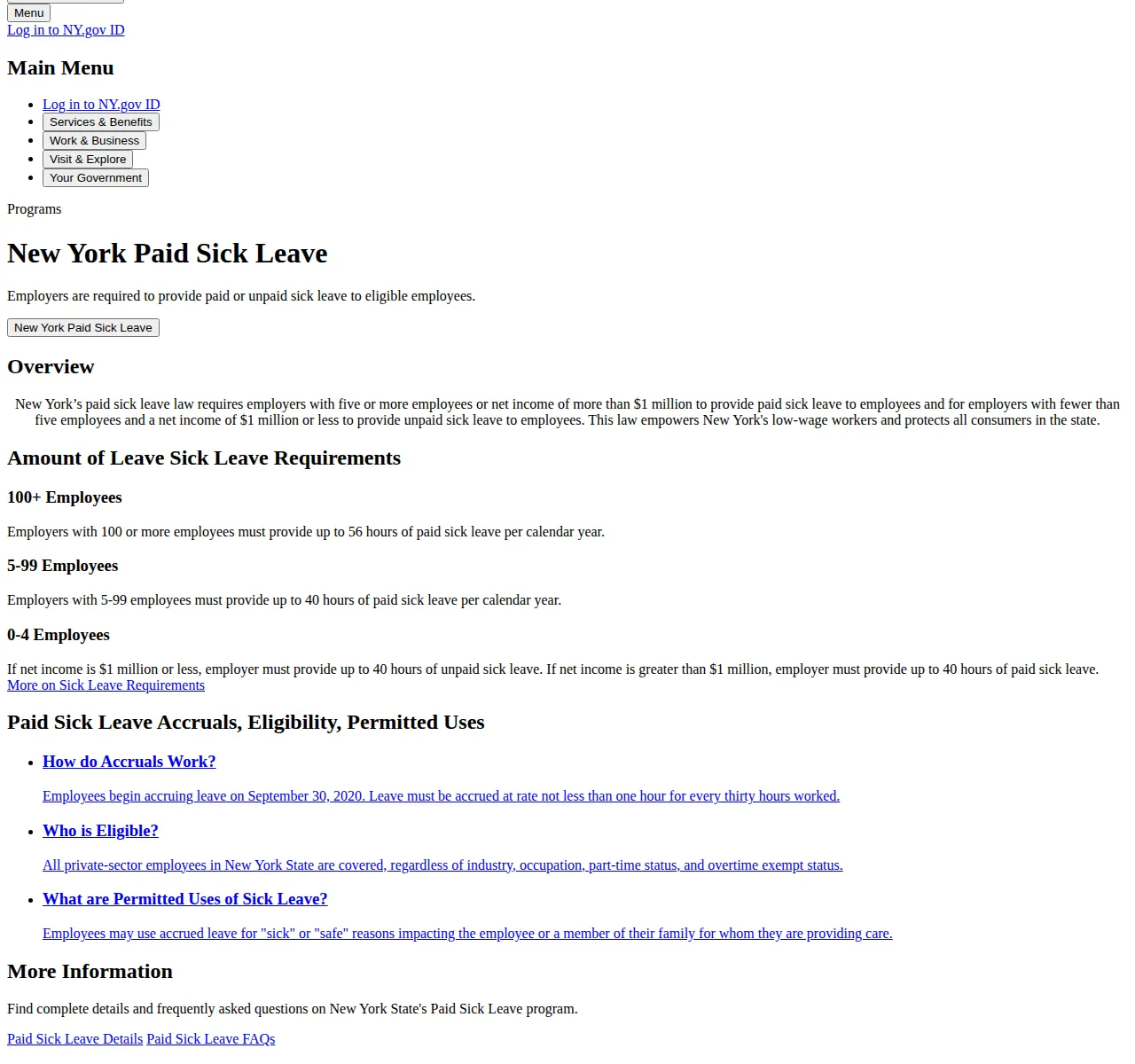
A full-time employee working 2,080 hours a year accrues 69.33 hours in California, reaching the 80-hour cap after 60 weeks; in New York the same 69.33 hours hits the 40-hour cap after 30 weeks or the 56-hour cap after 42 weeks; in Illinois the employee accrues 52 hours a year, hitting the 40-hour cap after 40 weeks. Part-time at 20 hours a week: 34.67 hours a year in California, 26 in Illinois.
In California, unused sick leave is not paid out at termination, and accrual starts on day one even though use waits until the 90th day — payroll shows the balance from the first paycheck.
Meals, rest, and the clock
Federal law does not require meal or rest breaks; California does. An employer may not employ an employee for more than five hours per day without a meal period of at least thirty minutes; if the total work period is no more than six hours, the meal period may be waived by mutual consent. A second meal period is required after ten hours, waivable only if the first was not waived. Rest periods are a net ten consecutive minutes for each four-hour work period, or major fraction of it — anything more than two hours, per the Division of Labor Standards Enforcement — and none is required where total daily work is less than three and one-half hours. An eight-hour shift carries two ten-minute rest periods.
The penalty for a missed meal or rest period is one additional hour of pay at the employee's regular rate for each workday the period was not provided. The claim must be filed within three years.
Remote work and company devices
Remote work needs four clauses, treated as conditions of the arrangement, not perks: eligibility (which roles are remote; remote work can be changed or ended at the employer's discretion); hours (scheduled hours, responsiveness during them, and the rule that non-exempt employees record all hours worked — answering messages at 9 p.m. counts toward the 40-hour week); the workspace (a safe work area, a reliable connection, and the employer's right to require on-site work); and devices and data (company equipment is for work, the employer may monitor company systems, and equipment and data return on departure).
Discipline and termination
Progressive discipline is the section most likely to become a contract the employer did not intend: state the steps as the company's normal practice, not a guarantee, reserve the right to skip them, and keep the at-will statement visible.
- Verbal counseling, noted in the file: the problem, the correction expected, and the deadline.
- Written warning: the problem, the prior counseling, the correction required, and the consequence of a repeat, signed by the employee.
- Final written warning or suspension, with a clear statement that the next occurrence may end employment.
- Termination: decided by the supervisor and a second manager or human resources, with the reasons written down before the meeting and the employee told the decision, the effective date, and what happens to pay, benefits, and equipment.
- Where the issue is misconduct, harassment, or theft: suspend with pay while the facts are established, and do not decide the outcome before the investigation ends.
Document the reason at the time, in the words the manager would use in front of a stranger — the reason written later is the reason nobody believes. Apply the procedure the same way to similar conduct: a procedure applied to one employee and skipped for another is the evidence in a discrimination claim.
The rollout
- Send the handbook to every employee with a cover note stating the effective date and what changed.
- Collect a signed acknowledgment from every employee confirming receipt, understanding of the at-will relationship, and where to direct questions.
- Train every supervisor on the anti-harassment procedure, the complaint routes, and the discipline steps; record attendance.
- File the acknowledgment in the personnel file, the training record in the training file. Payroll systems key PTO balances to the employee record, which carries the employee's Social Security number (SSN) and the employer's EIN.
- Review the handbook once a year with counsel or a CPA who reviews the pay clauses, and after every change in the law in a state where the company has employees.
- Publish the new version with a version number and date, keep the prior version on file, and never silently edit a policy after an incident it governs.
What it costs to get it wrong
A missed meal period in California costs one hour of pay per workday: $7,800.00 a year for one $30.00-per-hour employee who misses one a day. A New York employer that fails to give the wage notice at hire, or to keep the signed acknowledgment for six years, faces a wage-statement penalty of $250 per day per employee, capped at $5,000 — twenty days of missing statements reaches the cap. That penalty figure is corroborated-secondary — from the Labor Department's Form P715 summary, not a page opened this cycle. A harassment complaint with no written procedure leaves the employer without the first half of the Faragher and Ellerth defense. Weigh one dispute against the afternoon it takes to write the policy down — our ROI calculator prices the return.
If the worker is not an employee at all, the handbook does not apply: our contractor vs employee classification guide runs the IRS 20-factor test. The payroll system enforcing the handbook's PTO and overtime rules is priced in our payroll software comparison; the quarterly filings those rules feed are covered in our quarterly payroll tax filing guide.