An email list is the one audience you actually own. Social platforms rent you reach, change the rules without warning, and can shut an account down overnight. This playbook covers the whole operation: choosing a lead magnet, placing opt-in forms, deciding between single and double opt-in, keeping the list clean, staying inside GDPR and CAN-SPAM, and knowing exactly what each subscriber costs.
List building fails in two ways: a list that never grows because the offer is weak or the form is hidden, and a list that grows fast and dies fast because the addresses were bought, scraped, or collected without real consent. The fix is a system: a magnet worth an email address, a form people can find, consent you can prove, and math you can check.
Pick the magnet first
Nobody hands over an email address for nothing. The lead magnet is the trade, and it has to be fair: one specific problem solved, right now, in a format the reader can use in under ten minutes. A 60-page ebook is homework; a one-page checklist that fixes a real task today is a lead magnet.
Four magnet types carry almost every list in B2B and creator businesses.
| Magnet | Best for | Cost to make | Time to value | Authority |
|---|---|---|---|---|
| Checklist | Readers who want a task done right | Low | Minutes | GetResponse benchmarks |
| Template | Readers who want a head start | Medium | Minutes | Mailchimp signup-form docs |
| Calculator | Readers who want their own number | Medium | Minutes | Ibravra pricing calculator |
| Mini-course | Readers who want a skill | High | Days | Kit landing-page docs |
A checklist wins on speed: the ten steps an expert would check before doing the job, stripped of every step a beginner already knows. A template wins on reuse: a budget sheet, a contract outline, an email script the reader copies and fills in. A calculator wins on proof: it turns a vague worry into a number the reader owns. A mini-course wins on depth but costs the most to make and keep current.
One magnet per audience, one promise per magnet. Name the outcome in the headline, name the format, and name the time it takes. "The 10-point pre-launch checklist" beats "Marketing secrets" every time.
Forms and placements
The form is where the trade happens. Mailchimp's help docs describe embedded signup forms that collect email and SMS contacts, and the pattern works on any sender: a form on the page, a form in the flow, and a form at the moment of highest intent.
Put the form in four places: at the end of every article matching the magnet's topic, on a dedicated landing page with one job, as an exit offer, and inside the product at the moment the user just got value, after a free tool result, a download, or a booking confirmation. Kit's landing-page builder ships 20-plus templates built for exactly this, with no-code design and publishing in minutes.
Ask for as little as possible: an email address and, at most, a first name. Every extra field cuts conversion. Say what happens next under the button: what they will receive, how often, and how to stop it. Under GDPR that sentence is part of informed consent.
Single opt-in versus double opt-in
Single opt-in adds the address the moment the form is submitted. Double opt-in adds a second step: the visitor gets a confirmation message and must click to confirm. Mailchimp offers both and documents the two-step flow: the visitor submits the form, then acts on the confirmation.
Double opt-in costs subscribers on paper and buys a better list in practice. Take 10,000 form views, a 3 percent single opt-in rate, and a 65 percent confirmation rate for double opt-in. Both rates are stated working assumptions, not benchmark claims.
You lose 105 addresses, 35 percent of the single opt-in total, and gain a list where every address belongs to a real person who wanted in twice. Mailbox providers watch bounces, complaints, and engagement, and a list full of typos and bots drags your sender reputation down until even good mail lands in spam. Choose double opt-in when your list is a sales asset.
What a subscriber costs
Subscriber-acquisition cost, or CAC, is total spend divided by new subscribers. These are stated working examples with round inputs so the arithmetic can be checked.
Paid social at $2,400 for 1,200 new subscribers costs $2.00 each. Search ads at $3,600 for 900 cost $4.00 each, exactly twice as much. That does not make search ads wrong: a search subscriber may buy faster or spend more, but you cannot know that until you track revenue per subscriber by channel.
A list of 5,000 growing at 4 percent net per month, after churn, reaches 8,005 subscribers in twelve months. The 4 percent figure is a stated assumption, not a benchmark.
Run the numbers in the pricing calculator before you commit spend to any channel, and re-run them monthly.
GetResponse analyzed more than 4.4 billion messages from active senders with at least 500 contacts: open rate 39.64 percent, click-through rate 3.25 percent, unsubscribe rate 0.15 percent, spam complaints below 0.01 percent, bounce rate 2.33 percent. Welcome emails opened at 83.63 percent, far above the 40.08 percent newsletter average. Omnisend's 2026 statistics show open rates rising from 26.6 percent in 2024 to 30.7 percent in 2025, with automated emails at a 38 percent open rate and $2.87 per email against $0.18 for campaigns, and $36 to $40 returned for every $1 spent. Both reports point the same way: automation and welcome mail outperform bulk campaigns by a wide margin.
Landing-page conversion varies hard by industry. GetResponse reports legal services at 25.05 percent, communications at 23.49 percent, financial services at 17.6 percent, arts and entertainment at 12.77 percent, and agencies at 1.86 percent. A 3 percent conversion is a triumph for an agency and a failure for a law firm. Judge your number against your own industry, not a single global average.
List hygiene and the sunset policy
A list rots. People change jobs, abandon inboxes, and stop caring. Every dead address you keep mailing hurts deliverability and inflates your bill, since most senders charge by list size.
Run this checklist every month:
- Remove hard bounces at once: the address does not exist, and mailing it again is pure cost.
- Watch soft bounces for three sends, then remove the address if it keeps failing.
- Flag every address with no open and no click in 180 days.
- Send the flagged group one re-engagement message: click to stay, or do nothing and leave.
- Suppress everyone who does not click, keeping the record for consent proof.
- Delete suppressed addresses after one more silent quarter, and record the removal date.
- Check the list against the GetResponse band: unsubscribe near 0.15 percent, spam complaints below 0.01 percent, bounce near 2.33 percent. Rates far above that band mean the list is the problem, not the copy.
The 180-day rule is this playbook's house policy, not an industry standard. A smaller list that opens beats a bigger list that ignores you. Every send to a silent address is a vote against your next send.
Price the sender: Klaviyo vs Mailchimp vs ConvertKit pricing. Build the flows: Mailchimp vs Klaviyo vs ActiveCampaign automation. Protect delivery: SPF, DKIM, DMARC deliverability.
The law: GDPR consent and CAN-SPAM
Two laws frame list building. GDPR governs consent for people in the EU. CAN-SPAM governs commercial mail to people in the United States. A list serving both must satisfy both, and the stricter rule wins wherever they overlap.
GDPR Article 7 sets the conditions for consent. The controller must be able to demonstrate that the person consented. Where consent sits inside a written declaration covering other matters, the request must be clearly distinguishable, intelligible, easily accessible, and in clear and plain language. The person may withdraw consent at any time, and it shall be as easy to withdraw as to give consent. Consent must be freely given, specific, informed, and unambiguous, and a contract cannot depend on consent that is not necessary for that contract. Pre-ticked boxes fail this test.
Under GDPR Article 83, consent-rule infringements carry fines of up to EUR 20,000,000, or up to 4 percent of worldwide annual turnover in the preceding financial year, whichever is higher, per infringement rather than per email. That is why consent records matter: the form text, the timestamp, and the exact words the person agreed to are your evidence.
CAN-SPAM is an opt-out law, not an opt-in law. It does not require consent before the first commercial email, but it sets seven requirements every commercial message must meet: honest headers, honest subject lines, ad identification, a valid physical postal address, a clear opt-out notice, honoring opt-outs within 10 business days, and monitoring what others send on your behalf. The statute text at 15 U.S.C. § 7704 confirms the 10-business-day window and the physical address requirement. There is no exemption for business-to-business mail.
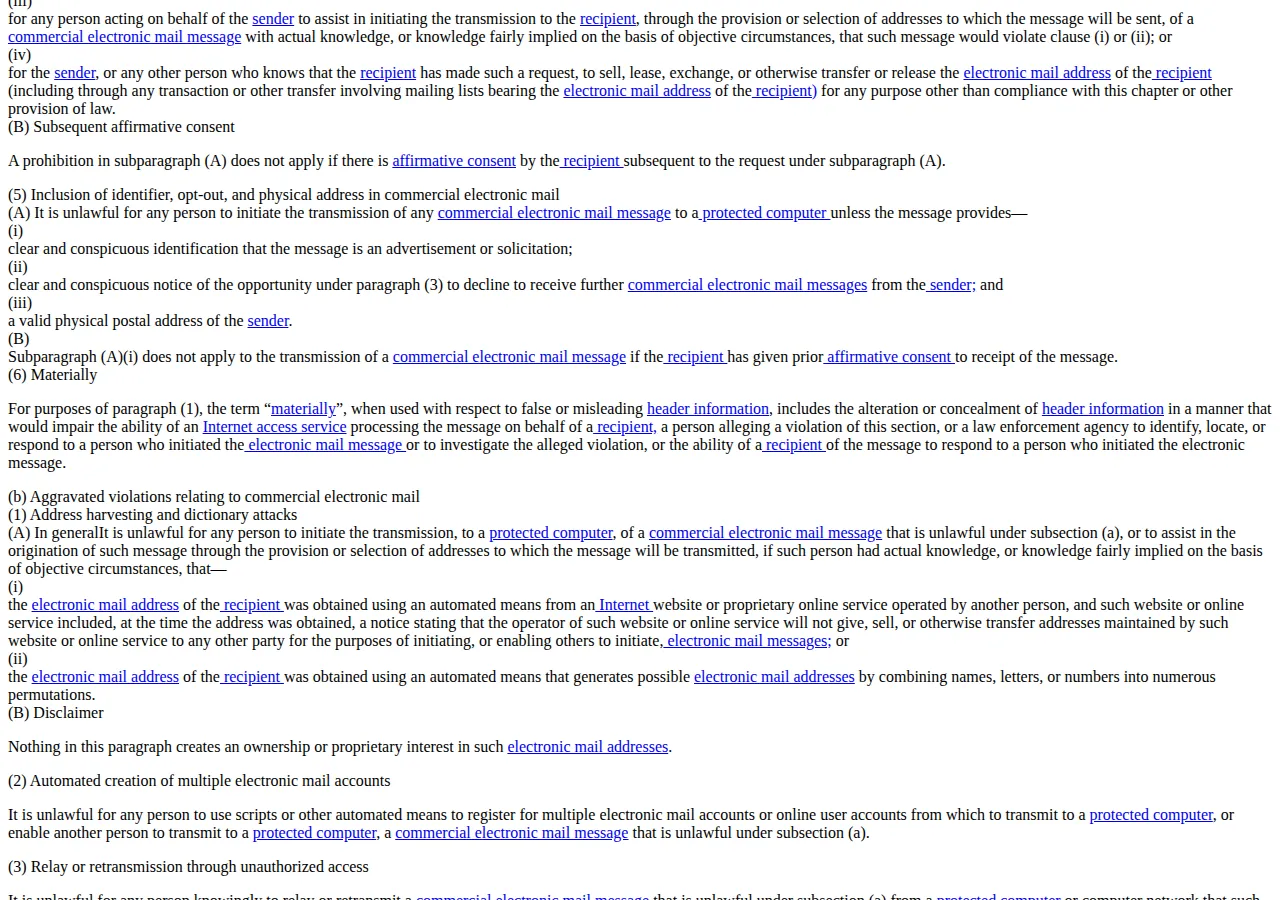
Practical compliance is a checklist, not a legal opinion. Keep the consent record for every address. Put a working unsubscribe link and a postal address in every commercial message. Honor opt-outs within 10 business days, across every list and every tool. Never buy a list: bought addresses have no consent record under GDPR and no opt-out history under CAN-SPAM.
Worked example: a $2,000 lead magnet that pays for itself
A creator builds a checklist magnet. Design and copy cost $800, promotion costs $1,200, total cost $2,000, and the magnet brings in 1,000 new subscribers. Each subscriber produces $6.00 of revenue over the next twelve months. All inputs are stated assumptions.
CAC is $2,000 divided by 1,000 subscribers, or $2.00 each. Gross revenue is 1,000 times $6.00, or $6,000. Net is $4,000. Breakeven revenue per subscriber is $2.00: above that the magnet pays, below it the follow-up needs work, not more spend.
At $1.50 per subscriber the magnet loses money and scale makes it worse. At $6.00, every promotion dollar that holds CAC under $6.00 is money well spent.
Paying for the list: the back office
If you pay a United States creator, affiliate, or freelancer to promote your magnet, collect a W-9 before the first payment. It gives you the person's legal name, address, and taxpayer identification number: an EIN for a business, an SSN or ITIN for an individual. For a creator outside the United States, collect a W-8BEN instead, which certifies foreign status and handles withholding. Keep both forms on file: without them you cannot report the payments.
The IRS reporting threshold for 2026 is $2,000 under P.L. 119-21, section 70201, per the Instructions for Forms 1099-MISC and 1099-NEC dated December 2026. Pay a creator $2,000 or more in the year and you generally must file a 1099-NEC. The old $600 threshold still applies to some categories in the same instructions, such as gross proceeds paid to an attorney, so check the category first. A CPA can confirm the filing for your exact mix of payees.
Pay by Wire or ACH inside the United States. ACH is cheap and traceable and fits recurring affiliate payouts. Wire fits large one-off payments and settles the same day. For international payouts, use IBAN and SWIFT, with the FX spread priced in before you quote the fee. Quote the net amount in the recipient's currency, spread included.
Entity choice shapes how the list business is taxed and how it can be sold later. An LLC keeps paperwork light and passes income through to the owner. An S-Corp can cut self-employment tax once profits clear the owner's reasonable salary, at the cost of payroll and extra filings. A C-Corp fits a business raising outside money or keeping profits inside the company, at the cost of double taxation on dividends. Pick the entity with a CPA after the list starts earning, and keep the list, the sender account, and the payment records in the entity's name from the start.
Export your list regularly as a CSV through the sender's API, and store the export with the consent records. The CSV is your exit plan: if a sender raises prices or shuts your account, the list moves with you in an afternoon. A list you cannot export is not an asset.
Founder & CEO Insight — Enow A. Jovial
Start with one magnet, one landing page, and double opt-in. Measure CAC by channel, sunset the silent addresses, and keep the consent records clean. The list compounds from there, and so does the revenue.