On published list rates, UPS Ground and FedEx Ground are the same shipment at the same price within cents, so the base rate is the wrong place to choose. A 5-pound residential parcel to Zone 5 costs $32.76 all-in on UPS and $32.29 on FedEx at the fuel surcharges in force the week of November 2, 2026: a $0.47 difference on a $32 shipment, decided by a 1-percentage-point fuel gap and a 5-cent residential gap, not by either carrier's headline rate. DHL Express does not compete for that parcel at all — it has no US domestic ground network — and it wins the shipment the other two price worst: a 5-pound box to London costs $361.65 all-in on DHL's published zone table.
The ladder: 2026 list rates, before fuel and surcharges
Both carriers publish a zone-and-weight matrix, zones 2 through 8, and both raised base rates by an average of 5.9 percent for 2026 — UPS from December 22, 2025, FedEx from January 5, 2026. The published lists are the ceiling every negotiated agreement discounts from:
| Service | 1 lb, Zone 2 | 1 lb, Zone 5 | 1 lb, Zone 8 | 5 lb, Zone 2 | 5 lb, Zone 5 | 5 lb, Zone 8 | 20 lb, Zone 8 | Authority |
|---|---|---|---|---|---|---|---|---|
| UPS Ground (Daily Rates) | $11.99 | $14.10 | $15.03 | $14.19 | $18.65 | $21.72 | $43.33 | UPS 2026 Rate and Service Guide |
| FedEx Ground (Standard List) | $11.99 | $14.00 | $15.01 | $14.06 | $18.53 | $21.69 | $43.52 | FedEx Standard List Rates 2026 |
At 1 pound the two lists are identical to the cent at Zone 2 and 2 cents apart at Zone 8. At 5 pounds to Zone 5 the gap is 12 cents. At 20 pounds to Zone 8, FedEx is 19 cents more expensive than UPS. Neither carrier is cheaper in general — each wins particular cells of the matrix, and the cells that matter are the ones your parcels actually occupy.
The all-in formula, worked in full
The list rate is roughly 60 percent of the invoice. The rest is fuel, charged weekly as a percentage of the transportation charge and most surcharges, plus a residential delivery fee on home addresses, plus any delivery-area surcharge the destination ZIP code triggers. For the week of November 2, 2026, ground fuel stood at 30.25 percent for UPS and 29.25 percent for FedEx, and the residential fee is $6.50 a package on UPS and $6.45 on FedEx. The formula for a residential parcel is:
A 5-pound parcel to Zone 5, delivered to a home:
The same parcel at 1 pound to Zone 8: UPS is $(\$15.03 + \$6.50) \times 1.3025 = \$28.04$; FedEx is $(\$15.01 + \$6.45) \times 1.2925 = \$27.74$. At 20 pounds to Zone 8: UPS is $(\$43.33 + \$6.50) \times 1.3025 = \$64.90$; FedEx is $(\$43.52 + \$6.45) \times 1.2925 = \$64.59$. FedEx wins all three worked examples — by $0.47, $0.30, and $0.31 — because its fuel index runs a point lower and its residential fee runs 5 cents lower, and those two edges compound on every parcel. The margin is thin enough that a single week's fuel movement erases it: the fuel surcharge resets weekly, so a shipper who chooses on one week's 1-point gap and never re-checks has chosen on noise.
The box is the price: dimensional weight
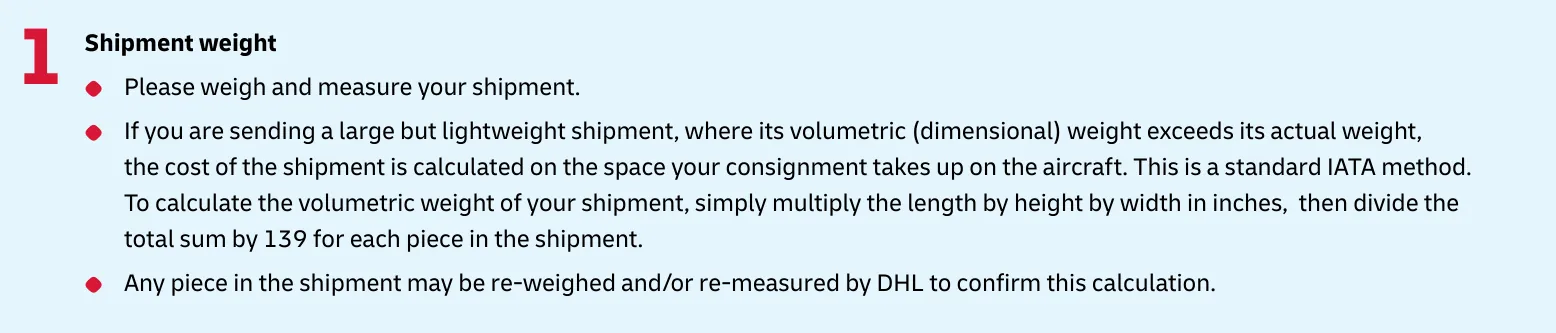
Both carriers bill on dimensional weight at a divisor of 139 for daily and list rates — length times width times height in inches, divided by 139, rounded up to the next whole pound, billed at the greater of actual or dimensional weight. Since August 18, 2025, both carriers round every fractional inch up to the next whole inch before multiplying. A 12-by-12-by-12-inch box holding a 5-pound product is 1,728 cubic inches divided by 139 — billed at 13 pounds, not 5.
Take a 14-by-10-by-9-inch box holding a 5-pound product: 1,260 cubic inches divided by 139 is 9.06 pounds, so the billable weight is 10 pounds. On FedEx Ground to Zone 5, the 10-pound list rate is $20.46 against $18.53 at 5 pounds — the oversized box costs $1.93 more before fuel, a 10.4 percent increase for the same product:
Since January 2026, both carriers trigger Additional Handling on cubic volume above 10,368 cubic inches and a Large Package or Oversize surcharge above 17,280 cubic inches or 110 pounds. Additional Handling runs $26.75 to $58.75 a package on UPS and $26.50 to $58.75 on FedEx in 2026, depending on the trigger and the zone — larger than the entire base rate of a 5-pound parcel. The cheapest packaging change in shipping is a smaller box: it cuts the billable weight and avoids the cubic-volume triggers.
Express: overnight costs twice the two-day price
FedEx 2Day on a 1-pound parcel to Zone 8 lists at $46.97; FedEx Standard Overnight on the same parcel lists at $99.65 — 2.12 times the two-day price for one day faster. UPS 3 Day Select on a 5-pound parcel to Zone 8 lists at $66.92; UPS Next Day Air Saver on the same parcel lists at $156.94 — 2.35 times. The multiplier is the decision: if the customer will accept three days, the overnight premium buys nothing but speed, and a shipper who defaults every order to overnight is paying more than double for a service level the customer never asked for. The ShipStation vs EasyShip vs Pirate Ship shipping software pricing playbook prices the platforms — including the ShipStation API — that let a store offer the slower service at checkout, and the Shopify vs Etsy vs Amazon seller fees playbook prices the marketplaces whose buyers expect shipping to be free, which is why the carrier choice lands in the product margin, not in a shipping budget line.
Founder & CEO Insight — Enow A. Jovial
DHL Express: the international price you can actually read
DHL Express has no US domestic ground service, so it does not appear in the ground tables above — and that absence is the point. DHL Express is an international express carrier, and it publishes a single transparent zone table in its DHL Express Service & Rate Guide 2026 for the United States: 14 export zones, A through N, with rates by weight. Canada is Zone A, Mexico Zone B, the United Kingdom, Germany, France, Italy, the Netherlands, and Spain Zone C, Switzerland Zone D, Japan Zone F, China Zone G, Hong Kong Zone H, and Australia and India Zone I. Volumetric weight uses the same divisor, 139, and the fuel surcharge is published weekly from the US Gulf Coast jet fuel index: 37.75 percent on exports for the week of November 16 to 22, 2026.
A 5-pound non-document shipment, all-in with the export fuel surcharge:
At 1 pound, a non-document shipment to Canada is $117.50, to the United Kingdom $148.69, to China $149.86, and to Australia $162.38 — while a 1-pound document to the United Kingdom is $118.54, $30.15 less than the same weight as a non-document parcel. The same guide publishes the surcharge stack: overweight pieces over 150 pounds carry a fixed $100 surcharge, remote-area runs $0.50 a pound with a $50 minimum, and a demand surcharge applies October 1, 2026 through February 5, 2027. FedEx and UPS publish international zone tables too, but in practice both quote international express per account — DHL's table is the only one a shipper can price from without a sales conversation.
What the list rate hides: discounts, and fuel on the surcharge
Most shippers pay a negotiated rate — a transportation incentive on the base rate, with accessorials usually sitting outside the discount entirely — and fuel is applied after the discount, to the discounted base plus the undiscounted surcharges. Take the 5-pound Zone 5 residential parcel with a 35 percent FedEx transportation incentive, the figure one rate-lookup tool uses as its worked example, against a 30 percent UPS incentive:
FedEx wins by $1.57 a parcel under those discounts — against $0.47 at list. The percentages are illustrative, not quoted rates, and the residential fee is not discounted in either calculation. The carrier with the smaller discount can still win if its fuel index is lower, and the carrier with the lower list rate can lose if its accessorials are not discounted. Run the formula on your own agreement before you sign.
Shipping is also a cost-of-goods problem, and the books should treat it that way. A store run as an LLC or an S-Corp books freight into cost of goods sold, and a 10.4 percent dimensional-weight penalty is a margin cut the pricing sheet must absorb — run it through the pricing calculator before the product page goes live. The EIN on the carrier account should match the entity on the tax return, the CPA who closes the books needs fuel and surcharges broken out, and a C-Corp with a VAT-registered European subsidiary prices DHL's Zone C rates against the import VAT at the border. The Wise vs Airwallex vs Payoneer cross-border payout fees playbook covers the payment side of the same international order.
The monthly math, and the decision
At 100 parcels a month of the worked 5-pound Zone 5 shipment, UPS costs $3,276 and FedEx $3,229 — $47 a month, $564 a year, at list rates and the November 2 fuel week. That is the scale of the domestic decision: real money, but smaller than one Additional Handling charge a week, and smaller than the saving from shrinking one box size.
| Shipment | Cheapest at list | Why | Authority |
|---|---|---|---|
| 5 lb, Zone 5, residential | FedEx $32.29 vs UPS $32.76 | Lower fuel index + lower residential fee | Rate guides + fuel tables, Nov 2, 2026 |
| 1 lb, Zone 8, residential | FedEx $27.74 vs UPS $28.04 | Same fuel and residential edge | Rate guides + fuel tables, Nov 2, 2026 |
| 20 lb, Zone 8, residential | FedEx $64.59 vs UPS $64.90 | Same edge, on a larger base | Rate guides + fuel tables, Nov 2, 2026 |
| 5 lb, UK, express | DHL $361.65 all-in | Only published zone table; UPS/FedEx quote per account | DHL Express Service & Rate Guide 2026 |
| Light, residential, no rush | FedEx Ground Economy | No residential fee; $1.15 delivery surcharge | FedEx Ground Economy fees, eff. Jan 5, 2026 |
| Bulky, light box | Neither — shrink the box | DIM weight at ÷139 bills 13 lb for a 5 lb product | Carrier DIM rules, 2026 |
Price it in five steps:
- Measure the box. Length, width, height, rounded up — divided by 139 for the billable weight.
- Find the base rate. Your billable weight and zone, on both published lists.
- Add the surcharges. Residential fee, delivery-area surcharge, Additional Handling if triggered.
- Apply this week's fuel. It resets every Monday; use the current week, not last month's.
- Apply your discount to the base only. Accessorials sit outside the discount; fuel applies after it.
Buy it in this order
- [x] Measure every box you ship. Length, width, height, rounded up, divided by 139. The billable weight is the greater of that number and the scale weight.
- [x] Price your top five lanes on both lists. Weight by zone, add the residential fee, add the current week's fuel. The winner is the one that wins your lanes.
- [x] Shrink the box before you negotiate the rate. A smaller box cuts billable weight and avoids the $26.50-plus Additional Handling trigger; a negotiated discount never pays for a box that is too big.
- [x] Offer the slow service at checkout. Overnight costs 2.1 to 2.35 times the two-day and three-day price. Most customers take the cheaper date when it is offered.
- [x] Price international on DHL's zone table, and quote the other two. A 5-pound box to the United Kingdom is $361.65 all-in on DHL's published rates with the November 16 export fuel surcharge — use that as the anchor.
- [x] Re-price in January. Both carriers raise rates by an average 5.9 percent within weeks of each other.