The bill most Delaware corporations file wrong
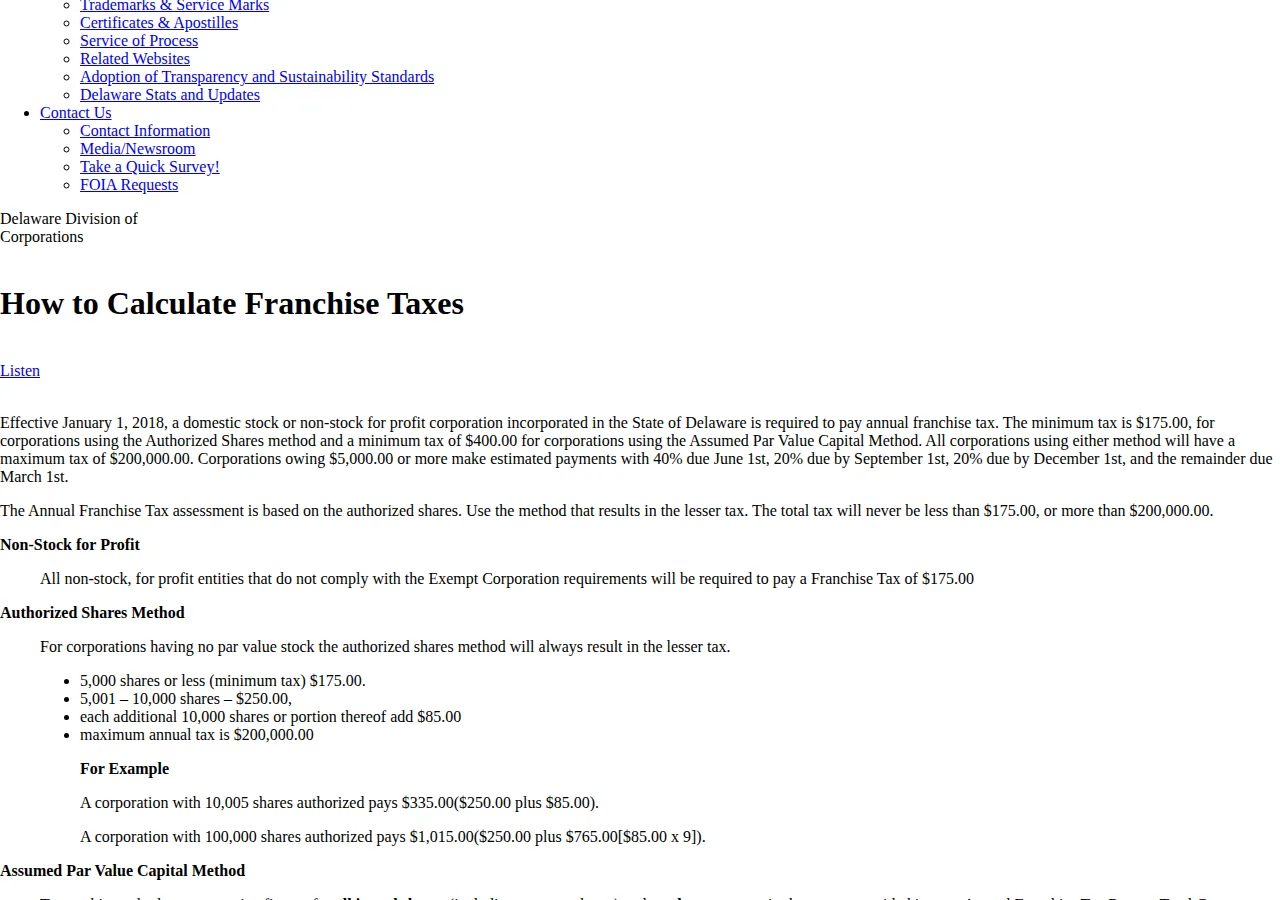
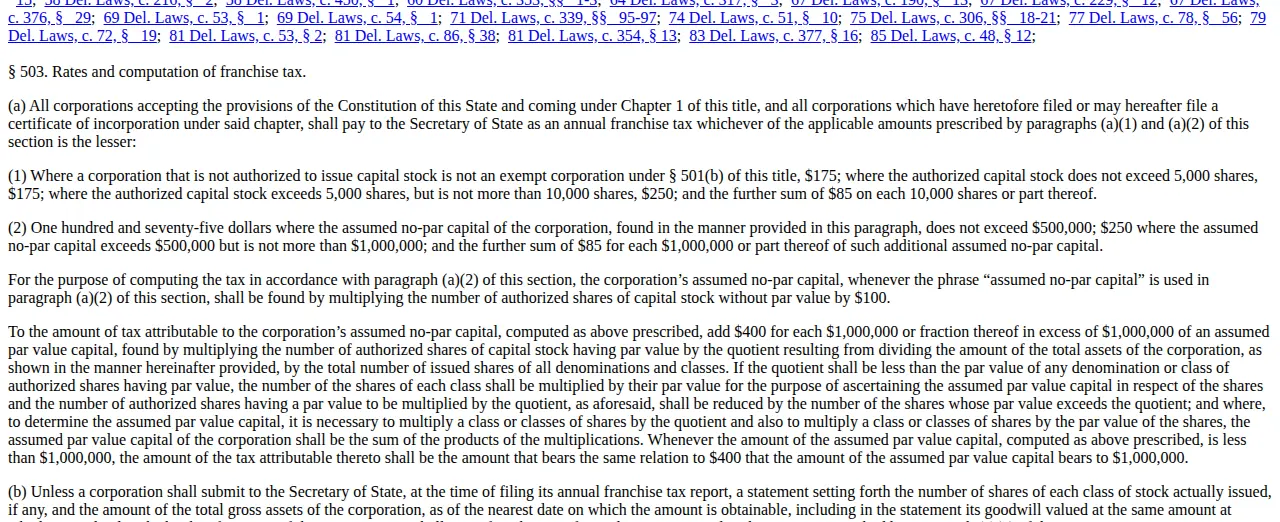
Every Delaware stock corporation owes an annual franchise tax, and Delaware does not pick the calculation for you. Under 8 Del. C. § 503(a), the corporation pays whichever of the two prescribed amounts is the lesser: the Authorized Shares Method (ASM) or the Assumed Par Value Capital Method (APVC). The Division of Corporations states the rule the same way on its calculation page: use the method that results in the lesser tax, with a floor of $175 under ASM, a floor of $400 under APVC, and a ceiling of $200,000 under either method ($250,000 for a corporation identified as a Large Corporate Filer).
That choice is not academic. A typical venture authorization — 10 million shares — produces an $85,165 bill under ASM and can produce a $400 bill under APVC on the same company. The difference is entirely a function of par value, issued shares, and balance-sheet assets, and it is knowable before you file.
> [!KEY TAKEAWAY]
> Delaware franchise tax is a choice between two formulas, not a fixed price. Authorized shares drive the first formula; issued shares and gross assets drive the second. Whichever input set is smaller relative to the authorization wins, and the Division requires you to pay the lesser result.
Who this guide is for, and who should stop here
This guide is for officers, controllers, and CPAs filing a Delaware stock corporation Annual Report, and for founders choosing an authorized share count before incorporation. It is written around the Division's published method, not around a calculator that hides its inputs.
Do not use this guide as a substitute for the Annual Report itself if any of these apply: your corporation amended its authorized stock or par value during the report year (the Division notes that mid-year amendments change the issued-share and gross-asset figures you must use); your corporation is exempt under § 501(b) (exempt corporations file an Annual Report with a $25 fee and pay no franchise tax); or your entity is an LLC, LP, or GP, which pays the alternative-entity tax instead. A Delaware LLC's $400 annual tax is a different levy with no method election.
Method 1: the Authorized Shares Method
ASM looks only at the certificate of incorporation: how many shares are authorized, regardless of how many were issued or what the company owns. The Division's brackets are:
| Authorized shares | ASM tax |
| :--- | :--- |
| 5,000 or fewer | $175 (the minimum) |
| 5,001 to 10,000 | $250 |
| Each additional 10,000 shares or portion thereof | Add $85 |
| Ceiling | $200,000 ($250,000 for a Large Corporate Filer) |
Expressed as a formula for authorizations above 10,000 shares:
$
ext{ASM Tax} = $250 + $85 imes leftlceil rac{ ext{Authorized Shares} - 10{,}000}{10{,}000}
ight
ceil
$
The Division's own examples confirm the rounding rule — a part of a 10,000-share block counts as a whole block:
The trap is scale. ASM charges for authorization, not use:
$
ext{ASM Tax (10,000,000 shares)} = $250 + $85 imes 999 = $85{,}165
$
A startup that authorized 10 million shares at formation and issued 8 million of them still pays on all 10 million under ASM. That $85,165 figure is the number founders quote when they call the Delaware bill a shock — and it is the number APVC exists to replace.
Method 2: the Assumed Par Value Capital Method
APVC looks at what the corporation actually issued and actually owns. To use it, the Annual Report must state the number of issued shares (including treasury shares) and total gross assets — the "total assets" reported on U.S. Form 1120, Schedule L, for the fiscal year ending in the calendar year of the report. The CPA or controller needs both figures; without a filed or final Schedule L, APVC cannot be computed honestly.
The Division's procedure, step by step:
1. Assumed par = total gross assets / total issued shares, carried to six decimal places.
2. Classes with par below the assumed par: multiply the assumed par by the number of authorized shares in those classes.
3. Classes with par above the assumed par: multiply those authorized shares by their own par value.
4. Assumed par value capital (APVC) = the sum of steps 2 and 3.
5. Tax = APVC rounded up to the next whole million (if over $1,000,000), divided by $1,000,000, multiplied by $400. If APVC is under $1,000,000, the tax is proportional: APVC / $1,000,000 x $400. The APVC minimum is $400.
$
ext{Assumed Par} = rac{ ext{Total Gross Assets (Form 1120, Schedule L)}}{ ext{Total Issued Shares (including treasury)}}
$
$
ext{Tax} = leftlceil rac{ ext{APVC}}{$1{,}000{,}000}
ight
ceil imes $400, quad ext{minimum } $400
$
The Division's worked example, reproduced
A corporation with 1,000,000 shares at $1.00 par and 250,000 shares at $5.00 par, gross assets of $1,000,000, and 485,000 issued shares:
Under ASM, the same 1,250,000 authorized shares would cost $250 + ($85 x 124) = $10,790. APVC wins by $9,190 — and the corporation pays $1,600 because § 503(a) requires the lesser amount.
The startup example: $85,165 versus $400
Take the venture-standard authorization: 10,000,000 shares, $0.0001 par, 8,000,000 issued, $400,000 of gross assets on Schedule L.
The lesser amount is $400. A founder who files ASM by default overpays by $84,765 in a single year, and repeats the error every year the authorization stays at 10 million shares.
Decision table: which method wins, and when
| Corporation shape | ASM result | APVC result | Winner, and why |
| :--- | :--- | :--- | :--- |
| 5,000 or fewer authorized shares | $175 | At least $400 | ASM — the APVC floor alone beats it |
| 10 million shares, $0.0001 par, small balance sheet | $85,165 | $400 (the APVC floor) | APVC — issued assets are tiny next to the authorization |
| 1.25 million shares, mixed $1/$5 par, $1M assets | $10,790 | $1,600 | APVC — the assumed-par base is far below the authorization |
| No-par stock, any size | Per ASM brackets | Inflated by the $100-per-share rule | ASM — the Division states ASM always gives the lesser result for no-par stock |
| Large balance sheet, few authorized shares | Small | APVC base tracks assets, not authorization | Compare both — a large Schedule L can push APVC above ASM |
| Non-stock for-profit corporation | Not applicable | Not applicable | Flat $175, unless exempt |
The general rule falls out of the formulas: APVC wins when the authorization is large relative to assets and issued shares; ASM wins when the authorization is small, the stock is no-par, or the balance sheet is large relative to the authorization. A corporation with $50 million of Schedule L assets and 1 million authorized shares should never assume APVC is cheaper — run both numbers.
Why no-par stock breaks the second method
Section 503(a)(2) contains a provision that surprises founders who chose no-par stock for flexibility: assumed no-par capital is found by multiplying the number of authorized shares without par value by $100. Ten million authorized no-par shares therefore carry $1 billion of assumed no-par capital into the (a)(2) computation before any asset figure is considered. That is why the Division's page is blunt — for no-par stock, ASM will always result in the lesser tax — and why a no-par authorization should be sized with ASM brackets in mind from day one. Par value is not a formality in Delaware; at $0.0001 par, it is the lever that makes APVC work.
Deadlines, penalties, and the quarterly trap
| Obligation | Figure | Authority |
| :--- | :--- | :--- |
| Annual Report + franchise tax due | March 1 each year | Division of Corporations, Annual Report and Tax Information |
| Annual Report filing fee, non-exempt corporation | $50 | Division of Corporations |
| Annual Report filing fee, exempt corporation | $25 (no tax) | Division of Corporations |
| Late-filing penalty (report not filed by March 1) | $200 | 8 Del. C. § 503(c) and Division guidance |
| Interest on unpaid tax balance | 1.5% per month | Division of Corporations |
| Quarterly estimated payments (tax of $5,000 or more) | 40% by June 1, 20% by September 1, 20% by December 1, remainder by March 1 | Division of Corporations |
| Maximum tax | $200,000 ($250,000, Large Corporate Filer) | Division of Corporations |
The quarterly schedule is the trap inside the trap. A corporation that owes $85,165 under ASM and pays nothing until March 1 has missed three estimated installments, not one deadline. Conversely, a corporation that computes APVC at $400 owes no quarterly estimates at all, because the $5,000 threshold is never reached. Method selection changes the payment calendar, not just the total.
> [!WARNING]
> Missing March 1 costs more than the $200 penalty suggests. Interest accrues at 1.5% per month on the unpaid balance, the corporation cannot obtain a certificate of good standing while a balance is outstanding, and a corporation that fails to file can have its charter voided for non-payment — which then requires a revival filing with all back taxes, penalties, and interest. Diarize February, not March.
Filing checklist
Cross-border and multi-entity notes
A non-U.S. founder incorporating a Delaware C-Corp faces the same two methods, with one extra discipline: the Schedule L asset figure must be the U.S. federal return figure, not a home-country balance sheet converted at a convenient rate. Groups with a Delaware parent and Delaware subsidiaries must compute each corporation separately — there is no consolidated franchise tax return, and a subsidiary's authorization does not shelter under its parent's APVC base. If the group holds a Delaware LLC alongside the corporation, budget the LLC's flat $400 annual tax separately; it is not part of either method above.
> [!FOUNDER]
> "Founders treat the Delaware bill as a tax. It is not — it is a filing choice with two prices, and the state tells you to pay the lower one. The $85,000 bill is what happens when nobody runs the second formula. Run both, keep the Schedule L workpapers, and the same company pays $400."
> — Enow A. Jovial, Founder & Chief Executive Officer
> [!TIP]
> Before amending an authorization upward, price the ASM step first. Each additional 10,000-share block (or part of one) adds $85 forever under ASM, while APVC only moves if issued shares or assets move. Authorizing 10,005 shares instead of 10,000 costs the same $85 as authorizing 20,000 — so if you must cross a 10,000 boundary, cross it by enough to matter.
Related reading on this site: the LLC vs Delaware C-Corp guide for venture startups for the entity choice that creates this bill in the first place, the Delaware C-Corp founder stock vesting guide for the 83(b) timing that sits beside the Annual Report, and the S-Corp election tax savings threshold for the pass-through alternative. To model the cash-flow effect of the bill against your own profit, run it through the Self-Employed Tax & Quarterly Estimator before the March 1 deadline. Before the first Annual Report ever arrives, the formation service that filed the charter sets the share count and agent that produce this bill — compare them in the Stripe Atlas vs Clerky vs Northwest Delaware C-Corp formation guide.