Claude vs ChatGPT vs Gemini: The Coding Assistant Cost Playbook
Three chat assistants now do the same job for a working developer: read a codebase, write the patch, explain the diff.
This playbook prices all three from the vendors' own pricing pages, read on 14 November 2026: the cost of one coding message, the monthly total at three stated volumes, the break-even message count, and what prompt caching does to the bill.
The chat plans
Claude Free costs $0, with limited usage every five hours and every week. Claude Pro costs $20 a month, or $17 a month billed annually with $200 paid up front. Claude Max costs $100 a month for five times the Pro usage and $100 in API credits. Claude Ultra costs $200 a month for ten times the Pro usage every week with no five-hour limit, plus $200 in API credits.
ChatGPT's ladder runs in parallel. Free costs $0. Go costs $8 a month. Plus costs $20 a month, with expanded Codex usage and a 256K-token reasoning context window. Pro comes in three tiers — Pro 100 at $100, Pro 200 at $200 and Pro 500 at $500 a month, billed monthly only — each carrying API credits equal to its price; Pro 200 removes the five-hour limit and carries a 400K-token reasoning context window. Business, formerly Team, charges $25 per user a month or $20 billed annually for a Standard seat, and $125 or $100 for a Premium seat at five times the Standard usage. A workspace needs at least two seats; API credits are pooled, capped at $500 per workspace per month.
Google's ladder is the simplest. Google AI Plus costs $9.99 a month. Google AI Pro costs $19.99 a month for four times the usage access of Free. Google AI Ultra starts at $99.99 a month for five times the Pro usage, with a $199.99 tier for twenty times. There is no Google team plan: a team buys one AI Pro subscription per developer.
Founder & CEO Insight — Enow A. Jovial
The API rates
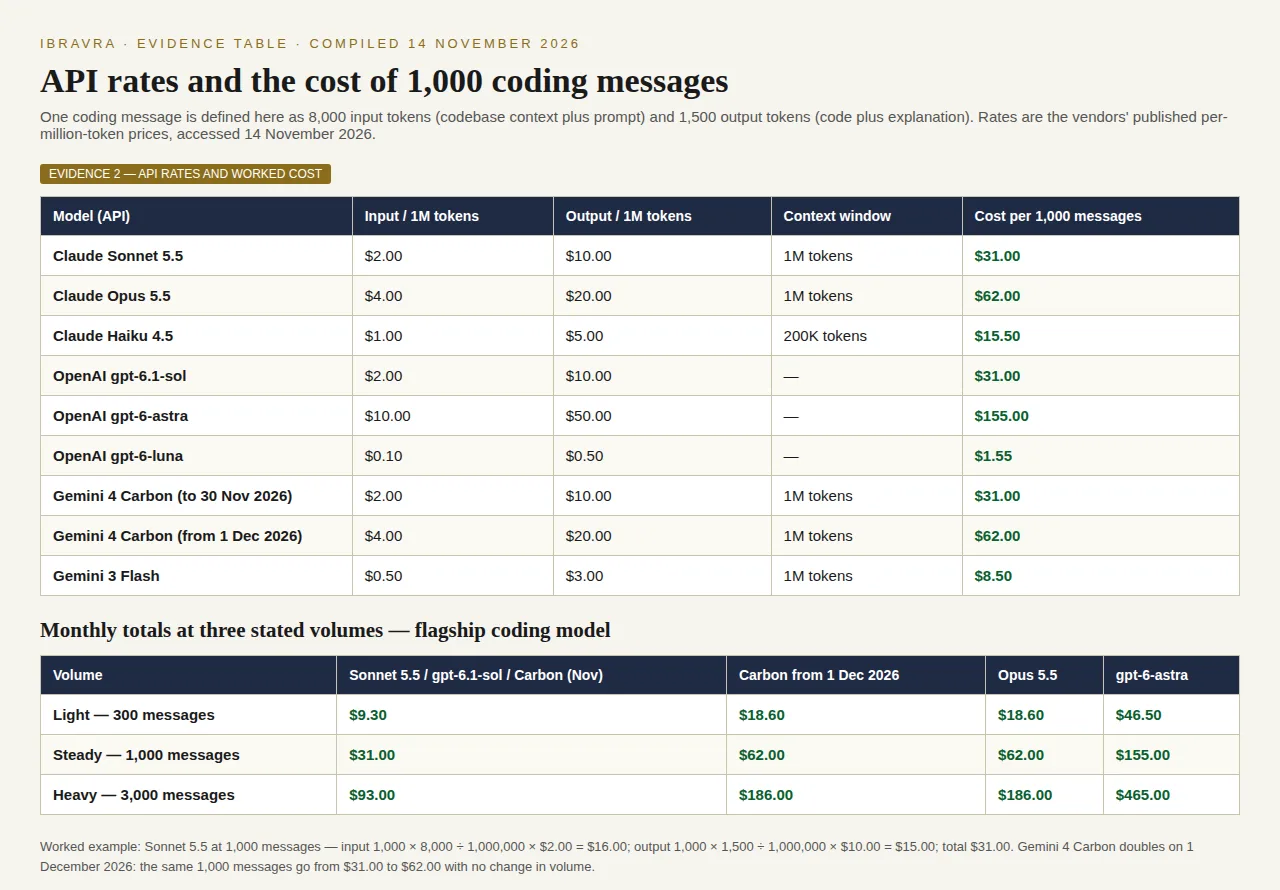
Through the API, a coding assistant is billed per million tokens: input tokens (the prompt and the codebase context you send) and output tokens (the code and explanation that come back).
| Model | Input per 1M tokens | Output per 1M tokens | Context window | Authority |
|---|---|---|---|---|
| Claude Sonnet 5.5 | $2.00 | $10.00 | 1M tokens | claude.com/pricing |
| Claude Opus 5.5 | $4.00 | $20.00 | 1M tokens | claude.com/pricing |
| Claude Haiku 4.5 | $1.00 | $5.00 | 200K tokens | claude.com/pricing |
| OpenAI gpt-6.1-sol | $2.00 | $10.00 | 272K tokens | platform.openai.com/docs/pricing |
| OpenAI gpt-6-astra | $10.00 | $50.00 | — | platform.openai.com/docs/pricing |
| OpenAI gpt-6-luna | $0.10 | $0.50 | — | platform.openai.com/docs/pricing |
| OpenAI gpt-6.1-terra | $1.00 | $5.00 | — | platform.openai.com/docs/pricing |
| Gemini 4 Carbon (to 30 Nov 2026) | $2.00 | $10.00 | 1M tokens | ai.google.dev/gemini-api/docs/pricing |
| Gemini 4 Carbon (from 1 Dec 2026) | $4.00 | $20.00 | 1M tokens | ai.google.dev/gemini-api/docs/pricing |
| Gemini 3 Flash | $0.50 | $3.00 | 1M tokens | ai.google.dev/gemini-api/docs/pricing |
Sonnet 5.5, gpt-6.1-sol and Gemini 4 Carbon all charge $2.00 per million input tokens and $10.00 per million output tokens, so the flagship cost is identical on all three sides until Gemini's rate doubles on 1 December 2026. The premium tier is where they separate: Opus 5.5 costs twice the flagship rate, gpt-6-astra five times it. The budget tier separates hardest: gpt-6-luna costs one-twentieth of the flagship rate, Gemini 3 Flash about a quarter. Claude's current models carry a 1M-token window by default with no beta header and no long-context surcharge; Haiku 4.5 stays at 200K.
The IDE-agent pricing comparison prices the same models inside an editor, and the AI search pricing playbook prices the same three vendors as search tools. This playbook is the third leg: the chat assistants themselves, priced as coding help.
Worked math 1: cost of 1,000 messages
A price per million tokens means nothing until it is attached to a unit of work. This playbook defines one coding message as 8,000 input tokens — prompt plus surrounding codebase context — and 1,500 output tokens — code plus explanation. That is a stated editorial assumption, not a vendor figure: a short fix uses fewer input tokens, a full-file rewrite uses more — re-run the arithmetic with your own profile.
On Claude Sonnet 5.5:
On OpenAI gpt-6.1-sol the rates are identical, so the result is identical: $0.031 a message, $31.00 per 1,000.
The other models diverge fast: Opus 5.5 costs $0.062 a message, or $62.00 per 1,000; gpt-6-astra $0.155 a message, or $155.00 per 1,000.
The budget models sit far below: Haiku 4.5 and gpt-6.1-terra $15.50 per 1,000 messages, Gemini 3 Flash $8.50, gpt-6-luna $1.55 — twenty times cheaper than the flagship, right for linting, wrong for a refactor that touches shared state.
Worked math 2: monthly totals
A per-message cost becomes a budget only when it meets a volume.
| Monthly volume | Sonnet 5.5 / gpt-6.1-sol / Carbon (Nov) | Carbon from 1 Dec 2026 | Opus 5.5 | gpt-6-astra |
|---|---|---|---|---|
| Light (300) | $9.30 | $18.60 | $18.60 | $46.50 |
| Steady (1,000) | $31.00 | $62.00 | $62.00 | $155.00 |
| Heavy (3,000) | $93.00 | $186.00 | $186.00 | $465.00 |
Read the table against the plan prices: at light volume the API costs $9.30 a month — less than half the $20 chat plan. At steady volume it costs $31.00, $11.00 more than the plan, so the seat starts to win under the ceiling. At heavy volume the API costs $93.00 against a $20 plan, and the seat wins by $73.00 a month, or $876.00 a year — unless the developer hits the five-hour or weekly limit, when the seat stops working and only the API still answers. The table is the whole argument: buy the seat only when your volume clears the break-even and your work fits under the ceiling.
Worked math 3: break-even volume
How many messages a month must I send before the flat plan is cheaper than the meter? One division answers it.
For Claude Pro at $20 a month against Sonnet 5.5 at $0.031 a message:
The same division gives the same answer on the other two sides: ChatGPT Plus at $20 against gpt-6.1-sol is 645 messages, and Google AI Pro at $19.99 against Gemini 4 Carbon is 645. Buy the annual Claude Pro at $17 a month and the break-even falls to 548 messages.
The expensive plans break even higher. Claude Max at $100 a month against Opus 5.5 at $0.062 a message breaks even at 1,613 messages a month, and Max also carries $100 a month in API credits, covering the first 1,613 Opus messages outright. ChatGPT Pro 200 at $200 against gpt-6-astra at $0.155 breaks even at 1,290 messages, with $200 of API credits likewise. Google AI Ultra at $199.99 against Carbon at the December $0.062 rate breaks even at 3,226 messages.
Run your own number through the break-even calculator with your measured monthly count before you buy. A developer who sends 400 messages a month and buys a $20 plan is paying $20 for $12.40 of API work; one who sends 2,000 messages a month and stays on the API is paying $62.00 for a $20 seat.
Prompt caching: cutting the flagship bill by a third
Every coding conversation re-sends the same context — the file, the module, the test file, the style guide. Prompt caching charges the repeated part at a cache-read rate instead of the fresh-input rate, and all three vendors price a cache read at $0.10 per million tokens on their flagship models.
Assume 6,000 of the 8,000 input tokens in a message are served from cache, and 2,000 are fresh. On Sonnet 5.5:
Caching cuts the flagship cost from $31.00 to $19.60 per 1,000 messages — a 37 percent reduction — and the same arithmetic holds on gpt-6.1-sol and on Carbon. Cache-write costs are excluded.
Scenario: Northbridge Labs
Scenario: Northbridge Labs is a six-developer product team that ships a SaaS billing tool. Each developer sends 1,200 coding messages a month — about 60 a day — and the team wants one vendor for the whole group, at the cheapest route that keeps working mid-sprint.
On the API at flagship rates, one developer costs 1,200 × $0.031 = $37.20 a month, and six developers cost $223.20 a month.
Six Claude Team Standard seats at the annual rate cost 6 × $20 = $120.00 a month, six ChatGPT Business Standard seats the same, and six Google AI Pro subscriptions 6 × $19.99 = $119.94. The seats save the team about $103.20 a month against the API — $1,238.40 a year — at November rates.
The seat price buys a capped chat window, not an uncapped meter. A developer who hits the five-hour or weekly ceiling on a release day stops getting answers, while the API keeps answering — and billing. Northbridge's answer is to buy the seats for daily chat work and keep a small API budget — the $100 of credits inside one Claude Max seat, or the pooled $500 inside a ChatGPT Business workspace — as the overflow for release days and for the CI pipeline, which cannot hold a chat seat.
The decision table
| Situation | Buy this | Why | Authority |
|---|---|---|---|
| Under 645 messages a month | API, any flagship | $9.30–$31.00 beats a $20 seat | claude.com/pricing; platform.openai.com/docs/pricing; ai.google.dev/gemini-api/docs/pricing |
| Over 645 messages a month, chat only | Any $20 chat plan | Flat $19.99–$20 beats the meter | claude.com/pricing; chatgpt.com/pricing; one.google.com/about/plans |
| Heavy user who hits the five-hour cap | Max $100 or Pro 200 $200 | 5x usage or no cap, plus credits | claude.com/pricing; Greenlight My App, 31 Oct 2026 |
| Team, chat only | Team/Business Standard seats | $20 a seat against $31 on the API | claude.com/pricing; Greenlight My App, 31 Oct 2026 |
| Team with a CI pipeline or agent | Seats plus API budget | A pipeline cannot hold a chat seat | platform.openai.com/docs/pricing; ai.google.dev/gemini-api/docs/pricing |
Operator boundaries
A flat chat plan is the wrong purchase for two kinds of buyer. First, the occasional user: under 300 messages a month, the API costs $9.30 and the seat costs $20. Second, the pipeline owner: a CI job, a code-review bot or an agent cannot log into a chat plan, so the seat buys nothing.
The API is the wrong purchase for two kinds of buyer. First, the heavy chat user who sends more than 1,613 messages a month and never touches a pipeline: Claude Max at $100 beats the Opus meter and carries the same $100 as credits. Second, the buyer who cannot tolerate a variable bill: a flat plan caps the month at $20, while the API has no ceiling — a runaway agent can spend the budget in an afternoon. Our editorial analysis found the most expensive mistake here is not picking the wrong vendor — it is picking the right vendor on the wrong billing route.
Because the meter has no ceiling, a single runaway job can burn a month's budget before anyone notices; therefore the flat plan is the only route that caps the month at $20.
The buying protocol
Buy it in this order:
- Count one real month of messages per developer.
- Divide the count by 645 to find your break-even.
- Cap every API key before the first invoice.
Execution checklist
- [x] Count your messages. Measure one real month per developer — the break-even is 645 messages.
- [x] Pick the billing route first, the vendor second. Under 645 messages, buy the API. Over 645 in chat only, buy the seat. With a pipeline, buy both.
- [x] Set the cache up before the first invoice. Keep context in a cached prompt; the 37 percent saving only exists if the context is reused.
- [x] Re-price Gemini before 1 December 2026. Carbon doubles from $31.00 to $62.00 per 1,000 messages.
- [x] Put a spend cap on every API key. A flat plan caps itself at $20; the API does not.